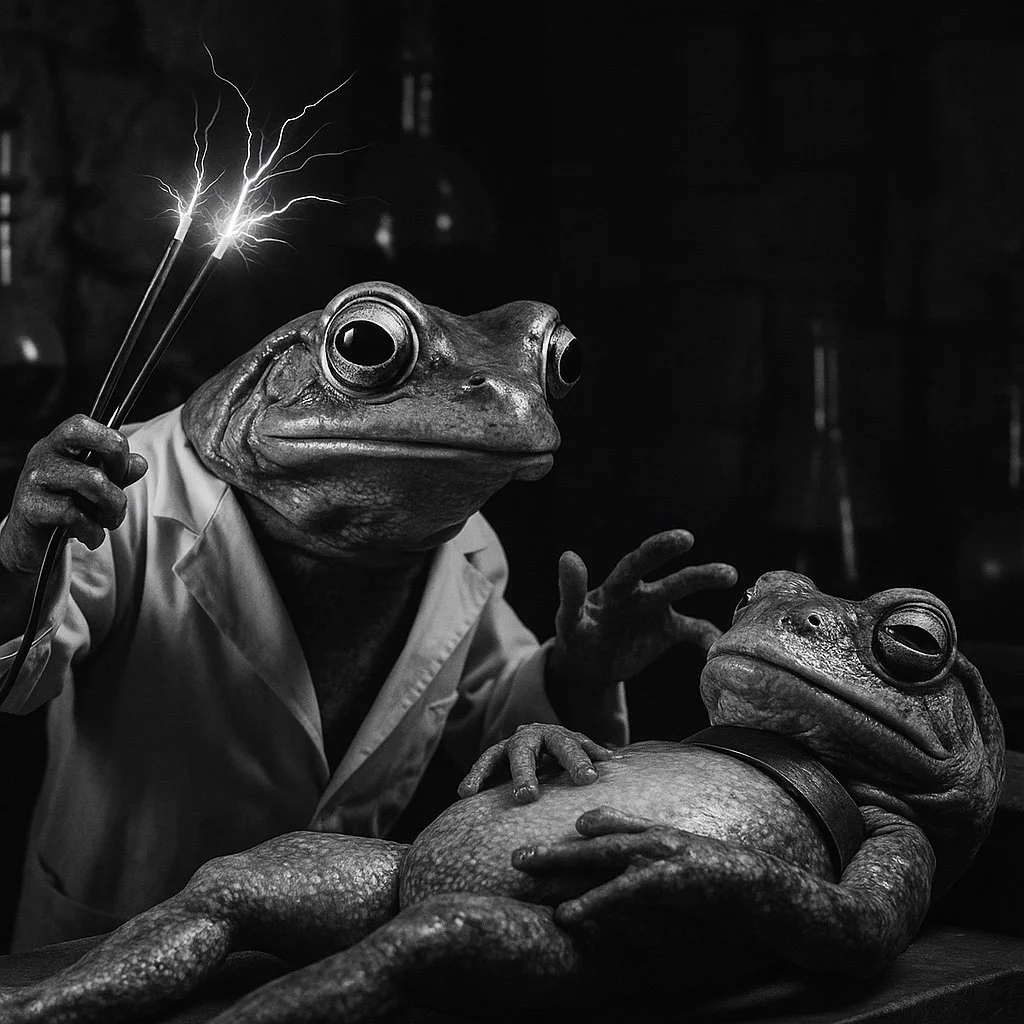
Luigi Galvani’s work reminds us that innovation often begins with curiosity, accidents, and a willingness to challenge conventional wisdom. AI image by Local Pigeon.
July 2025
“AI is the new electricity.” ”
“Electricity seems to bridge the gap between the lifeless world and living matter.”
The year 2025 feels like standing at the confluence of two rivers. One is the Mississippi, which has shaped the town of Hastings since its founding; the other is the torrent of artificial intelligence flooding every industry. Even the calm bluffs overlooking the river seem to whisper about the intelligence explosion that futurists have long debated. At the same time, another river of knowledge—bioelectricity, the hidden language of cells—runs beneath us. Although these two currents might seem unrelated, they share surprising parallels and offer valuable lessons for local entrepreneurs. This article explores how the origin story of bioelectricity, modern AI breakthroughs, and new research on consciousness can inform a forward‑looking business strategy for Hastings in 2025.
The Intelligence Explosion: Where AI Stands in July 2025
In July 2025, AI is not just a buzzword; it’s the backbone of many industries. A TS2 Space report estimates that the global AI market is worth $391 billion in 2025 and projects it to reach $1.81 trillion by 2030, noting that AI permeates every sector, from healthcare to manufacturing ts2.tech. More than 6 % of global startups and nearly 10 % of unicorn companies are AI‑powered ts2.tech. Investments are so intense that companies like Meta have launched “Superintelligence Labs,” hiring top researchers and planning multi‑gigawatt data centers ts2.tech. This fervor echoes the gold rush of the 1800s—except the miners are data scientists, and the stakes involve human‑level machine intelligence.
Breakthroughs on the Horizon
The last few weeks alone have produced jaw‑dropping achievements. OpenAI’s experimental reasoning model solved five of six International Math Olympiad problems under contest conditions ts2.tech, hinting at new forms of AI creativity. Google DeepMind’s CEO Demis Hassabis predicts that AI could reach human‑level problem‑solving within five years, calling the transformation “bigger than the Industrial Revolution” ts2.tech. Meanwhile, NVIDIA and university labs unveiled a “DiffusionRenderer” that inserts CGI elements into real videos with photorealistic shadows ts2.tech. If you’ve ever seen a dragon swoop over Hastings’ Levee Park in a smartphone video, you may have glimpsed this technology at work.
For everyday users, the line between science fiction and reality is blurring. OpenAI’s new ChatGPT Agent mode, released July 17, allows the chatbot to browse the web, make purchases, and book reservations on the user’s behalf ts2.tech. In one example, the agent ordered a wedding outfit, considering dress code and weather ts2.tech. While this feature is currently unavailable in the European Union due to regulatory uncertainties ts2.tech, it signals a future in which digital assistants handle mundane tasks so we can focus on creativity and strategy. Not to be outdone, Amazon’s AgentCore toolkit for building AI agents at scale promises to “upend how software is built and used” ts2.tech, and Meta is investing hundreds of billions of dollars to develop AI supercomputers and agents ts2.tech.
A Warning from Visionaries
As excitement builds, so do concerns. The Future of Life Institute warns that a superintelligent AI could emerge within five years, echoing claims from experts like Geoffrey Hinton and Yoshua Bengio that such a leap could occur in a similar timeframe futureoflife.org. They caution that an “intelligence explosion”—a system recursively improving itself—could lead to runaway outcomes if not properly controlled futureoflife.org. Elon Musk has famously said that AI could be “the best or worst thing to happen to humanity”, emphasizing the need for oversight time.com. Bill Gates stresses aligning AI with humanity’s best interests, given its potential for superintelligence time.com. In other words, we must treat AI like the Mississippi River: powerful and life‑giving, but requiring levees and policies to prevent floods.
The Birth of Bioelectricity: Frogs, Frankenstein, and a New Code
Before electricity powered factories and AI algorithms, Luigi Galvani discovered its role in life itself. In the 1770s, Galvani experimented with frog legs on a table used for electrical demonstrations. When a metal scalpel touched the exposed nerve, the legs twitched. He concluded that an “animal electricity” inherent in tissues caused the movement nationalmaglab.org. This finding was controversial but inspired Mary Shelley’s Frankenstein, cementing the idea that electricity could animate lifeless flesh nationalmaglab.org. Alessandro Volta later disagreed, arguing that metals created the effect, but the debate spurred new experiments and ultimately birthed electrophysiology, the study of electrical phenomena in biological tissues.
Galvani’s work reminds us that innovation often begins with curiosity, accidents, and a willingness to challenge conventional wisdom. For business leaders, this story parallels the early days of AI: a few tinkerers playing with neural networks discovered unanticipated capabilities. Those who recognized the potential and persisted have built today’s tech giants. Hastings entrepreneurs might similarly look for “twitches” in the market—unexpected responses that signal a new field.
The Bioelectric Code: How Cells Collaborate
Today, scientists know that every cell produces and senses electrical signals, forming bioelectric circuits that guide development and repair. A 2021 article in Cell explains that because DNA does not directly specify geometric layouts, cells need a morphogenetic code—a set of instructions enabling them to adjust behaviors until the desired anatomy is achieved pmc.ncbi.nlm.nih.gov. These bioelectric states serve as a kind of software, instructing cells when to divide, differentiate, or even regenerate. The concept challenges the gene‑centric view of biology: genes are like parts lists, but bioelectric circuits are the blueprint and operating system.
Biologist Michael Levin compares this to computers: genes provide the hardware (proteins), but it is the bioelectric “software”—voltage patterns and ion flows—that shapes tissues and organs statnews.com. By rewriting voltage patterns, Levin’s lab can induce cells to form eyes on tadpole bellies or coax flatworms to grow two heads statnews.com. Such experiments illustrate that bioelectric networks contain intelligence, albeit of a distributed kind. Cells act like agents, communicating locally through ions yet achieving global goals like forming a limb. This decentralized intelligence echoes the way AI agents or blockchain nodes cooperate without central oversight.
Bioelectricity and Regeneration
The bioelectric code doesn’t just sculpt embryos; it also guides healing. Humans are bioelectrical beings—our tissues and organs communicate using voltages and electric fields produced by ion channels embedded in cell membranes the-scientist.com. This electrical language orchestrates the self‑organization of tissues, giving physical shape to the body the-scientist.com. Researchers at Stanford University implanted a conductive polymer loaded with neural stem cells into the injured brains of rats. When they stimulated the transplanted cells electrically, brain healing and functional recovery improved faster than with stem cells alone the-scientist.com. The stimulation upregulated the gene for stanniocalcin 2, which controls cell proliferation and increased the brain’s own stem‑cell production the-scientist.com. The study underscores the power of electrical cues to unlock regenerative potential the-scientist.com.
Such findings suggest future medicine may use bioelectric therapies—like pacemakers for the immune system or electricity‑infused implants—to trigger healing. For entrepreneurs, this signals business opportunities at the intersection of health and electronics. Hastings, with its emerging mix of residential, commercial, and industrial development hastingsmn.org, could attract startups designing wearable bioelectric devices, neurofeedback headbands, or electrically conductive fabrics.
Consciousness and the Energy of Mind
No conversation about bioelectricity is complete without addressing consciousness, the mysterious sense of being aware. A 2024 review argues that conscious experience arises when nervous systems transfer, transduce, and transform energy, involving complex energy processing at classical and quantum scales pmc.ncbi.nlm.nih.gov. In other words, consciousness is not a mystical add‑on but an energy process. Another perspective comes from a 2025 “adversarial collaboration” between scientists testing two leading theories: Integrated Information Theory (IIT) and Global Neuronal Workspace Theory (GNWT). The Allen Institute study found that consciousness seems more tied to perception than planning, with functional connections between early visual areas and frontal areas of the brain sciencedaily.com. Neither theory won outright, but the research highlights that consciousness may be about being rather than doing sciencedaily.com.
How does this connect to business? First, the energy‑processing view suggests that human creativity and decision‑making depend on balanced bioelectric states and sensory inputs. Overworking or constant multitasking may disrupt those states, leading to poor judgments. Second, the perception‑centric view implies that what we focus on shapes our consciousness. Entrepreneurs who cultivate mindful attention—by choosing which signals to amplify and which to ignore—can align their brains’ energy with their goals.
Metaphors and Lessons for Business: The “Bio‑AI Strategy”
1. Voltage Patterns as Business Strategy
Just as cells use bioelectric voltages to coordinate growth, businesses need strategic signals to coordinate teams. A startup’s mission statement functions like a resting membrane potential: it sets the baseline from which all actions flow. When leaders apply an **exciting “voltage change”—a new project or pivot—**they signal cells/teams to change behavior. Without clear signals, employees (like confused cells) may differentiate in the wrong direction.
2. Morphogenetic Code and Organizational Design
The bioelectric morphogenetic code ensures that each cell knows its role in the body. Similarly, a company must define the interfaces between departments—marketing, R&D, finance—so they cooperate toward a common structure. If one group hoards information (similar to a bioelectric gap junction closing), the organization may grow malformed limbs: redundant products or conflicting services. Transparent communication channels act like ion channels, allowing the flow of ideas.
3. Distributed Intelligence and AI Agents
The collective intelligence of cells provides a model for AI agents working in tandem. In July 2025, ChatGPT’s Agent mode can perform tasks autonomously ts2.tech. Just as cells aren’t individually conscious yet achieve complex outcomes, AI agents don’t need to be superintelligent to transform businesses. Entrepreneurs can deploy multiple simple agents—one for customer support, one for data analysis—and allow them to “talk” through APIs. The challenge is to build guardrails (bioelectrical boundaries) to prevent runaway growth or harmful feedback loops.
4. Mindfulness as Bioelectric Hygiene
Stress is like an electrical storm in the brain: chaotic spikes disrupt normal rhythms. A 2025 randomized controlled trial of a mindfulness program showed a significant drop in median stress scores from 26 to 19 after the intervention, while the control group’s scores remained unchanged pmc.ncbi.nlm.nih.gov. Statistical analyses confirmed a large effect size pmc.ncbi.nlm.nih.gov. Mindfulness practices, such as focused breathing and body scanning, may stabilize our bioelectric networks, leading to calmer decision‑making. For entrepreneurs facing the AI rush, regular mindfulness can act like a surge protector, preventing burnout.
5. Innovation Requires Both Curiosity and Constraints
Galvani’s frog experiments were messy and serendipitous, yet they birthed a field. Similarly, AI breakthroughs often emerge from playful exploration, like letting a language model write poetry or solve puzzles. At the same time, the Future of Life Institute warns about unsafe recursive self‑improvement futureoflife.org. This tension mirrors the Yin and Yang of biology: neurons fire spontaneously, but networks inhibit runaway activity. Business leaders should encourage experimentation but establish ethical guidelines—for instance, evaluating AI outputs for bias or privacy risks.
6. River Metaphor: Flow and Boundaries
Hastings sits at the meeting of the Mississippi, St. Croix, and Vermillion Rivers. The rivers provide power, transport, and beauty—but only because we built levees and channels. AI and bioelectricity are like rivers: they offer immense opportunity if channeled wisely. A flood can destroy a town; an uncontrolled AI can disrupt industries or spread misinformation. Entrepreneurs must design dikes and sluice gates: policies, regulations, and ethical boards that direct the flow of technology.
7. Humor, Humanity, and Philosophical Perspective
As we consider machines solving math Olympiad problems and cells orchestrating limbs, it’s worth remembering that humor and philosophical reflection keep us grounded. Sundar Pichai notes that AI should augment human capabilities, not replace them time.com. Ginni Rometty adds that “those who use AI will replace those who don’t” time.com. In other words, the robots aren’t coming for our jobs—unless we refuse to collaborate with them.
A favorite quip from the 19th century asserts that electricity was discovered when someone rubbed a cat the wrong way. Today we might say AI was discovered by feeding the internet to a neural network and seeing what popped out. The lesson? Don’t be afraid to pet the cat—but wear gloves and consult your local electrician.
Stress, Consciousness, and Decision‑Making
Beyond metaphors, bioelectricity influences our health and mental clarity. The brain is a massive electrical network; disruptions in energy flow can lead to depression, cognitive decline, or chronic fatigue. The mindfulness study mentioned earlier doesn’t just lower stress; participants also reported better sleep, reduced anxiety and depression, increased social support, and higher life satisfaction pmc.ncbi.nlm.nih.gov. Mindfulness may modulate brain waves—oscillations measured by EEG—bringing them into coherent patterns. This resonates with the energy‑processing theory of consciousness, which posits that conscious experience emerges when the brain’s energy flows are harmonized pmc.ncbi.nlm.nih.gov.
For entrepreneurs, understanding this connection means recognizing that stress impairs judgment. Under pressure, we may react impulsively—like a cell misreading its voltage cues. Practices such as meditation, yoga, and biofeedback can help maintain healthy brain rhythms. Incorporating nature walks along the Mississippi or “digital sunsets” (shutting off screens after dusk) can also reset your nervous system. Think of these habits as recalibrating your inner circuitry, ensuring that you remain a conscious pilot rather than an overwhelmed passenger.
Practical Steps for Hastings Business Owners
Adopt AI Responsibly: Explore tools like ChatGPT’s Agent mode for automating scheduling, marketing, or logistics, but ensure human oversight to avoid errors and ethical pitfalls. Remember the EU’s hesitation about autonomous agents ts2.tech; regulations may shift quickly.
Invest in Bioelectric Wellness: Partner with local health providers to offer mindfulness programs, EEG‑based coaching, or bioelectrical therapies. This not only supports employees’ mental health but may foster innovation and productivity.
Foster Cross‑Disciplinary Conversations: Bring together AI experts, biologists, ethicists, and community leaders to envision bio‑AI solutions. Could Hastings host a bioelectricity‑powered art installation or sponsor a hackathon exploring AI for river conservation? These events build social capital and attract talent.
Encourage Ethical Innovation: Establish internal guidelines or boards to evaluate AI initiatives for fairness, transparency, and environmental impact. Consider the energy costs of AI supercomputers; can you purchase renewable energy credits or invest in local solar farms?
Stay Curious and Adapt: The intelligence explosion may not arrive as a single event but as a series of disruptions. Monitor research from institutes like the Allen Institute, which challenge our assumptions about consciousness sciencedaily.com. Subscribe to updates from HastingsNow.com, attend webinars, and be ready to pivot.
Leverage the Local Spirit: Hastings thrives on small‑town charm combined with easy access to the Twin Cities hastingsmn.org. Use this uniqueness to brand your business: emphasize community values while adopting cutting‑edge technology. For example, a local café could employ an AI‑powered app for ordering while hosting workshops on mindfulness and bioelectric health.
Conclusion: Riding the Confluence of Currents
In 2025, AI and bioelectricity are not separate streams but twin rivers feeding a vast delta of innovation. One is an external technology—the machine intelligence that powers our gadgets and algorithms. The other is an internal technology—the electrical language that organizes our cells and perhaps underlies consciousness. Both are experiencing rapid advances: AI edges toward solving olympiad problems and automating our to‑do lists ts2.techts2.tech, while bioelectric research shows we can regenerate brains and shape bodies through voltage patterns the-scientist.com. For entrepreneurs in Hastings, understanding these currents can provide a competitive advantage and a compass for ethical decision‑making.
As you watch the Mississippi River roll past downtown Hastings, imagine the unseen currents inside your own body and the circuits running in the cloud. The future belongs to those who learn to read and respect both languages—who embrace AI as a tool, not a tyrant, and who nurture their bioelectrical health. In doing so, Hastings can become a model of small‑town resilience in a high‑tech era, proving that you don’t need a gigawatt data center to harness the power of these invisible rivers—just curiosity, courage, and community.
Establish clear internal guidelines or dedicated review boards to thoroughly evaluate AI initiatives, focusing on ensuring fairness, maintaining transparency, and assessing their environmental impact responsibly. AI image by Local Pigeon.