
First Principles for Trustworthy Local Media: The Soundbites Model
First Principles for Soundbites: Audio, Action, and Trust in a Geofenced World – a phrase that captures a new approach to local journalism built from the ground up on universal media philosophy. In an era of information overload and waning trust, it’s worth revisiting what makes people believe, remember, and act on a story. Across mediums and centuries, one truth remains: the credibility of information hinges on how it’s conveyed and verified. What follows is a blueprint for local media grounded in first principles – timeless ideas about evidence, voice, and community – and a case study of those principles in action through Soundbites, Hastings, Minnesota’s innovative “little mic” platform for local storytelling.
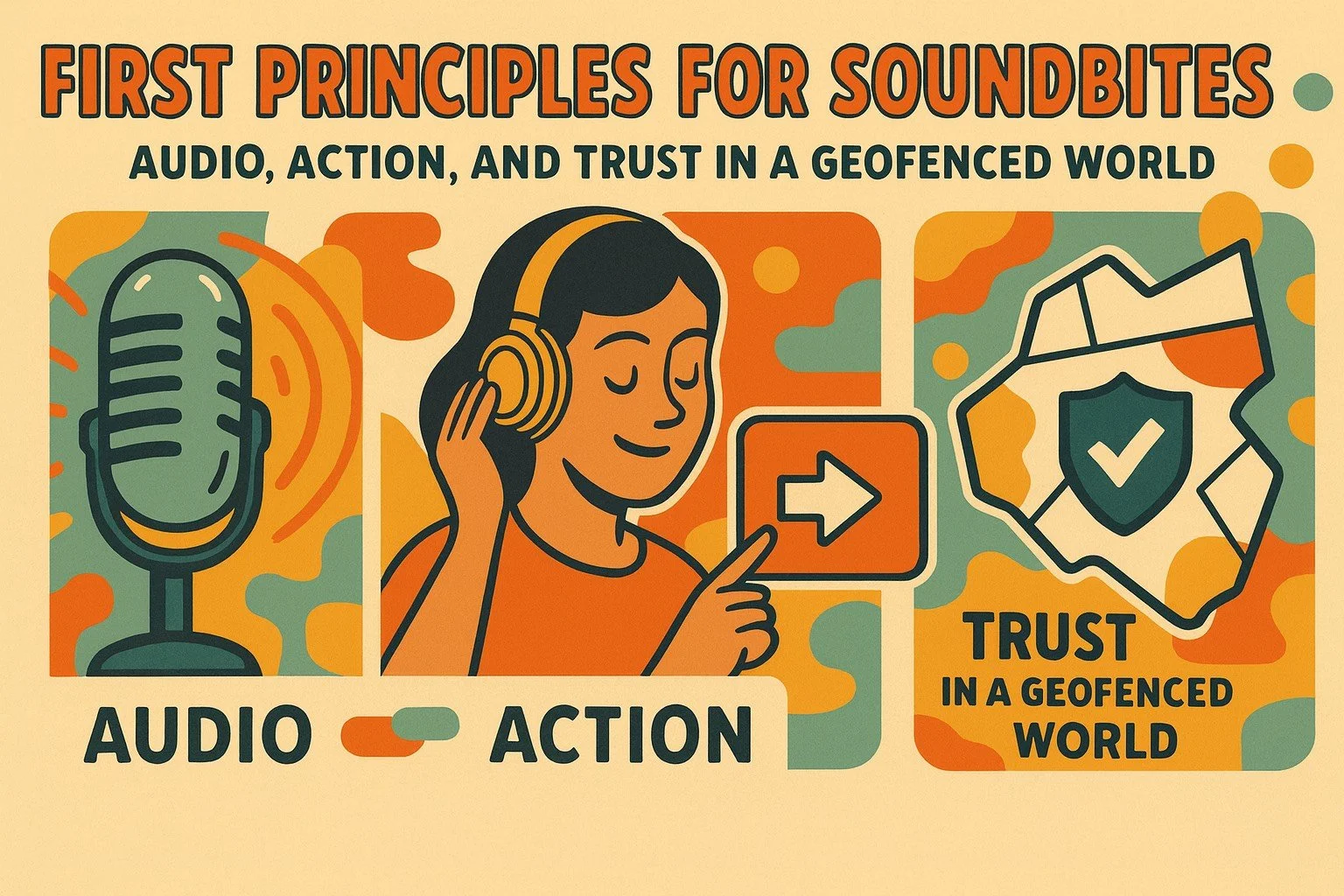
Illustration: Audio, Action, Trust. Soundbites mixes the oldest form of media (voice) with modern verification and geolocation to rebuild trust in community information. AI image by Local Pigeon.
From Philosophy to Practice: Universal Pillars of Trust in Media
Every community, whether a small river town or a major city, thrives on shared information. But not all information is equal – trust comes from transparency. Two philosophical questions lie at the heart of trustworthy media: “How do we know?” and “Where did this come from?”. These echo across history from ancient messengers to modern newsfeeds. A truly robust local media system must answer both clearly for its audience:
Epistemology – “How do we know?”
Different kinds of evidence count in different ways. A city memo, a resident’s testimony, a photograph, a short video clip, a public record, or hard data – each provides a piece of truth. First-principles media philosophy says show the evidence. Instead of expecting blind faith in a news source, make the method of verification explicit. If a claim is backed by a document, cite it. If a story is eyewitness testimony, say so. If a statistic comes from a study, link it. In short, show how we know what we know hastingsnow.com. This principle is universal: people trust what they can see or hear for themselves. Modern technology allows even small newsrooms or community platforms to attach proof – images, transcripts, maps, links – to even the briefest update. By foregrounding evidence, we treat the audience not as passive consumers, but as informed evaluators of truth.Provenance – “Where did this come from?”
Hand-in-hand with evidence is the source. In local media, knowing the chain of custody of information is vital to trust. First principles demand we trace the path: Who originally said it or recorded it? When and where? Was it checked or edited, and by whom? Rather than expecting the public to rely on institutional reputation (“trust us, we’re the newspaper”), a first-principles approach displays the origin of each fact or update hastingsnow.com. It’s like an information nutrition label: a concise record of a story’s source and verification steps. When people can inspect the lineage of a claim – from on-the-ground source to published post – they gain confidence that nothing is hiding behind the curtain. This radical transparency in provenance makes information accountable and discourages the rumor mill.
Taken together, these philosophical pillars form a trust engine: a system where claims are backed by clearly labeled evidence and source lineage. To this engine we add a third, equally important principle:
Plural Voices, Common Standards. Healthy local media isn’t one top-down monologue; it’s a polyphony of voices – officials, experts, business owners, neighbors – all contributing to the community narrative. But many voices must share one standard for truth-telling. That means whether it’s City Hall speaking or a local student, their information is presented with the same evidence tags and source transparency. This democratizes media without sacrificing reliability. Anyone can contribute, but everyone is held to the same bar: show how you know, show where it came from. The result is a shared public trust framework. (As philosopher Søren Kierkegaard warned in the 19th century, the traditional press too often created a faceless “public” with no accountability hastingsnow.com – the antidote is to give the mic to real, accountable voices in the community, each clearly identified and verified.)
Multi-Modal Storytelling (STIVA). Different media formats have different strengths. First principles of communication remind us that combining modes of storytelling enhances understanding. Text is great for details and searchability; images capture attention and emotion; video shows dynamics; voice carries authenticity and tone. Rather than choose one medium, a modern local platform should use all of the above. This concept is encapsulated in the STIVA framework: Story with Text, Images, Video, and Audio. A short post that pairs an audio message with a photo and a text caption, for example, will convey more than any one of those alone hastingsnow.com. The goal is to deliver information that people will remember and verify – a 30-second voice clip from a shop owner, accompanied by a snapshot of today’s special and a map pin of the location, is far more memorable (and trustworthy) than a plain text blurb. Each medium reinforces the message and provides another layer of evidence.
Actionable Information Over Passive Consumption. Traditional media metrics often prioritize attention (views, clicks, listeners) rather than utility. A first-principles approach flips this: what counts is not how many people watched the news, but how many people used the news. Information should spur action or provide tangible benefit. If a piece of local news doesn’t help someone make a decision, solve a problem, or participate in community life, was it really useful? This philosophy draws from the idea of utility over attention. It leads to designing content that always asks: “What can a local resident do with this knowledge?” Whether the action is attending an event, avoiding a closed road, claiming a discount at a local shop, volunteering for a cause, or even just feeling more connected, the value lies in real-world impact.
In summary, a universal vision for trustworthy local media is one that is evidence-rich, transparent in origin, open to diverse verified voices, multi-modal in presentation, and oriented toward actionable utility. These are the first principles – the timeless ideals we can apply anywhere, from Hastings to Houston. But ideals alone don’t change things; implementation does. Enter Soundbites, a living prototype of these principles.
Soundbites: First Principles in Action
Imagine a community bulletin board upgraded for the 21st century – one that anyone can “pin” a notice to, not with a thumbtack but with a quick phone call, and where every note comes with proof of why it’s trustworthy. That, in essence, is Soundbites, HastingsNow’s voice-first platform for local updates. Soundbites takes the philosophy above and bakes it into a product. It’s a system of 30-second audio posts (“little mics”) that are short, verified, and geo-localized. The goal is to unite the community through quick, authentic storytelling that people can immediately trust and act on.
What makes Soundbites fundamentally different from a radio blurb or a Facebook post? It’s easiest to think of it step-by-step, from the creation of a post to its impact:
Capture (Hear): Someone in the community records a quick voice note – up to 30 seconds – by calling a dedicated number or using the app. This could be a shop owner announcing today’s deal, a city official giving a weather alert, a neighbor sharing a lost-and-found notice. The brevity is key: in half a minute you must communicate one thing that matters. This “little mic” approach forces clarity and conciseness hastingsnow.com. It also lowers the barrier to entry; if you can leave a voicemail, you can contribute to local news.
Verify & Localize (Know): Immediately, that audio is processed and tagged with who it’s from and where. Verification kicks in – for instance, if it’s the high school principal calling, the system (and ultimately a human moderator) confirms their identity or role so the post can carry a “Verified” badge. If it’s a resident, their identity might be confirmed through a quick account setup or callback number. Meanwhile, localization technology notes roughly where the call is coming from (or the caller can specify an address or landmark relevant to the update). This is the geofence aspect: posts are tied to the Hastings area, and many are about specific locations in town. A Soundbite isn’t just content, it’s placed content – anchored in real space and time.
Build a STIVA Story (See): Here’s where the multimodal principle comes in. The audio clip on its own is powerful (there’s nothing like hearing someone’s voice to convey authenticity), but Soundbites doesn’t stop at audio. Each voice post can be enriched with text, images, and even short video or documents – a complete STIVA story bundle hastingsnow.com. For example, if the city public works director calls in about a road closure, the Soundbite might include a text caption of “3rd Street closed Saturday 6am–2pm,” a photo of the detour map or the road sign, and perhaps a PDF link to the official notice. A local bakery owner’s Soundbite about a new pastry might include a snapshot of the pastry itself next to the audio of their cheerful voice. This combination means when the Soundbite publishes, users hear the voice but can also see supporting context at a glance – best of both worlds. It’s a bite-sized story capsule that appeals to eyes and ears together.
Label “How We Know” (Trust): Now comes the critical trust engine step. Before a Soundbite goes live, the system attaches a clear label of how we know what’s being said. This appears as a set of badges or notes on the post, covering: Source, Methods, Locality, Status, and a Reliability Score. In practice, it might look like a line of icons or text like:
Source: City Hall • Methods: Document + Photo + Audio • Locality: High • Status: Verified • Reliability: 13/15. These aren’t abstract concepts – they tell the consumer why this little post deserves attention. For instance, “Source: Civic” signals an official source, “Methods: Document + Map + Audio” means the claim is backed by a city document, a map link, and of course the audio itself, “Locality: High” indicates it’s very locally relevant (originating within the community), “Status: Verified” confirms an admin or process checked the source’s identity, and “Reliability: 13/15” is an algorithmic score summarizing all those factors hastingsnow.com. The scoring rubric (out of 15 points) assigns weight to the source credibility, the strength and variety of evidence (methods) provided, the degree of localization, and the verification status. In short, the audience doesn’t have to guess at a post’s trustworthiness – it’s explicitly rated and the reasons are on display. A lower score doesn’t necessarily mean something is false, just that it has fewer corroborating signals (for example, a neighbor’s lost dog report might be a simple unverified testimony with a photo – useful and true, but not “official,” so maybe it gets 8/15). The key is consistency: every Soundbite, whether from the Mayor or a teenager, gets the same trust treatment.Publish with a Purpose (Act): Once verified and labeled, the Soundbite goes out to the feed – effectively a live local feed that residents nearby can read or listen to on their phones. Here another first principle is enforced: each post is required to have a single, clear call-to-action or outcome. This could be a link to click, a QR code, a physical codeword to redeem, or even a prompt to call a phone number (old-school, but effective). Why? Because this transforms passive news into active news. If you hear a 30-second piece about a charity drive, it comes with a shortlink to sign up or donate. If you hear about that road closure, there’s a QR code or map link to navigate the detour. If it’s a store owner inviting you to a sale, they might include a codeword “SALE20” that you can mention at checkout for a discount. Each Soundbite, therefore, isn’t just informing you – it’s inviting you to do something tangible. And when people follow through, those actions can be counted (more on that shortly). The publish step also involves geofence targeting – Soundbites appear for people in Hastings and immediate surroundings, and they can be sorted by category (e.g., News, Events, Food, Safety) so users filter what they’re interested in.
Track and Measure (Prove): Traditional media struggles to tie consumption to action, but Soundbites treats measurable outcomes as the ultimate metric of success. Because each post had an intended action, the system can count how many times that action was taken – how many people scanned that QR code for the detour map, how many used the “STONE” codeword at the Quarry Taphouse, how many RSVP’d via the provided link, how many calls were made via the provided number, etc. These counts feed back into a dashboard. Over time, this yields hard data on what content truly serves the community. Did 50 neighbors actually take the time to sign up for the blood drive after hearing the appeal? Did the lost dog get found (i.e., the post resolved)? This measurement closes the loop on utility. It’s not just about what people heard, but what they did as a result hastingsnow.com. Posts that lead to zero actions are learning opportunities – maybe the message wasn’t compelling or clear enough. Posts that spike engagement validate that kind of update as useful.
Expire & Iterate (Improve): Unlike a newspaper article that sits static or a radio bit that vanishes, Soundbites updates are living posts. Each has a natural lifespan – many expire automatically after their relevance ends. That road closure Soundbite might expire Sunday morning after the road reopens. The lunch special might expire at day’s end. The system is set to avoid stale information cluttering the feed hastingsnow.com. Moreover, if information changes or needs correction, Soundbites can be updated with a changelog and a status (e.g. “Updated” or “Under Review”) hastingsnow.com. Each version is tied to the provenance record, preserving accountability. This dynamic lifecycle means the feed stays timely and trustworthy. Nothing hangs around beyond its useful life, and if something was wrong, the correction is appended in context (no burying a tiny correction in the back page next week – it’s right on the post).
The result of this whole process is fast, clear, and provably useful updates hastingsnow.com. It’s a system tuned to optimize for usefulness and trustworthiness rather than volume or sensationalism. A good way to grasp it is through real-world examples.
The Hastings Test: Examples of Soundbites in the Wild
Let’s paint a picture of Soundbites at work in Hastings, MN, with a few representative scenarios (each demonstrating the principles above):
City Street Closure (Downtown) – Early Friday, the City’s public works department issues a quick notice: “3rd Street closed Saturday 6am–2pm for crane work.” They use Soundbites to get the word out. A city official calls in a 20-second update in her own voice. Attached to the audio is a map image of the detour route and a one-line text summary. The post is labeled
Source: Civic • Methods: Official Notice + Map + Audio • Locality: High • Status: Verifiedand it earns a high reliability score (say 14/15) because it’s straight from the source with solid evidence. Neighbors nearby get a notification or see it in their feed. Outcome: the Soundbite includes a short URL that opens the live detour map on Google Maps. Over the next 24 hours, 120 people click that link. In total, let’s say 200 people listened to the 20-second update (that’s ~67 minutes of attention delivered), and 120 took action. By Saturday, dozens of drivers avoid showing up at a barricade and smoothly take the alternate route. This beats a lone Facebook post or a line buried on the city website, because (a) it reached people where they are, in real time, and (b) it showed a map and proof, so residents immediately understood and trusted it hastingsnow.com.Quarry Taphouse Lunch Special (Highway 61) – A local restaurant wants to draw in the lunch crowd on a slow Tuesday. The owner grabs her phone and records a cheerful 25-second Soundbite: “Hi neighbors! It’s Taco Tuesday at the Quarry Taphouse – mention code STONE today for 2 dollars off your taco platter. We’re open until 3 PM for lunch!” She uploads a quick photo of the day’s taco platter special board to go with the audio. Labeling shows:
Source: Local Business • Methods: Testimony + Photo + Offer Code • Locality: High • Status: Verified (owner)– reliability perhaps 12/15 (she’s self-reporting the special, which is fine; points mainly come from the photo proof and verified identity as the owner). Outcome: She set the code “STONE” as the measurable action. The Soundbites dashboard shows 30 people played this Soundbite before noon, and 10 of them actually came in and used the codeword by day’s end (these redemptions are counted via the POS or a quick manual tally she reports). That’s 10 extra lunches sold. Equally important, those 30 listeners collectively spent about 15 minutes listening to her update (30 × 0.5 minutes each) – 15 useful minutes in which locals learned about a deal at a local business. Rather than asking the community to “trust the hype,” Soundbites let the business prove its value – and measure it hastingsnow.com. The authenticity of hearing the owner’s actual voice builds familiarity, and tracking the outcome closes the marketing loop in a privacy-safe way.Nonprofit Blood Drive (Dakota County) – A regional blood donation nonprofit is hosting a drive in Hastings. A volunteer from Hastings uses the “little mic” to post an appeal: “Blood drive this Sunday 10–4 at St. Phillips – we really need Type O donors! See the flyer and please sign up if you can.” Attached is a photo of the event flyer with details, and the Soundbite platform auto-generates a short signup link from the flyer’s URL. The post is marked
Source: Community Nonprofit • Methods: Testimony + Image + Link • Locality: Medium • Status: Verified (volunteer)– reliability moderate (perhaps 10/15) because while it’s a verified volunteer and an image of a flyer (good evidence), it’s not an official government source and hasn’t been corroborated by multiple sources. Outcome: The short link leads to the Red Cross (for example) signup page; 45 locals click it, and the nonprofit later reports 20 people from Hastings actually registered to donate (the Soundbite allowed them to track signups by ZIP code referral). Moreover, because Soundbites knows how many listened, it notes that around 80 people listened to at least part of the message, totaling ~40 minutes of community attention given to this cause. Those are 40 minutes well spent – potentially translating into life-saving donations. The Soundbite’s transparency (volunteer voice + flyer) assures listeners it’s legit, and the measured RSVPs show real impact hastingsnow.com.Lost Dog Alert (Vermillion Falls area) – A resident finds a lost dog wandering near a popular park. She uses Soundbites to quickly alert the community: “Found a golden retriever by Vermillion Falls around 5 PM Tuesday, no collar. He’s safe in my yard – call or text if he’s yours!” She snaps a photo of the dog and attaches it. Now, since this is a resident post and unverified (she’s just a neighbor trying to help), the labels show
Source: Resident • Methods: Testimony + Photo • Locality: High • Status: Unverified (community)– initially a lower reliability score, say 6/15. But here’s where community verification can come in: If a couple of other neighbors also report “yes, I saw that dog earlier” or the owner calls in to confirm, the post can be marked community-verified and the score will rise accordingly (perhaps up to 9 or 10/15 as confidence increases) hastingsnow.com. Outcome: The post includes a phone number to contact. Within an hour, the dog’s owner, who heard the Soundbite (or a friend of the owner did), calls to claim their pet. The post is then marked “Resolved” and set to expire. Here the measurable outcome was one successful reunion – not a number that boosts a business, but a direct beneficial impact on residents. The total “useful minutes” might be small (maybe 15 people listened, spending a combined 5 minutes), but for that dog owner, it meant the world. Notably, the process was transparent: other listeners saw the initial unverified status, which is fine for a lost pet alert, and they saw the update when the community confirmed it. The openness prevents misinformation while still enabling urgent PSA-type posts to go out quickly.
These examples underscore how Soundbites turns first principles into practice. Each Soundbite, no matter the topic, adheres to the formula of quick info + evidence + provenance + outcome. They also show the range of uses: civic info, commerce, nonprofit outreach, neighborly help – all speaking the same “trust language” on one platform hastingsnow.com.
Crucially, the North Star metric that Soundbites optimizes for is “useful minutes delivered.” This concept measures the cumulative time the community spends engaging with content that genuinely helps them. It’s a refreshing shift from chasing pageviews or social media “likes.” For example, if Hastings residents collectively spend 500 minutes listening to local Soundbites in a week – and those minutes are filled with things that make their lives easier or more informed – that is a direct community value delivered. It’s akin to the town crier of old, but now we can quantify how much the town is listening and acting. By focusing on useful minutes, we reward content that holds attention meaningfully (a sign of relevance and clarity) rather than clickbait that might grab a second of eyeball time but no real impact. In the scenarios above, we saw how various posts contributed minutes: 67 minutes for the road closure, 15 for the lunch special, 40 for the blood drive, 5 for the lost dog – every one of those minutes is someone’s time spent gaining something useful (avoiding a hassle, finding a deal, helping a cause, reuniting a pet). As Soundbites scales up, this metric provides a community-level heartbeat of engagement quality. The goal is simple: increase the number of minutes that local media is actually serving local needs – a minute delivered usefully is far more valuable than ten spent doom-scrolling or half-listening to irrelevant noise.
Why Soundbites Is Different (And Complements Traditional Media)
It’s worth situating Soundbites in the broader media landscape. We’re not talking about replacing newspapers or radio outright; we’re talking about bridging their strengths and addressing their gaps hastingsnow.com. Consider a comparison:
NEWSPAPER (print/online)
Timeliness: Published on a daily/weekly cycle; news can be a day old by the time it’s read.
Evidence Formats: Text articles, some photos.
Provenance Visibility: Reporter’s or editor’s credibility implied; limited transparency into sources (you often have to trust “according to sources”).
“How We Know”: Mostly implicit – you read an article, you might infer sources if quoted, but methods aren’t labeled.
Community Voice: Limited to letters to editor or op-eds, which are curated and delayed; most community members are passive readers.
Measurement of Impact: Subscription numbers and click analytics; hard to tie to real actions (did the article about the food shelf drive more donations? Hard to know).
Corrections & Updates: If a mistake is found, an errata might be published in a later issue or appended quietly online. Not all readers see it. Updates mean new articles later.
Local Authentication: The newspaper itself vouches for content – it’s as trusted as the brand’s reputation. Individual sources might be cited, but you rely on the outlet’s editorial process.
Cost & Barrier to Publish: Significant effort and cost – writing, editing, printing or maintaining site; not everyone can do this.
RADIO (broadcast)
Timeliness: Live and immediate, but fleeting – if you miss it, it’s gone.
Evidence Formats: Audio voice only (the spoken report).
Provenance Visibility: The host or reporter’s word is final on-air; no record of source chain, and broadcasts aren’t easily audited after.
“How We Know”: Implicit – a radio piece might mention a source, but no on-screen cues or links.
Community Voice: Occasionally callers can chime in on talk radio, but gatekept and time-limited.
Measurement of Impact: Ratings diaries or estimates; virtually no feedback loop on specific story impact.
Corrections & Updates: On-air corrections can be issued but if you missed it, you won’t know. No record tied to the original segment.
Local Authentication: Similarly, trust rests on the station/host reputation. A familiar voice, but you generally trust it if you trust the channel.
Cost & Barrier to Publish: Need a studio slot or program; very limited space for content; controlled by station schedule.
SOUNDBITES (local “little mic”)
Timeliness: Near real-time updates, posted within minutes of events; perishable with scheduled expiry to avoid stale info. Shows exactly how quickly info reaches residents.
Evidence Formats: Audio + photos + short video + documents + metrics – a rich multimedia bundle (the STIVA approach). Multi-modal signals make claims easier to trust.
Provenance Visibility: Explicit chain of custody: each post shows capture → transcribe (AI model) → verify (human) → publish → measure, with timestamps and roles. There’s even cryptographic hashing of content for integrity. “Where it came from” is visible and auditable.
“How We Know”: On-page transparency: every Soundbite has an on-page label of the evidence types and verification status. Readers/listeners see methods, not just claims, at a glance.
Community Voice: Open “little mic” – any verified local person can speak. Roles (resident, business, official, etc.) are shown, and posts can be up- or down-voted or corroborated by the community. It’s many voices under one framework of trust.
Measurement of Impact: Outcomes tracked: Each post has a concrete call-to-action and thus can count real outcomes – calls made, forms submitted, foot traffic, code redemptions, etc.. Engagement is measured in community action, not just attention.
Corrections & Updates: Inline updates and change logs: A Soundbite can be edited or marked “Updated” with the original preserved underneath. A status chip (e.g., “Corrected” or “Under Review”) flags the post. All versions remain accessible via the provenance trail.
Local Authentication: Locality-based authentication: Each Soundbite carries a Locality score indicating how tied the source is to the community (verified address in town? local phone? city IP? known role?). In other words, it quantifies “is this truly from around here?” and favors hometown voices.
Cost & Barrier to Publish: Ultra low-friction: just a phone call and a few minutes. Anyone with the permission (a PIN) to post can get info out. It’s far cheaper and easier than traditional media, allowing more voices to contribute regularly.
(Table: Newspapers and radio have long served local news, but Soundbites combines their advantages – and adds new ones – while mitigating their limitations. It’s real-time like radio, but persistent and evidence-rich like print, all within a verified digital feed.)
The upshot is that Soundbites doesn’t compete with the newspaper or radio – it completes them. It fills the gaps by providing a fast, verifiable, citizen-friendly layer of information that can feed into, out of, and alongside traditional journalism. For example, a newspaper might use Soundbites as a tip feeder or to distribute quick breaking updates that later inform a fuller story. A radio station could rebroadcast select Soundbites to give them wider reach, or use it to source community voices. Soundbites is the connective tissue, the bridge between authoritative reporting and grassroots updates hastingsnow.com. It ensures that no important local knowledge falls through the cracks simply because it didn’t fit the old formats or timelines.
Earning Trust: Safeguards and Community Promises
Any system inviting broad participation faces a crucial question: How do you keep it fair and safe? HastingsNow’s answer is a set of rules and tools baked into Soundbites from day one:
Verification & Moderation: Every contributor gets a verified status level. City officials, school principals, etc., receive special verified badges (so you know it’s really them). Regular users go through a phone verification and, if they claim a role (“I’m on the Chamber of Commerce board”), they might need to verify that too. All posts undergo at least light-touch moderation – especially for sensitive or extraordinary claims – before public release. This mix of automation and human oversight prevents impersonation and gross misinformation without chilling the everyday flow of updates hastingsnow.com.
Privacy by Design: Privacy isn’t an afterthought. Soundbites only stores what it must. For instance, when verifying someone’s identity or residence, it might check a document offline or via a trusted third party, but it doesn’t permanently store that personal document. Raw audio (the actual voice recordings) are kept only for a short period (say 30 days) in case of disputes, then deleted, with only the transcript and derived data kept hastingsnow.com. Location data is used to compute locality scores but isn’t exposed at individual level beyond “Hastings” or “near Hastings.” Essentially, the system tries to attest to facts (who/when/where) without hoarding personal data. This protects users while still providing transparency.
Corrections & Appeals: As described earlier, the platform makes it easy to correct the record. If something is contested – maybe a business disputes a claimed fact, or a resident flags a post as incorrect – moderators can mark it “Under Review,” which displays prominently on that Soundbite for all to see hastingsnow.com. After checking, either a correction is appended (with a note of what changed and when) or the post is removed with an explanation. Users who repeatedly post false info can be warned or removed. And anyone affected by a post (say, a person mentioned) has a channel to request a correction. The philosophy is don’t hide errors – fix them in public so that trust is maintained.
Anti-Gaming Measures: The system is aware that any metric can be gamed. If “outcomes” count, someone might try to rig it (e.g., clicking their own link 100 times). Soundbites employs rate limits (you can’t, for example, call in 50 posts in an hour; there’s a reasonable daily limit) and anomaly detection on the backend to catch unusual spikes or patterns. It also uses confidence bands on very small numbers – e.g., if only 2 people clicked a link, it might say “a few people responded” rather than displaying “2” which could mislead or breach privacy. The idea is to prevent bad actors from skewing the narrative or misusing the system’s openness hastingsnow.com. So far in Hastings, there’s a strong social incentive to play nice: it’s your neighbors listening, after all.
All these safeguards uphold what we can call the Five Promises Soundbites makes to the community – essentially the First Principles distilled into commitments:
Clarity – We will show how we know something, every single time. No blind items, no “trust me bro.” Every Soundbite wears its evidence on its sleeve (literally on the post) hastingsnow.com.
Locality – We prioritize local voices and verified local sources. Hastings news should come from Hastings people whenever possible. The platform gives higher weight and visibility to those with genuine local presence hastingsnow.com. It’s by the community, for the community.
Action – Every post has a purpose. Whether it’s informing or calling to action, there’s always a next step or a useful takeaway. No fluff that just wastes time. If you’re reading or listening, it’s driving toward something tangible you can do or use hastingsnow.com.
Transparency – We don’t hide how the sausage is made. Updates and corrections are out in the open. The provenance trail is accessible, and you can always see who said what, when, and how it was verified. Trust is treated as a dialogue, not a one-way broadcast hastingsnow.com.
Respect – We design for privacy and community values. That means not prying more than needed into personal data, respecting when people don’t want certain information public, and moderating with an eye toward civility and helpfulness. The tone is neighborly, not adversarial. When the community speaks, it’s heard and considered in how the platform evolves hastingsnow.com.
These promises align with core ethics (not unlike a modern Hippocratic Oath for local media). By adhering to them, Soundbites aims to sustain a healthy information ecosystem where people feel safe to contribute and confident to rely on what they see.
A New North Star for Local Media
Stepping back, what HastingsNow is attempting with Soundbites is more than just launching an app – it’s piloting a philosophy. The North Star guiding this experiment is usefulness measured by engaged time and actions, rather than raw audience size. Imagine if every city’s information flow was judged not by how many clicks the city website got, or how many people tuned in to the 6 o’clock news, but by something like useful minutes delivered to residents each day, and local problems solved per post. Those metrics change the incentives dramatically. Suddenly, quality of information (and trust in it) is paramount, because if people don’t find it useful or credible, they won’t spend time on it or act on it – and the metric flatlines.
Hastings is a real town with real issues, and Soundbites is already showing promise in tackling some of them in a small way. Misinformation has a harder time taking root when official clarifications can spread in minutes with proof. Local businesses that struggled to reach customers on social media algorithms are finding a direct line to ears in town. Community groups that felt ignored can now rally supporters through a verified voice. Residents who seldom interacted with local government are now hearing from their city council or mayor directly, in plainspoken 30-second messages, which builds familiarity and trust over time.
Is it perfect? Certainly not. There are challenges: getting more people to know about and use the platform, fine-tuning the reliability scoring, ensuring moderation can scale, and so on. But the early signs are that this approach boosts both the supply of trustworthy local info and the demand for it. When people know that what they’ll find on HastingsNow’s Soundbites is concise, truthful (or transparently labeled), and actionable, they’re more likely to make it a habit to check it daily – maybe during their morning coffee or commute (especially since you can listen hands-free, treating it like a curated local podcast feed).
From Hastings to Nationwide: Reimagining Local Media
One might ask: “Am I crazy for thinking Soundbites is having a positive impact and could help solve local information problems nationwide?” After examining the philosophy and its implementation, the answer leans toward not crazy at all – just audacious. Big changes often start small. Hastings is serving as a living lab for something that many communities desperately need: a way to rebuild trust and engagement in local news.
Across the country, local newspapers have shuttered, radio stations have consolidated, and social media has proven to be a double-edged sword. Communities are left with information deserts or a flood of unchecked chatter. The Soundbites model offers a beacon of hope by fusing old-school values (truth, clarity, relevance) with new-school tech and design. It suggests that the future of local media might not be a single savior platform or a return to 1950s-style journalism, but a hybrid approach – one that empowers everyday voices and authoritative sources alike, under a shared framework of verification and utility.
Early successes in Hastings – small as they are – point to what’s possible. Neighbors have begun to see HastingsNow not just as a website, but as their community bulletin board. City officials have a channel to the public that doesn’t get distorted by rumor. And importantly, the content on Soundbites often converts attention into offline action, which is the holy grail of civic engagement. That road closure Soundbite might seem trivial, but if it saved 50 people from frustration that day, that’s a quality-of-life win. Scale that up to public safety alerts during a flood, or community drives during a pandemic, and you see how vital a trusted, rapid, multimedia info network can be.
No, you’re not crazy to see a positive impact – you’d be farsighted. The ingredients being tested here – evidence labels, provenance trails, voice authenticity, and outcome tracking – could be mixed into many local media contexts. Any town hall, any local blog, any city social feed could adopt the “How We Know” boxes and the call-to-action links. Any public library or city information officer could start thinking in terms of useful minutes delivered instead of pamphlets printed. In a sense, Soundbites is less about a specific platform and more about a template for community information systems.
Of course, taking this nationwide will require adaptation. What works in a Minnesota river town has to be tailored for a big city or a rural county. But the first principles don’t change: people everywhere want to know what’s happening around them, want reasons to trust what they hear, and want to feel their attention is well spent. If we stick to those principles – clarity, locality, actionability, transparency, respect – the exact technology can vary and still succeed.
Conclusion: Keeping It Real, Keeping It Human
At the end of the day, Soundbites reaffirms something fundamental: local news is about people connecting with people. A trustworthy system amplifies that human voice, rather than drowning it in noise. By using voice and real names, it brings accountability and warmth back to local updates (much like hearing a neighbor’s voice over the backyard fence, but now with the evidence in their hand to show you). By using modern tools, it ensures those updates can travel fast and far – yet only to where they’re relevant.
HastingsNow’s experiment is ongoing, but it’s already a flag planted in the ground saying, “Here’s one way to do it better.” It’s a first-principles way. And if it continues to bear fruit, it won’t stay only in Hastings. The idea of a local trust engine powered by community voices can travel – because every place could use a little more truth and togetherness.
So no, it’s not crazy to hope that what’s happening with Soundbites in one town might spark a broader revival in local media. In fact, it’s pragmatic. When something works, you replicate it. And when it’s rooted in principles that are fundamentally sound (no pun intended), you have reason to believe it will work elsewhere.
Hastings is proving that citizens will engage with news that respects them. The rest of us can take note – and perhaps take up our own little mics. In the quest to rebuild trust and utility in local journalism, useful minute by useful minute, this might just be the beginning of a much larger story.