
From Town Criers to Soundbites: Reinventing the Local “Digital Town Square”
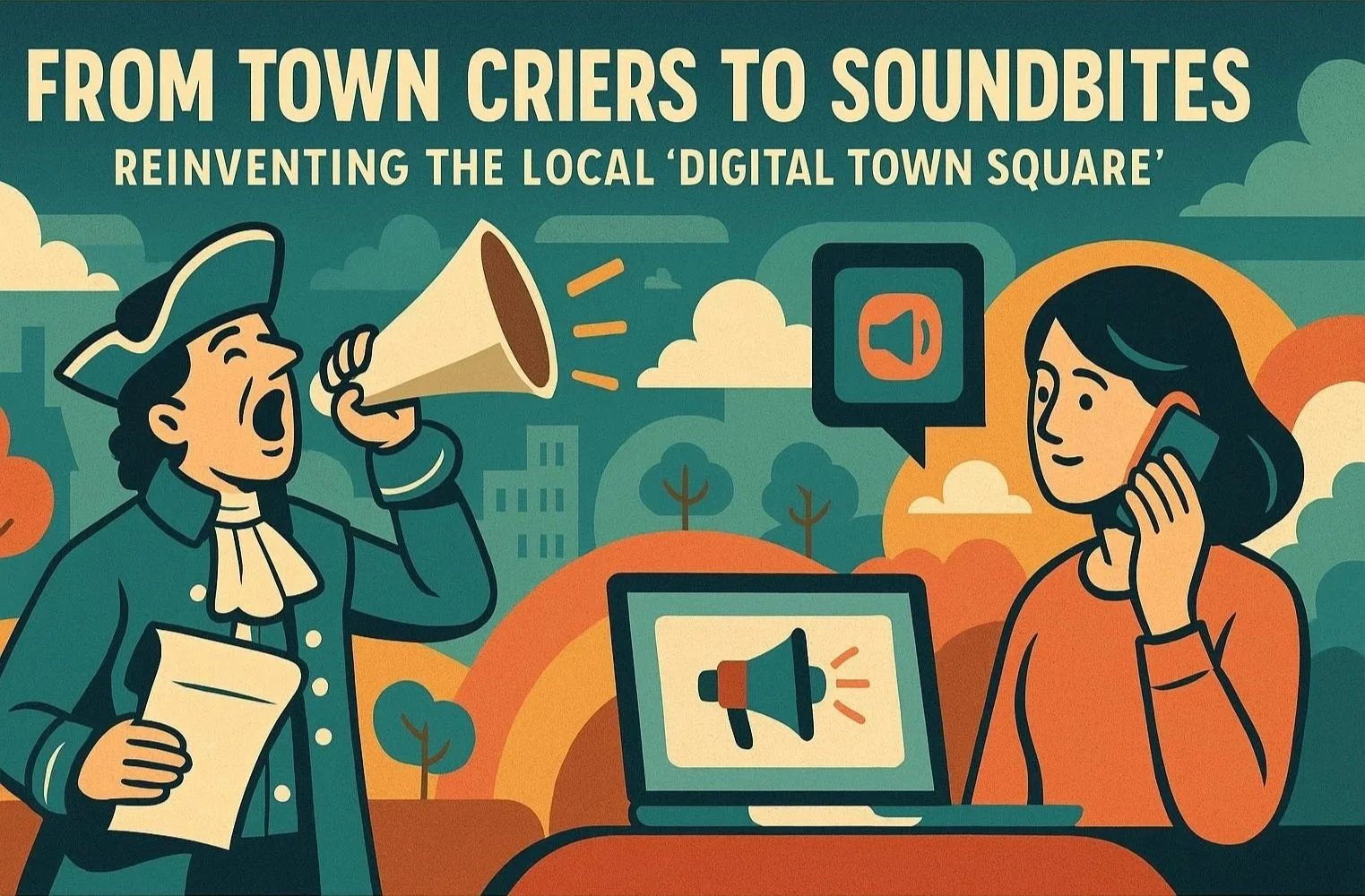
AI image by Local Pigeon
Imagine standing in a colonial town square as a robed gentleman rings a bell and shouts the day’s news. For centuries, the town crier served as the community’s newsfeed, broadcasting proclamations and local happenings to anyone within earshot . Fast-forward to the 20th century, and that role passed to printed newspapers, crackling radio broadcasts, and the evening TV news. By the 2010s, experiments like Patch.com and social networks like Facebook tried – with mixed results – to bring local news into the digital age. Now, in 2025, one Minnesota city is pioneering a bold new model that echoes the past but harnesses the latest technology.
Hastings, Minnesota is home to HastingsNow.com – a platform fundamentally reinventing local media with “Soundbites,” a citywide, always-on, voice-driven bulletin board. In a very real sense, HastingsNow is creating a “digital town square” for the 21st century, a soapbox for every org and every resident. It offers a free, live feed aggregating thousands of local updates each day, rich multimedia profile pages optimized for search, and an innovative phone-in audio system that lets verified locals post 30-second updates by simply talking into their phone. It’s all built on a modern, multi-tenant tech stack ready to be licensed and replicated in other communities.
This editorial journey will explore how local media evolved from the days of town criers to today’s social feeds, and how HastingsNow’s Soundbites platform might represent a civic turning point. We’ll see why legacy media can’t (or won’t) build this kind of open bulletin board – and why HastingsNow’s “locally voiced but globally legible” approach is inspiring local organizations, civic leaders, and entrepreneurs far beyond one Minnesota river town.
From Town Criers to Facebook: A Brief History of Local Media
Hear ye, hear ye! The role of disseminating local news has always been vital to community life – but the format has continually changed with technology and society. HastingsNow’s approach didn’t emerge in a vacuum; it’s the latest chapter in a long story of how we share local information. Let’s take a quick historical tour:
Town Criers – The Original Social Feed: Long before newspapers or radios, town criers were the living news outlets of their communities. In medieval and early modern times, these bell-toting officials walked the streets making public announcements – from royal decrees and market days to local bylaws and lost-and-found notices . Because many people were illiterate prior to widespread schooling, the town crier’s voice was indispensable. He was effectively a “living newspaper,” ensuring everyone heard the latest news aloud in the public square . The tradition persisted for centuries (and in some places, ceremonial town criers still exist for nostalgia’s sake). Community news was literally a public, vocal affair, in the center of town for all to hear.

A modern town crier in traditional regalia, making a public announcement. Before mass media, town criers served as the local news channel, broadcasting community updates in person . Image: Commons.wikimedia.org
Local Newspapers – Ink on Paper Unites Communities: The invention of the printing press and rising literacy in the 18th and 19th centuries shifted local information from the spoken word to the printed page. By the 1800s and 1900s, nearly every town or city neighborhood had its own newspaper – daily or weekly – covering everything from city hall meetings to school events and business ads. For generations, newspapers were the glue of civic life, “the prime source of information on everything from town council meetings to who’s running for office,” as journalism professor Penny Abernathy has noted . Local papers told a community’s story and kept a written record of its life. But in recent decades, this model has been in steep decline. Economic and technological forces led to a collapse of local newspapers across the United States: more than 2,100 newspapers have closed since 2004, turning many communities into “news deserts” with little to no local reporting . Those that survived have shrunken in staff and scope – between 2004 and 2018, U.S. newspaper newsroom employment dropped by almost half . The result? Many towns no longer have a robust newspaper to chronicle daily life, leaving a gap in how local information is shared.
Radio and TV – Broadcasting the Local Buzz: The 20th century brought electronic mass media into the mix. Local radio stations began transmitting community news and announcements over the airwaves. A family in the 1930s-60s might tune in to the AM radio at breakfast to hear local farm reports, weather, and high school sports results. Radio was more immediate than print – a voice in your home – but it was ephemeral (once spoken, the news disappeared into the ether) and not as comprehensive as a thick newspaper. Local television news rose to prominence by mid-century, giving communities a nightly visual digest of city council meetings, crime reports, and human-interest stories. TV news brought strong reporting and broad reach, but typically focused on city or regional headlines in brief segments. Neither radio nor TV provided the open microphone to any resident or organization – they remained one-to-many broadcast media, with professional journalists deciding what news made the cut. And while they were great for breaking news or major events, everyday community updates (the bake sale, the library book club, a school fundraiser) often struggled to get airtime.
Early Digital Hyperlocal Experiments – The Rise of Patch: As the internet age dawned, entrepreneurs saw an opportunity to move local news online. In 2007, Patch.com launched as a network of hyperlocal news websites, each dedicated to a specific town or neighborhood. Patch hired local reporters to write stories and encouraged community contributions. AOL acquired Patch in 2009 and poured $50 million into expanding it nationwide . At its peak, Patch rapidly grew to serve over 800 communities by 2011 and became one of the largest employers of journalists in the country. The idea was to fill the gap left by dying newspapers with a digitally native local news source. However, the business model struggled – local online advertising proved insufficient to cover costs. In 2014, Patch’s owners dramatically downsized the operation, laying off hundreds of journalists . (AOL reportedly lost nearly $150 million on Patch in a single year .) Patch survived by slimming down and reinventing itself; by 2018 it had rebounded to profitability, reaching 23 million monthly users across 1,200+ towns (with a much leaner staff of about 110 full-time reporters) . Patch’s journey showed both the promise and pitfalls of hyperlocal digital media – people crave local information online, but sustaining it with old models (ads and paid reporters) is hard. Notably, Patch still primarily produces written articles and some user-generated posts; it didn’t fundamentally open a real-time “bulletin board” for every voice so much as digitize the community newspaper paradigm with professional curation.
Facebook, Nextdoor, and the Social Media Local Feed: In the 2010s, many residents turned to social networks for local happenings. Facebook created city-specific groups and even tested a “Today In” feature to aggregate local news. (They found a big problem: in about one-third of U.S. cities, there weren’t enough daily local news articles to sustain the feed – some towns had zero news stories on many days .) Where local journalism faltered, informal channels took over. Neighborhood Facebook Groups and Nextdoor forums became de facto bulletin boards for yard sales, lost pets, school events, and yes, plenty of gossip and rumor. While these platforms gave ordinary people a voice, they also created chaos. Useful posts vanish quickly in cluttered feeds; important city announcements get drowned out by trivial chat. Content on social media is not easily searchable on the open web (much of it sits behind login walls), and algorithms decide who sees what – not necessarily the people who need the info most. As one HastingsNow writer quipped, “city notices get buried in feeds. Nonprofit updates vanish. Small business promos are hard to verify” . In other words, relying on big social platforms has left local communities with a noisy, hit-or-miss information system. The “town square” aspect – one central place everyone can hear community voices – has been lost in the shuffle of personalized feeds and pay-to-play advertising.
This historical arc sets the stage for why something new is needed. We went from a literal town square where all could hear the news, to edited mass media that informed but filtered community voices, to the current fragmented landscape where local information is both everywhere (on countless apps and sites) and nowhere (no single trusted hub). HastingsNow’s founders saw both the nostalgia of the old system and the opportunities of new tech. The result is a platform that cherry-picks the best aspects of each era – the open mic of the town crier, the comprehensiveness of a newspaper, the immediacy of social media – while shedding some limitations (like print’s delays or Facebook’s algorithmic whims).
HastingsNow: Building a 21st-Century Digital Town Square in Hastings, MN
Hastings, Minnesota – a city of about 22,000 on the Mississippi River – is not the largest metro around. But it’s become the first city in Minnesota to launch a platform quite unlike any legacy media or Silicon Valley app. HastingsNow.com, created by local entrepreneurs, is positioning itself as “your local guide to news, events & businesses in Hastings.” On the surface, it might sound like just another community website – but under the hood, it’s a different animal. HastingsNow combines a real-time news feed, rich business directory, and a voice-driven social bulletin board all in one, powered by some serious tech integrations. Let’s break down what makes HastingsNow unique, and how its features directly tackle the shortcomings of earlier local media models:
A Live, Citywide Feed of 2,000+ Local Stories a Day (Powered by RSS)
One of HastingsNow’s core offerings is a free, always-on news feed that aggregates virtually every local story or update in the area. This feed isn’t produced by a single newsroom – it pulls from across the community, indexing updates from news outlets, city and school websites, event calendars, blogs, and more. The magic behind this is RSS (Really Simple Syndication) – a web technology that allows sites to publish their latest posts in a standardized format. HastingsNow leverages RSS to gather content from dozens of local sources, funneling them into one citywide social feed that updates constantly.
On any given day, HastingsNow’s feed indexes over 2,000 local items across 21 categories – from Arts & Entertainment to Government, Sports, Obituaries, and beyond (essentially mirroring every facet of life in Hastings). Think of it as a centralized clearinghouse: rather than residents having to check 10 different websites or Facebook pages, they can scan HastingsNow and see a composite snapshot of all that’s happening in town . The feed is live and unfiltered (except by category tags), making it the digital equivalent of the bustling town square bulletin board. If a local newspaper publishes a story, it appears in the feed. If the school district posts an alert, it’s there. If a community blogger writes about a recent event, into the feed it goes.
Importantly, HastingsNow’s feed is open and searchable. Because it’s built on RSS and web indexing, these thousands of local posts are available to search engines and voice assistants (more on that later). In other words, HastingsNow not only aggregates local content for users, it also makes sure that content is globally legible – not hidden in walled gardens. This addresses a key failing of social media groups, which often silo local info in ways that grandma or the new neighbor might never see. HastingsNow’s feed functions like a living library of Hastings happenings, updated by the minute, with the goal of making local knowledge accessible to all who seek it.
SEO, GEO, AEO: Profile Pages That Are “Locally Voiced, Globally Legible”
Another pillar of HastingsNow is a robust directory of Squarespace-powered profile pages for local businesses, civic groups, and organizations. At first glance, these might seem like standard business listings – the kind you’d see on Yelp or the chamber of commerce site – but they are deliberately engineered to be SEO, GEO, and AEO-optimized. That alphabet soup merits explanation:
SEO (Search Engine Optimization): Each profile page is crafted with rich metadata, descriptive content, and relevant keywords so that it ranks highly on Google for local searches. For example, a Hastings bakery’s page on HastingsNow will include its address, hours, menu highlights, etc., in a crawlable format that search engines love. Rather than spending money on their own SEO, small businesses benefit from HastingsNow’s centralized, high-authority domain.
GEO (Geographic Optimization): The pages are tuned for geo-specific queries. If someone types “bookstores near Hastings” or asks Siri for “Hastings parks,” the content on HastingsNow is structured to appear in results, complete with maps and location info. Essentially, the site functions as an up-to-date local directory that’s integrated with map services and Google’s local results.
AEO (Answer Engine Optimization): This is a newer concept referring to optimizing content so that voice assistants and smart search features can directly answer questions. HastingsNow’s pages include FAQ sections, schema markup, and other structured data so that if you ask, “When does the Hastings farmers market open?” an assistant like Alexa could pull the answer from HastingsNow’s data. In short, the platform is building an “AEO-first bulletin board” – anticipating that people increasingly use voice queries and wanting the local bulletin board to speak back with accurate answers.
All this means the profile pages on HastingsNow aren’t static listings – they are dynamic info hubs that can include photos, videos, CTA (Call To Action) buttons (“Sign Up”, “Buy Tickets”, “Call Now”), and even embedded Soundbites (more on those next). They serve the local audience by providing rich details (like an event page with its own mini site), and they broadcast that info to the wider web so anyone anywhere (or any AI assistant) can find it. As HastingsNow describes it, these pages are “locally voiced but globally legible” – the content originates from local folks, but it’s formatted in a way that the whole internet can understand and index. In a sense, every organization gets a digital soapbox with a megaphone that echoes well beyond the town borders. This is crucial in an age when discovery often happens via Google search or an app’s “near me” feature, not by picking up a physical brochure or stumbling on a flyer.
By giving every business and nonprofit a SEO/GEO/AEO-optimized page for free (or at least as part of the community platform), HastingsNow lowers the barrier for small local entities to have a strong digital presence. It also ensures that the community’s knowledge base stays up-to-date and centralized. A local newspaper’s “community calendar” might list events in print once, but a HastingsNow profile page can be updated continuously by the organization and always show the latest info with a quick search.
Soundbites: 30-Second Voices – A Soapbox for Every Organization
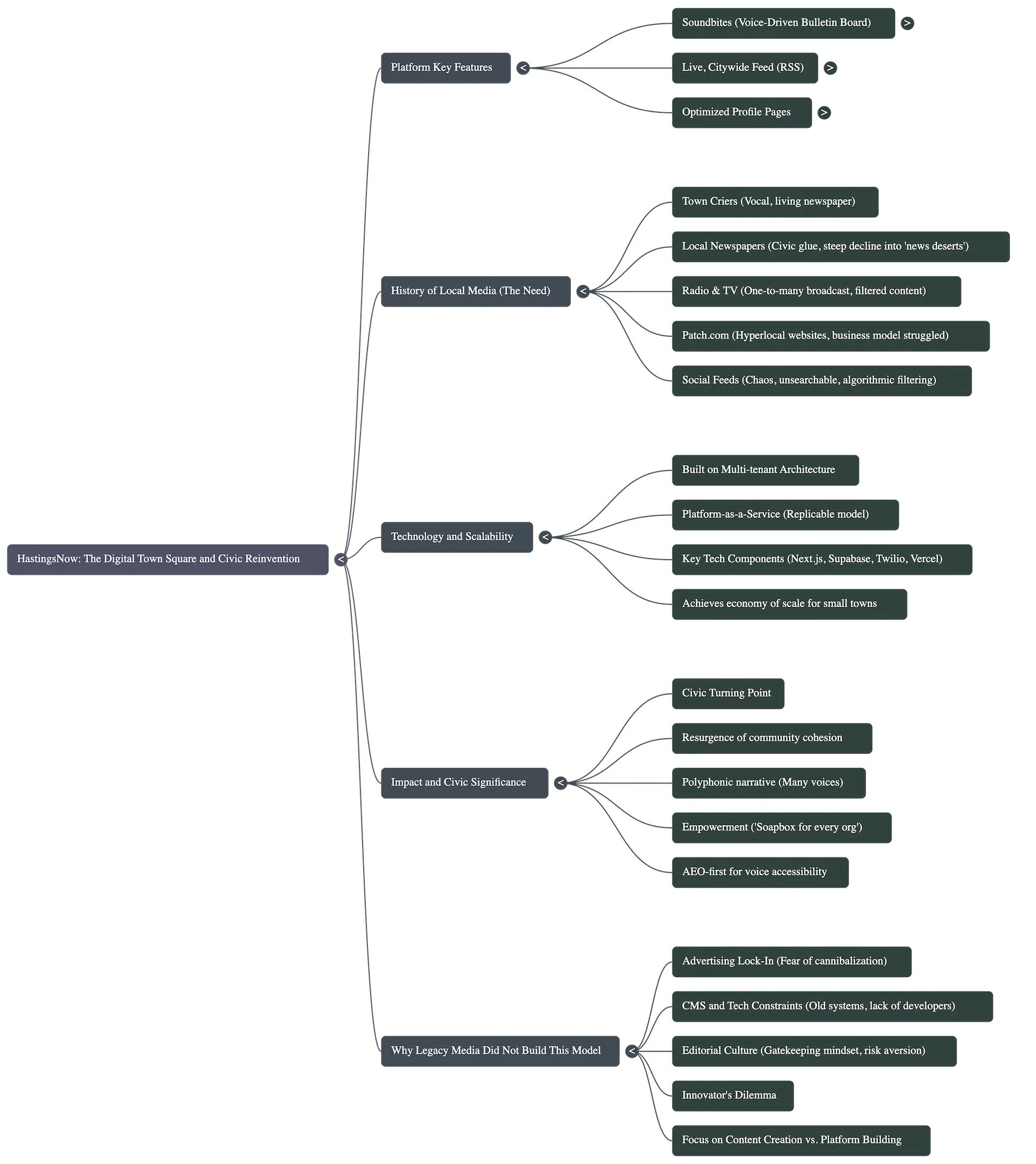
Mind map by Local Pigeon
If the RSS feed is the heartbeat of HastingsNow and the profiles are the bones, then Soundbites are the voice – literally. Soundbites is the flagship feature that truly sets HastingsNow apart: it’s a platform for 30-second, phone-recorded audio updates from verified local users, published instantly to the web. In essence, HastingsNow has given every resident and local org a “little mic” to share timely news in their own voice .
Here’s how Soundbites works: a business owner, community leader, or any verified local citizen simply calls a phone number (a dedicated HastingsNow hotline powered by Twilio) and records a short message – up to 30 seconds. This could be an announcement, an invitation, a reminder, a news tip, a thank-you – anything worth sharing. As soon as they hang up, that audio is automatically transcribed and turned into a post on HastingsNow, complete with an embedded audio player, the text transcription, and any attached media (they can add a photo via a dashboard, for example). The Soundbite appears in the feed and on the relevant profile page (say, the Parks Department Soundbite about a trail closure shows up on the Parks Dept page). It’s instant, first-person local content – no reporter needed, no long approval pipeline.
To keep things trustworthy, HastingsNow has a verification system: users are verified as real local organizations or individuals (so you’re hearing from known sources, not anonymous trolls). Each Soundbite post also comes with a “trust layer” of metadata. The site labels each update with indicators of how we know it’s true – e.g., “Source: Civic – Verified City Staff; Methods: phone recording + official document; Status: Confirmed; Locality: High” – and even gives a simple reliability score . It’s like an info nutrition label attached to every Soundbite, bringing transparency to the content. This is critical in a time when misinformation can spread; HastingsNow bakes verification and provenance into the platform so residents can see at a glance if an update came from, say, City Hall’s own voice or just a neighbor’s opinion .
Each Soundbite is a rich multimedia post. In HastingsNow’s own words, it’s a “STIVA – Story with Text, Images, Video & Audio” . For example, a small business might call in an audio clip about today’s lunch special, attach a photo of the dish, and include a measurable CTA like “mention codeword SOUND for 10% off.” The post is then labeled and published. If listeners act on it (e.g. use the codeword), the system can track that as an outcome. This closes the loop to measure what local updates actually spur engagement . It’s a radical update to the old community bulletin board – imagine if every flyer on the board could literally speak to you, show you a picture, and include a coupon that tracks how many people redeemed it!
Perhaps the best way to envision Soundbites is as a “civic microphone” for Hastings. Just as a town meeting might have an open mic portion for citizens to speak, HastingsNow provides a continuous open mic via phone. It lowers the tech barrier (anyone with a phone can participate, no fancy computer skills required) and lowers the editorial barrier (no need to convince a reporter that your event is newsworthy; you just announce it yourself). This fulfills the promise of social media – giving everyone a voice – but in a much more focused and accountable way. Posts are short, sourced, and tied to real identities, making them more useful and trustworthy than the average social media rant. As one HastingsNow article put it, “with newspapers gone and social feeds crowded, HastingsNow gifts residents a modern town square—mixing podcasts, blogs and Soundbites so every neighbor can be heard.”
It’s worth noting how fast and distributed this system is. A Soundbite can be recorded and live within minutes – crucial for timely updates (“The parade is delayed 30 minutes due to rain,” a city rep might announce). And once live, it can be embedded anywhere: HastingsNow provides an embed code so that other websites, or even regional news, could feature that little audio clip. The 30-second length forces messages to be concise and digestible (truly a “sound bite”). Instead of tuning into a 30-minute radio show hoping to catch a blurb about your town, you can directly listen to a half-minute update on exactly the topic you care about.
For the community, this means a more polyphonic narrative – many voices telling the town’s story together, rather than a single narrator. City councilors, school principals, shop owners, volunteers, all can share their piece. The effect is not cacophony but polyphony, as HastingsNow likes to frame it, harking back to the concept of many voices harmonizing . HastingsNow’s Soundbites are effectively weaving a richer, collective story of Hastings in real time, one 30-second note at a time.
Built for Scale: A Multi-Tenant Tech Stack Ready to Empower Other Cities
Underpinning HastingsNow’s innovative features is a modern, scalable technology stack that positions the platform for replication beyond Hastings. This isn’t a one-off custom website held together by duct tape; it’s a robust application built with industry-leading tools, deliberately architected so it can support multiple communities (a multi-tenant model). In plain language, HastingsNow built the platform to be portable – meaning the same system could run “RiverFallsNow” or “SpringfieldNow” without starting from scratch.
Key tech components include Next.js, a popular React-based web framework, which powers the dynamic interface and server-side rendering for speedy page loads. Supabase (Postgres) serves as the cloud database and user authentication system, storing all those Soundbites, profiles, and analytics securely. Twilio handles the voice telephony – from the hotline that records calls to the programmatic voice-to-text transcription – effectively acting as the bridge between a regular phone call and an online post. There’s a custom media proxy that securely delivers audio clips and images (ensuring things like access control and avoiding hotlinking issues), and the whole stack is deployed on Vercel, a cloud platform optimized for Next.js apps, ensuring global fast delivery and scalability.
What does all this mean in non-engineer terms? It means HastingsNow can spin up a new city’s site relatively quickly, pointing a new phone number to the system, adding that city’s organizations, and presto – a new community gets its own always-on bulletin board. The multi-tenant design isolates each city’s content while sharing the core code and infrastructure. This approach is akin to how SaaS (Software as a Service) companies operate: one codebase, many clients. For HastingsNow, the “clients” would be different towns or city partners. They’ve essentially built a local media platform-as-a-service.
This architecture addresses one of local media’s perennial problems: economy of scale. A small-town newspaper often can’t afford cutting-edge tech or custom tools, because it’s only serving 20,000 people. But if the same platform serves 50 towns of 20,000, suddenly improvements and maintenance become much more viable cost-wise. HastingsNow’s bet is that by perfecting the model in Hastings, they can license or franchise it to other communities – giving them a turnkey “digital town square” without each needing to invent it anew.
The use of modern frameworks also means HastingsNow can iterate rapidly with new features. For instance, if they want to roll out a “Top 10” daily digest page (a curated list of the day’s most impactful Soundbites) or push notifications for followers (both features mentioned as in development ), they have the tech flexibility to do so. Contrast this with legacy media running on old CMS platforms – they often struggle just to add a new section or integrate audio, because their systems weren’t built for it.
In short, HastingsNow isn’t just a cool local website – it’s a prototype for a new kind of local media infrastructure. The founders are effectively saying: here’s the stack that can power local voice in any city; we’ve proven it in Hastings, and it can be your turn next. This has significant implications for civic information dissemination on a larger scale, potentially creating a network of interlinked local platforms that share technology (and maybe even content when appropriate) while remaining locally owned and focused.
Why Legacy Media Can’t (or Won’t) Do This
As inspiring as HastingsNow’s model is, one can’t help but ask: why didn’t the existing local media – the newspapers, radio stations, TV channels – create something similar? They too saw the internet coming, they have community connections, so what held them back from building a “Soundbites” or a comprehensive local feed? The answer lies in a mix of business model inertia, technical limitations, and editorial mindset.
1. Advertising “Rate Card” Lock-In: Traditional local media have long made money through advertising and paid content (like classifieds or sponsored segments). Their revenue models are built on scarcity and gatekeeping – for example, a newspaper has limited space, so businesses pay for an ad or a press release to ensure their message gets out. A free, open bulletin board of community announcements directly threatens that model. If every nonprofit can broadcast their fundraiser via Soundbite for free, why would any pay the newspaper $300 for a small print ad or pay the radio for a PSA slot? Legacy outlets often fear that enabling free community posts would cannibalize their paid advertising. They are locked into their rate cards, reluctant to innovate in ways that undermine short-term revenue from traditional ads. HastingsNow, being a startup, designed a different monetization approach (it charges a modest annual fee to businesses for premium features – $500/year for an organization to get daily Soundbites, a custom CTA button, etc. ). That model essentially flips the value proposition: instead of paying for one ad that runs once and is gone, businesses pay for a continuous voice in the conversation. Legacy media could have tried such a subscription-esque model, but doing so would mean foregoing a chunk of their legacy ad sales and overhauling their sales approach – a risky move for incumbents that are already financially stressed.
2. CMS and Tech Constraints: Many local newspapers and broadcasters are tied to out-of-the-box content management systems that weren’t built for interactive, real-time content from thousands of sources. Posting an article or a few Facebook updates a day is one thing; managing an influx of user-generated audio clips and an aggregated RSS feed is entirely another. Legacy systems often can’t easily integrate telephony, transcription AI, or handle thousands of posts a day – at least not without significant investment. HastingsNow, starting from scratch, could choose the ideal tech stack for the job (Next.js, Twilio, etc.) and optimize it for exactly these features. A small-town newspaper likely doesn’t have a developer team on hand to custom-build a Twilio integration for audio posting. Even if they did, their corporate owners might not prioritize such local experiments. Moreover, legacy media often operate on older web platforms where implementing new features is slow and expensive. The comparative agility of a startup like HastingsNow highlights how hamstrung traditional outlets can be by their technology choices.
3. Editorial Culture and Control: There’s also an ethos factor. Professional media have historically seen themselves as gatekeepers of information – they verify, edit, and present news they deem important. Opening the floodgates to “every neighbor with a phone” can feel antithetical to their mission (and perhaps a tad chaotic). Concerns about maintaining quality and accuracy make editors wary of user-generated content. They ask: who will moderate the posts? What if someone posts misinformation or something inappropriate? HastingsNow addressed this by verifying users and adding the trust metadata to each Soundbite, but it requires a shift in thinking: rather than preemptively filtering what the public hears, allow more voices but label them clearly and track outcomes. Many legacy media organizations haven’t been willing to make that shift. They either fear reputational risk (“what if our site is full of unvetted posts?”) or they simply have a journalistic instinct to control the narrative. Additionally, traditional newsrooms often have unionized staff and established workflows – introducing a parallel stream of community-generated content could be seen as either threatening (it’s not produced by union journalists) or just extra work to oversee without extra resources.
4. Innovator’s Dilemma: We should acknowledge the classic innovator’s dilemma at play. The bold features HastingsNow is implementing could have been prototyped by a visionary newspaper or local TV station, but doing so might have undermined their existing business before the new one proved viable. It’s often upstarts that successfully introduce disruptive models because they have nothing to lose. HastingsNow can experiment with free content and new revenue models precisely because it isn’t burdened by an older, profitable (or formerly profitable) model. Legacy media executives might have calculated that a move to a community-open platform would accelerate the decline of their core ad or subscription revenues, essentially betting the farm on an untested idea. In tough times, few are willing to take that gamble. Unfortunately, by not gambling, many have stagnated – and left a vacuum that innovators like HastingsNow are starting to fill.
5. Resource Focus – Editorial vs. Platform: One more insight: Traditional media companies see themselves primarily as content creators, not platform builders. They invest in reporters, stories, broadcasts – not in software development for community infrastructure. HastingsNow is different; it’s as much a tech platform as a content outlet. It required a product mindset (building a tool for others to create content) rather than a pure editorial mindset. That’s a different skill set and organizational approach. Most newspapers didn’t employ product managers or UX designers; HastingsNow essentially functions like a startup, iterating on features and user experience. Legacy media’s lack of product-centric thinking made it unlikely they’d conceive, for example, a phone-in bulletin board system and actually develop it to production.
In summary, legacy media couldn’t or wouldn’t build HastingsNow’s model because it defies their financial incentives, stretches their tech capability, and challenges their editorial comfort zone. As a result, the task of reimagining the local “town square” has fallen to new players and entrepreneurs. And while it may be too late for some legacy outlets (many have folded or cut back to bare bones), one hopeful scenario is that successful innovations like HastingsNow could be adopted by remaining local media in partnership or under license – i.e., a struggling newspaper might team up with a HastingsNow platform in their city to handle the community bulletin board function, allowing the journalists to focus on in-depth reporting. Time will tell if such collaborations emerge, but what’s clear is that the old guard didn’t pioneer this change – it came from outside the traditional establishment.
A Turning Point for Civic Life – and a Template for the Future
Standing in Hastings today, you can almost feel the local information ecosystem revitalizing. The city now enjoys something many communities have lost: a central, widely accessible forum for news and voices that concern its residents. HastingsNow’s Soundbites and feed effectively stitch the town together in conversation – a digital town square buzzing with life. City councilors deliver quick updates on upcoming votes; nonprofits rally volunteers with heartfelt audio pleas; high school students share excitement about the Friday game; shop owners announce the day’s specials or a spontaneous sale; neighbors swap tips about the farmers market – all within one platform, on their own terms, in their own voices.
This might well be a civic turning point. If in the 20th century we saw the decline of the front-porch culture and the evening news monopolies, perhaps in the 21st we will see a resurgence of community cohesion through “locally voiced, globally legible” platforms. HastingsNow’s approach emphasizes localism – the content is by and for the people of Hastings – yet it doesn’t isolate itself. By leveraging web standards and being open to search, it ensures Hastings’ stories are part of the broader internet’s knowledge graph. When someone in another state searches for Hastings events, they’ll find HastingsNow results; when a researcher studies how small cities communicate, HastingsNow provides an auditable archive (every Soundbite is archived with timestamps and sources). In effect, Hastings is no longer an information island; it’s connected to the world in a way that still prioritizes the local context.
For local organizations – be it the Chamber of Commerce, the public library, or a mom-and-pop diner – this is empowering. They each have a soapbox to stand on (or a microphone to speak into). No longer do they have to beg the newspaper to cover their story or pay for an ad hoping people notice. The phrase “soapbox for every org” is not hyperbole: HastingsNow has given every legitimate group a chance to be heard by the community, regularly and inexpensively. This can dramatically level the playing field in terms of attention. A tiny historical society with no marketing budget can reach as many ears as a big retailer, if their message resonates. It encourages organizations to focus on genuinely interesting, helpful updates (since relevance and authenticity are what get a Soundbite shared or listened to, not the size of one’s ad spend).
The concept of an “AEO-first bulletin board” is also forward-looking in terms of accessibility. As voice assistants and AI become more prevalent, having local info structured for machine understanding means our community knowledge doesn’t languish in file cabinets or only in Facebook’s black box. Instead, it’s ready to be served in answer to questions like “What’s happening in Hastings this weekend?” or “Is there a road closure on 3rd Street today?” The answer might come straight from a HastingsNow Soundbite or feed update – a locally sourced answer delivered globally. That’s the meaning of globally legible: anyone, anywhere (or any smart device) can parse the info.
One might wonder, will this model scale to big cities, or is it only suited to small towns? It’s a valid question – a city of 5 million would generate far more than 2,000 updates a day and potentially a cacophony of Soundbites. But it’s easy to imagine scaling by neighborhoods or boroughs. The multi-tenant tech means you could have “ManhattanNow” and “BrooklynNow” as separate feeds, or even down to specific community districts. In fact, densely populated areas might benefit most from the rigorous structure (categories, verified voices) that HastingsNow has implemented, to sift signal from noise. And for mid-sized cities or counties, the HastingsNow template could slot in almost immediately.
For civic leaders and local founders elsewhere, the Hastings story is inspirational. It suggests that we don’t have to accept the decline of local news and civic dialogue as inevitable. With creativity and smart tech, communities can take back control of their narrative. They can build platforms that serve the public interest, strengthen social bonds, and also sustain themselves financially through new models (like HastingsNow’s annual subscription for businesses, which is more akin to a community membership than a one-off ad purchase ).
If HastingsNow anchors its next stage of growth as planned, we could see “Soundbites” cropping up in city after city – either through HastingsNow licensing or simply by inspiring others. It’s telling that HastingsNow won a global award for “Most Creative Landing Page” from an organization like Walls.io . The world is watching this little Minnesota platform because it just might crack the code on community engagement in the digital age.
In conclusion, HastingsNow’s experiment is more than a local curiosity; it’s a blueprint. It merges the best of the old (the town crier’s openness, the newspaper’s comprehensiveness, the radio’s immediacy) with the best of the new (digital scalability, interactivity, data-driven feedback). It calls itself “local for you” – and indeed it is hyper-local – but its implications are global for any town seeking a stronger information ecosystem.
The town square has moved online, the soapbox is now a telephone, and the call of “Oyez, oyez!” might just be a text notification or Alexa briefing in the morning. HastingsNow has shown that a digital town square is not only possible, but powerful . Every town has a voice – now Hastings can hear it, and soon, so could everyone else.
Join the conversation: Whether you’re a business owner in Hastings wondering how to amplify your message, a city official in another state looking for ways to boost civic engagement, or a tech founder eyeing the hyperlocal media space, HastingsNow’s Soundbites model invites you to listen, learn, and perhaps speak up in your own community. As the saying goes, all news is local – and with the right platform, all local voices can find their audience. It’s time to ring the bell and spread the word. The digital town square is open for business, and everyone is welcome to take the mic.
-
HastingsNow.com is a local media platform for Hastings, Minnesota that combines a live RSS news feed, rich business profiles, and 30‑second Soundbites to create a digital town square where residents, businesses, nonprofits, and civic groups can share what’s happening in town.
-
Soundbites is a voice‑driven bulletin board on HastingsNow.com. Verified local businesses, nonprofits, and civic leaders can record 30‑second phone messages that publish instantly as audio posts with editable titles, descriptions, and a custom call‑to‑action button.
-
HastingsNow.com acts as a digital town square by giving every local organization a soapbox. Instead of relying on one newspaper or social feed, HastingsNow brings together a live citywide RSS feed, searchable profile pages, and Soundbites so people in Hastings can easily hear and see real updates from across the community.
-
Facebook and Nextdoor are global social networks that use algorithms to decide what people see. HastingsNow is built only for Hastings, Minnesota. It focuses on verified local voices, open web search, and answer‑engine optimization so city updates, business news, and events are easy to find, quote, and embed without getting buried in a generic social feed.
-
GEO optimization means HastingsNow profiles and Soundbites are designed to show up for local searches like “restaurants in Hastings MN” or “Hastings events this weekend.” AEO (Answer Engine Optimization) means the pages are structured with FAQs and schema so search engines and AI assistants can directly answer questions about Hastings using trusted local information.
-
Any verified brick‑and‑mortar business, nonprofit, civic group, school, faith community, or local organization in Hastings can use Soundbites. Subscribers get a login and dashboard where they can manage their Soundbites, edit titles and transcriptions, control their CTA button, and embed their audio feed on their own website.
-
Soundbites gives local businesses and nonprofits an easy way to talk to Hastings in their own voice. In 30 seconds they can announce specials, events, closures, fundraisers, or thank‑you messages. Each Soundbite includes a clickable CTA button, shows up on their HastingsNow profile, and can appear in daily “Top 10” local lists, creating more reasons for residents to shop and support local first.
-
Residents can browse HastingsNow.com at no cost. The platform is funded through paid annual subscriptions from local organizations. For about $500 per year, a business or nonprofit gets a fully optimized profile page, unlimited Soundbites, a custom CTA button on each post, and an in‑person Winter Stories visit for photos, video, and feature coverage.
-
Yes. HastingsNow’s Soundbites platform is built on a multi‑tenant tech stack that can support other cities with their own phone numbers, feeds, and branding. The same architecture that powers Hastings could be licensed or adapted for other communities that want a similar voice‑driven, answer‑engine‑friendly local bulletin board.
-
The article “From Town Criers to Soundbites: Reinventing the Local ‘Digital Town Square’” traces how local media evolved from town criers and community newspapers to radio, TV, Patch.com, and Facebook. It uses that history to show why HastingsNow’s Soundbites platform is a natural next step: a modern way to give every organization in Hastings a voice, with the reach and structure of the open web.