
Patterns in Excitable Media: From Chemical Waves to Artificial Life

Figure: A famous oscillatory chemical reaction propagating in a Petri dish, showing expanding concentric wave fronts and rotating spiral patterns. Such striking patterns exemplify “excitable media,” where local excitations spread as self-organizing signals across a medium. AI image by Local Pigeon.
Imagine a shallow dish of chemicals coming alive with pulsing concentric rings and spirals of color, or a grid of digital cells flickering in coordinated waves. These mesmerizing displays are patterns in excitable media – dynamic structures that emerge when a simple medium is pushed out of equilibrium and begins to signal and organize itself. From the analog realm of chemical reactions and biological tissue to the digital realm of cellular automata simulations, excitable media produce patterns that are not just pretty – they can carry information, perform computations, and even mimic life-like behavior. This article dives into how these patterns form, why they matter for communication, and what they could mean for fields as diverse as biology, artificial intelligence, and even new media technologies like HastingsNow’s Soundbites platform.
What Are Excitable Media?
In scientific terms, an excitable medium is any system of many locally interacting units (molecules, cells, circuit elements, etc.) that sits in a stable rest state but will fire off a response when sufficiently perturbed. Once triggered, a wave of excitation travels through the medium without damping – meaning the signal can propagate long distances intact. After an excitation passes, the medium typically goes through a refractory period (a short time during which it cannot be excited again) before returning to its quiescent state. Classic examples include certain chemical solutions, heart and brain tissue, and even forest fire models. What they have in common is this threshold-based response: a small poke can trigger a big, self-sustaining wave, but only if the poke is above some critical threshold; smaller disturbances die out without effect.
In chemical systems, the Belousov–Zhabotinsky (BZ) reaction is a legendary case of an excitable medium. In a well-mixed beaker, the BZ reaction oscillates in time (periodically changing color), but in an unstirred Petri dish it forms rotating spiral waves and expanding target patterns – concentric rings like ripples on a pond. Each colorful wave is a chemical concentration pulse that triggers its neighbors, creating a spreading ring. Where two wave fronts collide, they annihilate each other, preventing overlap. Unless a continuous source (like a “spiral core”) keeps emitting waves, the patterns eventually dissipate at the boundaries. This behavior defines excitable media: unlike sound or light waves, these reaction-diffusion waves don’t pass through each other or reflect; they are dissipative structures, using up reagents or energy as they move and then vanishing. In living organisms, a similar mechanism underlies how our heart muscle contracts in a coordinated fashion – an electrical pulse (the action potential) propagates across cardiac cells to produce a heartbeat. If an abnormal spiral wave of excitation takes hold in heart tissue, it can lead to fibrillation (a dangerous, chaotic rhythm). In the brain, waves of neuronal firing (like theta or gamma waves) may propagate to encode information or coordinate different regions. Excitable media are literally nature’s signal carriers.
On the digital side, researchers have long been fascinated by excitable-like behavior in computational systems. The most famous example is Conway’s Game of Life, a simple cellular automaton (CA) on a grid of black/white cells. Each cell follows a few basic rules (come to life or die based on neighbor counts), yet this digital “medium” produces an array of emergent patterns – some static, some oscillatory, and some that travel across the grid. These moving patterns are evocatively called spaceships, the smallest of which is the glider. A glider is a 5-cell configuration that, every four updates, reproduces itself shifted diagonally, essentially gliding indefinitely across the grid. What’s remarkable is that gliders can interact: they can bounce off obstacles or other gliders, annihilate, or combine to form new structures. In fact, because they can be created or destroyed in controlled ways, gliders can carry information over long distances in the grid – much like pulses in a wire. Pioneers of the Game of Life showed that by colliding gliders one can implement logic gates and memory; astonishingly, Life was proven Turing-complete, meaning it can compute anything given the right configuration In essence, digital excitable patterns can serve as a communication medium inside the automaton: a glider traveling from point A to B is like a telegram, and glider collisions are like interactions or computations.
It’s no coincidence that these phenomena in chemical baths and toy computer worlds sound similar. In both cases, we have simple local rules (reaction kinetics or cell-update rules) giving rise to complex global patterns. These patterns often fall into a few categories: target waves (concentric circles), rotating spirals, irregular turbulence, or moving localized structures (the digital “spaceships” or analog wave-pulses). The specifics differ by system, but a unifying idea is that information – in the form of a spatial/temporal pattern – is being generated and transmitted through the medium. The medium “excites” in one spot and that excitement communicates to distant spots via the wave. This makes excitable media especially interesting as communication systems. We can think of them as nature’s proof-of-concept for how simple substrates can self-organize to send messages. Next, we’ll explore how scientists and engineers are tapping into these patterns as signals – and even as living, cognitive agents.
Patterns as Signals and Communication Pathways
One way to appreciate excitable pattern dynamics is to see them as signals flying around a network. In our nervous system, for example, neurons are classic excitable units: a neuron’s membrane stays quiet until a threshold is crossed, then it fires a spike (action potential) that travels down the axon. That spike is essentially a solitary wave propagating along a wire-like medium (the nerve fiber). It doesn’t fade out as it travels; it’s regenerated at each segment of membrane – an undamped traveling pulse, just like a chemical wave or a glider. When it reaches the synapse, it triggers the next neuron (if above threshold). In this way, the brain employs excitable media (networks of neurons) to carry information – a thought is literally patterns of spiking activity shuttling across neural tissue.
The concept of using excitable waves for communication has even been tested in unconventional computing. Researchers have built experimental logic gates using chemical wave collisions. For instance, in one setup a chemical excitable medium is laid out such that two incoming wave fronts will either annihilate or produce an output wave depending on timing – effectively performing an AND or OR logic operation via chemistry. One article proposed a “chemical transistor” where inhibitor chemicals act like gating signals to turn excitable wave propagation on or off. The authors demonstrated that by controlling the medium’s excitability, they could guide waves to represent binary states and even achieved an oscillating circuit analogous to an electronic flip-flop. This field of reaction-diffusion computing treats each spiral or wave as a potential data carrier. Similarly, optical engineers have experimented with optical excitable media (like certain lasers or nonlinear optical cavities) that support light pulses which behave like particles, colliding and annihilating in ways that could process information. The grand vision is that a soup of interacting patterns could one day perform computations in parallel, potentially more like a brain than a sequential CPU. While these approaches are still largely experimental, they underscore a key point: an excitable pattern is not just a byproduct of hardware – it is the signal and can be the message.
The Game of Life’s gliders illustrate this vividly. A single glider can be thought of as a bit flying across the grid – it has a defined trajectory and can be detected at some location later (that’s your “1” signal arriving). If no glider arrives, that’s a “0”. Glider streams can encode any information you want. Pioneering Life enthusiasts like Bill Gosper invented the glider gun – a configuration that periodically spits out gliders forever. This serves as a continuous information source in the grid. Multiple guns can send gliders that crash into each other to perform logical operations. For example, two gliders aimed to collide will annihilate each other if they meet (representing, say, 1+1=0 with a carry), but if only one is present, it could be routed somewhere to represent 1+0=1. Using many such collisions, researchers showed that patterns in Life can emulate binary circuits. In other words, gliders communicate and process information entirely within the dynamics of the medium – there are no external wires or traditional transistors, just pattern-on-pattern interactions. This is a radical way to think about computing: the geometry of moving dots does the logic. It hints at a future where we might design computing devices that work more like living tissues or chemical soups, with waves of state propagating and interacting to compute answers.
Even beyond computing, one can view communication itself as pattern dynamics in an excitable-like network. Human language, for instance, travels as pressure waves in air (sound) or as electrical pulses over phone lines. Those are not excitable media in the strict sense (they are linear wave propagation), but the information content is in the pattern of the wave. However, one could imagine a communication scheme that uses excitable bursts – for example, a network of smart sensors that send out a pulse to neighbors when a threshold event happens (fire detection networks do this), creating a spreading alarm signal. In fact, social media “viral” trends have an excitable flavor: a post stays quiet until a threshold of attention makes it go viral, after which it spreads broadly but then dies out as people become “refractory” to it. The analogy is loose but enticing: many systems where information spreads quickly and then saturates have a whiff of excitable dynamics.
All this frames an intriguing possibility: what if patterns in excitable media could themselves be used as a language or protocol? Instead of just reading out a pattern as an end-result (like a scientist observing a spiral wave in a chemical dish), one could target these patterns and modulate them to send messages. In a chemical system, one might input a pulse at one location and watch it navigate a labyrinthine reaction-diffusion network to deliver a “signal” somewhere else. In a neural context, brain-machine interfaces could, in principle, introduce patterned stimuli that propagate through brain tissue to encode information (some researchers are studying how to use induced waves to treat disorders like epilepsy or depression). The crucial insight is that the pattern is not just a result of some underlying hardware – it can be the medium of communication. This represents a shift in perspective: normally we treat patterns (e.g. a blinking LED array) as outputs of a device, but in excitable media, the patterns are active entities that can travel, interact, and effect change.
Patterns as Agents: When Dissipative Patterns Come to Life
Beyond carrying signals, complex patterns in excitable media can start to look surprisingly alive. They maintain themselves, react to their environment, and even reproduce or move with purpose. In other words, a pattern can be an agent. Pioneering theoretical biologists Maturana and Varela in the 1970s introduced the idea of autopoiesis – a system capable of reproducing and maintaining itself. Remarkably, even the humble Game of Life glider has been analyzed through this lens. In a paper titled “The Cognitive Domain of a Glider in the Game of Life,” Randall D. Beer (2014) applied the biology-of-cognition framework to this simplest of “organisms.” He found that one can map out the glider’s “cognitive domain” by cataloging all the perturbations (e.g. collisions or noise in its path) it can withstand without being destroyed. The glider’s structure (the specific 5-cell configuration regenerating itself) defines what perturbations are nondestructive, and thus what interactions it can engage in. From this, Beer describes the glider as having a primitive knowledge of its environment – for instance, it “knows” how to navigate a periodic lattice of blockers if it can squeeze through, but it “doesn’t know” how to survive a head-on collision with another glider (that would be outside its cognitive domain). He even demonstrated a form of communication between two gliders: by exchanging a series of perturbing signals (like timing their collisions just right), one glider can influence the state of another in a persistent way. In essence, Beer treated the glider like a minimal living agent – it has a boundary (its moving shape), an ongoing process that sustains it (its rule-based regeneration every few ticks), and a set of possible interactions it can respond to. This boundary and process together form what Beer calls a structurally coupled unit: the glider and its environment mutually affect each other along the glider’s boundary of cells. It’s a mind-bending perspective: a little pattern of pixels can be analyzed as if it has perceptions and actions, albeit very rudimentary ones.
Moving up a level, entire ecosystems of patterns can emerge in some cellular automata. A modern and awe-inspiring example is Lenia, created by Bert Wang-Chak Chan in 2018. Lenia is a continuous-valued, continuous-space cellular automaton – essentially a smoother, higher-resolution generalization of Game of Life. In Lenia, dozens of stable self-propagating patterns have been discovered, many of which strikingly resemble organic forms. These patterns, often called “lifeforms” or “critters,” swim around the grid, grow, divide, or even hunt each other in the simulation. Chan and collaborators have catalogued over 400 such species in Lenia. They have names like Orbium (a rolling doughnut-shaped creature), Oscillitus (which flaps or oscillates as it moves), and so on. What makes them life-like? For one, they self-organize and self-maintain: the pattern persists over time, buffering itself against small perturbations (if you poke a Lenia creature slightly, it might wobble and then recover – much like a jellyfish might jiggle but not die if nudged). They also show self-repair – if a piece of the pattern is cut off, sometimes it regrows or the organism continues with a slight deformation. Many exhibit bilateral or radial symmetry, akin to real animals or microorganisms. They move with purposeful dynamics, and some even respond adaptively to stimuli (for example, researchers have experimented with feeding “food” cells into Lenia and observed lifeforms altering behavior as if attracted or repelled). In short, Lenia’s creatures are emergent agents – they are not explicitly programmed to be creatures; they arise from the underlying rules. Each Lenia species is essentially a unique attractor in the system’s state space: if the cells fall into that pattern, the pattern perpetuates itself and often replicates its shape as it moves. Chan describes these autonomous patterns as “geometric, metameric, fuzzy, resilient, adaptive, and rule-generic” compared to those in classic Life. They aren’t just random blobs; they have identifiable morphologies and behaviors, much like simple artificial organisms.

Figure: An example of a Lenia artificial lifeform (rendered in false-color). In Lenia’s continuous cellular automaton, hundreds of autonomous patterns or “digital creatures” have been found, exhibiting lifelike traits such as self-organization, symmetry, locomotion, and adaptation. These emergent organisms highlight how simple rules can spawn complex agents in a simulated medium. AI image by Local Pigeon.
It’s fascinating to think that patterns can be “alive” and “cognitive” in their native environment. The Lenia creatures, for instance, often behave as if they have their own internal goals – e.g. maintaining a certain shape while moving. Some Lenia patterns will chase others or form multi-pattern colonies that exchange signals (perturbations) — a rudimentary form of social behavior in the simulation. This blurs the line between object and process: is the creature the static shape we snapshot on screen, or is it the whole process of continual regeneration and interaction? Clearly, it’s the latter – the pattern only lives as an ongoing process. This brings us to an insightful concept by theorists Chris Fields and Michael Levin, who in 2025 argued for the “complementarity between objects and processes” in understanding cognition and life. In their view, what we call an “object” (like a cell, an organ, or even an organism) is inseparable from the processes that create and sustain it. For example, a coral reef’s physical form (object) cannot be divorced from the living processes of coral polyps depositing minerals and exchanging nutrients (process); the reef is those processes extended in space. Similarly, the Game of Life’s glider or a Lenia orbium is both a pattern (object) and a process of cell updates. Fields and Levin suggest that to truly understand such systems, we must sometimes switch perspectives – treating the stable pattern as a persistent object with identity, and other times focusing on the underlying process interactions that constitute it. Both views are complementary.
By treating patterns as agents, we open up a new way of communicating with them and through them. If a pattern can sense perturbations (like Beer’s glider reacting to inputs, or a Lenia creature being “poked”), then one can imagine sending a message to the pattern by choosing a perturbation the agent recognizes. Likewise, the pattern’s change could be interpreted as a response – effectively it has “communicated” back. In biology, this is already how we communicate with cells: a chemical gradient might tell a cell colony to form a spiral wave, which in turn signals something (like triggering development of a structure). Some recent work in synthetic biology envisions programming colonies of cells or biofilms that communicate via self-generated patterns (like light or chemical pulses) rather than through a central controller. The cells themselves become agents sending and reading the signals. Even at a cognitive level, one could argue our thoughts are patterns of neural excitation that we (as larger agents) manipulate and converse with – a perspective that leads into deep philosophical territory about self and subselves.
The key takeaway is that excitable media blur the line between data and doer. A pattern in an excitable substrate can be simultaneously a message, a memory, and a messenger; it persists by dissipating energy or resources (hence sometimes called a dissipative structure), but in doing so it can maintain a form and exert influence. This realization is inspiring scientists to rethink how we design technology and understand life’s fundamental operations. Could we one day grow computations in chemical soups, or cultivate intelligence in fields of electronic signals, the way Lenia grows digital creatures? To explore that, we need to connect these ideas to real-world systems.
Real-World Implications: Biology, AI, and Media Technology
Excitable pattern dynamics aren’t just abstract theory; they have practical implications across several domains:
Biological Insight and Biomedical Applications
In biology, understanding excitable patterns is crucial for health. Take cardiac arrhythmias: as mentioned, a spiral wave of electrical excitation in heart tissue can cause ventricular fibrillation, a life-threatening condition. Researchers are actively studying how to control or eliminate such spirals – essentially, how to communicate with the pattern to extinguish it. One promising approach is low-energy defibrillation: instead of one massive shock, apply a carefully timed stimulus at the right location to break up the spiral wave (phase resetting the pattern). This is analogous to nudging a self-sustaining process at a sensitive moment so that it cannot continue. Similarly, in the brain, epilepsy can be viewed as runaway excitation patterns; techniques like transcranial magnetic stimulation (TMS) or targeted electrode stimulation can sometimes disrupt these pathological waves. On the flip side, not all brain waves are bad – some neural oscillations correspond to healthy cognitive function. Technologies like neurofeedback and brain-computer interfaces attempt to modulate or harness these patterns. For example, entraining a particular brain oscillation via sensory stimulus (flashing lights or rhythmic sounds) might enhance concentration or memory if done properly. This is effectively using an external signal to speak the brain’s own wave-language.
In developmental biology, Turing patterns (another kind of reaction-diffusion pattern proposed by Alan Turing) explain how animals get their spotted or striped coats via chemical pre-patterns in the embryo. Though not “excitable” in the classical sense (they arise from steady-state instabilities, not pulses), these patterns demonstrate how biological systems use chemical spatial patterns as informational cues – a stripe of a morphogen chemical tells cells “turn on gene X here, but not there,” leading to pigment stripes, for instance. These are like standing waves that encode a blueprint. Understanding and manipulating such patterns could lead to regenerative medicine advances – e.g., guiding tissue growth or organ formation by setting up the right pre-patterns (a vision that researcher Michael Levin and colleagues are actively pursuing with bioelectric and chemical pattern control in tissues).
Reservoir Computing and AI
In the field of artificial intelligence, there’s growing interest in physical reservoir computing and neuromorphic systems that exploit the natural dynamics of excitable or nonlinear media. A classic reservoir computer uses a medium (say, a bucket of water, an analog circuit, or an optical fiber network) that can generate rich patterns in response to inputs. The medium’s transient patterns effectively perform a computation on the input (mixing and transforming signals in complex ways), and a simple readout layer is trained to interpret the medium’s state to produce a result. Certain excitable media are attractive as reservoirs because they can support a wide range of spatiotemporal patterns (hence a rich computational repertoire) and naturally fade old signals (due to refractory return to rest) which helps with processing new inputs. For instance, experimentalists have used the Belousov–Zhabotinsky chemical medium to classify signals by encoding them as spatial chemical wave patterns and letting them interact, effectively computing in goo. Others have used photonic excitable systems (like laser arrays) to do high-speed pattern recognition, leveraging the fact that light can trigger optical excitations that interfere in complex yet reproducible ways. While these approaches are in early stages, the appeal is a form of analog parallel processing that could be faster or more energy-efficient than digital logic for certain tasks. Instead of crunching zeros and ones in sequence, an excitable processor would unleash a wave of activity that spreads and interacts, with the final pattern implicitly containing the answer.
Even in conventional AI software, we see pattern-based strategies. Recurrent neural networks, especially those that are chaotic or critical, sometimes exhibit repeatable activity patterns that can be interpreted as the network “thinking” in terms of excitable modes. The free energy principle and active inference theory in cognitive science (pioneered by Karl Friston) also emphasize the importance of sustained cyclic patterns (like brain oscillations) in how agents make sense of the world. Some theorists propose that our brains literally align their internal waves to external rhythms to communicate – a process not unlike two excitable media getting in sync (imagine two firefly populations synchronizing their flashes – another excitable-like phenomenon). As AI progresses, especially with neuromorphic hardware (spiking neuron chips and such), we may see more deliberate use of excitable dynamics. Already, IBM’s TrueNorth and Intel’s Loihi chips simulate spiking neurons that fire and reset, mimicking brain-like communication. Future “liquid AI” or “physical AI” might intentionally let patterns bloom in a substrate as part of computing or learning algorithms.
Media Technology and Soundbites: Patterns in Social Communication
Modern media networks themselves can be viewed through the lens of excitable pattern spread. An intriguing example is HastingsNow’s Soundbites, a community information platform that distributes 30-second audio clips (“little mics”) geo-targeted to a local area. While it might seem far removed from chemical spirals, there’s a conceptual resonance. Each Soundbite is like a localized excitation in the social medium of a town – a burst of verified information (a road closure announcement, a local event promo, a neighbor’s alert) that, once triggered, propagates through the community via notifications and word-of-mouth. Crucially, Soundbites are designed with a life-cycle: they appear, spread to nearby users, and then dissipate (expire) after their relevance period. In excitable media terms, they don’t linger indefinitely to clutter the “feed” (avoiding a buildup of static); they have a refractory period concept (expired posts can’t misinform after the fact). Each Soundbite carries context (attachments like images, maps, or text) which provides a sort of evidence pattern that helps recipients verify and act on the information. In other words, Soundbites leverages short-lived, authentic signals to achieve meaningful communication, treating information more like actionable pulses than permanent content. This mirrors the idea of focusing on transient, useful patterns (a helpful alert that you hear and respond to) rather than accumulating noise.
One could argue that a healthy information ecosystem in a community functions akin to an excitable medium: reliable signals should propagate (good info spreads quickly to those who need it), while the system should damp out false or irrelevant signals (after a burst of attention, the topic fades to rest). Indeed, Soundbites explicitly optimizes for “useful minutes delivered” – essentially measuring the effect those audio patterns had on the community (did people act on the info?) rather than just passive reach. That’s analogous to evaluating a signal by what it accomplishes (e.g. a heart excitation successfully causing contraction). The Soundbites model, with its geo-fenced distribution and verification, ensures that the pattern (the audio message and its attached evidence) only excites the intended area, much like an excitation wave limited to a certain tissue region, preventing spam elsewhere. It’s a stretch as an analogy, but it highlights a forward-thinking approach: using media in a targeted, ephemeral, and evidence-based way to maximize signal value and minimize noise – very much the way an efficient excitable medium operates.
Looking ahead, media technologies might become even more “excitable.” Consider augmented reality feeds where local sensors automatically send short bursts (pings) to nearby devices when something noteworthy happens (traffic accidents, sales in a shop, lost pet alerts). If done naively, that could become chaotic (too many pings). But with principles learned from excitable systems – thresholds, refractory periods, signal combination rules – one could design a civic communication platform that self-regulates. Only salient messages trigger a wave, and once a wave has passed, the system resists redundancy. Soundbites is a step in that direction, privileging high-value, verified information and letting it ripple out quickly, then vanish to keep the space clean.
The Soundbites platform also underscores the complementarity of object and process in media. The pieces of content (audio clips) are like objects, but the real value is in the process of engagement – recording in one’s own voice, attaching proof, broadcasting within a radius, and listeners taking action. It’s an ongoing process of community sense-making, not just a static database of posts. In that sense, it aligns with Fields & Levin’s object-process complementarity: the “news” isn’t just the story (object), it’s the dynamic of how it travels and prompts activity (process). Each Soundbite generates a pattern of attention in Hastings – perhaps a flurry of listens and responses in the first hour (an excitation wave through the local info-space) – and then quiets down. This could be measured and analyzed almost like a scientist analyzes a chemical wave: how far did it spread? how fast? did it trigger secondary waves (responses, comments)? Such analysis can improve the design of the system to ensure important signals propagate optimally while maintaining trust and not triggering misinformation cascades. Essentially, engineering a media platform can draw inspiration from excitable media to balance reactivity with stability – too excitable (everything goes viral) is chaos; not excitable at all (nothing spreads) is stagnation. The goal is a critical balance where the right patterns amplify.
Conclusion: Toward a Future of Living Patterns and Communicative Matter
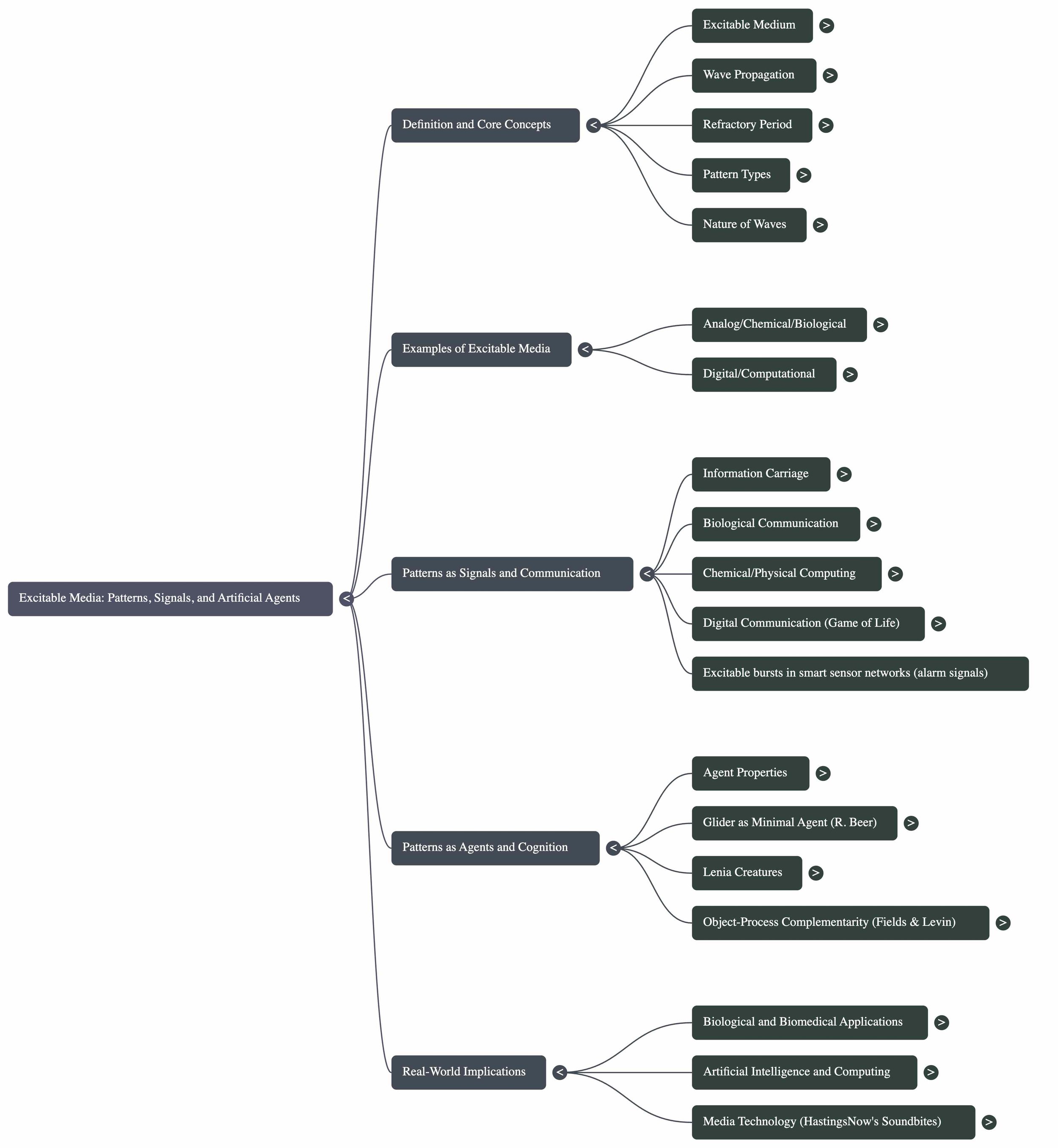
AI mind map by Local Pigeon.
From chemical soups to cellular automata to community media, we’ve seen that patterns in excitable media are much more than ephemeral curiosities. They are signals, computational substrate, even organisms in their own domains. This convergence of ideas suggests a visionary future where we intentionally create and use such patterns as a form of biological and digital language. Imagine programming a swarm of microscopic robots not by individually controlling them, but by injecting an excitable wave that they all respond to collectively – like organizing the swarm via a propagating pattern. Or consider materials that compute: a piece of “smart gel” might process inputs (chemicals, light) by forming spatiotemporal reaction patterns that solve a problem (say, finding the shortest path through the gel, as a chemical analog of pathfinding algorithms). In communications, perhaps wireless networks could adopt excitable principles so that signals route themselves dynamically: a base station’s ping could spread just enough through peer-to-peer relays to find an optimal path, then vanish (self-routing packets acting like gliders in a network).
Fundamentally, studying excitable media teaches us about resilience and adaptability. These patterns arise under constant energy dissipation – they need a flow (like a battery or metabolism) to persist, yet they manage to create order from it. In technology, this could inspire more robust systems that gracefully handle overloads (by design, waves collide and cancel rather than blow up) and self-stabilize after perturbations. It’s a very organic mode of operation. No doubt, there are challenges: harnessing analog patterns for deterministic tasks is tricky (they can be sensitive to noise or initial conditions). But even if the end goal isn’t to build a chemical computer, the lessons from excitable media can influence design thinking.
At a philosophical level, excitable pattern research is shifting our understanding of what constitutes an “agent” or a “message.” We find agency in a glider or Lenia blob, and information in a swirl of chemicals. It prompts us to broaden our view of cognition and communication: maybe mind and message are not confined to neurons and letters, but can live in any medium rich enough to propagate patterns. As Fields and Levin argue, the self might be seen as a kind of “cognitive light cone,” a set of processes bounded in space-time – perhaps not unlike a persistent spiral wave that maintains its identity while continually transforming. This is a beautifully recursive idea: we ourselves might be patterns in an excitable biological medium (our bodies and brains), communicating within and between, trying to understand patterns in other media. In doing so, we’re essentially patterns communicating about patterns – a poetic thought to end on.
In summary, excitable media offer a powerful metaphor and toolset for 21st-century science and technology. Whether it’s improving heart rhythm therapies, creating artificial life in silico, designing novel computers, or building better information networks for communities, the principles of threshold activation, self-propagating signals, and emergent organization hold great promise. By treating patterns not as static outputs but as active participants – even agents – in a system, we unlock new modes of communication and control. The boundary between hardware and software, between medium and message, starts to dissolve. In its place, we get living patterns: dancing shapes that compute, communicate, and adapt. And perhaps one day, when we address our technologies or even our social networks, we won’t just be pressing buttons or sending blind broadcasts – we’ll be cultivating and conversing with the dynamic patterns that inhabit them. The language of excitable media might become the language of life and mind itself, spoken across chemistry, silicon, and society.
References: The insights and examples in this article draw on a range of interdisciplinary research, including Beer’s analysis of the Game of Life glider’s cognitive domain, Chan’s work on Lenia and continuous cellular automata lifeforms, Fields & Levin’s theoretical framework on object-process complementarity, and numerous studies of excitable media in chemical, biological, and computational contexts. These sources collectively illustrate the evolving understanding of patterns not merely as outputs of systems but as fundamental actors within them. By studying and citing such works, we acknowledge the growing convergence of ideas across artificial life, complexity science, and media technology that inform this exciting domain.
-
A system that stays at rest until a local trigger crosses a threshold, then launches a self‑propagating wave followed by a short “refractory” recovery period.
Examples: Belousov–Zhabotinsky chemical waves, cardiac and neural tissue, forest‑fire models, and cellular automata like Life/Lenia. -
Reaction–diffusion dynamics with autocatalysis and inhibition create circular wave fronts; a broken symmetry or obstacle “pins” a rotating core, producing spirals.
-
No. Excitable waves travel and collide/annihilate; Turing patterns are stationary spatial motifs (e.g., stripes/spots) created by diffusion‑driven instabilities.
-
Yes. Waves act as signals; their timing, paths, and interactions encode and transform information—like gliders in the Game of Life or pulses in heart/brain tissue.
-
Lenia is a continuous cellular automaton by Bert Chan that produces hundreds of stable, lifelike “digital creatures” showing symmetry, locomotion, and adaptation.
-
Life is binary with sharp rules; Lenia uses continuous states, smooth kernels, and richer neighborhoods—yielding more resilient, organism‑like morphologies.
-
A glider has a set of perturbations it can survive while maintaining identity; within that domain, it can interact and even “communicate” through structured collisions.
-
Patterns (objects) are inseparable from the ongoing dynamics that sustain them (processes). Seeing both views clarifies how patterns can function as agents.
-
Heart rhythms (spiral waves/fibrillation), neural oscillations and traveling waves, calcium waves in cells, slime‑mold aggregation, and retinal development waves.
-
Through chemical/optical logic, collision‑based computing, and reservoir computing where complex transient patterns serve as a computational substrate.
-
Run an open‑source Lenia implementation; vary kernel size, growth function, and time step; seed with symmetric blobs; record species behavior and robustness.
Tip: Start with known parameter sets (e.g., “Orbium”) to learn the landscape.
-
Yes—simulate the Oregonator (BZ model) or Gray–Scott equations. Adjust feed/kill or rate constants to produce target rings, spirals, or spots.
-
If a pattern self‑maintains, has a boundary, and responds to inputs in reliable ways, it can be treated as an agent in its native medium.
-
Wave speed, wavelength, refractory time, collision outcomes, routing reliability, signal‑to‑noise, and mutual information between input and observed pattern.
-
Soundbites are short, verified, geo‑targeted audio signals—like intentional “excitations” that spread value through a community and then dissipate to reduce noise.
-
Use simulations or classroom kits. Laboratory BZ chemicals require proper handling, ventilation, and disposal. This article is informational—not medical or lab safety advice.
-
Toward bioelectric control in regeneration, neuromorphic/photonic reservoirs, programmable chemical/soft‑matter computers, and pattern‑aware media systems.
-
In excitable media, patterns are not just outputs—they are signals and agents that can communicate, compute, and organize matter and meaning.