
Leave the Water Walking to Jesus
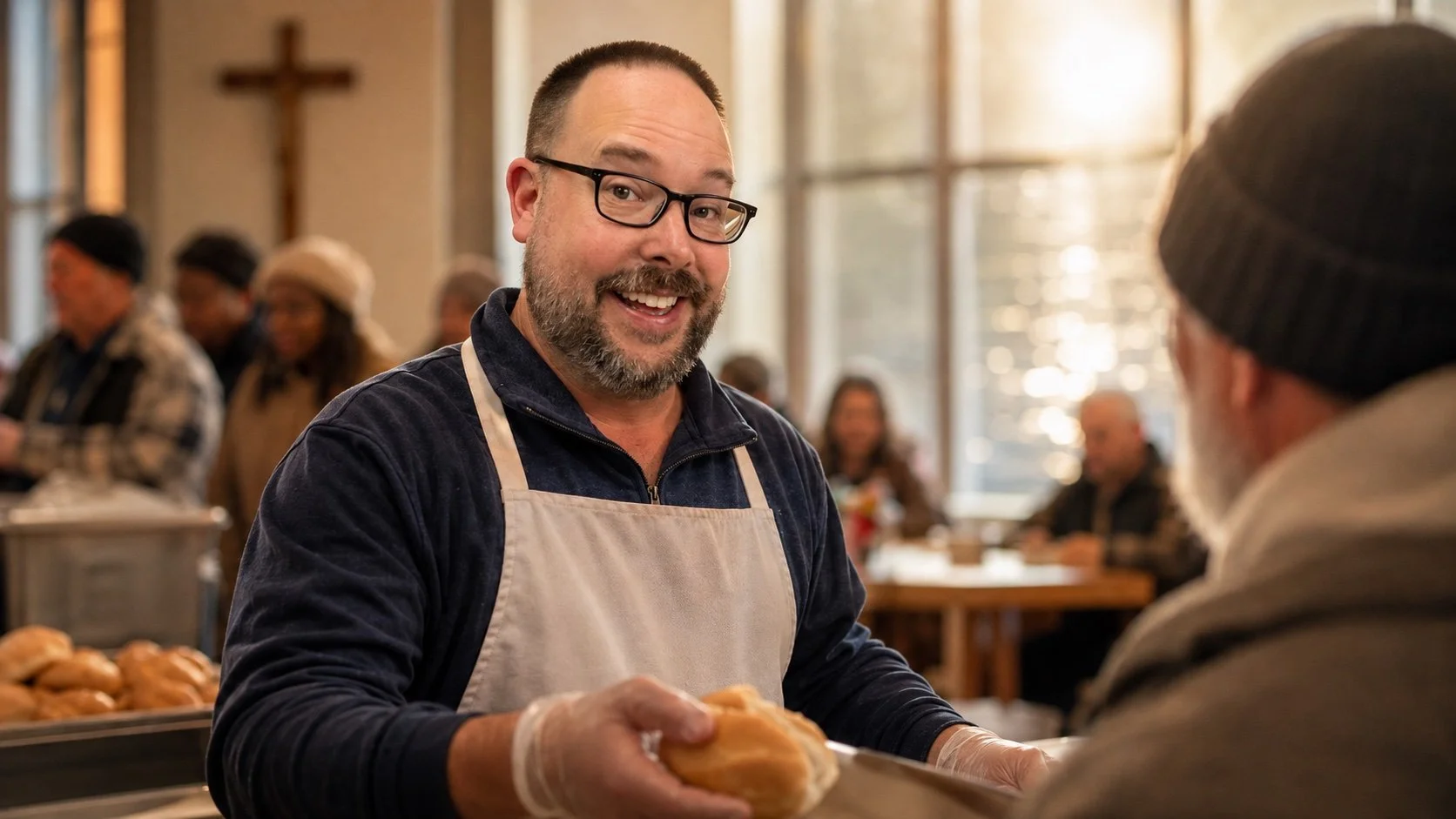
AI image by HastingsNow.com
What Matthew 14 teaches us about faith, fear and finding Christ in the storms of life — and how Cottage Grove United Church of Christ is putting that faith into action in Cottage Grove, Minnesota.
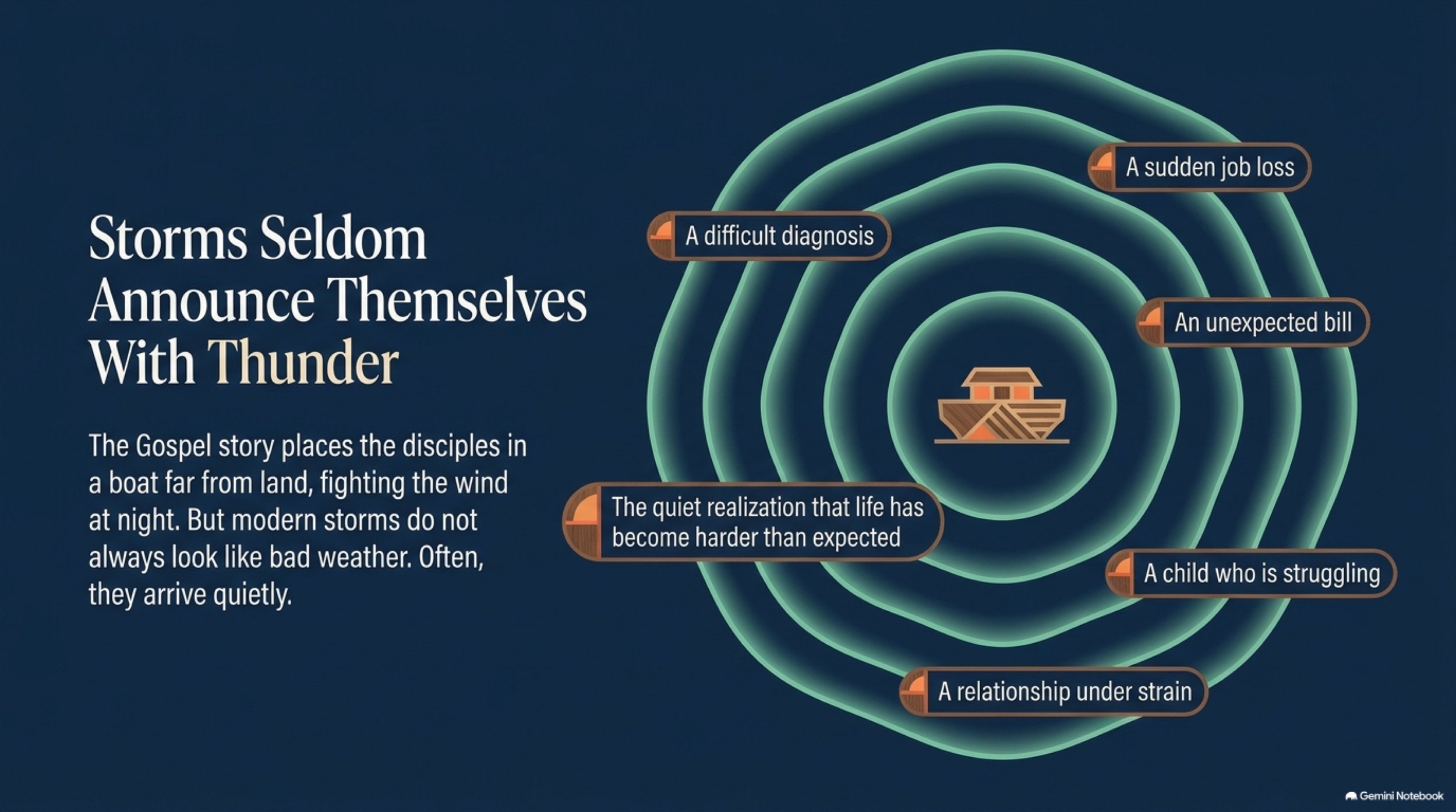
Some storms announce themselves with thunder.
Others arrive as a diagnosis, a difficult phone call, a lost job, an unexpected bill, a child who is struggling, a relationship under strain or the quiet realization that life has become harder than we expected.
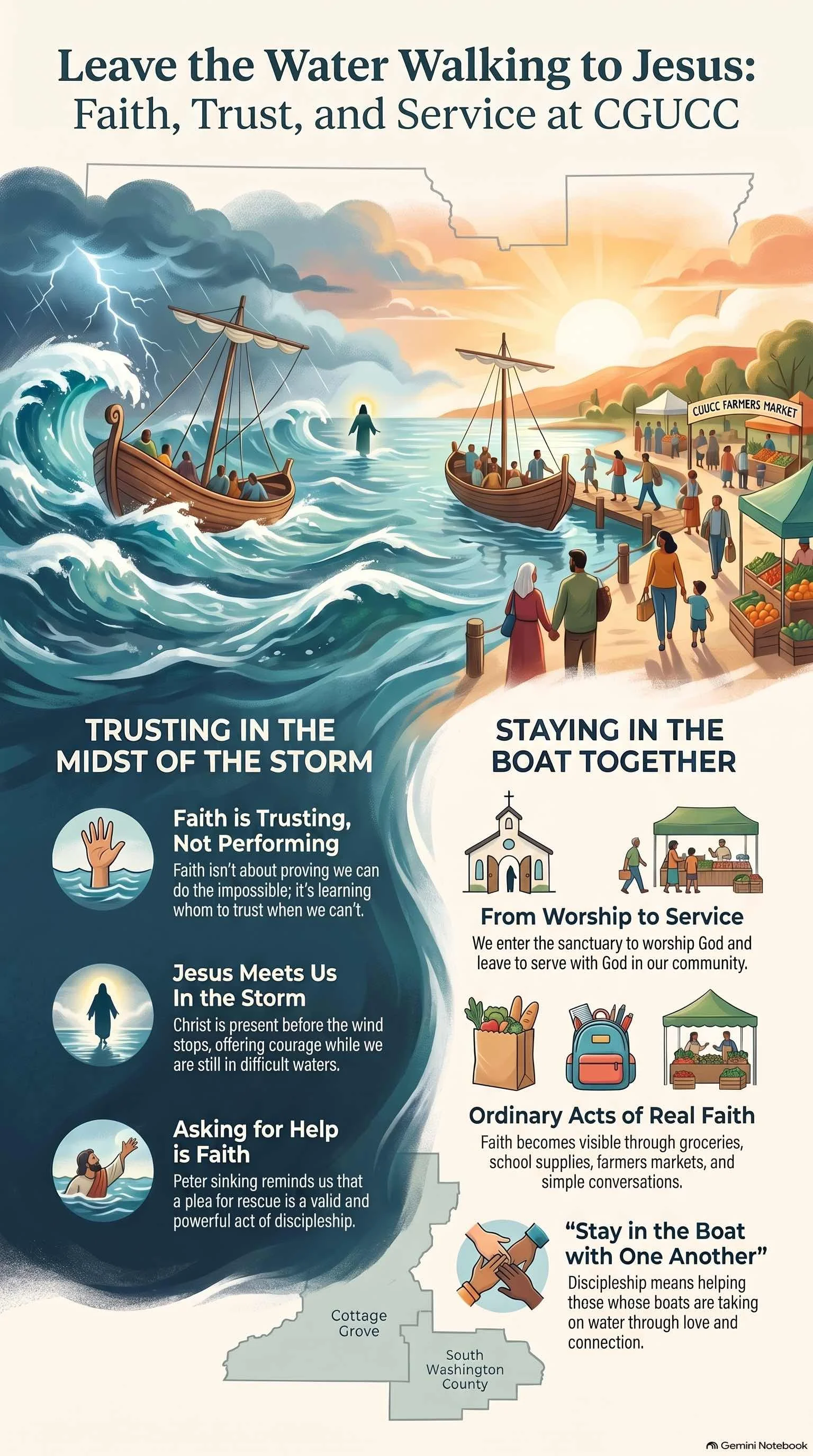
The Gospel reading at Cottage Grove United Church of Christ on August 9, 2026, placed Jesus’ disciples in a storm of their own. Matthew 14:22–33 describes a boat far from land, battered by waves and fighting against the wind. Jesus comes toward the disciples across the water, and they are terrified until he tells them to take heart and not be afraid. Peter then attempts to come to Jesus on the water, becomes frightened by the wind, begins to sink and cries out for rescue. Jesus reaches for him, and eventually Jesus and Peter enter the boat together.
Pastor Bryan Olson called his message that morning “Leave the Water Walking to Jesus.”
It is a memorable title because it turns one of Christianity’s best-known miracle stories slightly sideways.
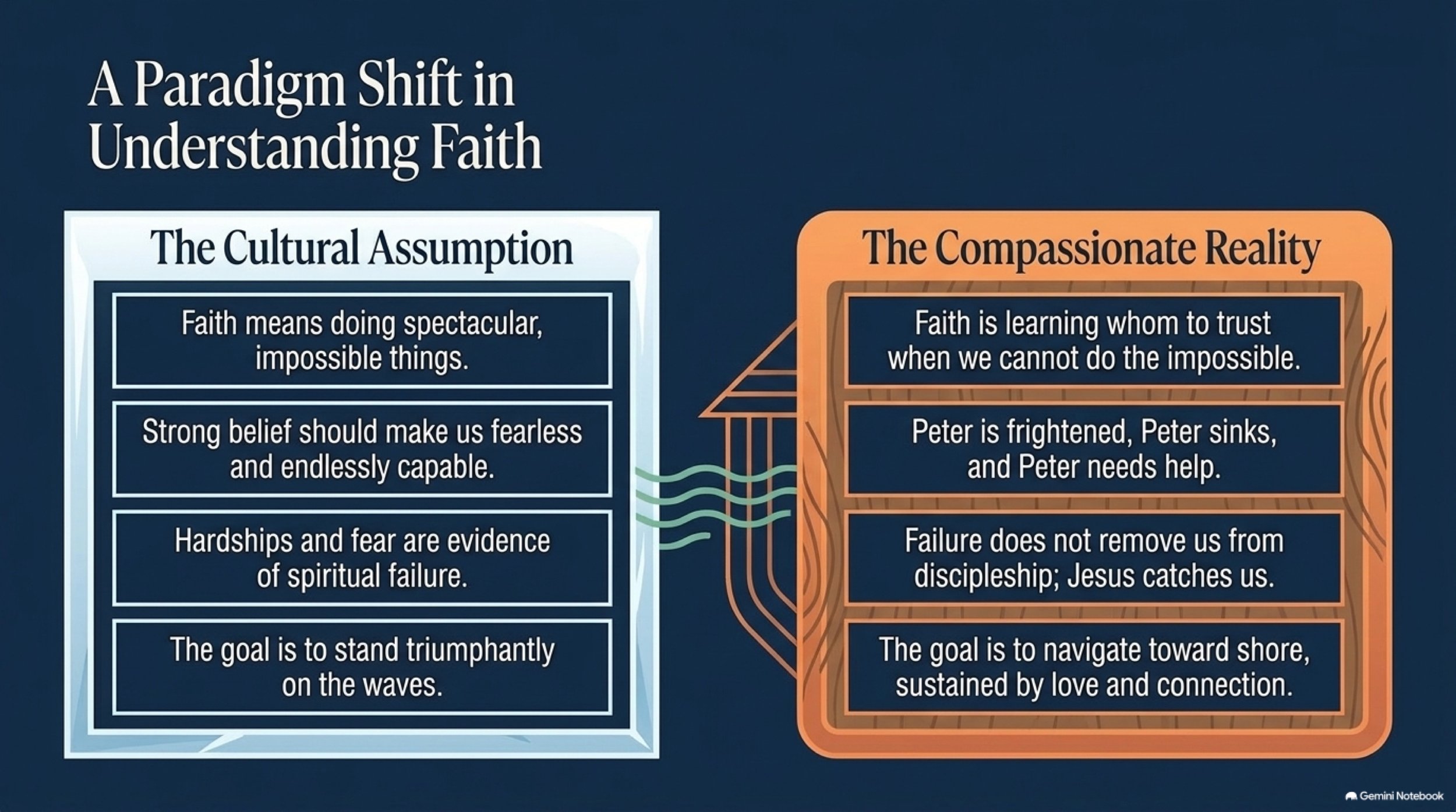
Perhaps faith is not primarily about proving that we can do spectacular things.
Perhaps it is about learning whom to trust when we cannot.
When faith feels like trying to do the impossible
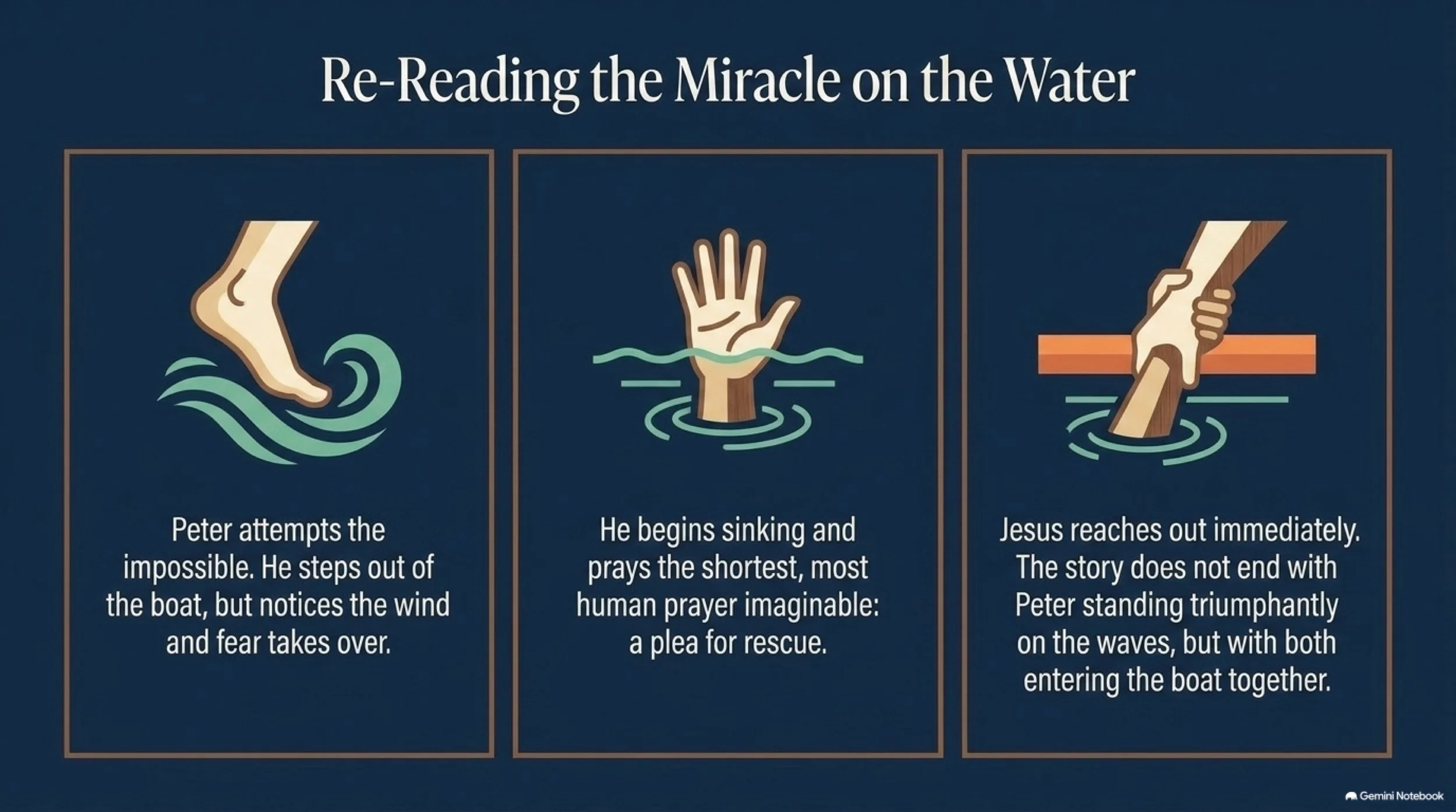
Peter is often remembered as the disciple bold enough to step outside the boat. There is something admirable in that courage. Yet Matthew’s story does not end with Peter standing triumphantly on the waves. Peter notices the wind. Fear takes over. He begins sinking. Then comes one of the shortest and most human prayers imaginable: a plea for Jesus to save him. Jesus reaches out immediately.
CGUCC’s August 9 worship bulletin provides an important clue to Bryan’s interpretation. Under “My Next Steps,” the congregation was encouraged to remember that in life’s difficult and dangerous waters, people do not need to demonstrate their faith by trying to accomplish the impossible. Instead, they can trust that Jesus is present with them, helping them navigate toward shore.
That is a liberating understanding of faith.
Many of us quietly assume that strong faith should make us fearless, endlessly capable or somehow immune to weakness. When hardship comes, we may even interpret our fear as spiritual failure.
Matthew offers a more compassionate picture.
Peter is frightened.
Peter sinks.
Peter needs help.
And Jesus reaches for him.
A United Church of Christ reflection on this same passage observes that Peter’s failure does not remove him from discipleship; Jesus catches him. Another UCC worship resource built around Matthew 14 emphasizes that people do not have to walk on water but are called to walk faithfully through ordinary life, sustained by love, compassion, faith and connection.
That may be especially good news for anyone whose life currently feels more like survival than triumph.
Jesus meets people in the storm, not only after it
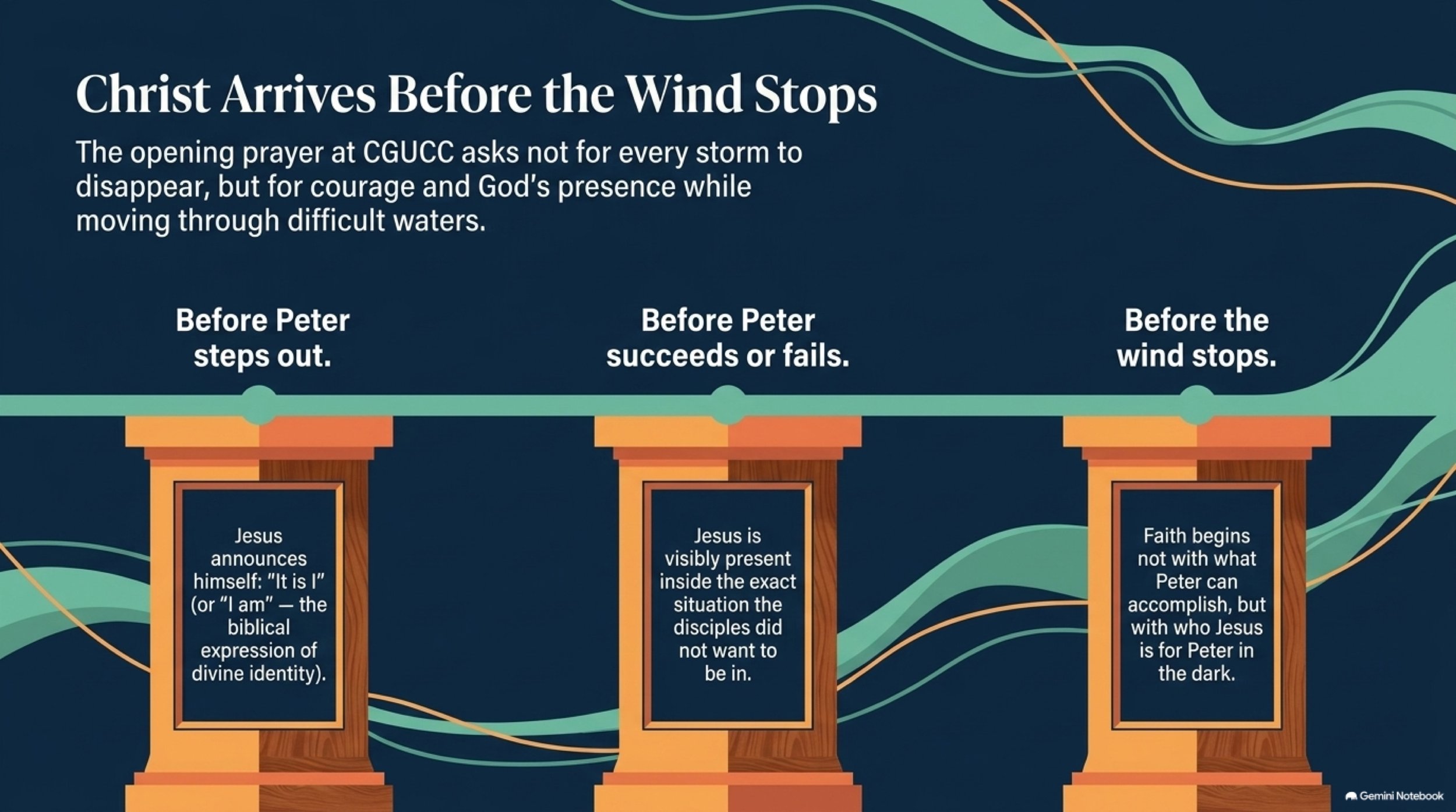
The opening prayer at CGUCC on August 9 captured another important distinction. The congregation prayed not simply for every storm to disappear, but for courage and for God’s presence while moving through difficult waters.
That matters.
Christian faith is sometimes reduced to the expectation that belief should make circumstances easier. Yet Matthew places the disciples precisely where they do not want to be: at night, away from shore, opposed by wind and battered by waves. Jesus' presence becomes visible inside that situation.
The passage therefore asks a different question from, “How do I avoid every storm?”
It asks, “Whom can I trust when the storm is already here?”
Scholarship on Matthew notes that Jesus’ words to the frightened disciples carry theological weight. The Greek expression behind “it is I” can also be rendered “I am,” language that commentators connect with biblical expressions of divine identity. The miracle is therefore about more than unusual movement across water. It reveals something about the identity and presence of Christ.
Before Peter ever steps from the boat, Jesus announces himself.
Before Peter succeeds or fails, Jesus is there.
Before the wind stops, Jesus is present.
That order may be the heart of the story.
Faith begins not with what Peter can accomplish for Jesus, but with who Jesus is for Peter.
What do the storms of Cottage Grove look like?
A biblical story becomes especially powerful when it leaves the page and meets the lives of real people.
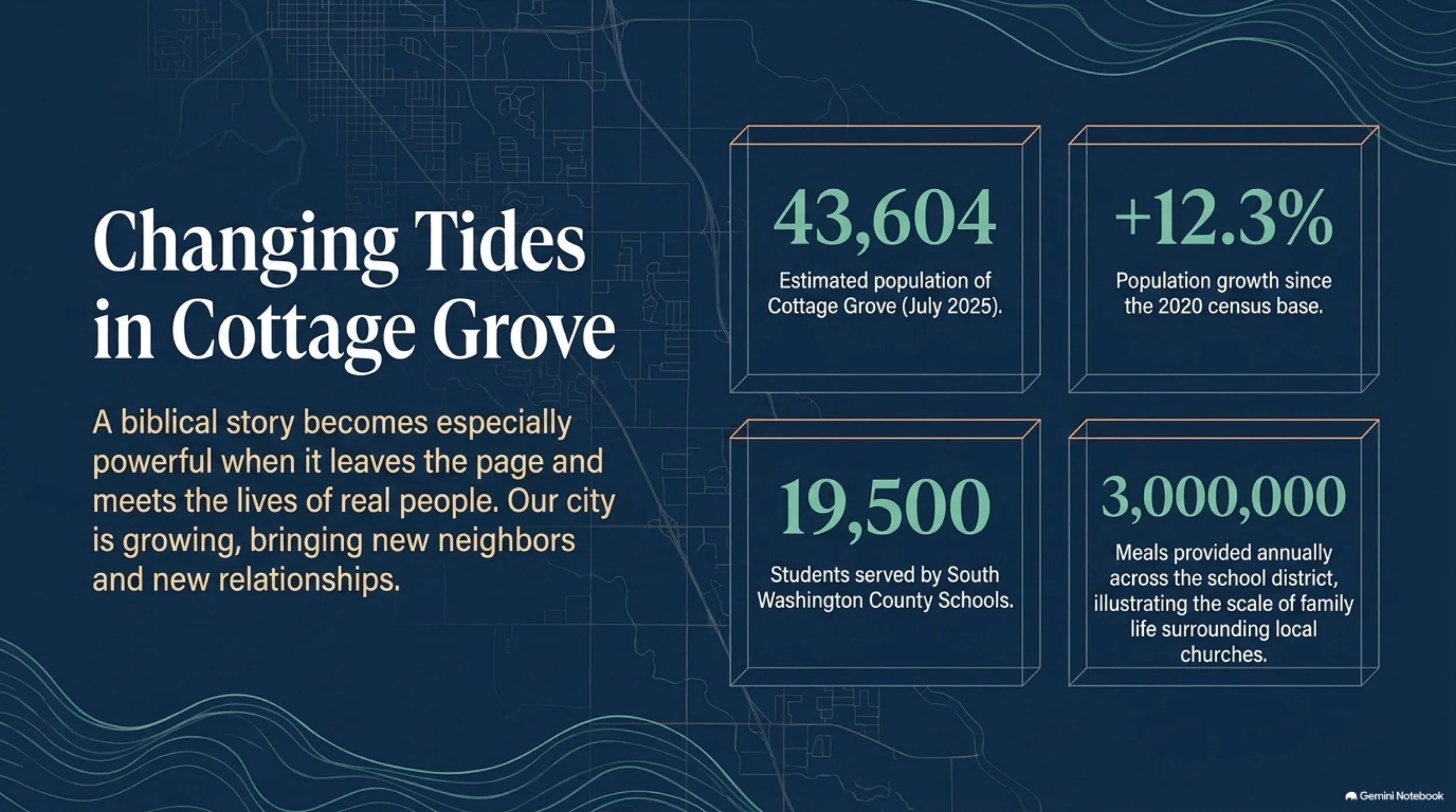
Cottage Grove is changing rapidly. The U.S. Census Bureau estimated the city’s population at 43,604 in July 2025, representing 12.3% growth from its 2020 population base. South Washington County Schools serves more than 19,500 students and provides nearly three million meals annually across the district, illustrating the scale of family life surrounding local churches and community organizations.
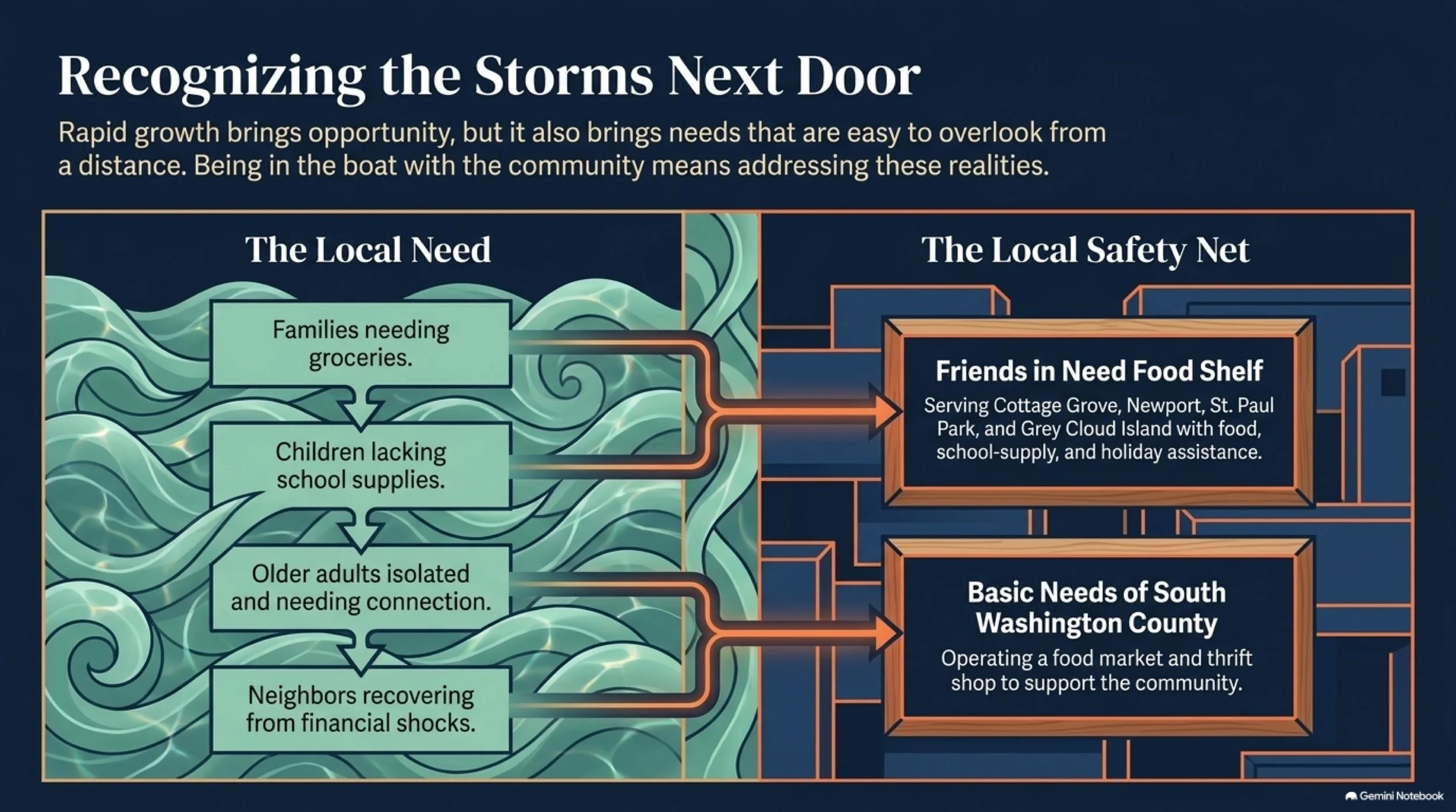
Growth brings opportunity, new neighbors and new relationships. It can also bring needs that are easy to overlook from a distance.
Some families need groceries.
Some children need school supplies.
Some older adults need connection.
Some people need help after a financial shock.
Some newcomers simply need a place where someone learns their name.
Those are not abstract issues in south Washington County. Friends in Need Food Shelf serves residents of Cottage Grove, Newport, St. Paul Park and Grey Cloud Island and provides food as well as school-supply, holiday and limited emergency assistance. Basic Needs of South Washington County operates a food market and thrift shop in Cottage Grove as another part of the local safety net.
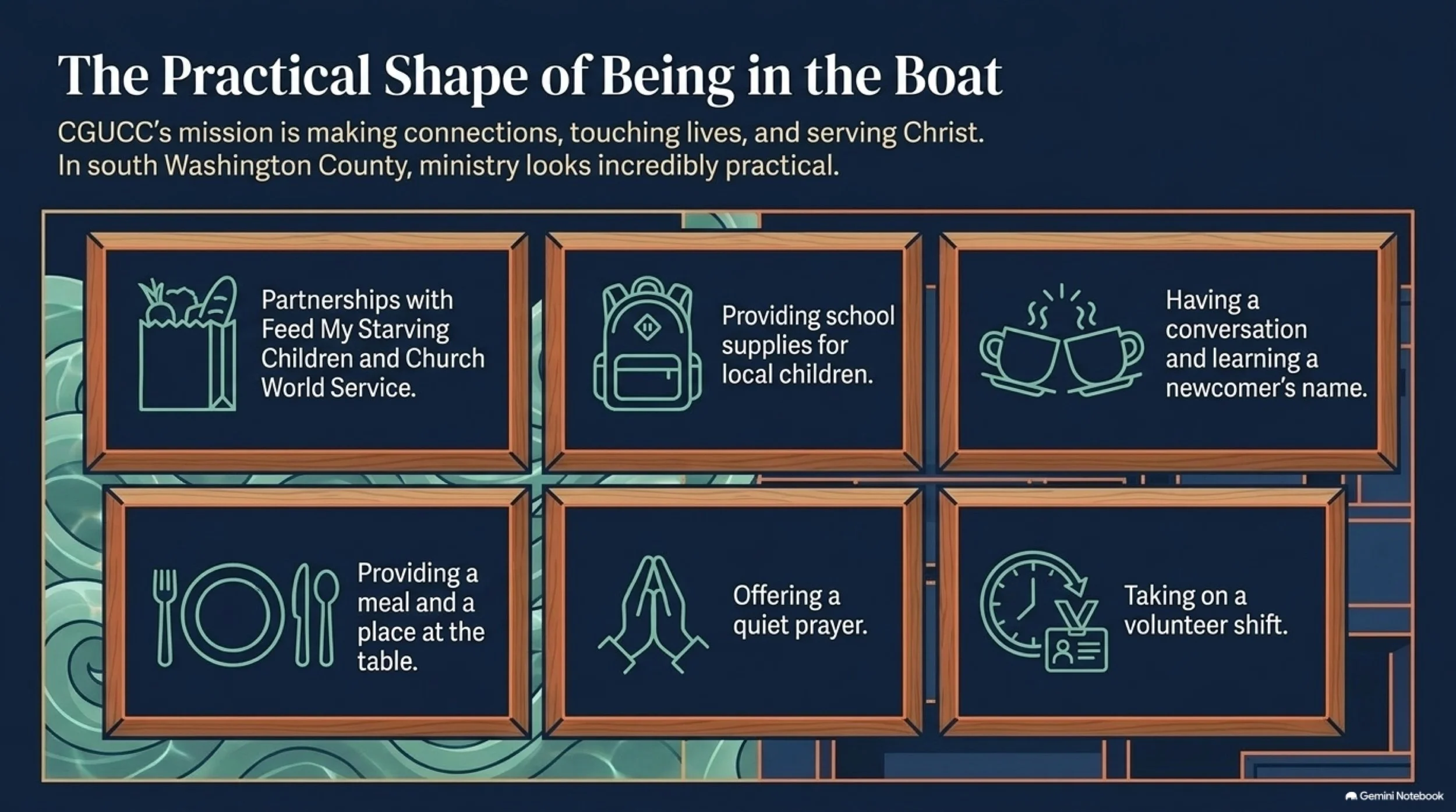
For a church, then, “being in the boat” with the community can become very practical.
It can look like groceries.
A backpack.
A conversation.
A meal.
A prayer.
A volunteer shift.
A place at the table.

From Sunday worship to Monday service
Cottage Grove UCC summarizes its mission as making connections, touching lives and serving Christ, and the congregation has built substantial portions of its ministry around service. Bryan’s church biography specifically describes the congregation’s commitment to feeding people physically and spiritually and identifies partnerships and ministries including Friends in Need, Feed My Starving Children, Church World Service and others.
The remarkable thing about the August 9 service is that the bulletin did not allow the sermon to remain an idea.
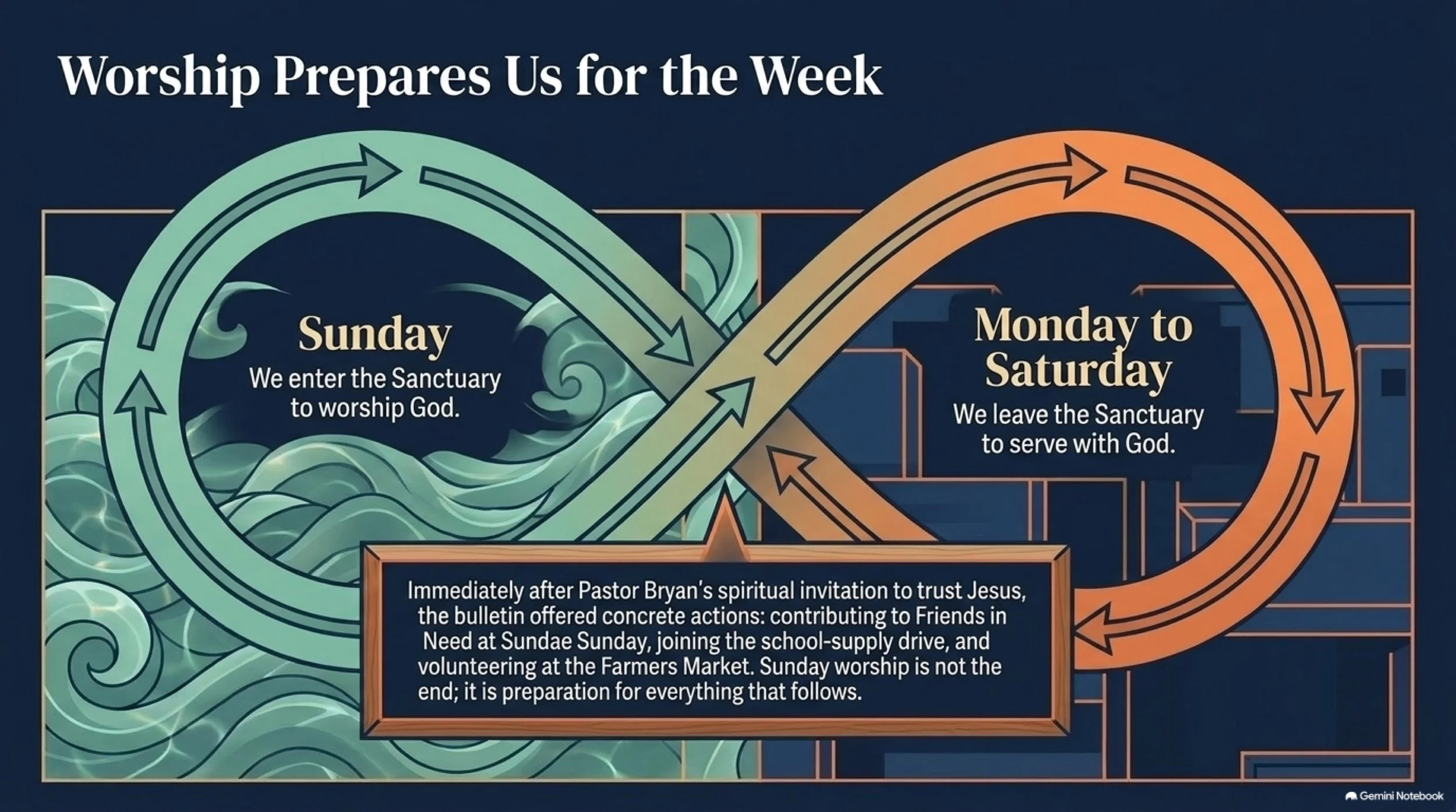
Immediately after its spiritual invitation to trust Jesus in troubled waters came several concrete invitations.
Congregants could enjoy the summer’s final Sundae Sunday and contribute to Friends in Need.
They could participate in the church’s school-supply drive for local children.
They could volunteer at the Farmers Market.
They could give.
That movement—from worship into service—is written directly into CGUCC’s liturgical identity. Its worship bulletins state: “We enter the Sanctuary to worship God. We leave the Sanctuary to serve with God.”
That sentence may explain Cottage Grove UCC better than a long institutional description could.
Sunday worship is not supposed to be the end of the Christian week.
It is preparation for everything that follows.
A farmers market can also be ministry
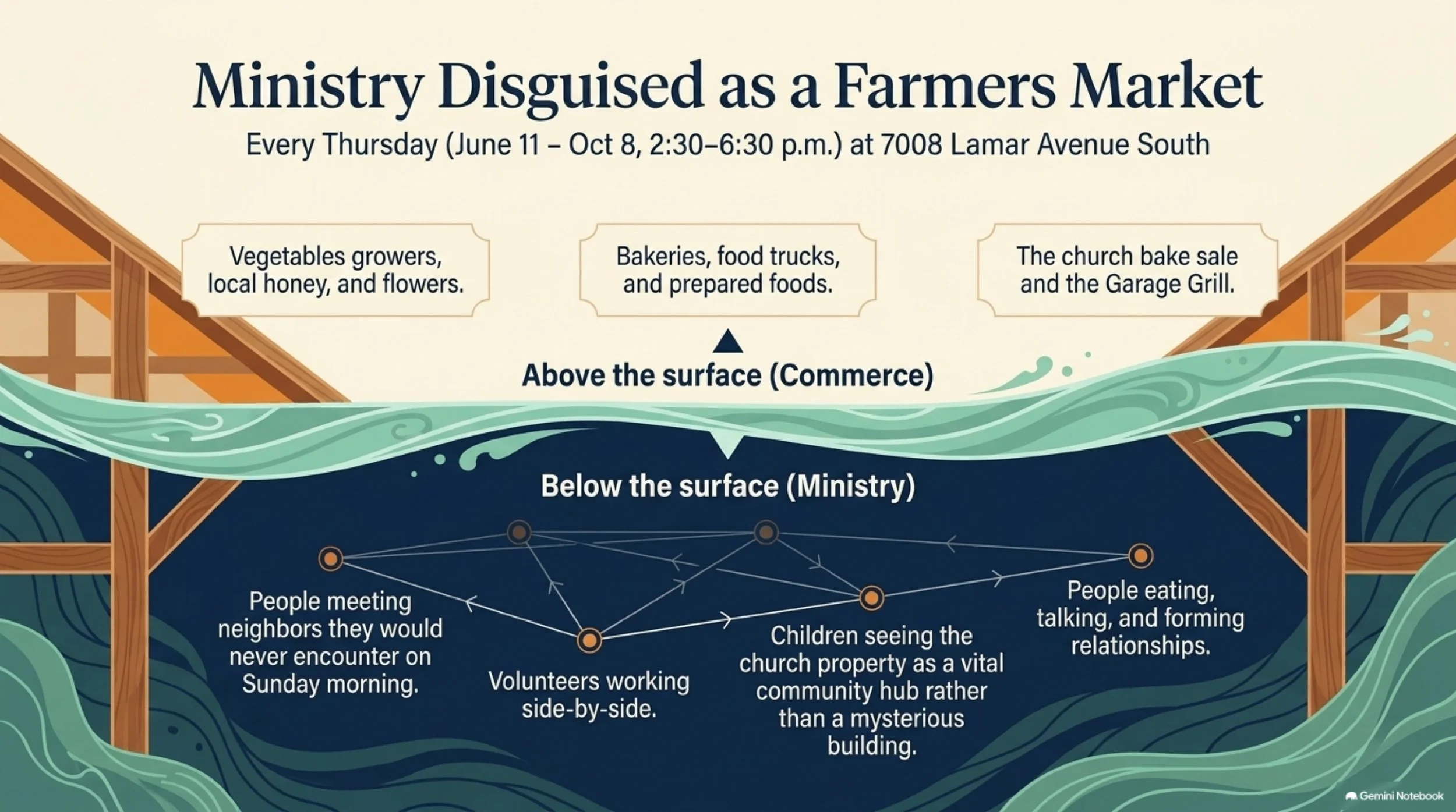
Consider what happens every Thursday during the summer and early fall at 7008 Lamar Avenue South.
CGUCC’s 2026 Farmers Market runs Thursdays from June 11 through October 8, from 2:30 to 6:30 p.m. The church lists vegetable growers, bakeries, makers, food trucks, local honey, flowers, coffee, prepared foods, the church bake sale and its Garage Grill among the market’s many offerings.
On the surface, that is commerce and community gathering.
Seen through the lens of ministry, it can also be something deeper.
People meet neighbors they might never encounter on Sunday morning.
Farmers and small businesses meet customers.
Volunteers work beside one another.
Children see a church property not as a mysterious building but as part of community life.
People eat.
People talk.
Relationships form.
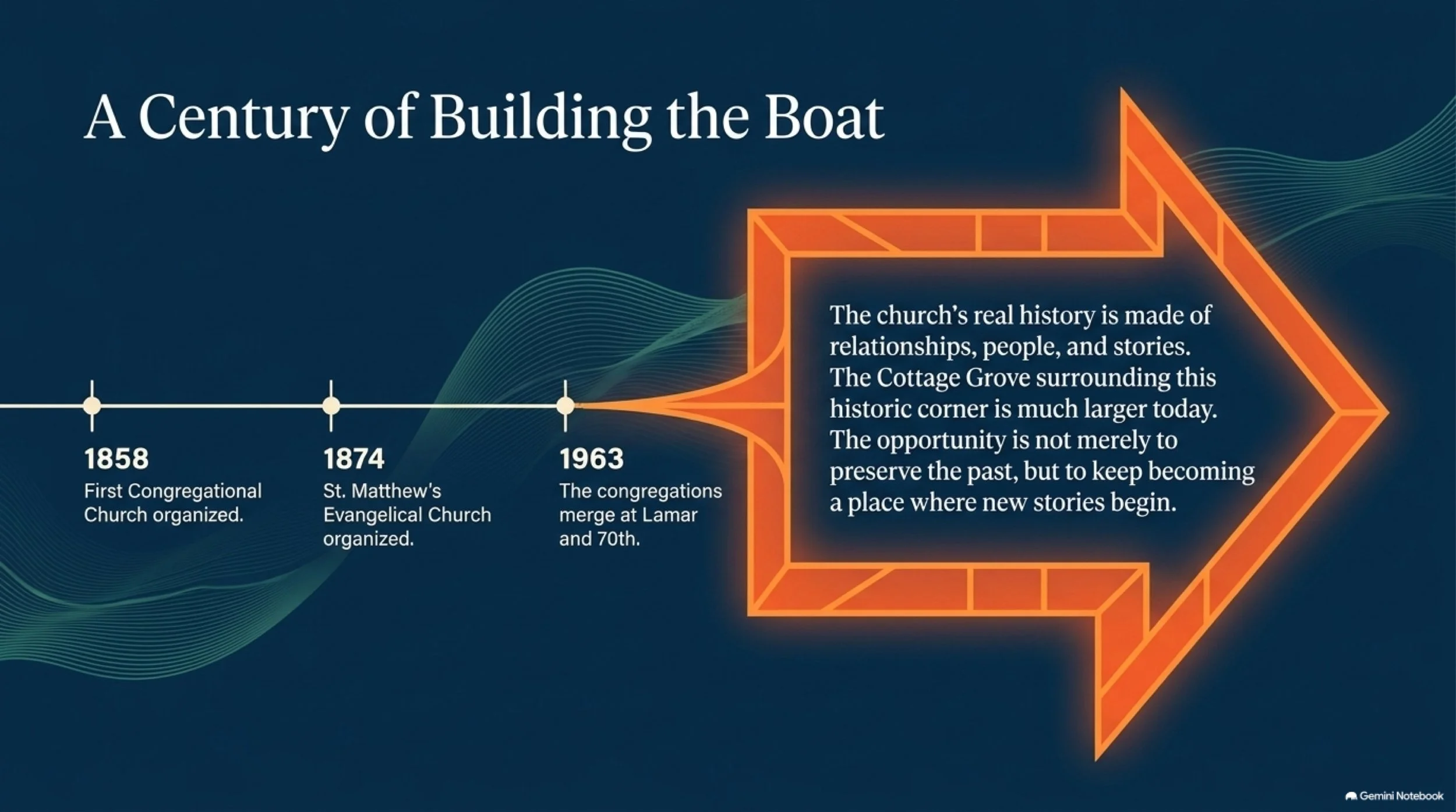
This has special significance for a congregation whose history at Lamar and 70th stretches back to the nineteenth century. CGUCC traces its roots to the First Congregational Church organized in 1858 and St. Matthew’s Evangelical Church organized in 1874. Those congregations merged in 1963. The church itself says its real history is made of relationships, people and stories.
The Cottage Grove surrounding that historic corner is much larger today.
The opportunity is not merely to preserve the past.
It is to keep becoming a place where new stories begin.
Faith does not have to look spectacular to be real
Perhaps that brings us back to Peter.
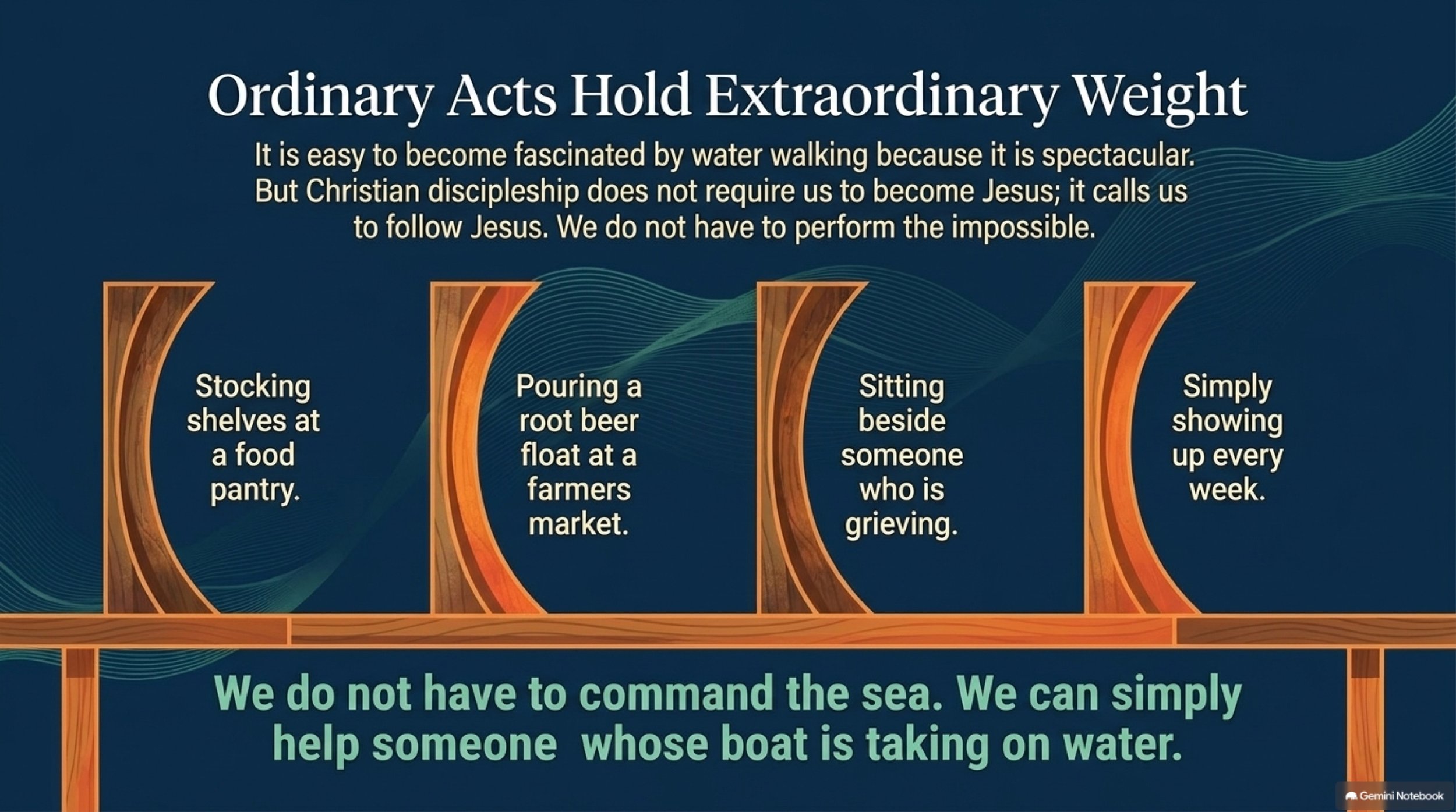
It is easy to become fascinated by the water walking because it is spectacular.
Most Christian service is not.
Nobody makes headlines for stocking shelves at a food pantry.
There is nothing supernatural-looking about packing school supplies.
A root beer float at a farmers market does not appear miraculous.
Neither does sitting beside someone who is grieving, bringing food to a neighbor, teaching a child, making a phone call, praying quietly or simply showing up every week.
Yet these ordinary acts may be precisely where faith becomes visible.
CGUCC’s stated beliefs emphasize that every person is valuable, that people are at different places on their spiritual journeys and that a life of faith produces love, purpose and connection.
Christian discipleship does not require us to become Jesus.
It calls us to follow Jesus.
That is a crucial difference.
We do not have to command the sea.
We can help someone whose boat is taking on water.
We do not have to perform the impossible.
We can offer what is possible: food, attention, generosity, community, prayer, patience and love.
And when our own strength fails, Peter reminds us that asking for help is not the opposite of faith.
Sometimes asking for help is faith.

You are welcome in the boat
Cottage Grove United Church of Christ tells newcomers that they can expect to be known and supported in their faith journey. The church invites people to worship, participate in small groups, explore children’s ministry, attend online or in person, and become involved in the community surrounding the congregation.
That invitation does not require someone to arrive with every question answered.
The disciples certainly did not.
Peter did not.
The story in Matthew is populated by people who misunderstand, fear, doubt, attempt, fail, cry for help, receive grace and continue following.
Maybe that is why it remains such a powerful story.
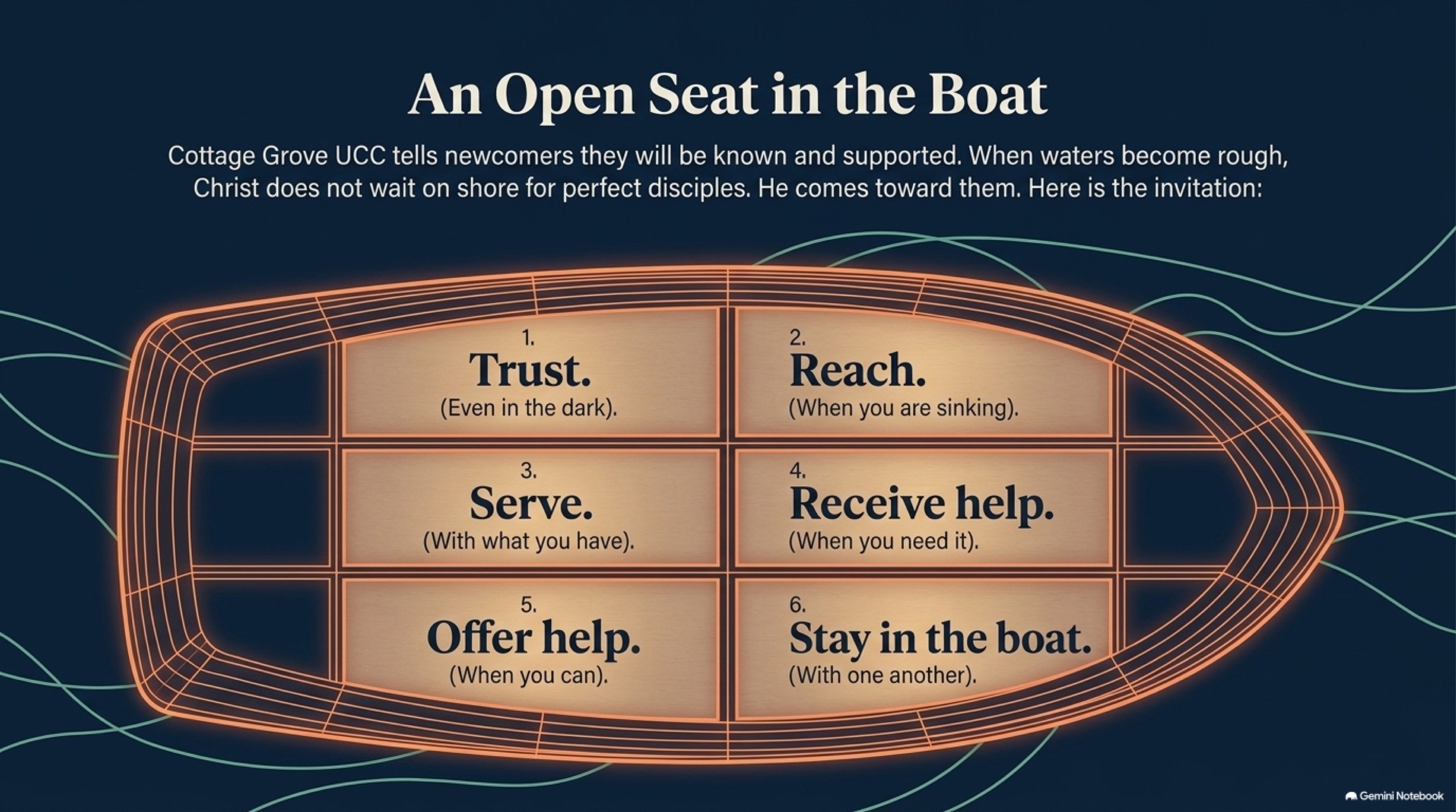
When the waters become rough, Christ does not wait on shore for perfect disciples to arrive.
He comes toward them.
And perhaps the invitation for us is simpler than we sometimes make it:
Trust.
Reach.
Serve.
Receive help when you need it.
Offer help when you can.
Stay in the boat with one another.
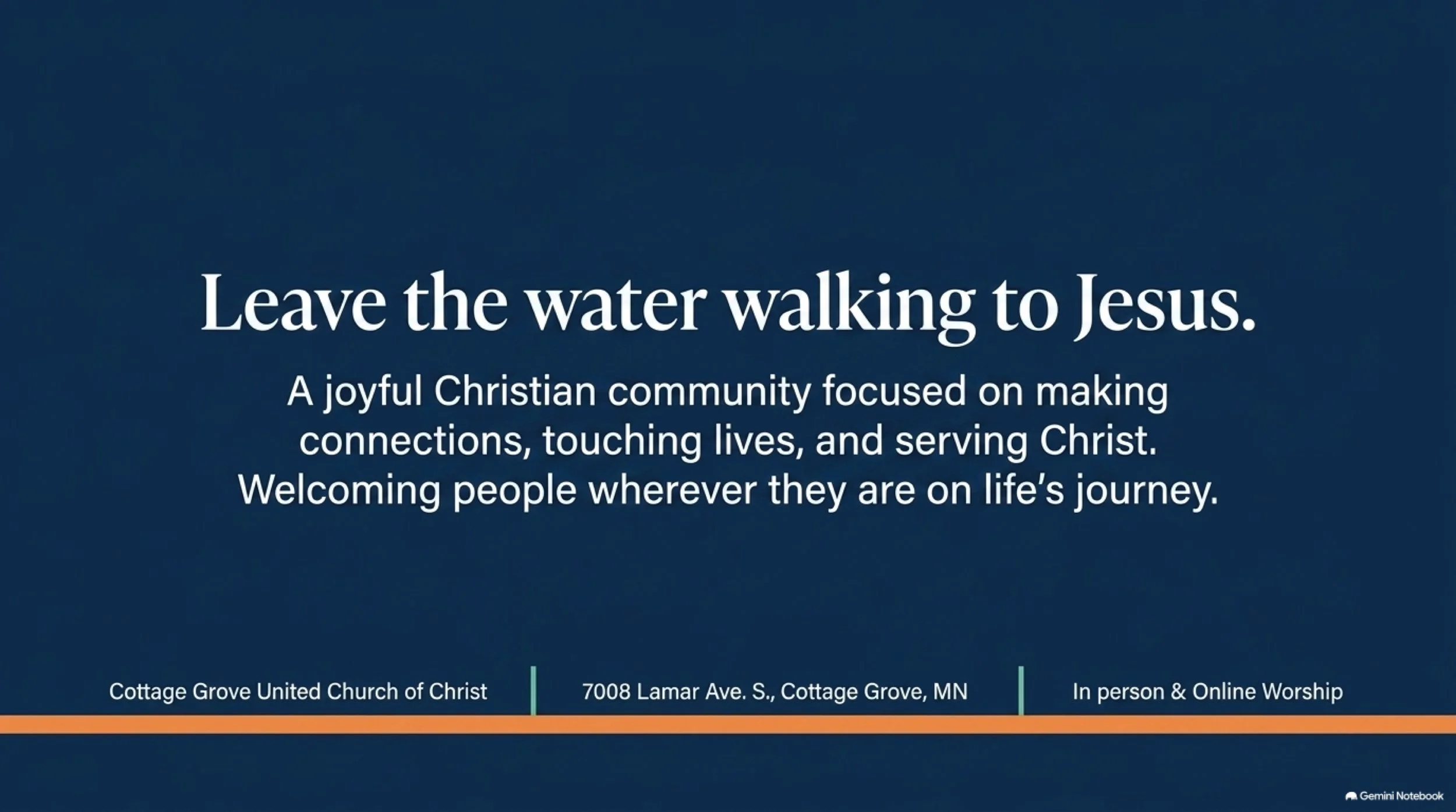
And leave the water walking to Jesus.
About Cottage Grove United Church of Christ: Cottage Grove UCC is located at 7008 Lamar Ave. S. in Cottage Grove, Minnesota. The congregation describes itself as a joyful Christian community focused on making connections, touching lives and serving Christ, and welcomes people wherever they are on life’s journey.