
Honoring Elders: Native American Traditions vs. Modern America’s Treatment of Seniors
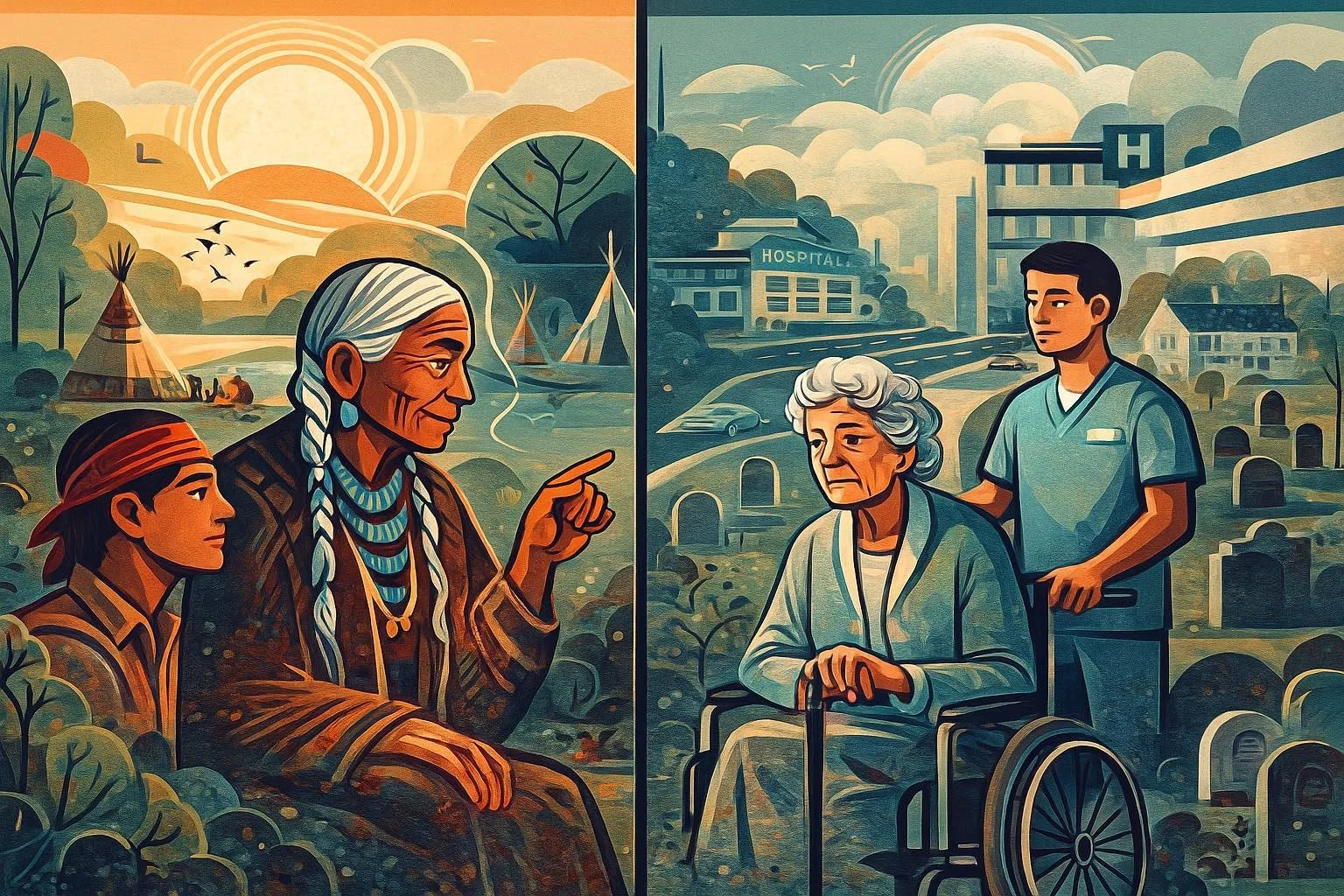
Image by Local Pigeon
Introduction: Two Worlds of Elder Care
Modern American society often treats aging as a problem to manage – sometimes profitably. Elders here frequently end up isolated in nursing homes, navigating a maze of hospitals, insurance forms, and bills, all while contending with a culture that idolizes youth. It’s a cynical cycle: senior homes, greedy hospitals, cutthroat insurers, pricey funeral parlors, accountants eyeing estates, sanctimonious advice from some groups, and often dispassionate family members. Contrast this with many Native American traditions, where elders have long been regarded with deep respect and dignity, seen as beloved knowledge-keepers and integral members of the community. The difference is stark and instructive.
By 2030, over 1 in 5 Minnesotans will be 65 or older – including many here in Hastings, Minnesota. How we treat our seniors is more important than ever. Could looking to the sacred traditions of Native American cultures help us do better? Let’s explore how peoples like the Lakota, Navajo (Diné), Cherokee, Haudenosaunee (Iroquois), and Inuit honor their elders, and then take a hard look at how modern America stacks up. The comparison is eye-opening – and it may hold valuable lessons for Hastings and beyond.
Sacred Roles of Elders in Native American Cultures
In Indigenous North American cultures, elders traditionally occupy a place of high honor. They are often seen as “living libraries” – repositories of cultural, historical, and spiritual wisdom for their people . Not simply “old people,” true elders are those who have earned respect by preserving knowledge and living by example. They serve as the memory-keepers, teachers, and guides of the community . Unlike in mainstream Western culture, where old age is frequently stigmatized, in Native cultures age is often equated with wisdom and virtue. As the International Association for Indigenous Aging puts it: “respect for elders remains one of the most common – and critical – values” across tribes . Elders are seen as possessors of knowledge, history, and spirituality, a valuable resource and legacy to be honored . They have served as everything from tribal leaders and veterans to “living examples of courage, perseverance, and modesty” .
Crucially, elders in these cultures are not shunted aside; they remain at the heart of family and community life. Often there is an expectation that younger generations care for and learn from their elders, creating a reciprocal relationship of nurture and respect. In fact, many Indigenous languages and customs encode this respect. For example, in some communities it is customary to address any older person as “Grandmother,” “Grandfather,” “Uncle,” or “Auntie” as a sign of affection and esteem – reinforcing a sense of extended family beyond blood ties. It’s common at gatherings for the community to ensure elders are comfortable and fed first. As one Ojibwe guideline succinctly says: “Elders first!” – children and young adults should serve the elders, who always eat first at meals . Never should a younger person cut in front of an elder in line; such behavior is considered very rude . This everyday etiquette reflects a deeply ingrained reverence.
While each Native nation has its own distinct traditions, there are broad themes in how elders are treated. Below, we highlight a few examples from different Indigenous cultures, illustrating the special roles elders play throughout the life stage of being an elder – from active leadership to wisdom-sharing to end-of-life care.
Lakota (Sioux): Grandparents as Sacred Guides
Among the Lakota people of the Great Plains, elders (often addressed as Uncí for grandmother and Lala for grandfather) are treasured pillars of the culture. A common saying in Lakota country is that grandparents “hold our families together”. They are looked to for guidance on life’s problems and for the continuity of tradition. In fact, Lakota language and spirituality intertwine respect for elders into their very words. The Lakota word for the Creator, Tȟuŋkášila, translates to “Grandfather”, underscoring the sacredness of that role . As one Lakota grandfather explained, when his grandchildren call him “Lala” (derived from Tȟuŋkášila), it humbles his spirit – they are, in effect, calling him by a title that echoes the Creator . This reflects both a great honor and a profound responsibility for elders to live up to being wise, generous and nurturing.
Lakota elders are expected to pass down the Lakȟól Wičhóȟ’aŋ (the Lakota way of life) – the language, songs, ceremonies, and virtues like bravery and compassion. Many sacrificed to preserve these traditions through years of colonization and hardship. Thanks to elders who quietly kept rituals alive (even when such ceremonies were banned in the U.S. until 1978), younger Lakota today are reconnecting with their heritage . It’s common to see Lakota elders at the center of events: leading prayers at powwows, telling ancestral stories at gatherings, or simply imparting “Lakota understandings of life” to any who will listen . They embody the phrase often heard in Lakota communities: “Mitákuye Oyás’iŋ” (we are all related) – a reminder that every generation is linked, and the elders hold the wisdom of those who came before.
Navajo (Diné): Pillars of the Family and Keepers of the Story
In the Navajo Nation, elders are often called “the pillars of the family”, especially grandmothers . From a young age, Diné children are taught to honor their elders for a simple reason – “They take care of us, and in exchange, we’re taught to look after them.” In traditional Navajo life, multiple generations commonly live together or nearby, reinforcing a tight family network. Grandparents play a central role in raising children, imparting the Navajo language (Diné Bizaad) and core values like Hózhǫ́ (walking in beauty/harmony). They are the keepers of stories, history, traditions, and culture – connecting the family to their ancestors and the earth .
A Navajo author reflecting on her upbringing noted that elders, particularly grandmothers, were the family’s foundation – the ones who carried the knowledge of how to live and passed down stories by the fireplace . She recalled how, when her own grandmother grew frail, the family rallied to care for her: driving her to doctor appointments, tending to her needs, making sure she wanted for nothing . This sense of duty is deeply ingrained; it’s a living application of the Navajo belief in K’é – the system of kinship obligations and reciprocal care.
Navajo tradition emphasizes teaching through example and storytelling. An elder might not scold a child outright; instead they’ll tell a cautionary tale or guide by gentle admonitions in Navajo, which often carry rich layers of meaning. Even today, community leaders urge young people to heed the words of elders. When COVID-19 struck, Navajo radio stations implored listeners to remember the safety of “our most vulnerable people: our elders.” That plea resonated because caring for elders isn’t just a nicety in Diné culture – it’s a sacred responsibility woven into the fabric of family life.
Cherokee: Living Libraries of Heritage
In Cherokee culture, elders hold one of the most respected roles in the community, revered as the living libraries of the Cherokee heritage . Their knowledge spans from ancient creation myths and historical survival stories to practical skills, songs, and the Cherokee language itself. Before there were books or the Cherokee syllabary, it was the elders’ spoken words that preserved the Nation’s history. Storytelling is a cherished duty of Cherokee elders. They carry and share the adajdvni (sacred stories) – recounting how the world was made, how the clans were formed, tales of heroism and resilience. As they tell these stories to the young around a campfire or at the Cherokee National Holiday, they aren’t just recalling the past; they are actively ensuring Cherokee identity remains strong for the future .
Cherokee elders are also teachers of culture and values on a day-to-day level. They guide the community in practicing traditional songs, dances, and ceremonies, often leading by example in how to “live in harmony with one another and with the natural world” . A grandparent might teach a child how to say a prayer in Cherokee or how to gather medicinal plants properly. Sitting at the feet of an elder to hear an old story or learn a verse of a Cherokee hymn is considered a moment of profound connection – one that ties the listener directly to their ancestors .
Beyond formal traditions, Cherokee elders impart life lessons. They stress values like respect, patience, and balance. In a fast-paced modern world, they remind younger folks to slow down and listen. Oftentimes, an elder’s soft-spoken advice ends up carrying the answer a young person was seeking – wisdom for everyday life honed through decades . The Cherokee even have an Elder’s Day (observed around August) to publicly honor and thank their elders for their guidance and sacrifices . On Cherokee Elder’s Day, communities come together to celebrate those “treasures” who enrich not only their families but the entire Cherokee Nation . The message is clear: each elder is a treasure – a keeper of heritage and a guiding star for the future .
Haudenosaunee (Iroquois): Clan Mothers and Councils of Wise Ones
The Haudenosaunee Confederacy (comprised of the Mohawk, Oneida, Onondaga, Cayuga, Seneca, and Tuscarora nations) offers a powerful example of elders integrated into governance and social structure. In these matrilineal societies, certain elder women hold the esteemed title of Clan Mother. A Clan Mother is often an older, wise woman in each clan who has the responsibility to select and advise the male chiefs representing her clan in the Grand Council . She even has the power to “dehorn” (depose) a chief if he fails to lead in the people’s best interest . This authority stems from the Great Law of Peace, the Haudenosaunee constitution, which balances male and female roles and entrusts senior women with preserving the integrity of leadership. These Clan Mothers, respected for their wisdom and life experience, ensure that decisions consider the welfare of the coming seven generations. In essence, the governance system inherently values the voices of elder women as a stabilizing, guiding force .
More generally, Haudenosaunee elders of all genders are highly respected within their communities as wisdom-keepers. A traditional Haudenosaunee family or village would never overlook its elders; they were the ones to impart the oral traditions and help raise the nation’s children . From an early age, kids are taught to listen intently to elders’ teachings – whether it’s advice, a story, or a lesson in making wampum belts. Elders often sit in positions of honor at ceremonies and in longhouse gatherings, sometimes speaking last (after hearing everyone else) to render judgment or summarize consensus. Their accumulated knowledge of Ohén:ton Karihwatéhkwen (Thanksgiving Address), planting cycles, treaty history, and moral lessons makes them indispensable.
Perhaps most telling is how Haudenosaunee compare their way of life with mainstream society. In a cultural curriculum, students are asked to contrast roles of elders: In Haudenosaunee communities “all members are important” and elders are the respected wisdom keepers who play a key role in community well-being . In contrast, they note that in the general U.S. society, “the role of elders is not significant.” That blunt assessment highlights how differently elderhood is valued. In Haudenosaunee thought, it would be unthinkable to cast aside the old – they are seen as essential to maintaining the Great Circle of unity and knowledge. Every member of the community, from infants to the most elderly, has a place and a purpose.
Inuit: Wisdom in a Harsh Land – Elders as Survival Experts and Custodians of Knowledge
In the Arctic communities of the Inuit (spanning Alaska, Canada, and Greenland), elders traditionally hold a place of deep respect as the custodians of wisdom needed for survival. Life in the far north has always been challenging – bitter cold, months of darkness, sparse resources. Survival hinged on knowledge passed down through generations: how to read the weather, how to navigate the ice, how to respectfully hunt seals and caribou so that the animals return. Inuit elders are the repositories of this hard-earned knowledge. They are master storytellers who share unikkaaqtuat (legends) and family histories that encode practical skills, moral values, and spiritual beliefs . Through long evenings in the iglu or communal qaggi (sod house), elders would tell stories that taught children how to behave and survive – often with a dose of humor or scariness to make the lesson stick. For example, a tale about the northern lights might also warn kids not to wander off lest malevolent spirits snatch them. A hunting story would include gratitude to the seal’s spirit, teaching both technique and respect.
These oral traditions play a vital role in preserving and transmitting Inuit cultural history . Elders, as nallunaikkummaat (those who provide instructions/guidance), share legends and teachings that encompass everything from finding the best snow for an igloo to the importance of cooperation and sharing. By doing so, they connect the younger generation with the wisdom of ancestors, reinforcing cultural identity and resilience in the face of a changing world . An Inuit elder might teach a teenager how to repair a sled or read the weakening sea ice – knowledge that could save lives. Equally important, elders impart the ethical code of the Inuit, emphasizing humility, community-first thinking, and adaptability.
Even today, in many Inuit communities, elders are consulted in decision-making. For instance, in Inuit self-governing regions like Nunavut, councils of elders (Issumat) advise on governance, ensuring it aligns with Inuit Qaujimajatuqangit – Inuit traditional knowledge and values. Traditionally, in communal hunts or gatherings, elders are served the choicest cuts of meat first as a sign of respect, and their comfort is prioritized. The harsh environment fostered an ethic where abandoning one’s elders was one of the greatest taboos – instead, communities found ways for everyone to contribute. (There are dramatic legends of some Inuit elders voluntarily walking into the snow during famine so others might have a better chance – a testament to their selflessness, though such acts are remembered as extraordinary sacrifices, not the norm.) In general, Inuit elders are cherished as living links to a way of life finely tuned to the Arctic. Their wisdom is not just historical; it’s highly practical, even lifesaving, and deeply spiritual.
A Common Thread
Across these diverse Indigenous cultures – whether Plains Lakota, Southwestern Navajo, Southeastern Cherokee, Northeastern Haudenosaunee, or Arctic Inuit – a common thread emerges: elders are valued, included, and respected as an essential part of the community. They are not seen as burdens; they are seen as teachers, guides, guardians of culture, and beloved family members. They hold respected positions as the ones to impart knowledge and nurture the young, thereby maintaining the people’s identity and values . As long as an elder draws breath, he or she has a role – whether advising the tribal council, tending grandchildren, or simply telling stories that make the young ones laugh and learn.
This stands in stark contrast to the prevalent attitude in modern American society, where aging can often mean marginalization. One educational guide for Haudenosaunee youth pointedly notes that in mainstream U.S. society, the role of elders is often “not significant” – implying many American elders are sidelined or ignored . Sadly, that’s not far from the truth, as we will see. The strengths of the Native approach – reverence, inclusion, community care, and honor – throw into relief the weaknesses of the modern American approach to elderhood.
Before we conclude what lessons Hastings, Minnesota and other communities might draw from these traditions, let’s delve into the reality for many American seniors today. It’s a reality shaped by individualism, institutionalization, and profit motives that can leave elders vulnerable or even dehumanized. Buckle up: this next section isn’t pretty, but it’s necessary to confront.
Modern American Elder Care: A Cynical Reality Check
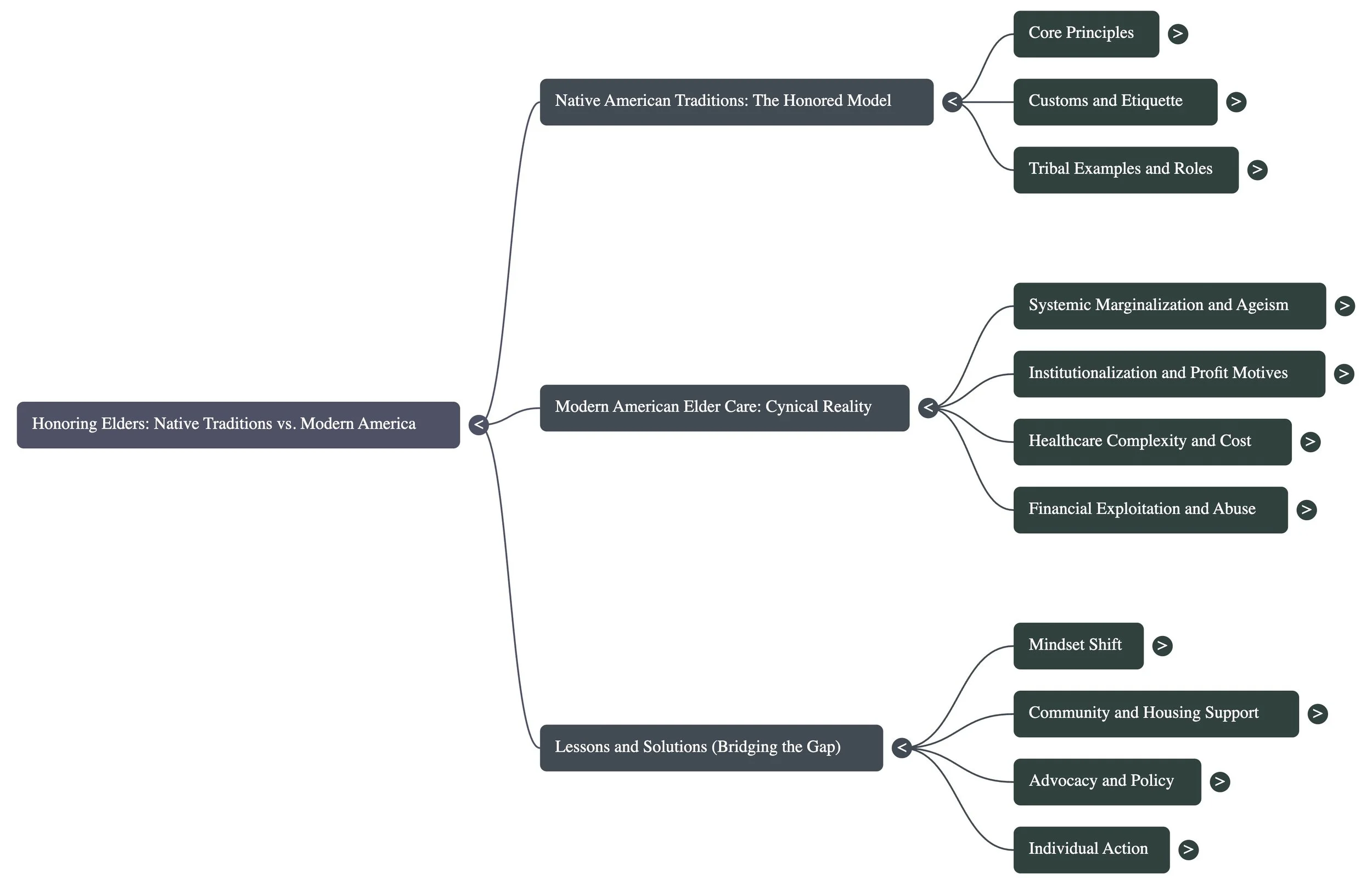
Mind map by Local Pigeon
If the Indigenous model is built on reverence and inclusion, the modern American model of elder care can often feel like the opposite. To be fair, many American families love and care for their aging parents and grandparents, and there are countless dedicated caregivers and ethical professionals. However, the dominant system and cultural norms around aging in the U.S. have serious flaws – flaws that a HastingsNow reader has bluntly summed up as “the American way” of “senior homes, greedy hospitals, greedy insurance companies, greedy funeral homes, greedy accountants, righteous religious groups, and dispassionate family members.” Let’s break down this cynical characterization and see what the facts say. Unfortunately, statistics and studies suggest there’s a lot of truth to these critiques. From systemic ageism and social isolation to the commodification of elder care at every turn, American seniors face challenges that would have been unimaginable in a traditional communal context.
Here’s an overview of the landscape in which many older Americans find themselves in their final years:
Growing Numbers, Shrinking Support: There are more seniors than ever – nearly 56 million Americans are 65 or older as of 2021 . The Baby Boom generation is entering old age en masse, meaning the senior population will continue to swell. By 2030, all Boomers will be over 65, and roughly 20% of the U.S. population will be senior citizens . In Minnesota, the number of older adults is on track to double between 2010 and 2030, and over one in five Minnesotans will be 65+ by then . Yet even as the elder population grows, families are having fewer children to share caregiving duties. As one expert noted, “We aren’t having enough children to take care of us in our old age”, reflecting on the reality that smaller families and dispersed relatives leave many elders without a robust support network . This demographic squeeze is real, and it’s straining both families and social services.
Social Isolation and Ageism: In the U.S., aging often comes with loss of social role. America prizes independence and productivity; once you retire, there’s an unfortunate tendency for society to marginalize you. Many seniors live alone or far from family. The result? An epidemic of loneliness. About one in three older American adults reports feeling lonely or socially isolated regularly . A University of Michigan national poll in 2024 found 33% of people aged 50–80 felt a lack of companionship at least some of the time, and 29% felt isolated – levels that match or exceed pre-pandemic rates . Loneliness isn’t just a feeling; it’s linked to serious health consequences (higher risks of dementia, heart disease, depression). Yet our culture doesn’t systematically address it. In Indigenous communities, it’s expected that elders remain integrated – “no one is overlooked” – but in America, elders too often fall through the cracks, unseen. The cultural attitude doesn’t help; American media and advertising glorify youth, often portraying seniors as out-of-touch, frail, or a burden. Age discrimination in hiring and healthcare is well documented. In short, we have an ageism problem that diminishes the dignity of older people. Contrast that with societies where being older automatically garners respect, and the difference is painful.
The Nursing Home/Assisted Living Industry: Perhaps the biggest tangible difference between traditional elder care and modern American elder care is the existence of a vast senior housing industry. Rather than elders living with family, millions of American seniors reside in institutional settings – nursing homes, assisted living facilities, memory care units, etc. In theory, these facilities provide needed care for those who can’t be cared for at home. In practice, they are a mixed bag, often influenced by profit motives. Consider the stats: There are over 15,300 nursing homes in the U.S. housing about 1.3 million residents as of 2020 . More than 1,000,000 additional seniors live in assisted living communities (less medical but still institutional environments) . This means at least ~2.3 million Americans have moved out of a family setting into a facility for their twilight years. Some find community and good care there; others experience neglect or loneliness behind those walls.
Perhaps most tellingly, about 70% of U.S. nursing homes are for-profit enterprises . Many are run by large chains or even private equity firms, whose primary fiduciary duty is to generate returns for investors. It’s not an overstatement to say elder care in America has become big business. The price tag for a bed is enormous: the national median cost of a private room in a nursing home is around $127,000 per year (as of 2024) . Even a semi-private shared room runs about $111,000/year . Assisted living isn’t cheap either, with a median cost of ~$5,350 per month (over $64,000 a year) . These costs often exceed what many families can afford, and they’re rising with each passing year.
When profit is at stake, there’s a constant tension between cost-cutting and quality of care. We’ve seen the results during the COVID-19 pandemic: overburdened staff, inadequate infection control, and tragic outcomes in many nursing homes. Even before COVID, government inspectors regularly find health and safety violations in a significant fraction of facilities (bedsores, medication errors, poor sanitation, etc.). Some studies have found that when nursing homes are acquired by certain profit-driven entities (like private equity firms), quality of care can decline and mortality rates for residents may even rise . This is not to demonize every facility – plenty of good ones exist – but structurally, the system often incentives doing elder care “on the cheap.” Frontline caregivers (nursing aides) are notoriously underpaid, leading to high turnover and staffing shortages. It’s not uncommon in a U.S. nursing home for one aide to be responsible for 10 or more residents on a shift, which makes truly attentive, personalized care impossible. The result? Many elders in these places languish with minimal social interaction beyond the TV blaring in the corner and rushed visits to deliver pills or meals. This warehousing of the elderly is a far cry from the engaged, honored role elders have in Native communities.
Another issue is that many seniors don’t actually want to be in institutional care – surveys consistently show the majority would prefer to “age in place” at home. But gaps in home care support and family availability force their hand. The American individualistic lifestyle (where adult children may live across the country and everyone is working full-time) sometimes leaves no option but a facility. In contrast, many Indigenous families, even today, make extraordinary efforts to keep elders at home or at least nearby, with relatives sharing duties. In the U.S. overall, about 27% of adults 60+ live alone, and that percentage increases with age (especially for women). When health fails and no family can move in, a nursing home often becomes the default.Hospitals and Healthcare: Profit and Overtreatment vs. Compassionate Eldercare: Healthcare for older Americans is a double-edged sword. On one hand, modern medicine can extend life and treat diseases that used to be death sentences. On the other hand, the way the healthcare system operates can be very profit-driven and impersonal, often causing unnecessary suffering for elders. A staggering statistic: roughly 25% of Medicare spending is on patients in their last year of life . Medicare (the government insurance for seniors) is the largest insurer for end-of-life care, and tens of billions of dollars each year go into ICU stays, surgeries, dialysis, chemo, and other interventions in the final months of life . Many of these measures might be worthwhile, but studies and personal stories alike suggest that sometimes they reflect a “do everything” default approach even when those treatments won’t significantly improve quality of life. It’s easy to see how hospitals – which earn revenue from procedures and bed occupancy – have a financial incentive to offer more, not necessarily better, care. For-profit hospitals (and even ostensibly non-profit ones) also chase high revenues; some have been caught doing things like “upcoding” diagnoses to charge more or keeping patients in costly settings longer than needed. Administrative complexity (multiple specialists, insurance approvals, etc.) means patients often feel like cogs in a big machine. Older patients can end up undergoing painful treatments they don’t fully understand, because no one took the time to have an honest conversation about goals of care. It’s a far cry from the holistic, spiritual approach many Indigenous cultures take toward death and dying, viewing it as a natural part of life’s cycle to be faced with family and community support.
Insurance companies, too, play their part in the cynical picture. In theory, Medicare (federal insurance) covers basic health needs for those 65+, but in practice, many seniors buy private Medicare Advantage or supplemental plans – and these insurers are notorious for their fine print and profit motives. There have been cases of Medicare Advantage plans denying claims for treatments that should be covered or throwing up obstacles to accessing rehab, specialist care, etc., to save costs. A government watchdog found that insurers wrongly deny a significant number of authorization requests, which can especially hurt older patients who may not know how to appeal. Meanwhile, those same insurance companies are raking in record profits, buoyed by taxpayer-funded premiums.
For the elder themselves, the healthcare maze is exhausting. Think of an 80-year-old managing five different doctors, a dozen medications (some of which cost hundreds of dollars a month), copays, deductibles, and endless paperwork. It can easily overwhelm even a savvy person, let alone someone with cognitive decline. And costs still leak through the cracks: hearing aids, dental care, vision care – many such needs aren’t fully covered by Medicare. Prescription drug costs have been so high that until recently, Medicare had no out-of-pocket cap. It’s not surprising that over 20% of adults 65+ have skipped medications or cut doses due to cost . In 2022, more than one in five older Americans did not adhere to prescriptions because they couldn’t afford them – skipping refills, halving pills, or even borrowing meds . And 8.5% of seniors in one survey said they went without basic needs (like food or utilities) or went into debt to pay for medicine . Think about that: elders in one of the richest countries on Earth having to choose between buying pills or buying groceries. This is healthcare rationing by personal poverty, and it disproportionately affects those who are poor or have multiple chronic illnesses.
The U.S. healthcare system’s complexity and cost can feel incredibly indifferent or even predatory to a vulnerable senior. Native American traditions emphasize caring for elders’ health with herbal medicines, ritual, and community care, treating the person’s spirit as well as body. In American hospitals, elders may feel like just another chart – sometimes experiencing age bias (e.g. undertreatment of pain, or conversely overtreatment without consent). And for many families, the end-of-life journey of a loved one becomes a crash course in medical bureaucracy and heartbreak, as they witness a loved one subjected to procedures when maybe what was needed was comfort and presence.Greed at the End: The Funeral Industry and Estate Issues: The journey doesn’t even end at death – American seniors (or rather, their families) often face exploitation even in burial. The funeral industry in America is notorious for its high costs and sometimes predatory sales tactics. By custom, many Americans feel obliged to hold elaborate funerals, and funeral homes sometimes take advantage of grieving families’ emotional vulnerability. The median cost of a funeral with a viewing and burial is about $7,848 as of a 2021 survey . By comparison, a typical traditional burial ceremony in many Indigenous communities is a communal affair with minimal expenses (perhaps just a simple wooden coffin and a feast prepared by family and friends). In the U.S. mainstream, though, funeral directors may upsell features like expensive caskets, “protective” vaults, or lavish services. The Federal Trade Commission had to institute a “Funeral Rule” to require price transparency, yet a recent investigation found only 18% of funeral homes surveyed posted their price lists online as required , making it hard for consumers to comparison shop in advance. There have been documented scams: for instance, some unscrupulous providers trick people into buying a casket even for a cremation (not needed), or they advertise low prices and then hit families with hidden fees . AARP warns that “unscrupulous operators take advantage of families’ most trying times for their own monetary gain.” Grieving adult children can easily be guilted into “honoring Mom” with a costly package, even going into debt for it.
There’s also the booming business of “pre-need” sales – selling elderly people prepaid funeral plans or burial insurance. Some of these are legit, but others have pitfalls (e.g. if the funeral home goes out of business, or if hidden clauses limit what’s covered). It’s telling that Americans have had to become savvy consumers even in death – reading fine print to avoid being swindled when buying a coffin or cremation. This is a far cry from Indigenous communities where typically the community all pitches in for an elder’s send-off, and the emphasis is spiritual (prayers, songs, honoring the person’s life) rather than financial.
“Greedy accountants” might refer to those involved in managing an elder’s finances, including estate planners or even court-appointed guardians. Unfortunately, elder financial abuse is rampant in the U.S., and the abusers can be family members, scammers, or professionals. The National Council on Aging estimates that financial exploitation causes older Americans around $28.3 billion in losses each year . This includes outright fraud (like phone scams targeting grandma’s savings), but also more insidious abuse like unethical financial advisors selling unsuitable investments to seniors or court-appointed conservators charging exorbitant fees while mismanaging elders’ assets. We’ve seen headline cases where elders with significant assets were effectively bilked by those supposed to protect them, sometimes even a lawyer or accountant who gains power of attorney. Even when no crime is committed, the elder care economy finds ways to siphon money. Reverse mortgages, Medicare fraud schemes, “free” hearing aid trials that lock seniors into subscriptions – the list goes on. It often feels like everyone has their hand in the elder’s pocket, from the minute they retire to the reading of the will.Family Dynamics: Dispassionate or Overwhelmed Relatives and the Erosion of Familial Duty: In many traditional cultures, family duty to elders is non-negotiable. In America, it’s more variable. Many families do lovingly care for their aging members at great personal sacrifice. But many others do not – sometimes due to selfishness, other times due to legitimate constraints like needing to work or lacking space/resources. The result is that some elders feel neglected or even actively mistreated by their own kin. Elder abuse is a hidden but shockingly common problem. It’s estimated that about 1 in 10 Americans age 60+ has experienced some form of elder abuse (physical, emotional, sexual, neglect, or financial) . And two devastating points: most abuse is never reported (perhaps only 1 in 24 cases comes to light) , and nearly 60% of the time the perpetrator is a family member . Specifically, analyses show about 47% of abusers are the adult children or relatives of the victim, and another ~13% are paid caregivers . This means the very people who should be caring are sometimes causing harm – whether through intentional cruelty, financial exploitation (e.g. a grandson stealing grandma’s Social Security checks), or neglect (simply not ensuring the elder’s needs are met). It’s a heartbreaking reality. While some cultures have social taboos so strong that mistreating a parent or grandparent would be unthinkable, American news occasionally carries stories of seniors found living in squalor or with untreated wounds because their family member responsible for them was negligent or abusive.
Even short of overt abuse, many American seniors experience a more subtle pain: feeling forgotten or burdensome to their children and grandchildren. How many elderly parents sit by the phone hoping for a call that comes infrequently, or look forward to holiday visits that last only hours? It’s common for younger Americans caught up in busy lives to not prioritize their elders. Sometimes the separation is geographic (kids move away for jobs), sometimes emotional (generational rifts or simply lack of close bonds). The irony is, some of these same people might post a flowery tribute on Facebook on Mother’s Day or attend church where “Honor thy father and mother” is preached – yet they don’t actually spend time with or listen to their living elders. This is where the “righteous religious groups” critique may come in: there can be hypocrisy when people espouse family values or charity in theory but do little to directly help the seniors in their midst. (It’s worth noting some religious and community groups do fantastic work visiting nursing homes or assisting senior congregants with meals, but it’s far from universal.)
The upshot is that the American nuclear family model – often scattered and individualistic – has left a vacuum in elder care that is filled by institutions and paid providers. Where three or four generations once lived under one roof or in one town, now an elder might be in Florida, a daughter in New York, a son in California. Relationships maintained by weekly phone calls or occasional visits are not the same as daily interaction. The absence of family can compound the loneliness and vulnerability of elders. Again, this is markedly different from many Native communities where extended family networks tend to remain closer (both geographically and relationally), and there’s a clearer expectation that you will take grandma in or at least make sure she’s okay each day.The Emotional and Ethical Toll: Beyond the dollars and data, consider the emotional experience of an average American elder today versus what it might be in a more traditional setting. Too often, aging Americans feel like they are “getting in the way” or are pressured to “not be a burden.” Some internalize this and reluctantly agree to go to a home or refuse to ask their kids for help when they need it, out of pride or fear of being unwanted. There is almost a cultural narrative in the U.S.: “They took care of you, now it’s your turn – but if you can’t, just put them in a facility and hope for the best.” We seldom articulate it so bluntly, but that is how it plays out in many cases. The lack of societal support (like affordable in-home care, or paid family leave for caregivers) makes it extremely hard for even well-intentioned families to manage. The result is guilt on the part of adult children and a sense of abandonment on the part of elders.
Meanwhile, entire industries thrive on this transfer of responsibility. There’s a poignant saying that “you can tell a lot about a society by how it treats its oldest and youngest members.” For the U.S., a hard look in the mirror reveals a society that has, in many ways, outsourced eldercare to impersonal systems and allowed it to become a profit center. Whether it’s hospitals billing Medicare, nursing home companies collecting rent, drug companies charging high prices, or funeral homes upselling coffins, at every stage there’s someone making money off the inevitable process of aging and dying. Even in death, we have professionalized what used to be a family/community undertaking (preparing the body, mourning rituals, burial) into something you purchase. It’s no wonder some commentators speak of a “longevity economy” – billions of dollars revolving around seniors, not necessarily to their benefit but to capitalize on their needs.
In sum, the modern American way of eldercare can indeed seem cynical and broken when contrasted with the idealized version of elderhood in Native cultures. Where the latter has respect, the former too often shows neglect; where one has dignity and purpose, the other imposes boredom and marginalization; where one has community, the other gives bureaucracy. It’s important to acknowledge that not all elders in America suffer – many live happy, supported lives, and there are efforts to reform and improve care. But the general critique holds: we, as a society, often fail to truly honor our elders. We might celebrate longevity in headlines (“Record number of centenarians!”), but we don’t ensure those extra years are lived in comfort, connection, and meaning.
Bridging the Gap: Lessons for Hastings and Beyond
The contrast drawn above is admittedly stark. One could argue it romanticizes Native cultures (which have modern challenges too) and paints all of American eldercare with a broad negative brush. Reality is nuanced. Yet, the core insight remains valid: many Indigenous traditions hold keys to treating elders with the respect and humanity they deserve, keys that our modern system seems to have lost. The question is, what can we do about it? How can communities like Hastings, Minnesota benefit from these insights and move toward a better model for their seniors?
First, reframe how we think about elders. Instead of seeing older people as “retirees” or dependents or problems to solve, we can start seeing them as assets – living knowledge banks, storytellers, mentors. This mindset shift costs nothing but can change everything. For example, schools and community centers in Hastings could invite elders (including Native elders from local Dakota or Ojibwe communities) to share stories and skills with younger generations. Imagine a weekly storytelling circle at the library where seniors share local history or cultural tales with kids – that harkens right back to the oral tradition model. The value of intergenerational connection is huge: it gives elders a sense of purpose and belonging, and it educates and roots the youth. Some communities have successful programs pairing teens with senior “buddies” to teach each other technology vs. life lessons, etc. Hastings could foster such initiatives, inspired by the reverence Native cultures have for elder wisdom.
Second, increase multi-generational and community-based living opportunities. Not everyone can have grandma move in, but cities can encourage housing models like “granny flats” (accessory dwelling units), co-housing communities that blend seniors with families, or simply better support for aging in place (home modification grants, visiting nurse programs). It’s telling that even the federal government recognizes that institutional care should be the last resort – there’s been a push for “aging in place” and Home and Community Based Services, but funding lags demand. Locally, advocating for such resources (through county services, non-profits, church groups) can make a difference. For instance, a volunteer network that checks in on homebound elders or helps with errands can prevent isolation and delay the need for a nursing home. This is reminiscent of how, in tight-knit Indigenous villages, someone is always stopping by an elder’s home to deliver food or just chat. We can recreate that neighborly care.
Third, combat ageism and celebrate elders publicly. This could be as simple as featuring elder residents in the local news (Hastings Now might profile a 90-year-old war veteran or a tribal elder sharing traditional art). Or organizing an annual “Honoring Our Elders Day” in town, similar to Cherokee Elder’s Day , where the community gathers to thank seniors for their contributions. It’s not about tokenism; it’s about genuinely valuing the lives and experiences of older people. One could imagine an event where elders are asked to speak on stage, perhaps alongside Native American elders who can perform an honor song or blessing for all the community’s grandparents. Such intercultural exchange could be beautiful: a Dakota elder from Minnesota blessing the city’s seniors with a prayer of gratitude, imparting that sense of sacred regard.
Fourth, advocate for better care standards and support systems. Not everything can be solved at the community level – some issues require policy changes. Hastings residents can lend their voice to causes that help seniors: improving nursing home staffing ratios, protecting against elder abuse and scams (maybe local law enforcement could do workshops on fraud prevention), expanding transit options for seniors who can’t drive, and supporting caregivers (e.g., adult day programs, respite care funding). The Native model teaches us that caring for elders is a communal responsibility – it shouldn’t fall solely on an exhausted daughter or an underpaid aide. Society must share the load. The Older Americans Act and other programs exist to help, but they need robust funding and community engagement to be effective. By pushing elected officials to prioritize elder services (from meal delivery to healthcare access), citizens honor their elders in a practical way.
Additionally, we should learn from and partner with local Native communities. Minnesota is home to Dakota and Ojibwe nations; their cultural centers, clinics, and elders programs might have strategies worth emulating. For instance, many tribes have Elder Councils or Elder Advocates in their health systems to ensure seniors are treated with respect. They often integrate traditional healing – perhaps something like that could be introduced in mainstream elder care (e.g., offering spiritual support or culturally sensitive activities for seniors of all backgrounds). During the pandemic, some tribes mobilized youth to deliver food and water to isolated elders – an idea any community can adopt in a crisis.
Let’s not forget the power of individual action too. Each of us can decide to practice a more Indigenous-inspired respect in our daily lives. Simple acts: call your grandparents more often, visit a neighbor in the senior home, ask an older person for advice (and really listen). Rather than seeing an elder’s slow gait in the grocery store as an inconvenience, see a human being who deserves patience and help reaching a high shelf. Change often starts in the heart, with empathy and attitude.
Key Lessons to Embrace
Elders are assets, not burdens: Reclaim the view of seniors as wise, valuable members of society (just as Native cultures do) rather than as obsolete or “over the hill.”
Community integration: Find ways to keep elders engaged in community life – through intergenerational activities, civic involvement, storytelling, volunteering, etc. Isolation is the enemy.
Family and community responsibility: Encourage families (with community support) to care for their elders at home whenever possible, echoing the tradition that it’s an honor and duty to do so. When not possible, ensure frequent visitation and inclusion so those in facilities aren’t forgotten.
Dignity in care: Insist on dignified treatment in healthcare and elder services. This means advocating for better standards in nursing homes, fair medical treatment (not over-treating or under-treating due to age), and calling out exploitation (financial or otherwise) when we see it.
Honoring heritage and personhood: If an elder comes from a particular cultural background, honor that in their care. For Native elders in mainstream facilities, for example, allowing space for smudging or prayer in their language is important. More broadly, see each elder as a person with a lifetime of stories – take the time to ask them about their life.
Hastings, Minnesota can lead by example. It’s a community that values both its history and its close-knit feel – who better to spearhead a renewed approach to honoring elders? We can draw inspiration from the Lakota ‘grandfather’ spirit, the Navajo pillar of the family, the Cherokee living library, the Haudenosaunee wisdom keeper, and the Inuit survival sage. These aren’t just romantic notions; they are practical models proven over centuries to create resilient, caring societies.
Conclusion: Towards a World that Honors the Aged
Our elders have weathered long decades – they’ve raised families, worked jobs, fought wars, built communities, and kept traditions alive. They have earned, at minimum, our respect and compassionate care in their final chapters. Native American cultures demonstrate that another way is possible: a way where getting older equates to rising status in society, where seniors are seen as sources of wisdom and “ultimate reservoirs of skills” , and where the entire community steps up to ensure elders live with dignity. Modern America, for all its progress and technology, has stumbled in this regard, often treating elders as expendable or invisible. But it’s not too late to change.
By learning from Indigenous values and critically examining our current systems, we can push for a cultural shift. Imagine a future America – or at least a future Hastings – where no elder fears being alone or discarded, where nursing homes (if needed) feel more like true homes with open doors and loving staff, where families receive the support they need to keep Grandma with them, and where profit never trumps compassion in decisions about elder care. In such a society, greed and indifference have no place at a beloved elder’s bedside.
Ultimately, caring for our elders is not just about them – it’s about us and the kind of humanity we wish to embody. One day, if we’re lucky, each of us will become an elder. The groundwork we lay now – by demanding better and doing better – is a gift to our own future selves as much as to today’s seniors. Let’s strive for a world where the wisdom of age is celebrated, not wasted, and where every elder can rightfully say they are treated with the respect, dignity, and love that Native American traditions have long taught us to uphold.
In the words of the Cherokee, “Each elder is a treasure… the guiding stars of our future.” May we act like we truly believe that – here in Hastings, and across America. Our elders are watching; let’s make them proud.
Sources:
Indigenous elders are widely regarded as repositories of cultural and philosophical knowledge, serving as “living libraries” of wisdom in their communities . They transmit beliefs, teachings, and practical knowledge to younger generations, embodying the role of mentors and leaders. Not all older people are automatically considered “elders” in the cultural sense – true elders earn that respect through their knowledge and service . This perspective contrasts sharply with mainstream U.S. society, where elder roles are often devalued. In Haudenosaunee (Iroquois) communities, for instance, elders are respected figures, wisdom keepers who impart oral traditions and help raise the nation’s children, whereas in the broader U.S. culture “the role of elders is not significant” .
Cherokee tradition holds elders in one of the most respected community roles – they are “living libraries” of history, language, and traditions . Cherokee Elders serve as storytellers preserving creation stories and clan traditions, teachers of songs and ceremonies, and everyday guides imparting values of respect and patience . The Cherokee even celebrate an annual Elder’s Day to honor elders as “treasures… whose knowledge enriches the entire Nation.” .
In Lakota culture, elders (Unčí and Lala, grandmother and grandfather) are profoundly honored. The term for Creator (Tunkášila) means Grandfather, and when Lakota grandchildren call an older man “Lala,” it’s considered deeply humbling – a reminder of the sacred responsibility to live up to that grandparent role . Lakota elders are credited with preserving language and ceremonies through hard times, passing down “Lakota understandings of life” to the young .
A Navajo journalist explains that in Diné culture, elders (especially grandmothers) are taught to be the “pillars of the family” – keepers of stories, history, traditions, and culture, who care for the young and in turn must be cared for by the family . Navajo elders connect the family to the ancestors and are cherished; when her own grandmother aged, the author drove her to appointments, cared for her on weekends, and ensured she lacked nothing .
The Ojibwe (Anishinaabe) and many other tribes instill respectful practices like always letting elders eat first. As noted in a Mille Lacs Band of Ojibwe guide: “Native Americans highly value the wisdom that comes with age. When eating, children and young adults serve the Elders, who always eat first.” One should never cut ahead of an older person in line, as that’s considered very rude . Such everyday etiquette demonstrates ingrained respect.
Inuit communities rely on elders as custodians of survival knowledge and cultural identity. Elders share stories, legends, and teachings that carry moral values, survival skills, and spiritual beliefs, thereby connecting younger generations to ancestral wisdom and reinforcing resilience . Through oral tradition, Inuit elders pass down detailed knowledge of the land, weather, and wildlife – knowledge vital for living in the Arctic environment.
The modern U.S. eldercare landscape is sobering. About 15,300 nursing homes house 1.3 million residents (2020 data) , and over a million more seniors live in assisted living facilities . The vast majority (roughly 70%) of nursing homes are for-profit businesses . Costs are sky-high: the median annual cost of a private nursing home room is about $127,750, and assisted living runs around $64,000 per year . These expenses can wipe out life savings, and profit pressures have been linked to quality issues. Studies indicate that in facilities acquired by private equity firms, deficiencies and mortality rates tend to increase .
Elder financial exploitation is rampant, causing an estimated $28.3 billion in losses each year for older Americans . Scams, fraud, and even abuse of powers of attorney contribute to this figure. According to the National Council on Aging, perpetrators are often people the elder trusts – nearly 47% of elder abuse cases involve family members, and another 13% involve caregiving staff . Overall, about 1 in 10 Americans age 60+ has experienced some form of elder abuse, yet only a small fraction of cases are reported .
Many American seniors struggle with healthcare costs despite Medicare. In 2022, over 20% of adults 65+ did not take medications as prescribed due to cost – they skipped doses, delayed refills, or outright didn’t fill prescriptions because they couldn’t afford them . In the same study, 8.5% of older adults reported cutting back on basic needs or going into debt to pay for medicine . High drug prices and gaps in insurance coverage leave too many choosing between their health and other essentials.
Loneliness and isolation afflict a significant portion of U.S. elders. A 2024 national poll found 33% of older adults (50–80) felt lonely and 29% felt socially isolated at least some of the time . These rates spiked during the COVID-19 pandemic and have since subsided to pre-pandemic levels – but those pre-pandemic levels were already concerningly high. Chronic loneliness is associated with higher risks of health problems, and addressing it will require community effort (e.g., senior centers, visitation programs, intergenerational activities).
In Minnesota, the senior population is rapidly growing. The state’s older adult (65+) count is expected to double from 2010 to 2030. By 2030, more than one in five Minnesotans will be 65 or older, according to the Minnesota State Demographic Center . This demographic shift is creating urgency to expand services like home care, transportation, and healthcare for seniors. It also means younger Minnesotans will need to adjust attitudes and infrastructure to support a more age-diverse society.
-
This article compares how Native American cultures traditionally honor and care for their elders with how modern American systems treat seniors, and then asks what a community like Hastings, Minnesota can do differently. It focuses on elders’ roles, dignity, and community connection, not just on medical care or retirement income.
-
Native American cultures generally treated elders as honored knowledge‑keepers, not burdens. Elders were consulted for decisions, asked to share stories, included in ceremonies, and cared for by family and community. They often ate first, sat in honored positions, and were expected to pass on language, values, and history to the younger generations.
-
While each nation is unique, elders often served as:
Lakota: spiritual guides and grandparents who help preserve language and ceremony.
Navajo (Diné): pillars of the family who teach traditions and keep stories alive.
Cherokee: living libraries who pass down history, songs, and cultural identity.
Haudenosaunee (Iroquois): wisdom keepers, including elder Clan Mothers who influence leadership.
Inuit: survival experts who teach how to live on the land and embody community values.
In all of these cultures, age tends to bring increased respect and responsibility.
-
No. Each tribe, nation, and community has its own language, history, and spiritual traditions. There are shared themes—like respect, interdependence, and storytelling—but the specific roles, ceremonies, and customs for elders vary widely. The article highlights broad patterns without claiming that one practice represents all Native peoples.
-
Modern American elder care is heavily shaped by institutions and markets. Many seniors live in nursing homes or assisted living, navigate a complex healthcare system, rely on insurance companies, and face high costs for medications and funerals. Families are often geographically scattered, which can lead to isolation. Instead of being at the center of community life, elders can end up on the margins of a profit‑driven system.
-
Common problems include:
Social isolation: many seniors live alone or rarely see family.
Institutionalization: heavy reliance on nursing homes and assisted living.
High costs: long‑term care, medications, and funerals can drain savings.
Staffing and quality issues: overworked caregivers and inconsistent care.
Financial exploitation and scams: elders are frequent targets.
Ageism: cultural bias that values youth over experience and wisdom.
The article argues that these problems are symptoms of a system that treats aging as a business opportunity instead of a shared responsibility.
-
No. The article critiques the system, not every facility or caregiver. Many people working in elder care are deeply committed and compassionate, and many families choose facilities for safety and support. The problem is that the overall structure is often driven by profit and convenience rather than by the kind of deep respect and interdependence seen in many Native traditions.
-
Hastings sits in a region that is historically Dakota and Ojibwe homeland, and Minnesota’s population is aging quickly. Native perspectives offer local, place‑based wisdom about community, reciprocity, and respect for elders. By learning from these values, Hastings can shape policies, programs, and everyday habits that keep elders connected, honored, and cared for close to home.
-
Families in Hastings can:
Call, visit, or video chat with elders more often.
Invite them into decision‑making about family plans and traditions.
Ask for their stories and record them for future generations.
Include elders in holidays, games, and everyday routines.
Support elders who want to age in place by helping with rides, groceries, or home tasks.
Small, consistent actions can make elders feel seen, valued, and loved.
-
Younger people gain real‑world wisdom, emotional support, and a stronger sense of identity by listening to elders. Elders can offer perspective on work, relationships, hardship, and resilience. In many Native cultures, elders are the bridge between past and future; for young people in Hastings, making time for grandparents or older neighbors can be just as powerful.
-
“Aging in place” means growing older while staying in your own home or community, rather than moving to an institution. It matters because many elders feel safer and happier in familiar surroundings. Aging in place works best when families, neighbors, and local services step up to provide support—an approach that echoes Indigenous ideas of community responsibility.
-
Local organizations can:
Churches/faith communities: organize regular visits to homebound and facility‑bound elders, and include elders as leaders and teachers in services.
Schools: create intergenerational programs where students interview elders or work on shared projects.
City government and nonprofits: expand senior transportation, meal programs, and social events; support caregivers with respite services and information.
The article encourages Hastings to see elder care as a shared civic duty, not just a private family issue.
-
The article is careful to avoid the idea that any culture is perfect. Many Native communities today also face serious challenges, including poverty, health disparities, and the legacy of colonization. The goal is not to idealize Native life, but to learn from enduring values—like respect for elders, communal care, and intergenerational responsibility—that can inspire better choices in modern Hastings and across the U.S.
-
Some suggested changes include:
Hosting an annual “Honoring Our Elders” event.
Supporting housing options that allow multi‑generational or elder‑friendly living.
Partnering with local tribal nations or Native organizations for cultural exchanges.
Strengthening local resources that reduce isolation, like senior centers and volunteer networks.
Advocating for better standards and oversight in area eldercare facilities.
The core idea is to move toward a Hastings where elders are visible, connected, and celebrated—not sidelined.
-
You can:
Share the article on social media or in local community groups.
Bring it to your church, school board, or city council as a conversation starter.
Use the ideas to start a volunteer group focused on visiting elders or helping them age in place.
Ask local organizations how they can incorporate more elder‑centered and Indigenous‑inspired values into their programs.
The more people in Hastings who engage with these ideas, the easier it becomes to change how the community treats its elders.