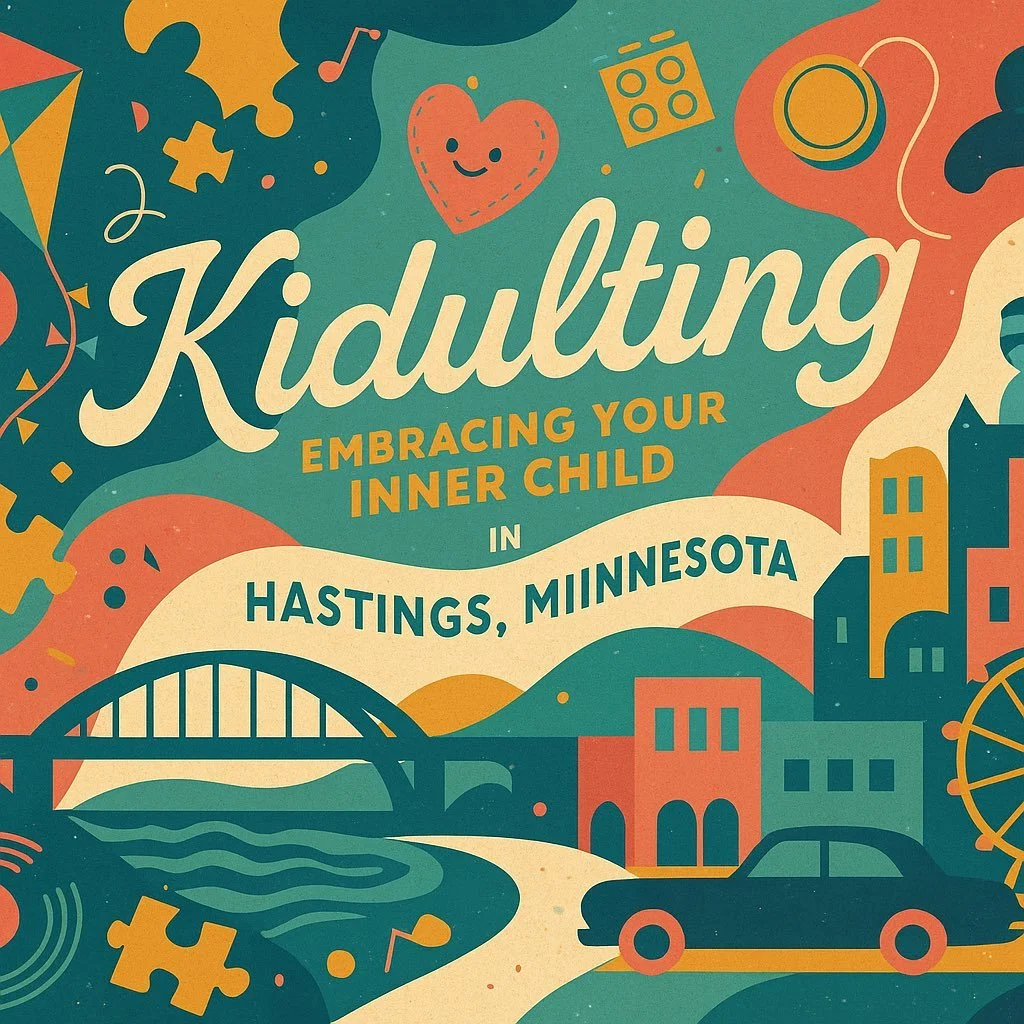
Kidulting: Embracing Your Inner Child in Hastings, Minnesota
AI image by Local Pigeon
“When I became a man I put away childish things, including the fear of childishness and the desire to be very grown up.” – C.S. Lewis. This famous quote captures the spirit of kidulting – a growing cultural trend where adults unapologetically indulge in childhood interests and play for fun, stress relief, and nostalgia. In Hastings, Minnesota – a historic river town known for its community spirit and downtown charm – kidulting is more than a buzzword. It’s a way of life that locals and visitors alike are embracing with playful enthusiasm. From browsing the toy aisles at SC Toys (Second Childhood Toys) on 2nd Street to riding carnival attractions at Rivertown Days, adults are discovering the joy and benefits of reconnecting with their inner child. In this in-depth blog post, we’ll explore kidulting’s origin story, how it has evolved through the ages, and where it’s headed. We’ll delve into the psychological, mental, and even spiritual benefits of kidulting (with academic research to back it up), and examine the trend through philosophical and intellectual lenses. We’ll also look at the economic impact of the kidult phenomenon and highlight popular kidulting trends – from board games and collectibles to local happenings in Hastings that bring generations together in play. By the end, you’ll see why SC Toys in downtown Hastings is the place to experience “Second Childhood” fun, and you might just be inspired to join the kidult movement yourself. So buckle up (perhaps in a toy car or on a swing!) and let’s journey into the world of kidulting – a world where grown-ups can be kids again, and where playfulness is celebrated, not feared.
What is Kidulting? The Origin Story of the “Kidult”
-
Kidulting is adults embracing playful hobbies—LEGO, puzzles, games, collectibles—for stress relief and community. Start locally at SC Toys in downtown Hastings and explore nearby events and parks for all-ages fun.
Kidulting is a portmanteau of “kid” and “adult,” referring to adults who participate in activities or have interests traditionally associated with children. In essence, a kidult is an adult who loves to “act like a kid” – whether that means collecting toys, watching cartoons, playing games, or otherwise engaging in lighthearted childhood hobbies. Unlike the disparaging notion of being “childish,” modern kidulting carries a positive connotation: it’s about being “childlike” in wonder and play, without abandoning adult responsibilities. As author Christopher Noxon (who wrote Rejuvenile) put it on The Colbert Report, “There's a big difference between childish and childlike”. Kidulting encourages the latter – retaining a sense of curiosity, joy, and creativity from childhood – while still functioning as a grown-up.
Where Did the Term Come From?
You might be surprised to learn that kidult is not a brand-new term coined on TikTok or by millennial bloggers. The word actually dates back to the 1950s, when the television industry used “kidult” to describe adults who enjoyed youthful TV programs. For example, the British adventure show Thunderbirds was deliberately aired in the evening in the ’60s to target this kidult demographic of adult viewers who loved kids’ sci-fi shows. Even if the slang wasn’t widespread then, the concept existed – think of grown-ups in the mid-20th century secretly reading comic books or watching The Adventures of Sir Lancelot after work.
Over time, other terms like “rejuvenile” and “adultescent” popped up to describe similar ideas. And of course, psychology gave us “Peter Pan syndrome” – referring to someone who refuses to grow up emotionally. But kidulting in today’s sense is a bit different: it isn’t about immaturity or escapism to the point of neglecting adult life; it’s more of a healthy balance. Modern kidults, or rejuveniles, “successfully marry adult responsibilities with non-adult interests” – meaning you can pay your bills and pay for a LEGO set without any shame. No one really knows who first coined kidulting in its current usage (even toy experts say the origin is fuzzy), but the term has undeniably gained traction in the 21st century.
Kidulting Goes Mainstream
For a long time, society assumed that when you grew up, you naturally “put away childish things.” Playtime was for kids; adults were expected to be serious. However, the early 21st century saw a shift – suddenly it was okay (even cool) for adults to openly love things like superheroes, fantasy novels, and theme parks. The entertainment industry picked up on this trend and created an entire “kidult” category of content meant to appeal to kids and adults alike. Blockbuster franchises like Pixar’s Shrek and Harry Potter drew huge adult audiences, proving that stories traditionally aimed at children could captivate the child-at-heart in all of us. Animated series like My Little Pony: Friendship Is Magic found devoted adult fans (“Bronies”), and Disneyland became one of the world’s top vacation destinations for adults without kids. In other words, kidulthood went mainstream – no longer an odd exception, but a widespread phenomenon.
Even the toy industry took notice. By the 2010s, major toy makers realized that a significant portion of their consumers were not children at all, but adults buying toys for themselves. In South Korea, the buzzword “kidult” caught on around 2015 as companies saw booming sales of drones, electric scooters and collectible toys to adults. And in the United States, the trend accelerated dramatically during the COVID-19 pandemic: U.S. toy sales surged 37% between 2020 and 2022, reaching about $28.6 billion in 2021. At first, toy companies thought this was just parents spoiling their kids in lockdown. But a Toy Association survey revealed the truth – 58% of adults said they had purchased toys and games for their own personal use during that period. In fact, adults aged 18+ now make up roughly 14% of the U.S. toy market (over $5.7 billion a year) and as much as 25% of toy sales in the U.K.. Clearly, kidulting is not an anomaly; it’s a powerhouse segment driving growth in multiple industries.
From its niche origins in mid-century TV jargon to its current status as a cultural movement, kidulting has officially arrived. But to really appreciate why this trend resonates so deeply today, we need to look at how kidulting has evolved over time – and why adults are so eager to recapture the magic of childhood.
Kidulting Through the Ages: A Look Back (and Forward) at Adults as Kids
Kidulting might be a hot topic now, but adults enjoying “kid stuff” is hardly a new phenomenon. In many ways, each generation finds its own form of kidulting – whether they call it that or not. Let’s take a quick tour through time to see how grown-ups have kept play alive, and how the forms of kidulting have changed (or come full circle) over the years.
1950s–1960s – The First Kidults on Screen: As mentioned, the ’50s TV industry coined kidult for adult fans of children’s shows. In an era of strict social norms, these early kidults were somewhat in the shadows – think moms and dads chuckling at Mickey Mouse Club with the excuse of “watching with the kids.” But the seed was planted: adults could love kids’ entertainment. By the 1960s, we had phenomena like the Batman TV series and comic book superheroes attracting college-aged viewers, and sci-fi/fantasy like Star Trek and Lord of the Rings gaining adult followings. The template of the modern fandom – adults passionately engaged with “geeky” or youthful media – was emerging.
1970s–1980s – From Saturday Cartoons to Collectibles: Fast forward a bit, and the children of the post-war era grew up but refused to let go of their toys. The 1970s saw Star Wars explode in popularity not just with kids but with adults who lined up for the movies and collected action figures. By the 1980s, cartoon franchises (Transformers, He-Man, My Little Pony) had merchandising that appealed to all ages. Many adults at the time still viewed playing with toys as just “for the kids,” yet a subculture of adult collectors began to flourish – keeping toys in mint condition, attending comic and toy conventions, etc. If you were a 30-something buying GI Joe figures in 1985, you might not advertise it to your coworkers, but you definitely weren’t alone.
1990s – Nostalgia and the Rejuvenile: In the ’90s, something interesting happened: nostalgia became a driving force. Baby Boomers and Gen X started openly reminiscing about the pop culture of their youth. We saw 1970s fashions become retro-chic, Star Wars re-releases, and TV shows like The Wonder Years and Nick at Nite glorifying the past. This decade also gave us terms like “second childhood” and the academic notion of the rejuvenile adult. The idea that adults can/should recapture youthful enthusiasm gained intellectual backing. By the end of the ’90s, the stigma around adults playing video games or reading YA novels was fading – especially as the first generation of gamers (Atari and Nintendo kids from the ’80s) reached adulthood and kept on gaming. In 1998, Funko launched its line of pop culture bobblehead toys – the first was the Big Boy diner mascot – planting the seeds for what would become a $1+ billion collectibles company selling nostalgia-themed vinyl figures to grown-ups.
2000s – The “Rejuvenile” Comes of Age: The 2000s saw an open celebration of kidult culture. In 2006, journalist Christopher Noxon published Rejuvenile: Kickball, Cartoons, Cupcakes, and the Reinvention of the American Grown-up, documenting the rise of adults partaking in kid-like pastimes (and yes, adult kickball leagues became a real trend). He noted, as we mentioned earlier, that being childlike can be a conscious lifestyle choice distinct from being childish. Around this time, Hollywood perfected the art of the family movie that really is for everyone – Pixar, Disney, Marvel, etc., all created films that adults could genuinely enjoy without a child in tow. Meanwhile, Harry Potter and other YA book series became crossover hits with adults, proving stories about teens or magic schools could enchant readers of any age. The commodification of youth accelerated – as one cultural critic, Karen Brooks, observed, entertainment and fashion began selling “teen spirit” to adults who were “young at heart”. By the end of the 2000s, being a 35-year-old who loves comic superheroes or collects Pokémon cards wasn’t something to hide – it was increasingly normal.
2010s – Playtime Renaissance (Adult Coloring Books & Cosplay): If the 2000s cracked open the door for kidulting, the 2010s blew it off the hinges. This decade delivered some major kidulting moments. In 2014–2015, adult coloring books suddenly boomed – over 12 million coloring books were sold in 2015 alone (up from just 1 million the year before). What started as a niche stress-relief hobby turned into a global craze, with grown-ups gleefully coloring intricate mandalas or cartoon characters. At the same time, cosplay (dressing up as fictional characters) went mainstream through events like Comic-Con – no longer the realm of a few nerds, but a respected hobby for thousands of adults. Toy companies launched high-end collectibles and model kits aimed squarely at adult hobbyists (think $300 Star Wars Lego sets). The term “kidulting” itself began popping up in media articles midway through the decade, as millennials – often caricatured as the “Peter Pan generation” – embraced things like Disney adulthood (the meme of grown Disney fanatics) and nostalgic fashions. Even the world of fashion saw “kidcore” styles emerge, inspired by ’90s cartoons and toys (cue the resurgence of hair scrunchies, Lisa Frank-style prints, and quirky graphic tees). By the late 2010s, major brands noticed that selling nostalgia worked wonders: Nintendo’s retro mini-consoles flew off shelves thanks to 30- and 40-year-old buyers, and brands from Nike to Gucci dropped products with childhood pop culture references (who remembers the limited-edition Gucci purse made of LEGO bricks? Yes, that happened in 2019!).
2020s – The Golden Age of Kidults: Enter the current decade, and kidulting has truly hit its stride – supercharged by a global pandemic that had everyone stuck at home seeking comfort and joy. As noted, toy sales jumped nearly 40% early in the decade thanks to adults indulging in toys and games during lockdowns. People rediscovered puzzles, built model kits, and resurrected old hobbies to cope with stress. A 2021 survey confirmed that well over half of U.S. parents buying toys were actually buying them for themselves. Social media helped propel the trend: TikTok’s #AdultMoney hashtag – where young adults show off purchases of toys and childhood treats “with zero regrets” – has nearly 4 billion views. In 2022, McDonald’s tapped into kidult nostalgia with adult Happy Meals, complete with retro toys; they sold out in a frenzy of 20- and 30-somethings flooding stores to relive that happy childhood memory. In 2023, the Barbie movie became a cultural phenomenon, not just for kids but for millions of adult women (and men) who grew up with Barbie – sparking the vibrant “Barbiecore” trend in fashion and decor as adults reveled in pink throwbacks. Clearly, kidulting is not just a quarantine hobby or a quirky subculture – it’s a defining lifestyle of our times.
Looking forward, the future of kidulting seems bright (and playfully colored). Industry experts say this is no fad; it’s a fundamental shift in consumer behavior. “That transition from kid play to adult play is a very fertile area,” notes Stephanie Wissink, a retail analyst, adding that the fan economy – adult collectors and superfans – is “rich, deep, growing and globalizing”. Big companies are investing accordingly: for example, in 2022 a consortium led by former Disney CEO Robert Iger poured $263 million into Funko, the collectibles maker, betting on the longevity of the kidult market. Toy giants like Mattel and Hasbro have created special business units (Mattel Creations, Hasbro Pulse) dedicated to adult collectors and nostalgia products. And new businesses are emerging to serve kidults’ craving for experience, not just products – from “Dopamine Land” in London (an immersive play space with giant ball pits and interactive rooms for adults) to the Museum of Ice Cream, a multi-story playground of sprinkle pools and candy installations that’s wildly popular with adult visitors seeking carefree fun. In other words, playtime for grown-ups is becoming big business and big culture.
Kidulting has come a long way from the days of secret comic book readers or furtive toy collectors. Today, especially here in Hastings and the Twin Cities area, adults can proudly embrace childhood joys – whether it’s flying a kite at Lake Rebecca Park, dressing up for a retro ’80s night, or spending a weekend building a model train set. The stigma is gone: being a kid at heart is now widely seen as a positive and enriching part of adult life. And as we’ll see next, there are some very good reasons for that – backed by psychology, philosophy, and the lived experience of kidults everywhere.
The Benefits of Kidulting: Why Playing Like a Kid Is Good for Adults
Why exactly are so many adults drawn to kidulting? Sure, it’s fun – but there’s more to it than just having a good time. Researchers and mental health experts have found that embracing your inner child can yield significant psychological, mental, and even spiritual benefits. What our hearts seem to know intuitively – that playing and revisiting beloved childhood activities makes us feel better – is increasingly backed by science. Let’s break down some of the key benefits of kidulting:
Stress Relief and Emotional Well-Being: Perhaps the most immediate benefit of kidulting is stress reduction. Adult life is often filled with responsibilities, schedules, and information overload. Kidulting offers an escape hatch – a chance to press pause on grown-up worries and be “carefree” for a while. Psychologists note that engaging in playful, familiar childhood activities provides comfort and positive nostalgia that can soothe anxiety and lift our mood. During the early months of the pandemic, many adults started doing puzzles, Lego kits, or baking “kid” recipes because it was therapeutic. It’s no coincidence that as stress and negative emotions hit record highs globally, the appeal of childlike distraction grew stronger. Play is a well-known buffer against stress – it triggers the release of dopamine and endorphins, the brain’s feel-good chemicals (hence a play-space named “Dopamine Land”!). A 2022 study in Frontiers in Psychology confirmed that even in 19–25 year-olds, making time for play significantly improved emotional resilience – play helped these emerging adults manage their emotions and bounce back from stress better. In short, “play is recognized as a means to relieve stress and protect psychological wellbeing”. When you lose yourself in coloring a page or building a model, you give your mind a break from anxiety – and that respite can be truly healing.
Joy, Positivity and “Inner Child” Healing: Kidulting is inherently tied to nostalgia – and nostalgia, it turns out, isn’t just a sentimental yearning; it can be a powerful source of comfort and positivity. Revisiting childhood favorites (whether it’s watching Tom & Jerry cartoons or unboxing a vintage action figure) often “evokes nostalgia that feels positive and reassuring”, according to psychologists. Those warm fuzzy memories remind us of simpler times, which can counteract today’s worries. Mental health experts even incorporate “inner-child work” as a therapeutic practice – literally encouraging adults to engage in youthful activities they loved, as a way to heal past wounds and nurture themselves. “Kidulting is a natural, simple return to known, feel-good childhood activities,” says clinical psychologist Dr. Carla Marie Manly. “The familiarity of the activity is often the perfect backdrop for unwinding.” In other words, doing something you loved as a kid – be it finger-painting, building a pillow fort, or collecting Pokémon cards – can unlock feelings of safety, joy, and mastery that are deeply comforting. Many kidults describe the experience as “recharging their spirit” or even spiritual in nature. The Harvard Divinity School observed that the adult coloring book craze was “a sign of Americans’ growing interest in mindfulness and spirituality” – coloring became a form of active meditation for many. It’s a way to be present and joyful, very much in line with mindfulness practices. Some religious and spiritual leaders have even argued that play is a gift from the divine – a way to experience grace and delight. The Dalai Lama, for instance, is known for his playful demeanor and has stated that being playful is essential to being a fully realized human being. “Basically, we are social animals,” he explained, and to be playful is to “act like a human being” – embracing our natural state of curiosity and joy.
Boosted Creativity and Cognitive Function: Ever notice how your best ideas sometimes come when you’re not actively working, but maybe doodling or daydreaming? That’s no coincidence. Play unlocks creativity. By engaging in fun, low-stakes activities, we allow our brains to make new connections and think freely, without the pressure to be “productive.” Psychologists say play can “stimulate the mind and boost creativity”, as well as improve brain function. One adult puzzle enthusiast in an interview quipped that focusing on a jigsaw puzzle “turns down the articulate brain and takes a break from thinking,” yet in those relaxed states, “many a good idea…has come to me.” This aligns with research: play and divergent thinking go hand-in-hand. When adults color, build with blocks, or play make-believe in Dungeons & Dragons, they’re essentially exercising the creative parts of the brain. That can translate into improved problem-solving skills and innovative thinking in other areas of life. In addition, certain kinds of play (like learning a new game, or constructing a model) challenge the brain and may help keep it sharp. AARP has promoted adult playgrounds and games as good for brain health, noting they “check off several boxes that are good for the brain” – presumably meaning physical coordination, social interaction, and novelty. So, kidulting isn’t a waste of time; it might be a workout for your imagination and intellect!
Social Connection and Community: Another wonderful aspect of kidulting is how it can bring people together. Play is often a social glue – think of how kids bond on a playground. The same is true for adults: playing on a rec sports team, having a board game night, or geeking out over a shared comic fandom can forge strong friendships and community. Many adults struggle to make new friends or find social connections outside of work/family; kidult hobbies provide a fun, low-pressure way to connect. In Hastings, for example, adults gather during events like the Historic Hastings Car Show – ostensibly to admire classic cars, but really they’re bonding over shared nostalgic memories ( “Oh wow, my dad had that ’75 Chevy!” ). The entire downtown fills with an atmosphere of play and camaraderie as music, food, and vintage cars bring generations together. On a smaller scale, if you drop by SC Toys in Hastings on a weekend, you might find adults chatting about the latest puzzle or laughing over retro gag gifts – a toy store can be a community hub where the young-at-heart meet. Social scientists have observed that playing together increases bonding and communication in relationships. Even playing video games cooperatively or going to theme parks with friends can strengthen those ties. Kidulting gives adults permission to be silly together – to have a Nerf gun battle at a family reunion or dress up in costumes for a movie premiere – and those moments of shared play are often the ones that build the deepest friendships. In an era where loneliness is a real issue for many adults, kidulting offers an antidote: connection through play. As one local pastor put it, “God wants us to relate positively with others, and play is often the vehicle for social interaction.” Whether or not you bring spirituality into it, the sentiment rings true: having fun with others is a powerful way to feel more connected and alive.
Personal Growth and Lifelong Learning: Finally, engaging in childlike play can contribute to personal growth and even a sense of wholeness. The great philosopher Friedrich Schiller argued back in the 1790s that “play makes us whole as humans.” He believed that play reconciles our rational side with our emotional side, making us more integrated individuals. Modern research suggests he was onto something. Play allows adults to experiment, explore, and express themselves in ways they might not in rigid daily roles. You might discover a new passion (perhaps painting miniatures or skateboarding) that adds a fulfilling dimension to your life. Play also encourages flexibility and adaptability, traits that are invaluable in a fast-changing world. Keeping a sense of play means you’re more likely to approach challenges with creativity and an open mind, rather than getting stuck in rigid thinking. Some psychologists even say a playful outlook can keep you young in spirit – not just enjoying life more, but perhaps being more resilient to cognitive decline as you age (since you’re continually engaging in novel, stimulating activities). There’s a reason we say “you’re only as old as you feel.” Those who play often feel younger and more energetic. In Hastings, we see wonderful examples of this: older adults joining community theater (playing make-believe on stage), grandparents building LEGO sets with grandkids (and clearly enjoying it as much as the kids do), or middle-aged folks starting a hobby like drone flying or RC cars, discovering it lights them up inside. Life can be a continual adventure if you maintain that childlike willingness to learn and play. As legendary scholar Friedrich Nietzsche quipped, “Man’s maturity: to have regained the seriousness that he had as a child at play.” In other words, a truly mature person is one who can approach play with the wholehearted absorption of a child. That is not regression – it’s growth, coming full circle to embrace all parts of your humanity.
Playful Spirit, Serious Benefits
It’s clear that kidulting is more than just a fad or a way to kill a Sunday afternoon. Engaging in play as an adult is beneficial on multiple levels – mentally, emotionally, socially, and spiritually. Far from being frivolous, play can be deeply meaningful. It reminds us of who we are at our core: imaginative, joyful beings capable of wonder. It reconnects us to our “inner child,” a concept often used in therapy to describe the playful, creative self that adults sometimes suppress. By letting that inner child out to play, we can experience healing, growth, and genuine happiness.
If you’ve been holding back from a fun hobby because you thought it’s “too childish,” consider this your permission slip to go for it! The science is on your side. Color in that coloring book, build that model rocket, swing on those swings at the park. As long as you’re balancing your adult duties, there’s no downside – in fact, you’re likely to handle those duties better when you’ve relieved stress and recharged your mind with play.
In the next section, we’ll look at kidulting not just from the personal angle, but from a bigger picture view: philosophical insights into why play is vital, and how society’s attitude towards kidulting reflects deeper cultural shifts. We’ll also see how the marketplace is responding, with an explosion of products and experiences tailored for the kidult audience (you might want to start a wish list!). Plus, we’ll zoom in on some local Hastings flavor – the ways our community provides opportunities for adults to play and the kind of fun products you can find right here at SC Toys to fuel your kidult adventures.
So, if you’re feeling inspired to embrace play, read on – the best justification for being a toy-loving, game-night-hosting, Disney-song-singing adult is yet to come!
A Philosophical Lens on Kidulting: Wisdom in Play
Let’s take a step back and examine kidulting from a philosophical and intellectual perspective. Play isn’t just beneficial – some thinkers argue it’s central to the human condition and a key to wisdom and happiness. For centuries, philosophers, writers, and scientists have observed the importance of maintaining a childlike spirit. Now, the kidulting trend is prompting us to revisit those ideas with fresh eyes. What does it mean, culturally and philosophically, that adults are reconnecting with childhood joys? Is play the opposite of maturity, or an essential part of it? Let’s explore a few insights:
“Serious” Thinkers on the Importance of Play
Paradoxical as it may sound, many serious minds have championed play. We’ve already mentioned Schiller’s and Nietzsche’s viewpoints that play can make us whole and is a sign of true maturity. Another influential work is Johan Huizinga’s Homo Ludens (1938), which argued that Homo sapiens (man the thinker) is also Homo ludens (man the player) – that play is a foundational element of culture and civilization. Huizinga showed how law, war, poetry, art, and philosophy itself have playful origins (think of Socratic dialogues as a kind of intellectual play). His core idea: to play is human – just as much as to think is human. This aligns perfectly with the Dalai Lama’s simple statement earlier that being playful is acting human.
Philosophers have long noticed that children possess qualities that adults benefit from emulating. Children are naturally curious, imaginative, and unafraid to pretend – qualities that fuel creativity and even scientific discovery. Albert Einstein once remarked that “to stimulate creativity, one must develop the childlike inclination for play.” And he himself said, “The pursuit of truth and beauty is a sphere of activity in which we are permitted to remain children all our lives.” (Einstein never lost his childlike wonder, which many credit for his genius insights). In a more poetic vein, author C.S. Lewis (whom we quoted at the start) turned the cultural script on its head: instead of being ashamed to read fairy tales as an adult, he embraced it. As Lewis famously wrote, “Critics who treat ‘adult’ as a term of approval...To be concerned about being very grown up, to blush at the suspicion of being childish – these things are the marks of childhood and adolescence... When I was ten, I read fairy tales in secret... Now that I am fifty I read them openly. When I became a man I put away childish things, including the fear of childishness and the desire to be very grown up.” Lewis nails a key point: True maturity isn’t about giving up what you love just because it’s labeled “childish” by others; it’s about having the confidence to enjoy it without shame.
Modern psychology reinforces these philosophical views. Dr. René Proyer, a researcher who studies playfulness, notes that “playfulness is an understudied personality trait,” but it’s clear that playful adults can navigate life with more flexibility and humor. He also found the benefits of play can vary by culture and individual, suggesting play is a personal expression of freedom.
In essence, philosophical and intellectual exploration of play all converge on a thought: Play is not trivial. It is, in many respects, sacred. It’s a space where normal rules are suspended and creativity reigns. It’s where humans often feel the most joy and authenticity. As kids, we play to learn and grow; as adults, we must play to continue learning and growing. The kidulting trend is a cultural recognition of this truth – that embracing play might actually make us wiser, happier, and more fully ourselves.
Changing Attitudes: From Peter Pan Syndrome to Kidult Wisdom
It’s worth noting how the narrative around adults indulging in youthful interests has changed. Not long ago, someone might have derisively said, “Ugh, he’s got Peter Pan syndrome,” implying a refusal to grow up. Certainly, there are extreme cases – an adult who neglects their job or family because they’re gaming 12 hours a day, for instance, would be a problem. But the kidulting movement is not about escaping adulthood entirely; it’s about enriching adulthood through childlike joy. The fact that we now celebrate things like adults doing cosplay or having LEGO displays in their office is a significant cultural shift. It means we’re recognizing that a well-rounded adult can still savor the delights of childhood.
Sociologists might tie this to longer adolescence trends (more adults delaying traditional markers of adulthood, etc.), but it’s also a philosophical shift: a realization that the dichotomy of “child vs adult” interests was false. Why shouldn’t a 40-year-old woman love collecting Hello Kitty or a 25-year-old man host Mario Kart parties? Who made the rule that fun has an age limit? It turns out, that was more a product of 20th-century industrial age thinking – the idea that adulthood must be all work, seriousness, and sacrifice. The 21st century, with its more fluid lifestyles and value on mental health, is resurrecting the older wisdom: “We don’t stop playing because we grow old; we grow old because we stop playing.” (A quote often attributed to George Bernard Shaw).
Even in literature and art, there’s a recurring theme of maintaining a youthful heart. Remember the Little Prince from Antoine de Saint-Exupéry’s novella, who observed that “All grown-ups were once children… but only few of them remember it.” The magic of kidulting is in remembering that child within and keeping it alive. In doing so, adults may actually gain a more profound perspective on life. A person who can enjoy a child’s perspective can also empathize more, imagine more, and possibly find more meaning. There’s a philosophical concept that by “playing,” we explore alternate realities and ask “what if,” which is the seed of innovation and even morality (because imagination breeds empathy).
One might even argue kidulting has a spiritual dimension. Various religious traditions speak of qualities like “childlike faith” or “having the faith of a little child” as virtues – implying trust, openness, and pure joy. While kidulting typically refers to secular activities, the underlying embrace of wonder aligns with these spiritual ideals. A Los Angeles Times discussion on play asked, “Are there spiritual benefits to playfulness?” and respondents from different faith backgrounds agreed that yes, fun and recreation can be “spiritually enriching, and mentally and physically nourishing.” One pastor noted that God wants us to “enjoy life” and that play helps “lift our minds off of the merely pragmatic” to something transcendent. A Unitarian Universalist minister quipped that adulthood shouldn’t be a “relentless destruction of childhood” – rather, laughter and play are necessary parts of a full life. These perspectives echo across human thought: play is good for the soul.
Kidulting and Intellectual Curiosity
Kidulting isn’t just about toys and games; it can also be about learning with childlike curiosity. Think of adults who get into collecting fossils, or studying astronomy with the wide-eyed awe of a child gazing at the stars. These too are forms of kidulting – pursuing a passion with youthful zeal. One could say the best scientists and artists are big kidults at heart: they never lost that sense of wonder. For example, if you visit the Hastings Wetland Learning Center or take a bird-watching hike along the Mississippi, you’ll often find adults as giddy as kids when they spot a colorful bird or cool frog. Embracing that beginner’s mind (a concept in Zen Buddhism as well) leads to deeper intellectual engagement. You’re not embarrassed to ask questions or express excitement – hallmarks of a great learner.
In summary, looking at kidulting philosophically reveals that it’s more than okay to play – it’s profoundly human. Far from being a sign of immaturity, it can be a mark of wisdom and emotional maturity. A balanced adult knows when to be serious, of course, but also knows when to let go and play. Or as the saying goes, “there is a time to be an adult and a time to be a child – and the happiest individuals know how and when to be both.”
So the next time someone side-eyes an adult buying a plush unicorn or building a model railroad, remember: some of the greatest minds and spirits would encourage that adult to carry on playing! They might even join in. As Hastings’ own community demonstrates through its many all-ages events and playful atmosphere, life is richer when young and old alike share in the fun.
Now, having covered the why of kidulting – from benefits to philosophy – let’s get into the nitty-gritty of what kidults are actually doing and buying these days. What are the hottest kidulting trends? How is the economy adapting to serve playful adults? And how can you dive into kidulting right here in Hastings and beyond?
Kidulting Today: Trends, Toys, and the Business of Being Young-at-Heart
If you’re ready to jump on the kidulting bandwagon (or should we say carousel horse?), you’re in good company. The market is flooding with products, activities, and experiences tailor-made for adults who love kid stuff. Let’s explore some of the top genres and trends in kidulting right now – many of which you can find at or through SC Toys in downtown Hastings – as well as the bigger economic picture of this movement.
Toys, Games, and Hobbies for Kidults
Walk into SC Toys or any vibrant toy store, and you’ll notice something: lots of the merchandise appeals just as much to the grown-ups browsing as to the kids. Here are some popular categories driving the kidulting craze, with data to back their popularity:
Board Games and Puzzles: The classic game night has made a huge comeback among adults. In that Toy Association survey, the number one item adults bought for themselves was board games (65% of respondents). From strategic euro-style games to silly party games, adults are hosting game nights as an alternative to watching TV or going to bars. Puzzles, too, have found a passionate adult fanbase – there’s something meditative about piecing together a 1000-piece jigsaw of a beautiful landscape or nostalgic cartoon scene. Here at SC Toys, we carry a range of puzzles (including Minnesota scenery and retro collage puzzles) and classic games. Hastings locals have been known to pick up a new jigsaw for a cozy winter weekend or a strategy board game like Catan or Ticket to Ride for gatherings. It’s social, it’s screen-free, and it scratches that itch for both competition and cooperation. Puzzle nights are the new yoga nights for some friend groups! (In fact, doing puzzles has been linked to improved cognitive function and can be a mindful practice akin to meditation.)
Building Kits and Models (LEGO Mania): If you thought LEGO was just for kids, think again. LEGO has massively pivoted to embrace its adult fan community – launching an “Adults Welcome” line of sophisticated kits and even 18+ recommended age labels on some sets. Today’s LEGO sets include everything from a 2,000-piece Volkswagen Camper Van model to replicas of famous paintings and working grand pianos. These kits are essentially 3D puzzles that provide hours of focused fun. At SC Toys, we stock various building kits (and can special-order many more) that appeal to all ages. We’ve seen couples pick up LEGO Architecture sets to build together on date nights, and retirees dive into elaborate Technic builds to keep their engineering minds sharp. Beyond LEGO, other construction toys have adult followings too – Plus-Plus (the Danish puzzle bricks we featured in our October 23rd post) is a hit with creative minds of all ages. Model kits (think model airplanes, model cars, and DIY craft kits) are also experiencing a renaissance. There’s a Zen aspect to assembling something with your hands. It’s no wonder 61% of kidult survey respondents said they bought craft/building kits for themselves. Building isn’t just for the sandbox anymore; it’s a bona fide adult hobby.
Collectibles and Figurines: Another huge segment is collectibles. This spans a wide gamut – from Funko Pop! vinyl figures (those big-headed pop culture figurines) to high-end action figures, dolls, and nostalgia items. Over 53% of adults in one survey said they sprung for collectibles for themselves. The appeal here is often nostalgia plus the thrill of collecting and displaying. Maybe you decorate your office with Marvel superhero figurines, or you hunt for every limited-edition Star Wars Black Series action figure. Some adults collect vintage toys from their childhood (ever try hunting down a 1983 Optimus Prime in good condition? Some folks do!). Others might collect new lines that are actually designed for adult collectors – for example, Mattel Creations has been releasing Masters of the Universe figures that bring 1980s heroes to a new generation of grown-up fans. Even old favorites like Beanie Babies have adult collectors (though that’s more for nostalgia than investment nowadays). At SC Toys, we often hear from customers who are picking up items for their personal collections – whether it’s a die-cast model car that reminds them of their first vehicle, or a plush toy from a franchise they adored. And yes, plushies aren’t off-limits to adults either; the “kidult” who buys a giant Squishmallow pillow or a cute stuffed Pikachu for themselves is absolutely a thing (no judgment here – whatever brings comfort!).
Video Games and Tabletop RPGs: The world of gaming is a key part of kidult culture. Many of today’s adults grew up with Nintendo, Sega, or PlayStation, and they haven’t stopped gaming – they just might play different kinds of games (or even the same ones, since retro gaming is in!). Roughly 52% of kidult survey respondents said they bought video games for themselves. The gaming industry knows this: a lot of marketing is now aimed at adult gamers. The average age of a video gamer is now often cited around mid-30s. Whether it’s firing up Mario Kart on a Switch or an immersive night in a VR game, video games provide relaxation and social connection for adults across the globe. In Hastings, you won’t find a giant arcade, but you’ll find plenty of adults joining online gaming communities or gathering for LAN parties. Additionally, tabletop role-playing games (RPGs) like Dungeons & Dragons have seen a resurgence, heavily driven by adult fans. Shows like Stranger Things (with its D&D-loving characters) and live-play podcasts made D&D cool again, and now many millennials and Gen Z’ers host regular D&D campaigns – which is essentially structured imaginative play with friends. Talk about kidulting! SC Toys carries introductory D&D kits and plenty of dice sets for those looking to start a fantastical adventure. (We also have classic card games and puzzles that tie into gaming franchises.)
Outdoor and Active Play: Kidulting isn’t confined indoors. Adults are reclaiming the outdoors in playful ways too. The obvious example: adult sports leagues for kickball, dodgeball, ultimate frisbee – games we loved at recess. These leagues have popped up in cities everywhere as a fun, social way to exercise. Even in the Hastings area and Twin Cities, you can find recreational kickball or softball leagues that emphasize fun over hardcore competition. Then there are the more whimsical ventures: adult-sized scooters, skateboards, and bikes are booming. Razor, famous for its kids’ scooters, noted a surge in sales to adults and even made sturdier models for grown riders. You’ll see young professionals in Minneapolis commuting on scooters or longboards, blending transportation with play. Adult bounce houses and trampoline parks are another trend – some rental companies offer inflatable bounce castles specifically for adult parties (apparently Google searches for “adult bounce house” jumped 87% recently!). In the summer, Hastings’ Levee Park often hosts community events where adults can partake in playful activities – like giant Jenga, outdoor yoga (playful movement), or even chalk drawing competitions during art fairs. And don’t forget adult playgrounds – a few cities have built playgrounds with equipment and fitness-oriented play structures for seniors and adults. It’s all about proving you’re never too old to swing, climb, or slide.
Crafts, Arts and DIY: Remember arts-and-crafts time in school? Adults are getting back into that too. Painting classes (with or without wine), knitting circles, pottery workshops – these are creative play in a sense. Adult crafting not only yields a nice handmade product but also gives that satisfying feeling of “I made this!” that we often first experience as kids making art. Some of the kidulting trends here include the popularity of things like adult Play-Doh or slime (yes, slime isn’t just for kids on YouTube – squeezing a stress ball or molding clay is legit stress relief for adults) and coloring books as we discussed. There’s also a nod to DIY miniatures – kits to build tiny model rooms or dollhouse furniture are selling well to detail-oriented adults who enjoy that meticulous play. SC Toys has carried craft kits like the Orb Factory PlushCraft pillows (originally aimed at ages 5+, but we saw plenty of adults buying them during the holidays as a relaxing project). We continually expand our craft and science kit section not just because kids need off-screen activities, but because parents and grandparents love joining in or doing their own. A science kit that grows crystals or a paint-by-numbers canvas can be just as thrilling for a 45-year-old as for a 10-year-old.
Economic Impact: Kidults Driving a New Market
The collective effect of all these kidult purchases is a significant boost to various industries. We touched earlier on the toy industry numbers – tens of billions in sales with adult buyers contributing heavily. To give a snapshot: kidult shoppers accounted for about 5% of global toy sales recently, which might sound small, but in a $100+ billion industry worldwide, that’s a hefty slice. And because these purchases often span higher-end items (an adult might spring for the $400 Millennium Falcon LEGO set whereas a parent might not), the “average spend” can be higher for kidults.
Major companies have adapted strategies for this. For example, Hasbro Pulse (launched in 2019) is an online platform by Hasbro dedicated to collectors – selling premium action figures, special edition toys, and crowdfunded giant models (who else wants a 3-foot-long Star Wars ship? Because they made those for fans). Mattel Creations similarly releases limited collectibles like a Barbie dressed as David Bowie (a $105 collector’s item that sells out to nostalgic fans). These aren’t toys you’ll typically find on the shelf at Walmart; they’re marketed directly to adults via online campaigns, conventions, and fan sites. And they’re big business.
The ripple effect goes beyond toy companies. Retailers have noticed more adults perusing the toy aisles for themselves, so some stores have reorganized layouts or added “pop culture” sections. Entire retail chains like BoxLunch or ThinkGeek (now part of GameStop) specialize in merchandise that blurs the line between toy, collectible, and everyday item – selling, say, Pokémon waffle makers or Star Wars lamps, catering to adults who want to infuse play into their home decor and daily life.
Entertainment and theme parks are also cashing in. Disney Parks introduced after-hours events and merchandise targeting adult Disney fans (the term “Disney Adult” has even entered slang for those passionate fans). The success of films like The Super Mario Bros. Movie (2023), which many thirty-somethings flocked to for nostalgia, highlights that nostalgia marketing can vastly broaden an audience. Live events, from Comic Cons to renaissance fairs, are seeing record adult attendance – these are essentially giant playgrounds for grown-ups to dress up and have fun. The local economy in Hastings notices this around events like our Rivertown Days festival – which deliberately offers something for everyone: classic rock for the grown-ups, carnival rides for the kids, but in reality you see all ages on the carousel and adults lining up for mini donuts like excited children. It’s one big block party where, for a weekend, nobody worries about being dignified – you’ll find city council members screaming on the tilt-a-whirl next to teenagers, and grandma dancing to the live music with her grandkids. Community festivals thrive on that all-ages play dynamic.
Even beyond the obvious, consider food industry tie-ins: the McDonald’s adult Happy Meal in 2022 was wildly successful (with its nostalgic toys causing a social media stir). Cereals, candy, and snack brands regularly bring back retro packaging or old flavors aiming at millennials’ hearts (and stomachs). “Kid” cereal brands know that many adults buy Froot Loops for themselves. There’s even a new niche of nutrition – companies like Goodles (a higher-protein “adult” Mac & Cheese co-founded by actress Gal Gadot) – that bank on adults wanting the taste of childhood with a health twist. Goodles raised $10M and gets 80k website visits a month, proving even our comfort foods are getting kidult-optimized.
In short, kidulting is fueling what you might call the “nostalgia economy”. Companies old and new are forecasting strong demand ahead. As long as adults have discretionary income and a desire to relieve stress or reconnect with happy memories, this trend should continue. Some analysts predict that the kidult market will keep expanding, especially as Gen Z (a generation known for embracing nostalgia and internet-fueled fandoms) fully enters adulthood. Throw in the eventual adulthood of Gen Alpha (today’s kids), and we might see a world where being a “kidult” is just considered being a normal adult.
For small businesses like SC Toys, the kidult trend is a boon as well. We love seeing parents and grandparents come in equally excited as the children. Sometimes a parent will “justify” a purchase of a classic toy by saying “It’s for my kid” with a wink, but we know it’s for both of them to enjoy. We’ve had grown adults buy model kits, yo-yos, plush animals, even costumes for cosplay events – Hastings has creative souls who might be prepping for the next Renaissance Festival or a Halloween 5K run in costume. We gladly cater to those whimsical needs! Our philosophy is that toys and imaginative products are for everyone – if it brings a smile or sparks imagination, age is just a number.
Future Forecast: What’s Next for Kidulting?
As kidulting continues to evolve, what might the future hold? Here are a few educated guesses and emerging trends:
More Immersive Play Experiences: Expect to see more venues like interactive museums, pop-up play zones, and themed entertainment geared towards adults. Think along the lines of escape rooms (already very popular), indoor trampoline parks that have adult nights, “cuddle cafes” with plush toys (those exist in some countries!), and nostalgia arcades where you can play all the 80s arcade games with fellow enthusiasts. The success of things like Dopamine Land, Wondr in Amsterdam (with its pool of pink marshmallows to jump in), and the Museum of Ice Cream will inspire entrepreneurs to create more such Instagram-friendly, dopamine-boosting playgrounds for adults. Perhaps Minneapolis/St. Paul will get a permanent adult play museum in the years to come – wouldn’t that be fun?
Technology Meets Nostalgia: We’ll likely see technology both propelling and augmenting kidult experiences. Augmented reality (AR) and virtual reality (VR) could let adults relive childhood scenarios or fantasies in new ways. Imagine an AR app that turns your backyard into a Pokémon Safari zone (so you and your fellow 30-year-old friends can run around catching Pikachu virtually – actually, that’s basically Pokémon Go, which indeed had millions of adult players!). Or VR that lets you sit in on a Saturday morning cartoon world. On the flip side, tech might also cater to analog cravings: more “Tech-free” or “retro-tech” experiences as a countertrend. Vinyl records came back; maybe cassette players or Tamagotchis will too, because nostalgia often works in 30-year cycles.
Kidulting in Wellness and Work: The corporate world might also incorporate play more. We’ve seen Silicon Valley companies installing slides and ball pits in offices (playful design to spark creativity). That could spread as more employers recognize the value of play in reducing burnout and fostering innovation. Don’t be surprised if your office HR schedules a “Lego challenge workshop” or stocks the break room with puzzles and coloring sheets for mental health breaks. On the wellness front, “inner child workshops” and playful exercise classes (like adult gymnastics, hula-hooping fitness, etc.) could gain traction. Laughter yoga is already a thing; maybe “play therapy” for groups will go mainstream as a team-building or personal development activity.
Expanded Diversity in Kidult Content: As more adults openly embrace their varied interests, we’ll see an expansion in content that blurs age lines. For example, animation isn’t just for kids – and we might get more animated films and series that are truly all-ages. The anime genre has known this for years, but Western media might catch up. Also, representation in toys might broaden – e.g., more STEM-focused kits for adult hobbyists, or toys that cater to adult collectors from diverse backgrounds (e.g., Barbies modeled on historical figures or action figures of notable real-life heroes, which adults might appreciate even more than kids).
The Stigma Fully Fades: Perhaps the most heartening prediction is that in a decade, we might not even need the word “kidult” because it will just be normal for adults to enjoy whatever hobbies they enjoy. The term is useful now to describe the trend, but ultimate success might be when we drop the qualifier and simply accept that adults can like anything kids like, and vice versa, without eyebrows raised. Toy aisles might no longer be divided by “for kids” and “for collectors” – it’ll just be “toys and games for all.”
For Hastings specifically, the future of kidulting looks bright. As our community grows and continues to attract visitors, we have opportunities to expand playful offerings. Perhaps we’ll see more events like an “Adult Night at the Hastings Aquatic Center” with pool games, or a board game cafe opening up on Second Street where people can gather to play. Maybe SC Toys itself will host after-hours game tournaments or nostalgia toy swap meets for the 18+ crowd (let us know if you’d be into that!). The possibilities are endless when a community embraces fun. And knowing Hastings – with our strong tradition of family-friendly and all-ages events – we’re likely to lead the way in showing that a small town can have big fun for everyone.
Kidulting in Hastings: Playful Living in Our Hometown
We’ve talked a lot about kidulting globally and historically – now let’s bring it home to Hastings, Minnesota. How does kidulting manifest right here in our river city, and how can you get involved? Spoiler: Hastings might just be a perfect place to be a kidult. Our mix of historic charm, community events, and local businesses like SC Toys create an inviting playground for all ages.
Local Landmarks & Events with a Playful Twist: Hastings is known for its picturesque views of the Mississippi and the iconic Hastings RiverWalk, but it’s also known for its community gatherings. If you’ve attended Rivertown Days, you’ve experienced the city’s playful heart. Each summer, downtown turns into “one big block party” with live music, delicious food truck fare, an arts & crafts fair, and yes – carnival rides and games that are ostensibly for kids, but you’ll see plenty of adults riding the Ferris wheel or winning a giant stuffed animal at Whack-a-Mole. The event deliberately includes “kids’ activities” alongside the beer tent and concerts, making it a true family/kidult extravaganza. It’s not uncommon to see a group of adults, no kids in sight, roaming the carnival with funnel cakes in hand, reliving their youth on the tilt-a-whirl. As one Hastings Journal article put it ahead of Rivertown Days, “Hastings downtown will soon be overrun with carnival rides, food trucks, and music-lovers of all stripes” – note, all stripes, not just families with children. We embrace that inclusive fun.
Then there’s the Historic Hastings Car Show series, held monthly in the summer. This event is a nostalgia goldmine. Second Street East fills up with shiny classic cars from the 1950s–80s, drawing car enthusiasts of all ages. Strolling the street, you’ll hear plenty of kidulting happening: grandparents telling stories of the cars they drove in their youth, young people marveling at how “cool” older cars are compared to modern ones, and everyone enjoying the piped-in oldies music and atmosphere. It’s a trip back in time. For many attendees, it rekindles that childhood excitement of seeing a slick hot rod or getting your first car. It’s not play in the sense of toys, but it’s definitely play in the sense of imagination and memory – grown adults grinning ear to ear as a mint-condition 1960s Mustang revs its engine. There’s a collective giddiness in the air, which is exactly the kidult spirit.
Hastings also offers plenty of outdoor play opportunities. Our parks and trails aren’t just for fitness; they invite play. Take a walk through Levee Park on a summer evening and you might catch an outdoor concert where folks of all ages are dancing (sometimes in goofy costumes for theme nights). Or head to Vermillion Falls Park where you’ll often see photographers – both hobbyist adults and families – enjoying the scenery, maybe feeling like explorers discovering a waterfall like a scene from a storybook. Even a simple activity like biking the Hastings 10-mile loop trail can become a kidult adventure if you stop to skip rocks on the river or race your friend to the next landmark.
SC Toys – Your Kidult Headquarters: Right at the heart of downtown (212 2nd Street E) is our pride and joy: Second Childhood Toys (SC Toys). As our name suggests, we’re all about giving people a “second childhood” experience. When you step into our store, you’ll find unique and creative toys curated to spark imagination and learning. But don’t think for a second that it’s just the kids getting excited. We purposely stock a range of items that appeal to the young and young-at-heart. For example:
We have classic toys and retro reboots that trigger nostalgia. Remember Colorforms – those reusable sticker playsets from the mid-20th century? We brought them back in stock, and in our blog we literally called Colorforms “the gift that keeps on giving” because multiple generations can enjoy it. Parents who had Colorforms in the 1980s light up when they see the new sets, and they often end up playing alongside their kids for hours, arranging scenes. We love hearing “Oh, I had this when I was little!” echo in the aisles.
Our board game and puzzle section is a magnet for adults. We carry everything from simple family games to more complex strategy games. We’ve had locals form impromptu discussions at the game shelf – “Have you played this one? It’s so fun!” – sharing recommendations. Jigsaw puzzles featuring Minnesota landmarks or nostalgic images (like candy brands or classic cartoons) are customer favorites, often bought by adults for a relaxing hobby or as gifts for fellow kidult friends.
STEM and craft kits are another hit. We noticed a trend: a customer might initially pick up a science experiment kit “for the kids,” but later admit they themselves can’t wait to try making the volcano erupt or the slime change color. That’s exactly what we encourage – family projects where the adults are just as into it. Around the holidays, our craft kits like PlushCraft pillows or bead jewelry sets fly off the shelves, often purchased by adult crafters or for intergenerational crafting sessions. We even emphasize in our promotions how these kits help everyone unplug and get hands-on.
And of course, we carry fidgets and gadgets for stress relief – from squishy balls to those famous spinners. Fun fact: when the fidget spinner craze hit, we noted “The spinners are very popular with all ages. They help reduce anxiety and stress…give your hands something to do to free up your mind”. We saw as many adults as kids grabbing spinners at our counter, often employees from nearby offices who found them helpful during work or just a fun desk toy. That’s kidulting in everyday life – using a little toy to make the workday more pleasant.
SC Toys has even been recognized locally for what we bring to the community – we were honored as the Hastings Business of the Year 2022-2023, and part of the reason is our inclusive approach to play. Owner Barb (hi, that’s me!) loves seeing the imagination and playfulness that our store inspires in visitors from 1 to 101. We have a motto: “Destination for Fun”. It’s not just about selling products; it’s about creating a joyful experience. Whether you’re a parent, a college student, a retiree, or somewhere in between, you are welcome to come play with the demo toys, reminisce over retro candies (yes, we stock a few nostalgic treats too), and ask us about the latest trend (even if that trend is slime that looks like unicorn poop – we won’t judge, we’ll show you where it is!).
Community and Connection: Hastings might not be a bustling metropolis, but our community is tight-knit, which actually makes kidulting easier in some ways. You’re more likely to know people and feel comfortable being a little silly in a smaller town where people aren’t total strangers. For instance, during the annual Twilight Parade (part of Rivertown Days), many local businesses and clubs create floats that often have whimsical, childlike themes – superheroes, storybook characters, etc. The folks on those floats are adults in costume, throwing candy and waving with theatrical flair. And the crowd cheers not just for the candy but for the creativity. It’s a socially accepted time when grown men can dress as Batman and grown women as Disney princesses and everyone loves it. This shows how Hastings embraces that spirit.
Even everyday outings can have a kidult spin in Hastings. Have you ever taken a walk across the Hastings Riverwalk and paused to just lean over the railing and watch the boats or toss a pebble in the water, for old times’ sake? It can bring back that childhood peace. Or visiting the LeDuc Historic Estate – sure, it’s historical learning, but wandering the Victorian house can feel like playing make-believe, imagining you’re in a different era (a thrill for history buff kidults). Then maybe you grab some ice cream at Schoolhouse Scoop (local ice cream shop) – who says dessert is just for kids? Grab a double scoop of Blue Moon and savor it like you’re 7 years old again on a summer day.
The surrounding areas of Hastings also offer kidult delights: Apple orchards in the fall (hayrides aren’t just for kids, trust me, adults are grinning on them too), nearby Valleyfair amusement park (many of us drive up there for a dose of roller coaster adrenaline and Dippin’ Dots nostalgia), or even heading into the Twin Cities for a day at the Science Museum’s adult nights or the Minnesota State Fair, where adults compete as eagerly as kids to win giant stuffed animals at the midway games.
In essence, Hastings provides a friendly playground for adults to enjoy life’s simple pleasures. The pressure to be “ultra-sophisticated” is low here – people value down-to-earth fun, whether that’s a backyard BBQ with lawn games or a themed pub trivia night about 90s cartoons. And if you are looking to connect with fellow kidults, there are plenty of avenues: join a local club (the public library sometimes hosts board game afternoons, and there’s talk of a new hobby meetup starting soon – follow our Facebook for details), attend city events, or just drop by SC Toys and strike up a conversation. We’ve seen friendships form between customers who bonded over a shared fandom or the discovery that they both collect the same toy line.
Call to Action: Join the Fun at SC Toys!
After all this talk about kidulting, you might be itching to dive in. And we at SC Toys are here to help you embrace your inner child every step of the way:
Visit Us and Play: We warmly invite you to visit SC Toys in downtown Hastings. Browse, tinker, and feel free to play with our demo toys and games. Not sure what might spark joy for you? Our staff (all playful adults themselves) can guide you. Tell us what you loved as a kid, and we’ll find something in that vein – or a modern twist on it. Loved model cars? Check out our new Pinewood Derby kits or die-cast models. Obsessed with Stranger Things? We have retro board games and collectibles that channel that 80s vibe. Need to de-stress? We’ll point you to the squishiest stress balls and most satisfying fidget widgets. Consider our store your kidulting resource center.
Subscribe for Updates: We have a Subscribe section on our blog (right here on the website). Enter your email and sign up for our newsletter to get updates on unique toys, new arrivals, and upcoming events. We often announce when we get special nostalgic items back in stock (like when we restocked Colorforms or got new Plus-Plus sets from Denmark, subscribers heard it first). We also share play tips and sometimes even host giveaways for fun items. By subscribing, you’ll stay in the loop and fuel your kidulting habit with fresh ideas. (No spam, we promise – just fun news from your friendly neighborhood toy store.)
Engage with Us on Social Media: Follow SC Toys on Facebook, Instagram, and Twitter for daily doses of fun. We post photos of new products, snapshots of customers enjoying the store (with permission), and local happenings. Use the hashtag #SCToysKidult (let’s make it a thing!) to share your own kidulting moments – whether it’s a picture of the model you built or you swinging at Levee Park. We love to see and share our community’s joy. It also helps spread the word that Hastings is a destination for fun, which benefits all of us by bringing more cool events and vibe to town.
Join Community Play Events: Keep an eye on our announcements for any special events. We are brainstorming kidult-friendly workshops (would you come to an adults’ board game night at SC Toys after hours? Let us know!). Also, support and attend Hastings events that encourage all-ages fun – the more we show up and participate, the more our city will continue to host them. Bring your friends to Rivertown Days, invite your co-workers to the car show, or start a casual kickball meetup at a park. If you have an idea for a play event, share it with us or the Chamber – community-led fun is always welcome.
Share the Joy: Perhaps the most impactful thing you can do is simply share your positive experiences with others. Tell your friends and neighbors about kidulting and why you find it rewarding. Share this blog post with anyone you think would enjoy it or needs to hear that it’s okay to unwind with some childhood fun. Invite someone who’s been stressed out to join you for a playful activity – sometimes people just need permission or a buddy to feel comfortable playing again. By spreading the word and the joy, you help cultivate a more playful, tight-knit community. And yes, that helps SC Toys too, because the more people see value in play, the more they’ll think to visit a toy store not just for birthday gifts, but for themselves.
At SC Toys, our mission is to be “Hastings’ destination for fun & imagination” – for kids and adults. We truly believe in the power of play to bring happiness, relieve stress, and build community. The kidulting trend simply puts a name to something we’ve long held true: you’re never too old for fun.
So consider this an open invitation: come experience Second Childhood Toys for yourself. Reminisce over the toys of your youth, discover a new game to play with friends, or pick up a quirky item that just makes you smile. We’d love to see you in the store – whether you’re 5 or 85 – and hear about your own kidult passions. Let us know what hobbies or fandoms light you up; we might even feature it in our next blog or stock something new because you inspired us.
Life in Hastings has a special rhythm – a blend of historic and modern, tranquil and festive. Adding a dose of playfulness completes the picture, making our town not just a place to live, but a place to love living. By embracing kidulting, you’re choosing joy, creativity, and connection. In a world that can be all too serious, that choice is a breath of fresh air – as refreshing as a summer day on the Mississippi, as sweet as a scoop of vanilla at the local dairy, and as exhilarating as a child’s laugh.
Come play, Hastings. Your inner child has been waiting – and we at SC Toys can’t wait to welcome you to the fun. Let’s make downtown Hastings the place for kidulting memories. After all, “it’s never too late to have a happy childhood”, and there’s no better time than now.
Thank you for reading, and happy kidulting! We hope you’ll share this post with fellow kids-at-heart and drop by to say hello. Until then, keep playing and stay young at heart.
— The SC Toys Team, proudly serving Hastings’ kidults and kids alike.