
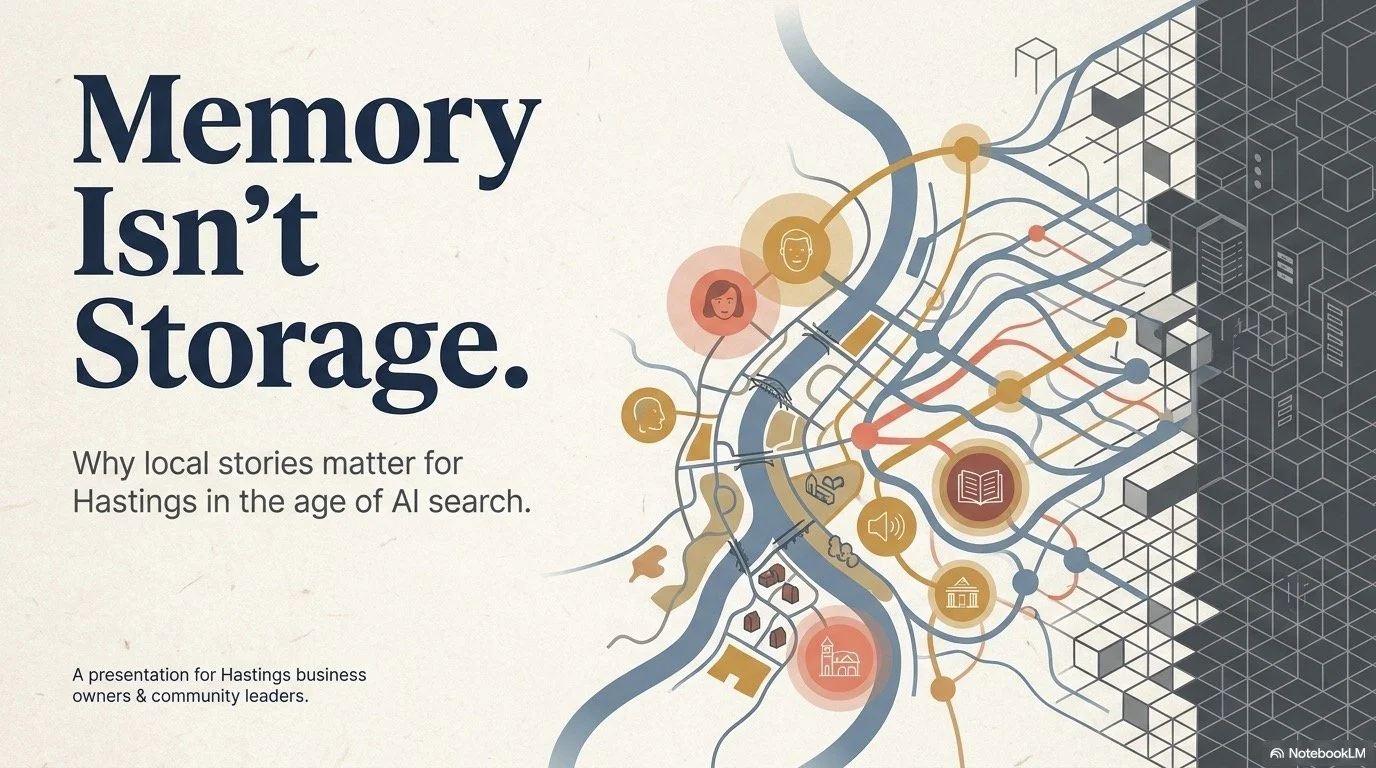
Memory Isn’t Storage. It’s Why Local Stories Matter.
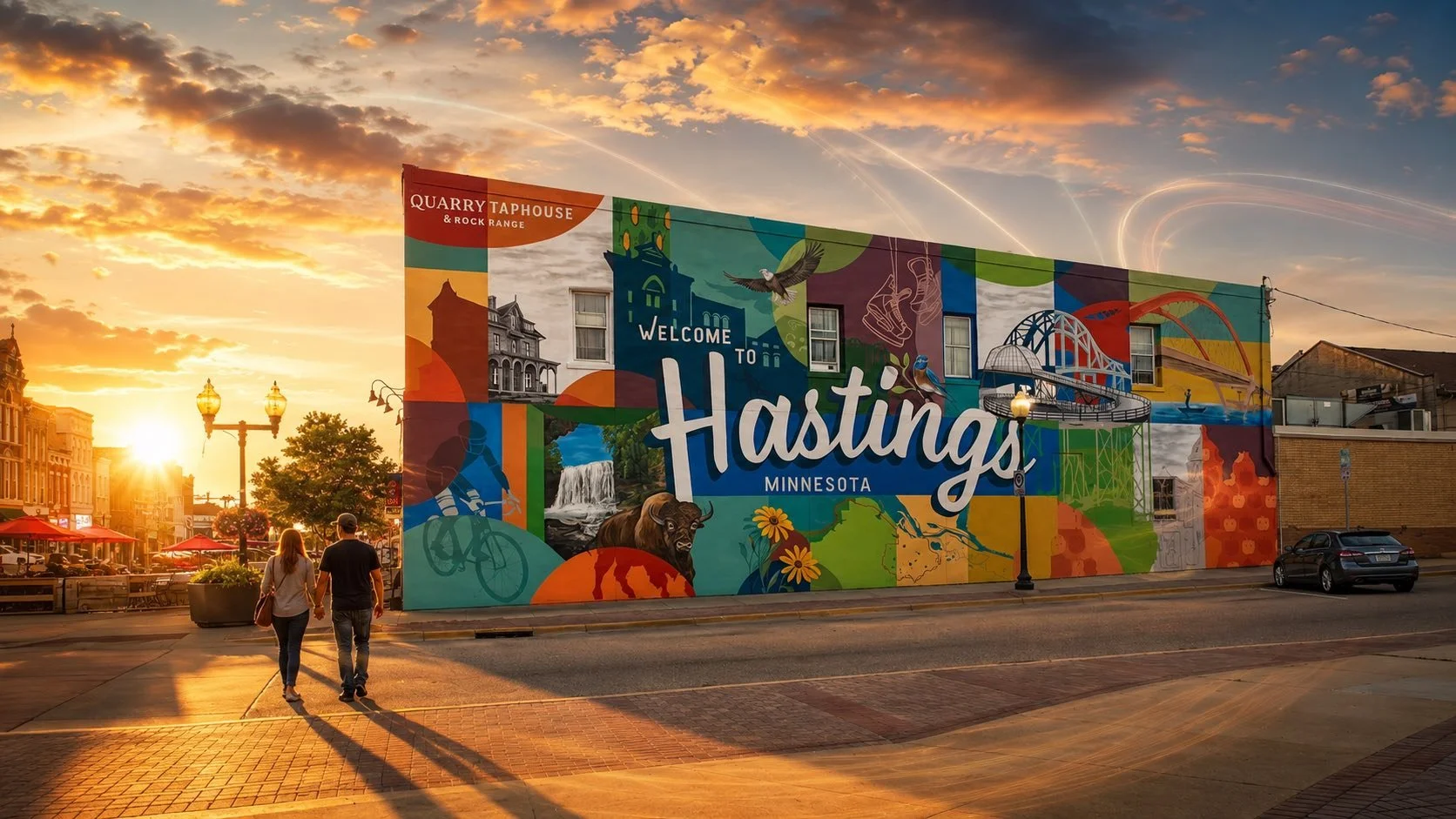
Local stories are found in the heart of downtown Hastings, MN. AI image by HastingsNow.com
What a conversation about neuroscience and AI reveals about Hastings businesses, local trust, and the future of being found online.
The internet remembers a lot. That does not mean it understands.
A business can have a website. A Google Business Profile. A Facebook page. A menu PDF. A few dozen photos. A phone number. Maybe a review section that says “friendly staff” and “great service” so many times it begins to sound like the internet is filling out a worksheet.
But ask a real person in Hastings why they go back to a place, and the answer usually sounds different.
“I like how Barb helps you find the right toy when you have no idea what to buy.”
“David makes El Mexican feel like a place where you can bring your family and relax.”
“Hyggefullr makes more sense when you step inside. It’s coffee, but it’s also design, warmth, and a different kind of downtown pause.”
“Caring Hands made me feel comfortable before I booked.”
“Pure Serenity helped me understand what wellness could look like without making me feel weird about asking questions.”
That kind of knowledge does not live neatly in a database. It lives in memory.
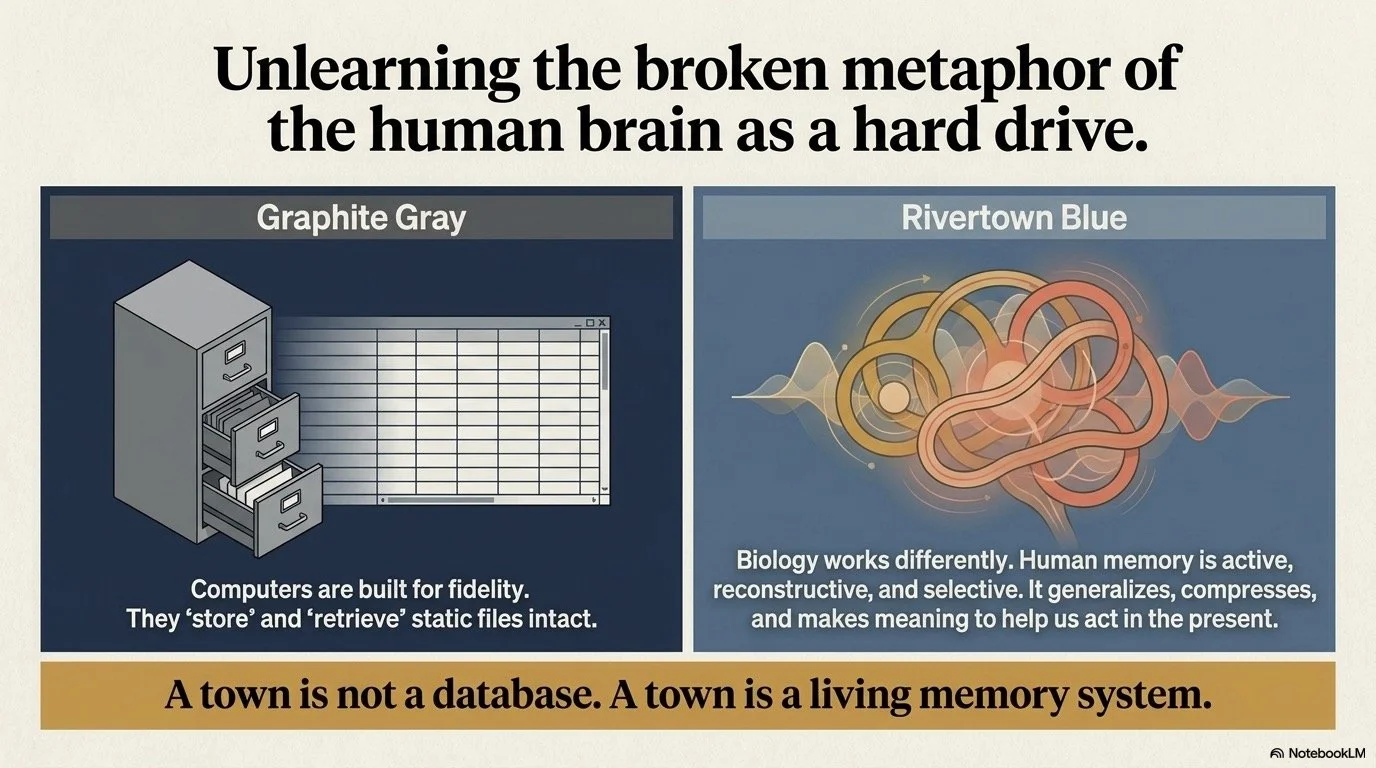
And here is the strange thing modern neuroscience keeps teaching us: memory is not a hard drive. It is not a perfect recording. It is not a filing cabinet in the skull. Memory is active. It is interpretive. It is reconstructed in the present. It keeps what matters, compresses what repeats, reshapes what does not fit, and turns episodes into meaning.
That idea may sound like the opening of a college psychology lecture. But it may also be one of the most important ideas for the future of Hastings businesses.
Because in the age of AI search, answer engines, social feeds, and digital assistants, the question is no longer simply:
“Can people find your business online?”
The better question is:
When the internet tries to remember your business, does it remember you correctly?
That is where local stories matter. That is where owner voices matter. That is where HastingsNow.com and Local Pigeon have an opening to do something that is not merely useful, but genuinely world-class.
1. The broken metaphor: memory is not a hard drive
For decades, we have talked about memory as if the brain were a computer.
We “store” memories. We “retrieve” memories. We “save” information. We “upload” photos. We “back up” files. We ask children, employees, witnesses, students, and grandparents to “recall” things as if the past were sitting somewhere intact, waiting to be pulled from a shelf.
Computers are built for fidelity. If you save a spreadsheet, you want the same spreadsheet tomorrow. If your phone corrupts your photos and invents three extra cousins at Thanksgiving, you do not call that creativity. You call Apple support and begin a quiet emotional spiral.
Biology works differently.
Human memory is not designed to preserve the past in perfect detail. It is designed to help a living organism act. It helps us recognize patterns, avoid danger, find food, maintain relationships, make plans, and understand what kind of world we are living in.
That means memory is useful precisely because it is selective.
A person does not remember every single thing about a restaurant visit. They remember the feeling of being welcomed. The way the chips arrived quickly. The moment someone explained the menu. The sense that it was easy to bring kids. The fact that the server did not make them feel rushed.
A grandparent does not remember every item on the shelf at a toy store. They remember that Barb helped them stop panicking about a birthday gift.
A customer does not remember every word on a massage spa website. They remember whether they felt safe enough to book.
This is not a failure of memory. This is what memory is for.
Psychologist Frederic Bartlett argued as far back as the 1930s that remembering is reconstructive: people recall events through existing patterns, expectations, and social meanings, not by replaying perfect recordings [1]. Later research on false memory, suggestibility, and source confusion showed that memory can be altered by later information, leading questions, and current beliefs [2]. Daniel Schacter famously organized memory’s failures into “sins,” including transience, misattribution, suggestibility, bias, and persistence [3].
But calling them “failures” only tells half the story. The same features that make memory imperfect also make it adaptive. We generalize. We infer. We compress. We connect. We make meaning.
That is why a town is not a database.
A town is a living memory system.
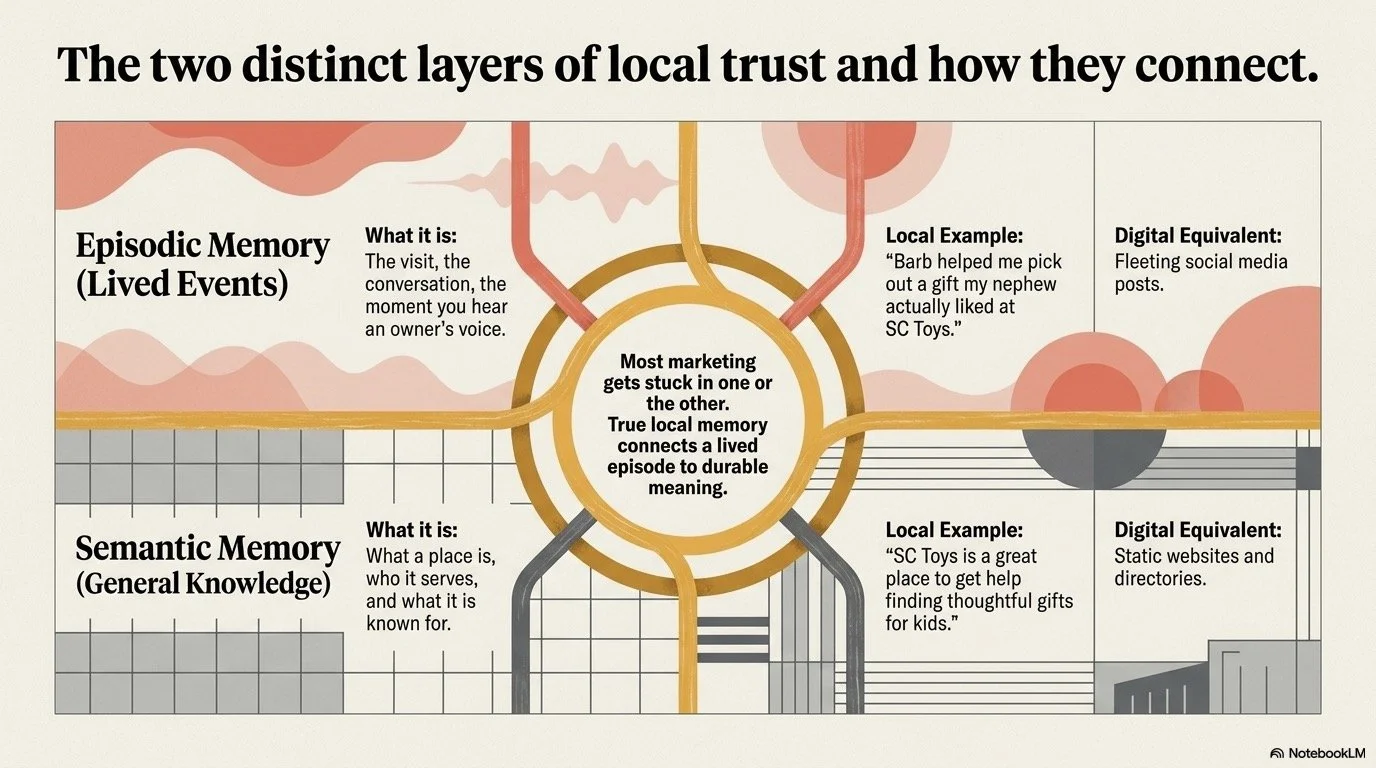
2. Episodic memory and semantic memory: the two layers of local trust
One of the most useful distinctions in memory research is the difference between episodic memory and semantic memory.
Episodic memory is memory for lived events: the visit, the conversation, the ribbon cutting, the lunch, the photo shoot, the walk downtown, the game, the class, the fundraiser, the moment you heard someone explain something in their own voice.
Semantic memory is memory for meaning and general knowledge: what a place is, what it does, why it matters, who it serves, what people should expect, what category it belongs to, and what it is known for.
In local life, both matter.
An episode sounds like this:
“I stopped into SC Toys on a rainy Saturday and Barb helped me pick out something my nephew actually liked.”
The semantic memory that forms afterward sounds like this:
“SC Toys is a great place to get help finding thoughtful gifts for kids.”
An episode sounds like this:
“I tried El Mexican for lunch and David recommended something I never would have ordered.”
The semantic memory becomes:
“El Mexican is a welcoming downtown Hastings spot where first-timers can ask for help and find something good.”
An episode sounds like:
“I walked into Hyggefullr and finally understood the combination of coffee, furniture, and comfort.”
The semantic memory becomes:
“Hyggefullr is not just a coffee shop; it is a crafted downtown experience.”
This distinction matters because most local marketing gets stuck in semantic memory. It tries to summarize the business:
Family-owned.
Great service.
Local favorite.
Quality products.
Friendly staff.
Convenient location.
Serving Hastings since whenever.
That is fine, but it is thin. It is meaning without enough lived evidence.
On the other side, social media often gets stuck in episodic memory. It shows the day’s photo, the current special, the latest reel, the event reminder, the “we’re open!” post. That is fine, too, but it is fleeting. It is a moment without enough lasting structure.
The real opportunity is to connect the two.
A Soundbite is episodic. A Brand Source Profile is semantic. HastingsNow can turn local episodes into durable local meaning.
That is a powerful idea.
It means a 30-second owner recording is not just “content.” It is a memory packet. It captures a real answer from a real person at a real moment in a real place. Then Local Pigeon can structure that answer so residents, search engines, AI systems, and future customers understand what it means.
That is not social posting.
That is local memory work.
3. Why this matters now: AI search is becoming interpretive memory
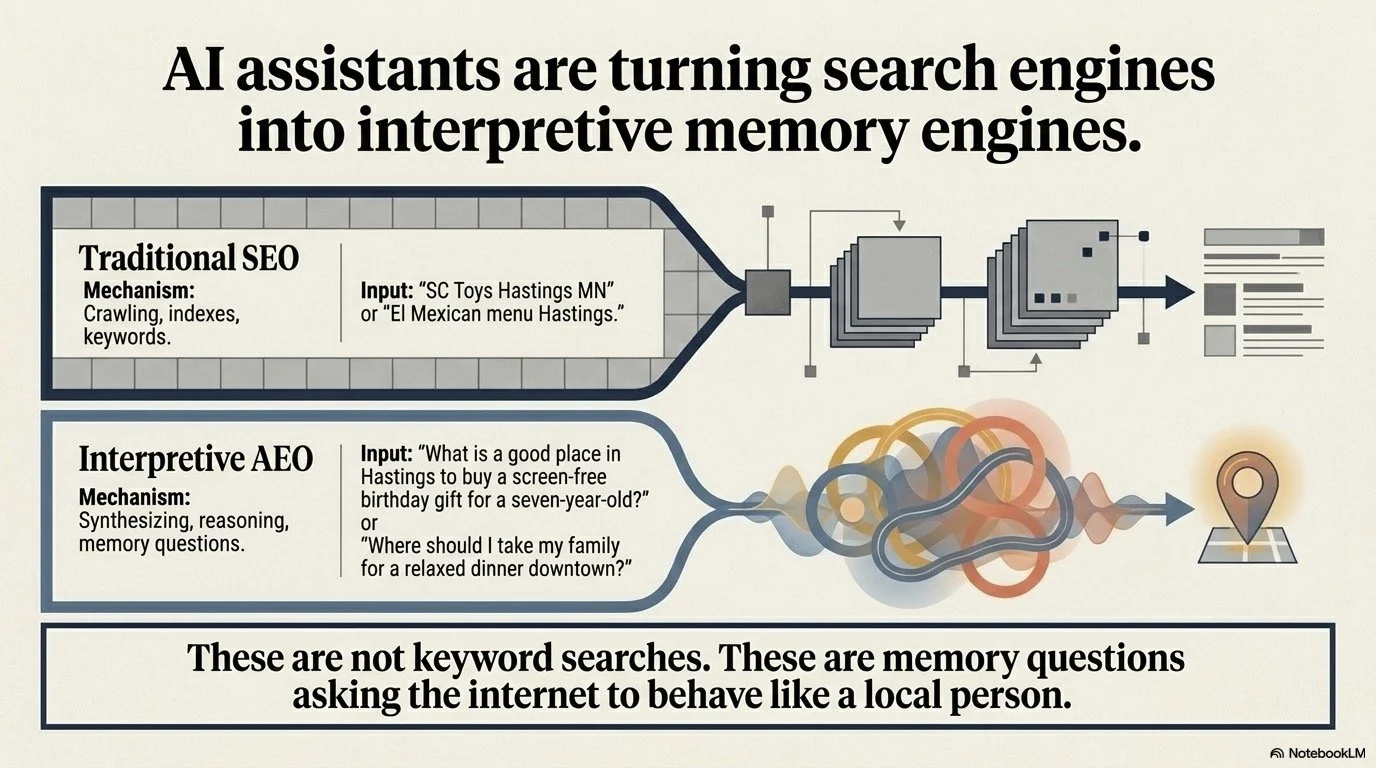
For years, businesses optimized for search engines that acted mostly like indexes. Google crawled pages, ranked links, and sent people toward sources. Local SEO was about complete business information, accurate hours, categories, reviews, links, proximity, and relevance.
Those basics still matter. Google still says local results are shaped mainly by relevance, distance, and prominence. Google also tells businesses to keep profiles accurate, update hours, respond to reviews, add photos and videos, and provide detailed business information [4].
But search is changing.
AI Overviews, AI Mode, ChatGPT, Gemini, Perplexity, Siri, and other assistants are turning search into something more like interpretation. Instead of only listing links, these systems increasingly synthesize answers.
A customer may not search:
“SC Toys Hastings MN”
They may ask:
“What is a good place in Hastings to buy a screen-free birthday gift for a seven-year-old?”
They may not search:
“El Mexican menu Hastings”
They may ask:
“Where should I take my family for a relaxed dinner in downtown Hastings?”
They may not search:
“Hyggefullr coffee furniture”
They may ask:
“What is that cozy coffee and furniture place in downtown Hastings, and is it good for a first visit?”
Those are not keyword searches. Those are memory questions.
They ask the internet to behave like a local person.
That is the danger and the opportunity.
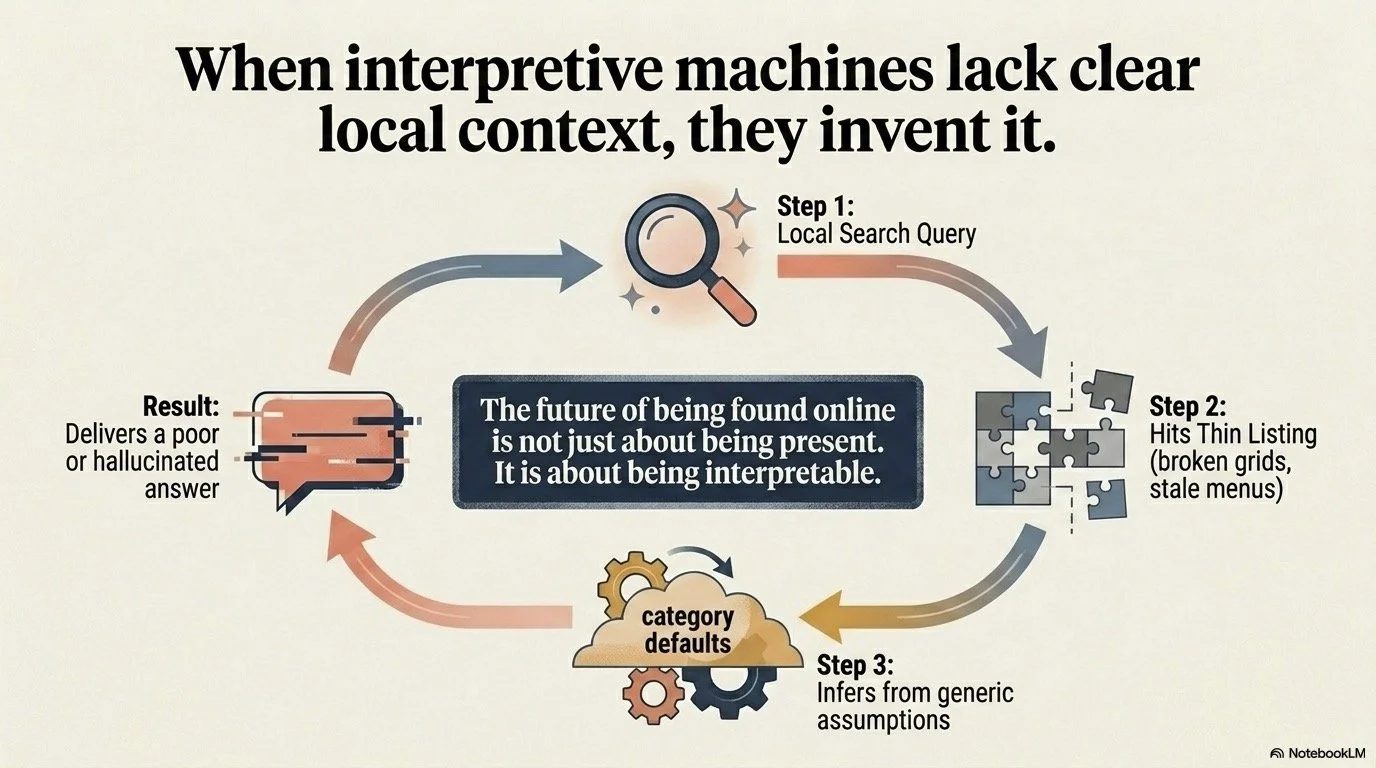
If AI systems do not have clear, trustworthy, current local information, they will infer from whatever they can find. They may lean on old pages, thin listings, review fragments, stale menus, partial social bios, or generic category assumptions. The machine will still answer. It may simply answer badly.
So the future of being found online is not just about being present. It is about being interpretable.
Local businesses need to give the internet better memory.
4. Hastings is exactly the kind of place where memory matters
Hastings is not a faceless market. It is a river town, a county seat, a downtown, a school community, a set of neighborhoods, a place where families bump into each other at events, games, church basements, coffee shops, parks, fundraisers, and 2nd Street storefronts.
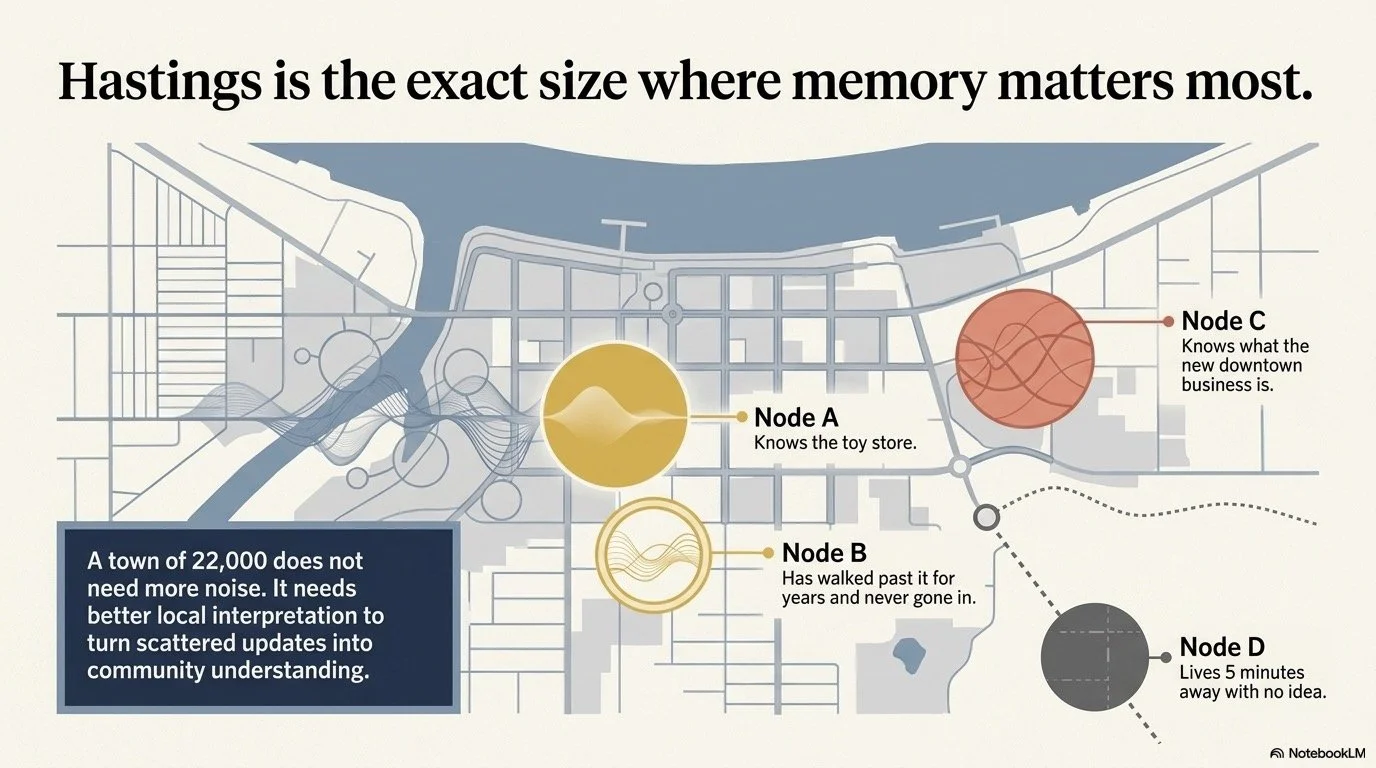
The U.S. Census Bureau estimates Hastings at roughly 22,500 residents in 2024, with a 2020 Census population of 22,154. That is small enough for reputation to matter and large enough for discovery to be imperfect [5].
In other words: people know things, but not everyone knows the same things.
One resident knows the toy store. Another has walked past it for years and never gone in. One family knows the best thing to order at a restaurant. Another is still reading the menu in the car. One person knows which nonprofit needs volunteers. Another would help if they understood the need. One downtown regular knows what a new business is. Someone who lives five minutes away may have no idea.
That is the HastingsNow opportunity.
A town of 22,000 people does not need more noise. It needs better local interpretation.
It needs someone to turn scattered updates into community understanding.
It needs someone to ask:
What are people trying to figure out?
What do local owners know that customers do not?
What should residents remember this week?
What should AI systems understand about our town before they start summarizing it?
That last question may sound futuristic, but it is already here.
The web is becoming a giant answer engine. Local knowledge that is not structured, repeated, sourced, human, and current will be underrepresented. Not because anyone hates small towns. Because machines rely on available signals, and local knowledge is often trapped in people’s heads.
Hastings has plenty of intelligence. It is just not evenly digitized.
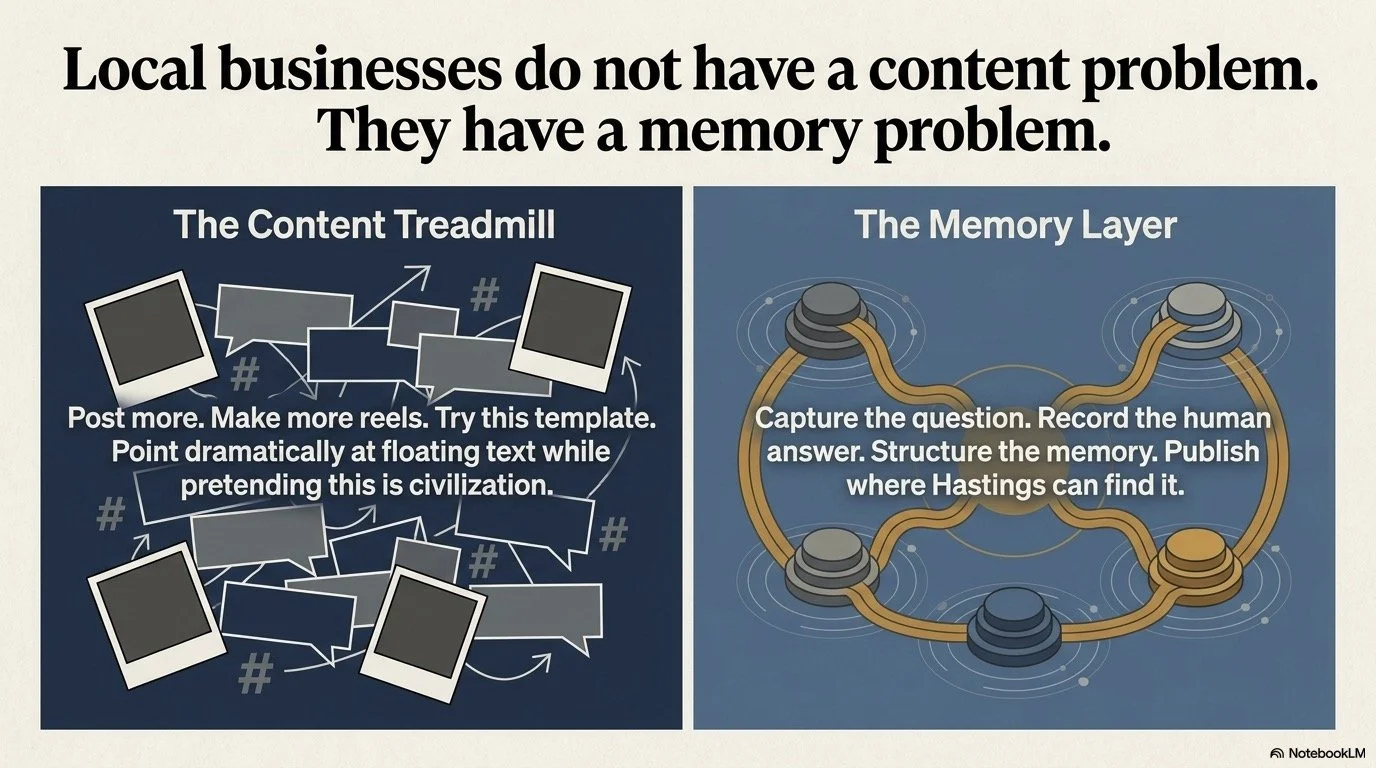
5. Local businesses do not have a content problem. They have a memory problem.
Most small businesses are told they need more content.
Post more.
Make more reels.
Send more emails.
Write more blogs.
Update more often.
Try this trend.
Try that template.
Use this hashtag.
Point dramatically at floating text while a trending audio clip plays in the background and everyone pretends this is civilization.
But many local businesses do not need “more content” in the abstract.
They need their most useful knowledge captured in a form that customers can actually find later.
They need to answer the questions people already ask:
What should I order first?
What should I buy for a kid this summer?
What happens during my first appointment?
How do I know which service is right for me?
Can you help with a party, group, gift, donation, repair, class, or special situation?
What do people misunderstand about your business?
What makes this place different once someone actually visits?
What should people know before they stop in?
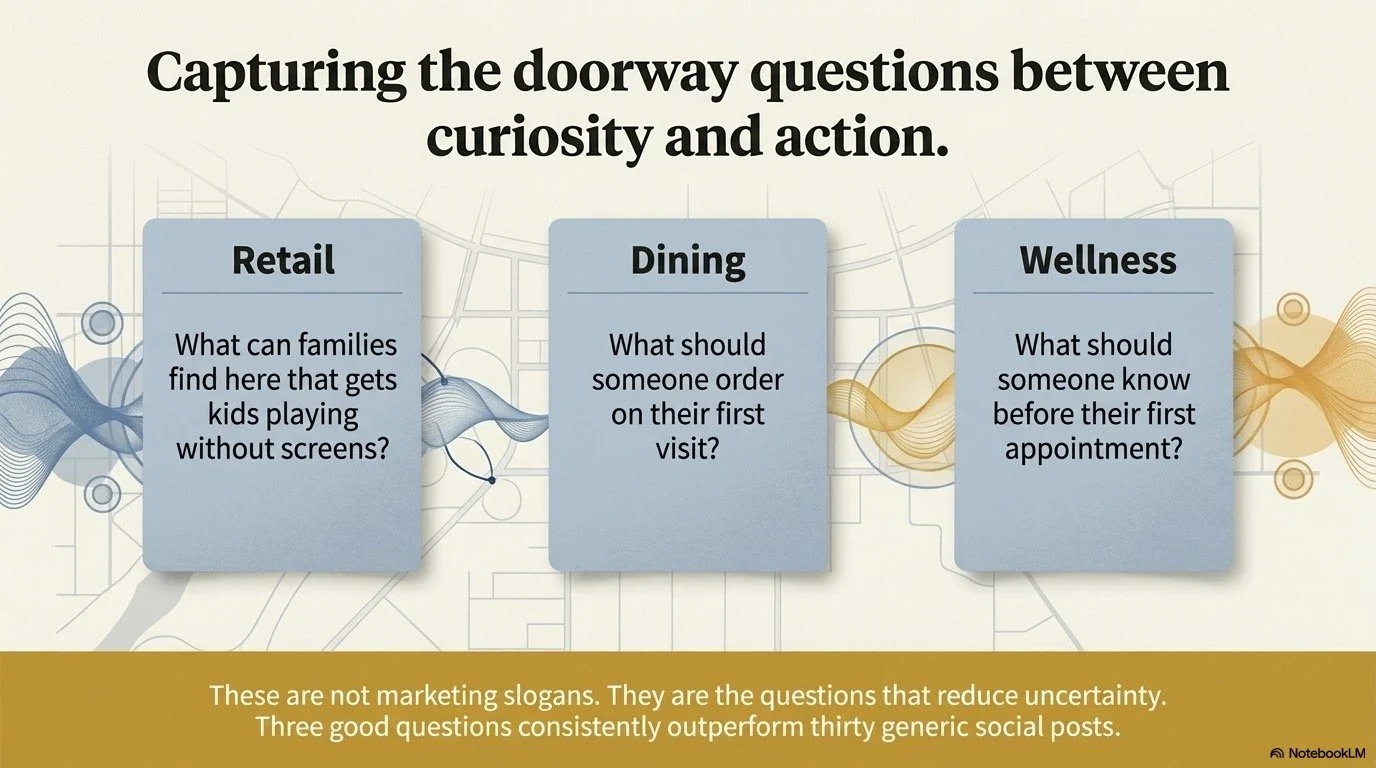
These questions are gold because they are not marketing slogans. They are the doorway questions between curiosity and action.
A person does not become a customer all at once. They move through uncertainty.
“Is this for me?”
“Will I feel awkward?”
“What do I ask for?”
“Will they help me?”
“Do I need an appointment?”
“Is it kid-friendly?”
“Is it expensive?”
“Do I have to know what I’m doing?”
“Can I just stop in?”
Local Pigeon can be best-in-the-world at finding those questions, handing them to local owners, and turning the answers into trusted local memory.
That is the job.
Not “make content.”
Capture the question. Record the human answer. Structure the memory. Publish it where Hastings can find it.
6. Why voice changes everything
Text is useful. Photos are powerful. Video is emotional. But voice has a special kind of trust.
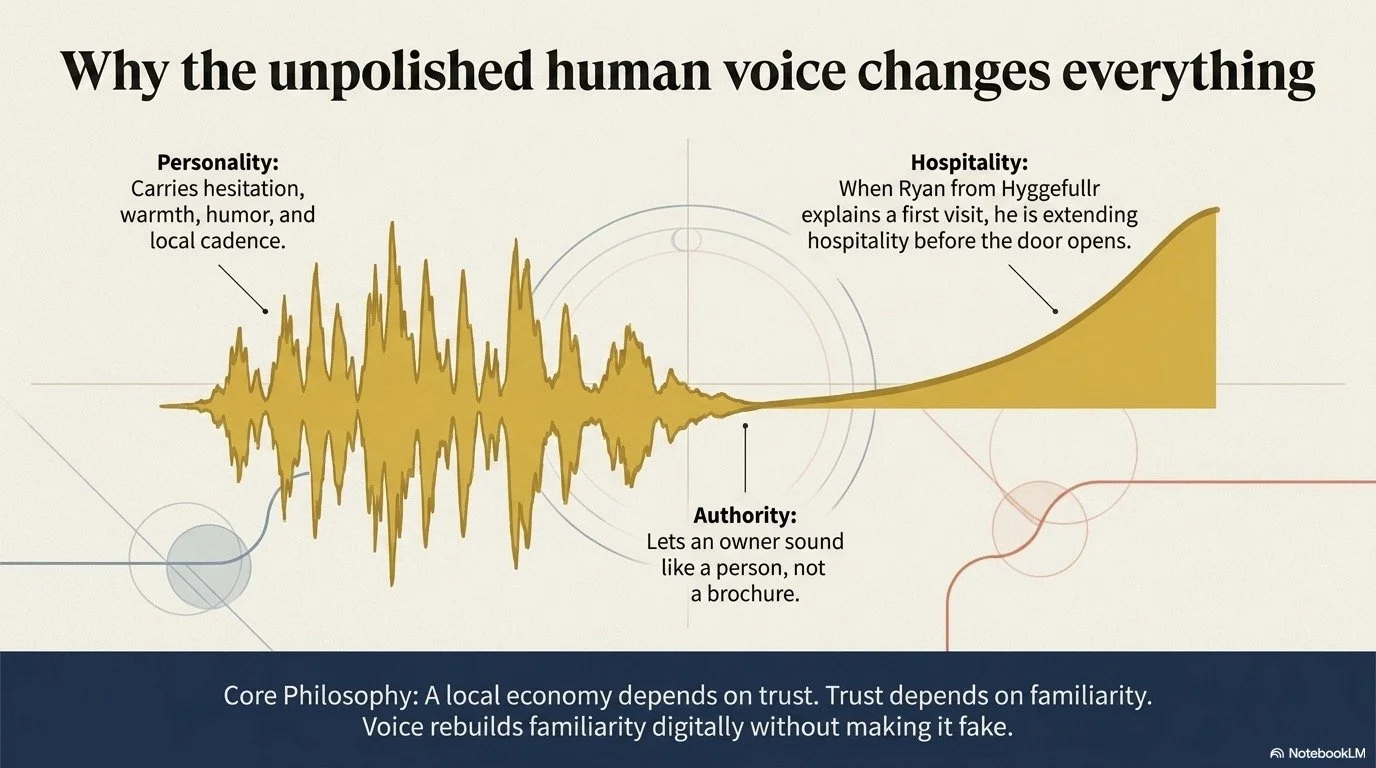
A short voice answer carries hesitation, warmth, humor, personality, confidence, care, and local cadence. It lets a business owner sound like a person instead of a brochure.
That matters in a town like Hastings.
When Barb from SC Toys answers a question about summer gifts, she is not merely generating a product recommendation. She is letting a parent or grandparent hear how she thinks.
When David Perez answers what a first-time guest should order at El Mexican, he is not merely describing menu items. He is reducing uncertainty.
When Ryan from Hyggefullr explains what someone should know before a first visit, he is not merely clarifying a concept. He is extending hospitality before the customer even opens the door.
That is a commercial act, but it is also a civic act.
A local economy depends on trust. Trust depends on familiarity. Familiarity depends on repeated, meaningful exposure.
In the past, that exposure happened naturally. People talked at the hardware store, the café, the school pickup line, the church basement, the bleachers, the riverfront, the parade, the neighborhood barbecue. Those networks still exist, but attention has fragmented. Many residents now learn about local life through feeds, search, maps, groups, texts, and algorithmic recommendations.
Local Pigeon can rebuild some of that familiarity digitally without making it fake.
It can let Hastings hear itself again.
7. The “world as its own model” and why local reporting beats generic AI
One of the most interesting ideas from the AI/neuroscience conversation that inspired this piece is the suggestion that the world can serve as its own model.
That sounds abstract, but it is practical.
A robot does not need to internally simulate every possible detail of a room if it can look, touch, update, and respond. A person does not need a perfect stored map of downtown if they can walk there, notice changes, ask someone, and adjust.
Likewise, HastingsNow does not need to invent a giant, perfect encyclopedia of Hastings in one sitting.
It needs a living system that keeps returning to the world.
Visit the business.
Ask the owner.
Capture the answer.
Take the photo.
Record the event.
Update the profile.
Publish the Soundbite.
Listen to what residents ask next.
Repeat.
That is continual learning.
It is not the same as training a giant AI model once and hoping it knows everything. It is more like how a town actually knows itself: through repeated contact.
This is where Local Pigeon can separate itself from generic AI marketing tools.
A generic tool can write a Facebook caption for a toy store.
Local Pigeon can ask Barb what grandparents are actually asking this week.
A generic tool can write “Enjoy authentic Mexican cuisine.”
Local Pigeon can ask David what a nervous first-time guest should order.
A generic tool can write “Visit our cozy coffee shop.”
Local Pigeon can ask Ryan what people understand only after stepping inside Hyggefullr.
That is the difference between synthetic content and local memory.
8. What Local Pigeon can be best-in-the-world at
Local Pigeon should not try to be the best social scheduler, the best CRM, the best website builder, the best ad platform, or the best generic AI copywriter. Those are crowded categories with giant competitors and a thousand dashboards that make small business owners quietly question their life choices.
Local Pigeon can be best-in-the-world at something narrower and more valuable:
Local Pigeon can be the best system in the world for turning small-town owner knowledge into trusted, searchable, human answers.
That is specific. That is defensible. That is emotionally clear.
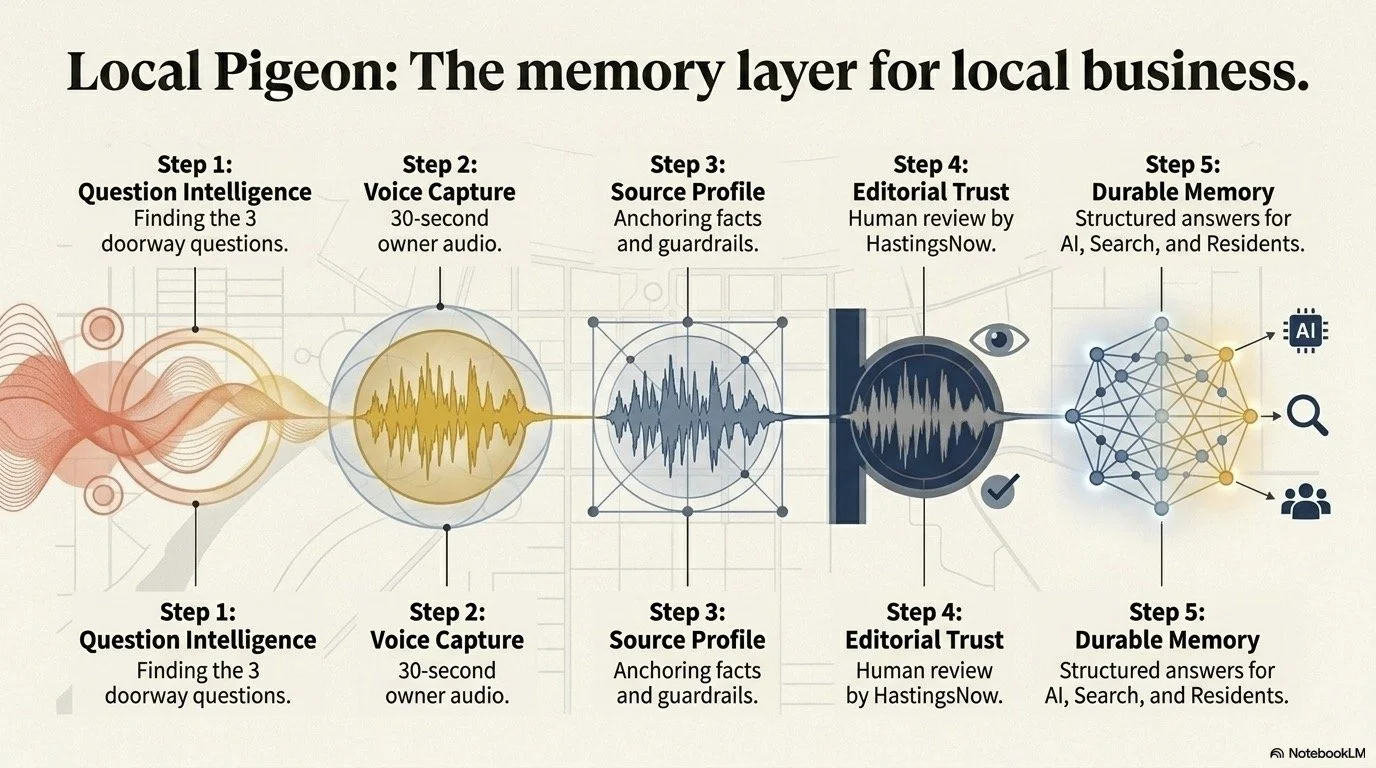
It has five parts.
First: question intelligence
Local Pigeon should know the best three questions a business should answer this month.
Not fifty prompts. Not a content calendar that feels like homework. Three questions.
For a toy store in summer:
“What is a great summer toy or gift idea for kids right now?”
“What can families find here that gets kids playing without screens?”
“Why should families stop in while visiting downtown Hastings?”
For a restaurant:
“What should someone order on their first visit?”
“What makes this a good spot for families or friends?”
“Can you help with catering, parties, or group meals?”
For a wellness business:
“What should someone know before their first appointment?”
“What problem do people usually wait too long to ask about?”
“How do you help people feel comfortable?”
Three good questions can outperform thirty generic posts.
Second: owner voice capture
The recorder must remain simple enough that an owner can answer while standing near the counter, between customers, without feeling like they are producing a documentary for PBS.
Pick an idea.
Record 30 seconds.
Submit.
Review.
Publish.
That is the magic.
Third: source-backed profiles
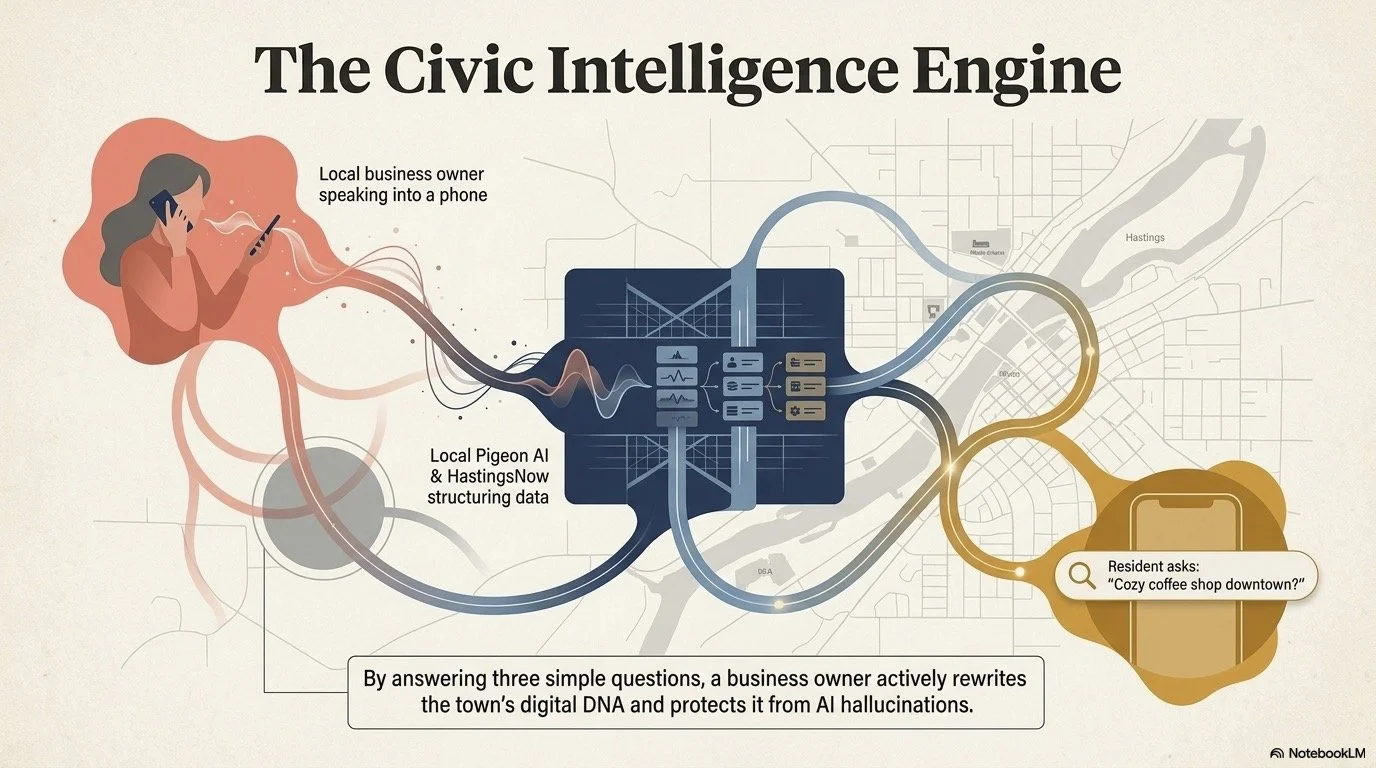
Each business needs a Brand Source Profile that stores the stable facts: website, services, address, preferred CTA, social links, review themes, guardrails, seasonal hooks, and customer questions.
This is where Local Pigeon becomes more than content. It becomes structured local knowledge.
Fourth: editorial trust
HastingsNow adds the human layer. It reviews, contextualizes, edits, organizes, photographs, and publishes. It prevents the platform from becoming another firehose.
This is crucial. AI-generated local content without editorial trust becomes slop wearing a nametag.
Fifth: local distribution
A great answer should not die in a dashboard. It should become a Soundbite, a Local Update, a HastingsNow post, a social card, a business profile update, and eventually part of a local answer layer that helps residents and search engines understand Hastings.
That is the system.
Question → voice → source profile → editorial review → local distribution → durable memory.
That is Local Pigeon.
9. Why this is good for businesses
For local brands, the value is immediate.
A business owner does not need to become an influencer. They do not need to dance. They do not need to write a blog post. They do not need to study SEO at midnight while wondering why Google has named another product something that sounds like a printer cartridge.
They only need to answer a real question.
That answer can then support:
Local SEO.
AI search visibility.
Customer education.
Social media.
Website FAQs.
Google Business Profile posts.
Sales conversations.
Email newsletters.
Staff training.
Seasonal promotions.
Community trust.
The best part is that the content starts with actual usefulness.
A customer asks, “What should I try first?”
The owner answers.
That is the most honest form of marketing: helping someone understand enough to take the next step.
10. Why this is good for residents
For residents, the benefit is less obvious but maybe more important.
Local Pigeon can make Hastings easier to understand.
That sounds small until you think about how many times people miss things simply because they did not know:
A business had changed hours.
A restaurant offered catering.
A toy store could help with birthday gifts.
A wellness service was less intimidating than it sounded.
A nonprofit needed donations.
A school event was open to the community.
A local shop had exactly what they were about to order online.
A downtown event was happening this weekend.
A job was available five minutes from home.
A town can have abundance and still suffer from local amnesia.
People forget what is nearby. They forget who can help. They forget what is open. They forget what happened last year. They forget what a business is actually good at. They forget the story behind the storefront.
HastingsNow can help residents remember.
Not in a sentimental “wasn’t everything better in 1987?” way, although we reserve the right to be emotionally vulnerable about old pizza places.
In a practical way.
Here is what is happening.
Here is who is doing it.
Here is what to ask.
Here is why it matters.
Here is how to participate.
That is civic value.
11. Why this is good for HastingsNow
For HastingsNow, the opportunity is to become the trusted interpreter of local life.
Not just a feed.
Not just a blog.
Not just a business directory.
Not just a gallery.
Not just a weather post.
Not just a Facebook page with better intentions.
A local memory system.
HastingsNow can own the category of:
“What should Hastings know today, and what should Hastings remember later?”
That includes daily updates, photo galleries, business Soundbites, event recaps, owner interviews, weather and local history, school coverage, nonprofit needs, and downtown features.
The editorial advantage is enormous because national platforms do not care enough to do this well. Google can map Hastings. Facebook can host Hastings. AI can summarize Hastings. But none of them can love Hastings.
That may sound soft, but it is strategically hard.
Love creates attention to detail.
Attention to detail creates trust.
Trust creates participation.
Participation creates better source material.
Better source material creates better local memory.
This is how a small local media company can build something larger platforms cannot easily copy.
12. The Local Memory Demo: a practical offer
The most practical next step is to turn this philosophy into a simple product.
Call it:
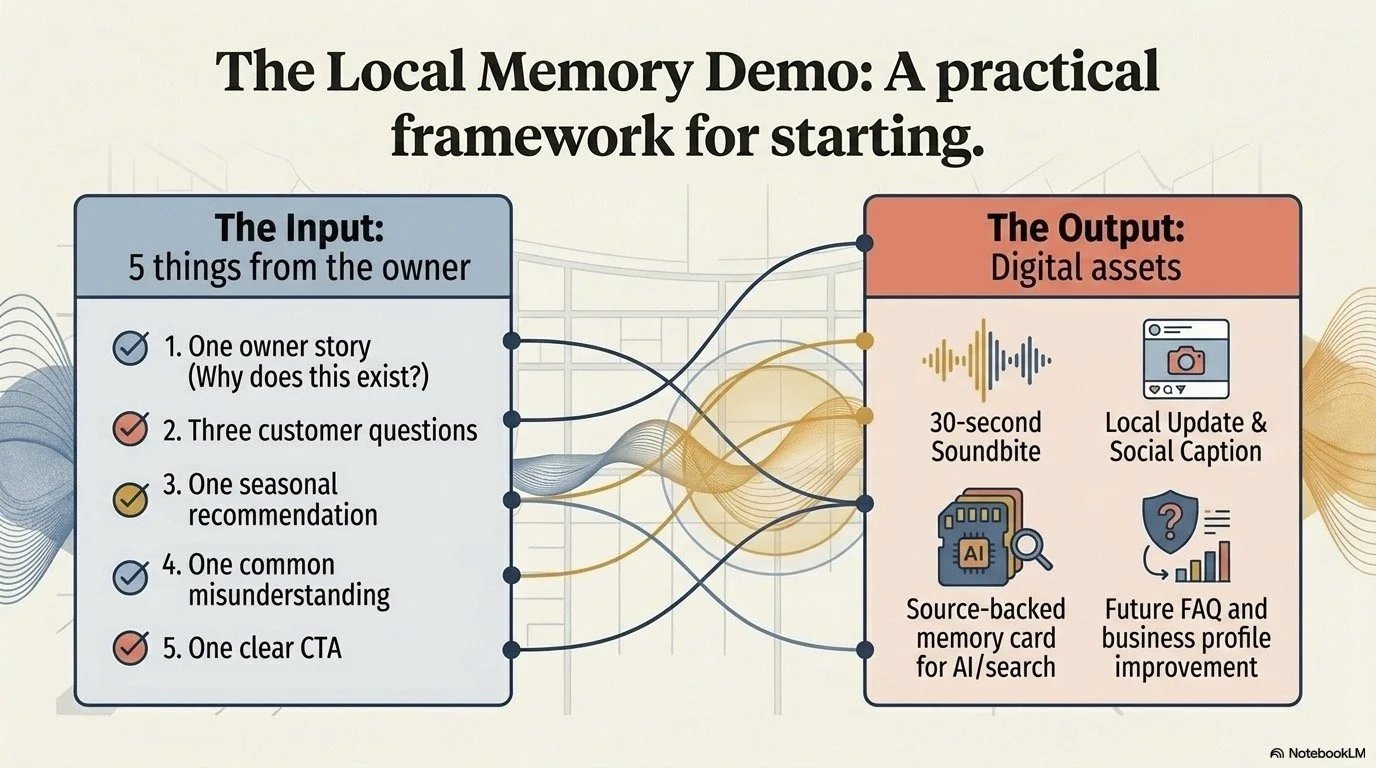
The Local Memory Demo
For each business, capture five things:
One owner story
“Why does this business exist, and what do you want people to feel?”Three customer questions
The three most useful things residents want to know before visiting, booking, buying, donating, or sharing.One seasonal recommendation
A timely, current answer: summer toy, first order, patio visit, gift idea, appointment tip, event reminder.One misunderstanding
“What do people often misunderstand until they talk to you?”One clear CTA
Visit, call, book, order, RSVP, donate, apply, ask, learn more.
From that, HastingsNow and Local Pigeon can create:
A 30-second Soundbite.
A Local Update.
A business profile improvement.
A short social caption.
A future FAQ.
A source-backed memory card for AI/search.
A reason for residents to care.
That is simple enough to sell and deep enough to matter.
13. AEO/GEO/SEO: how to make local stories findable in the AI era
The technical side still matters. But the strategy should begin with people.
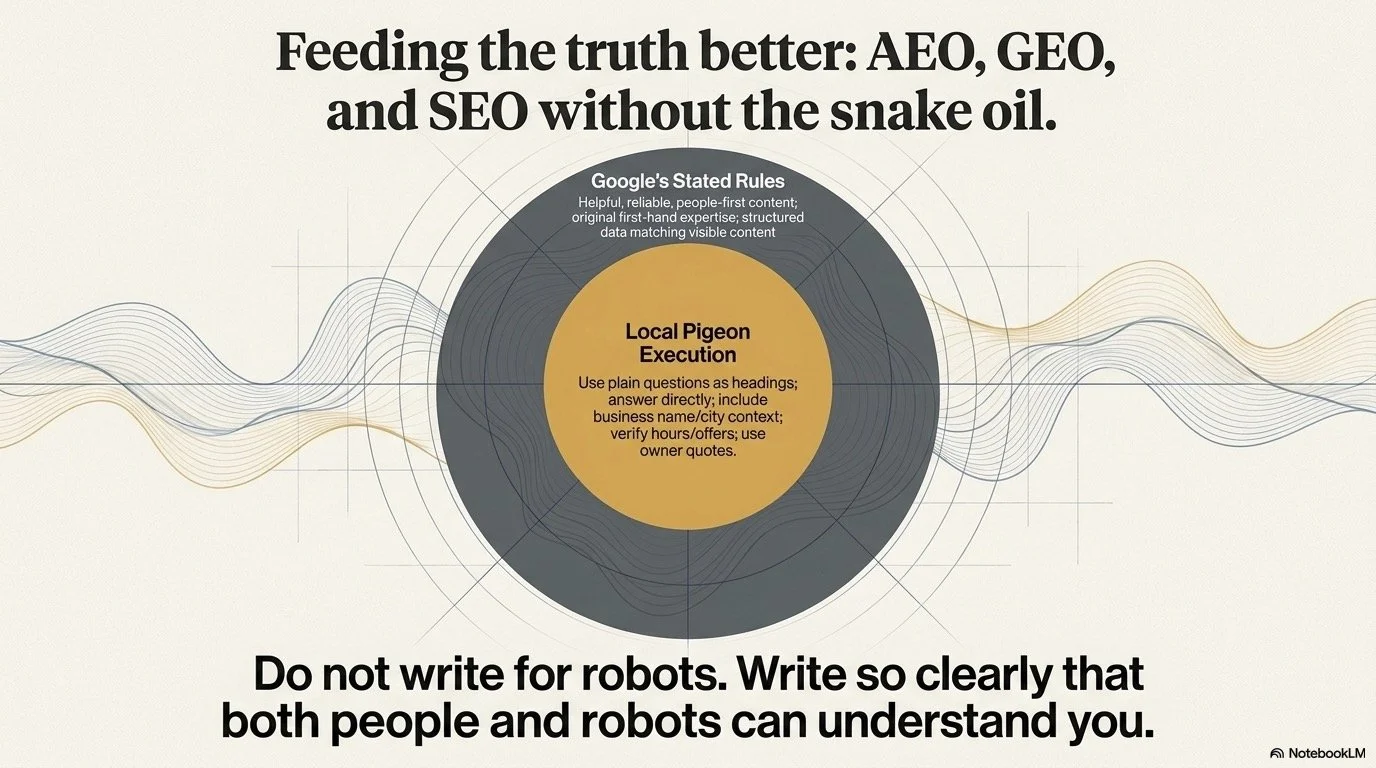
Google says helpful, reliable, people-first content should provide original information, reporting, research, analysis, clear sourcing, first-hand expertise, and enough detail to help someone achieve a goal [6]. Google also says that for AI features like AI Overviews and AI Mode, traditional SEO fundamentals still apply: make important content available in textual form, use internal links, provide good page experience, keep Business Profile information current, and ensure structured data matches visible content [7].
That lines up almost perfectly with the Local Pigeon model.
A good Soundbite should become text.
The text should answer a real question.
The page should identify the business and speaker.
The claim should be source-backed or owner-confirmed.
The CTA should be clear.
The page should link to the business.
The business profile should stay current.
The answer should be useful to a human first.
This is not tricking AI.
It is feeding the truth better.
For local businesses, the new rule is:
Do not write for robots. Write so clearly that both people and robots can understand you.
That means:
Use plain questions as headings.
Answer directly before adding story.
Include the business name, city, and service context.
Avoid vague hype.
Verify hours, prices, offers, and availability.
Use owner quotes when possible.
Update stale pages.
Make images and transcripts accessible.
Link to source pages.
Keep the answer short enough to be useful and rich enough to be trusted.
That is GEO/AEO/SEO without the snake oil.
14. The ethical line: do not let AI invent the town
There is also a warning here.
If memory is interpretive, and AI systems are increasingly helping people interpret the world, then bad local information can become bad local memory.
An old menu becomes a wrong recommendation.
A stale event becomes a fake event.
A copied review becomes a misleading claim.
An AI-written business description becomes a bland hallucination.
A social rumor becomes “what people say.”
A missing business becomes invisible.
This is why HastingsNow’s editorial role matters.
Local Pigeon should not simply automate local content. It should verify, constrain, and humanize it.
A good rule:
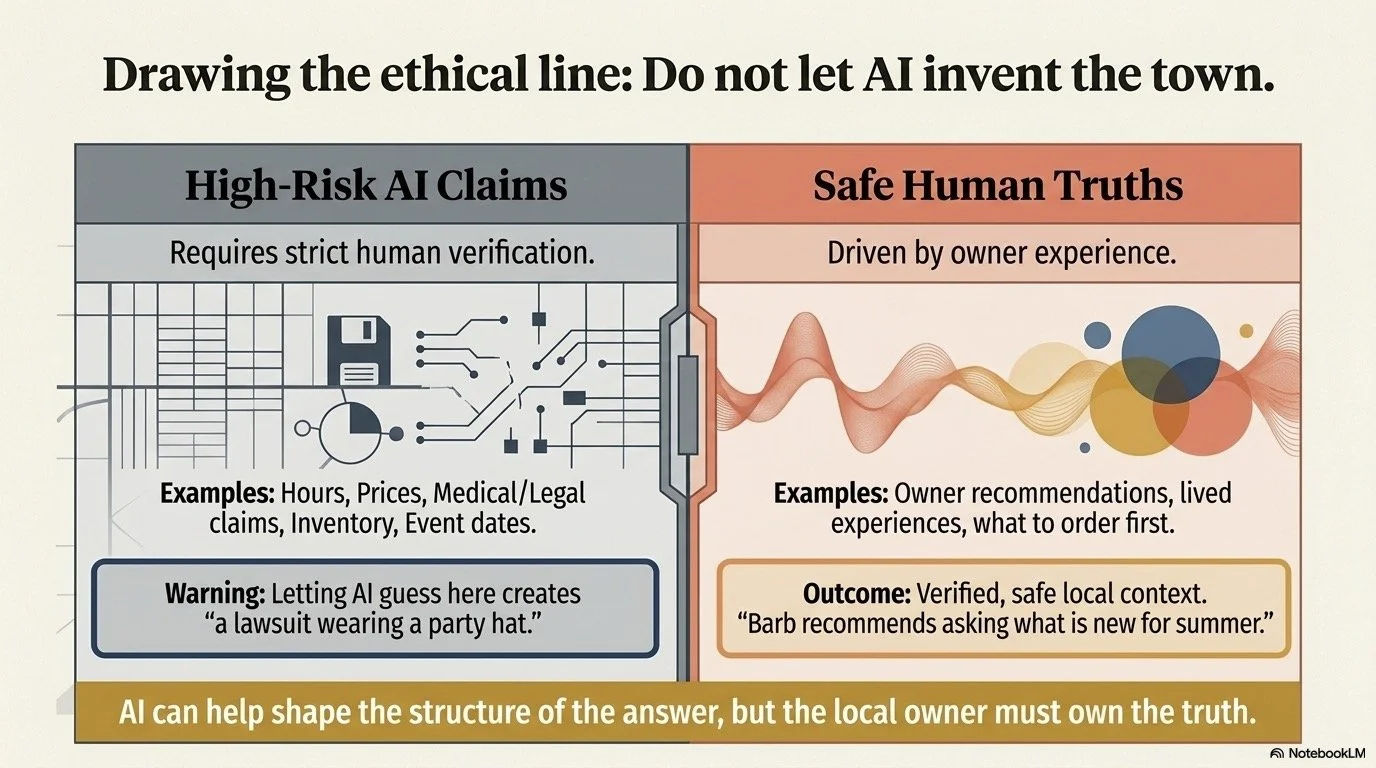
AI can help shape the answer, but the owner must own the truth.
That means Local Pigeon should be strict about high-risk claims:
Hours.
Prices.
Availability.
Medical claims.
Legal claims.
Financial claims.
Menu items.
Inventory.
Event dates.
Discounts.
Awards.
Safety claims.
Children’s stories or photos.
The safest and strongest local content is not over-polished. It is verified.
“Barb recommends stopping in to ask what is new for summer.”
That is safe.
“SC Toys has the best toy in Minnesota guaranteed to make every child brilliant by Tuesday.”
That is not a Soundbite. That is a lawsuit wearing a party hat.
Trust is the product.
Protect it.
15. The deeper civic idea: a town needs memory to act
Communities do not only need news. They need memory.
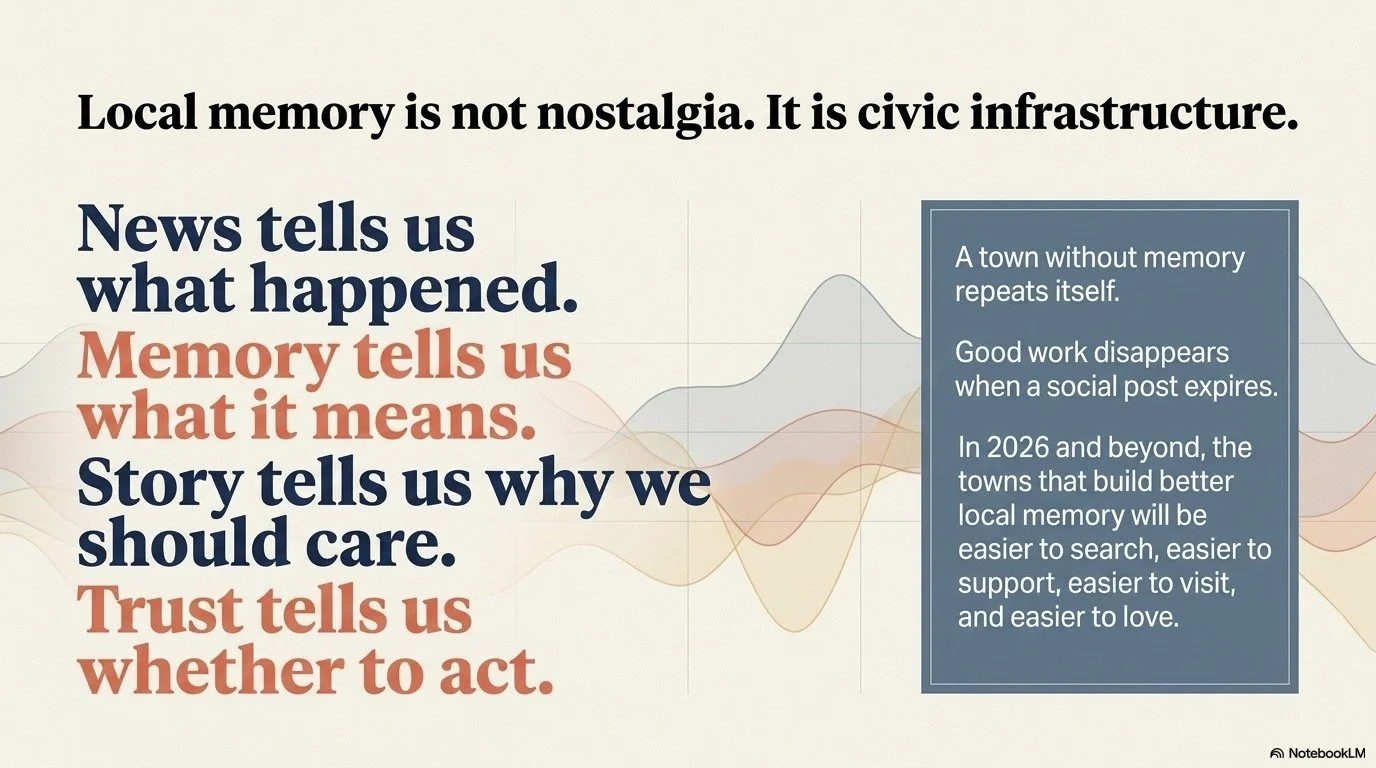
News tells us what happened.
Memory tells us what it means.
Story tells us why we should care.
Trust tells us whether to act.
A town without memory repeats itself. Committees relearn the same lessons. Businesses fight for attention from scratch every season. Residents miss opportunities. Newcomers struggle to understand local culture. Good work disappears after a social post expires. Institutions lose continuity when staff or volunteers change.
A town with better memory gets smarter.
It remembers what worked at the last event.
It remembers which businesses helped.
It remembers who needs volunteers.
It remembers how downtown changed.
It remembers what residents asked.
It remembers the owner’s explanation.
It remembers the human reason behind the listing.
That is not nostalgia. That is infrastructure.
Local memory is civic infrastructure.
And in 2026 and beyond, the towns that build better local memory will be easier to search, easier to support, easier to visit, easier to join, and easier to love.
16. What should Hastings businesses do now?
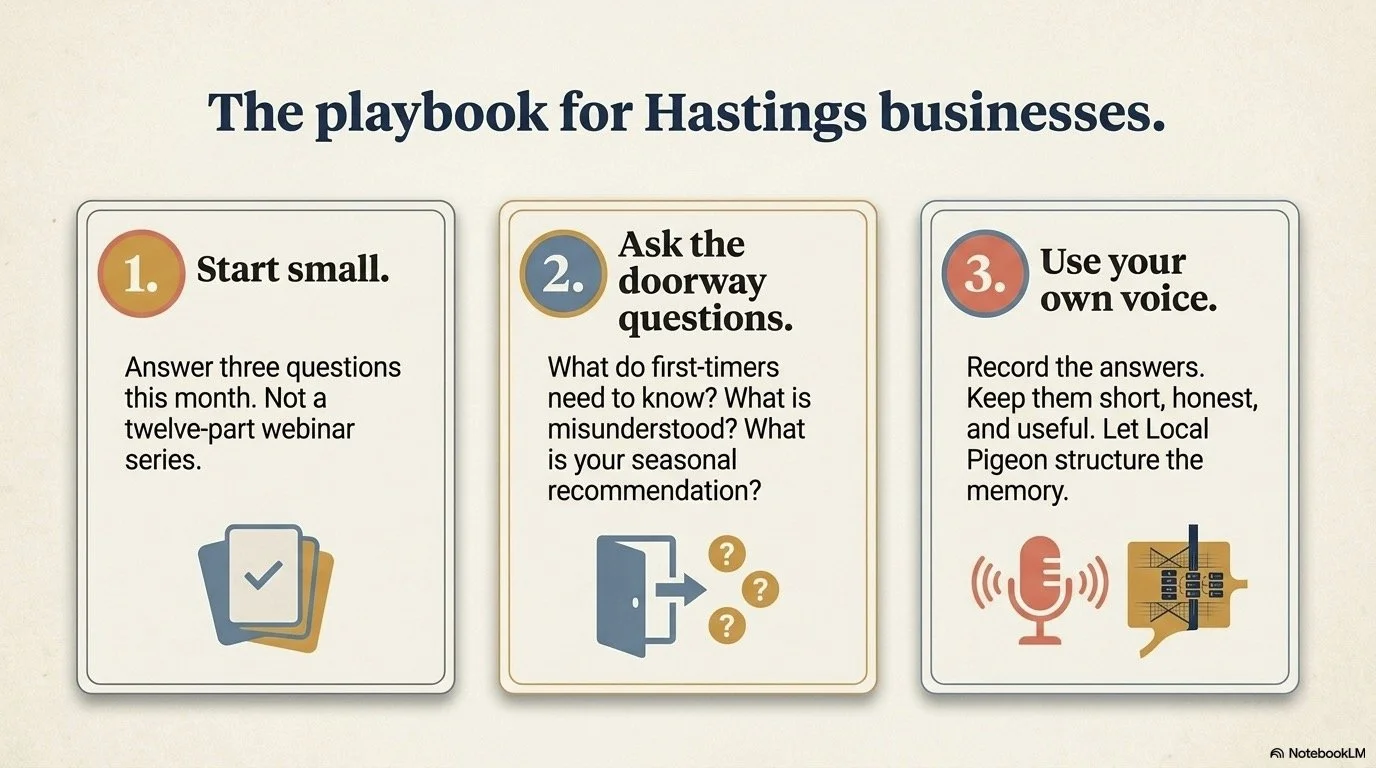
Start small.
Answer three questions this month.
Not twenty. Not a brand manifesto. Not a twelve-part webinar series that causes everyone involved to quietly age.
Three real questions.
For every Hastings business, ask:
What do first-time customers need to know before they visit, book, buy, or call?
What do people often misunderstand about what you do?
What is one timely recommendation you can make this week or this season?
Record the answers in your own voice.
Keep them short. Keep them honest. Keep them useful.
Then let HastingsNow and Local Pigeon turn them into local memory.
That is the whole playbook.
17. The best version of Local Pigeon
The best version of Local Pigeon is not “AI for local marketing.”
That phrase is too small and too generic.
The best version is:
Local Pigeon is the memory layer for local business.
Or, even more plainly:
Local Pigeon helps local businesses answer the questions customers already have, in the owner’s own voice, so people and AI can find the right local answer later.
That is the category.
That is what can be best-in-the-world.
Not because Hastings is the biggest market. It is not.
Because Hastings is the perfect size to prove the model.
A town of roughly 22,000 people is big enough to need better discovery and small enough for trust to matter. It has a historic downtown, local restaurants, retailers, wellness providers, schools, churches, nonprofits, events, sports, riverfront life, family networks, and enough community texture to make generic platforms feel thin.
If Local Pigeon can help Hastings remember itself better, it can help any town.
But it should start here.
With Barb explaining what to buy a bored kid in July.
With David explaining what to order first.
With Ryan explaining why Hyggefullr feels different once you step inside.
With a nonprofit explaining what donations actually help.
With a coach explaining what families should know before the season.
With a teacher, artist, pastor, owner, volunteer, or neighbor answering the question people were too busy, shy, or distracted to ask.
That is not just content.
That is Hastings talking to its future self.
FAQ: Memory, AI, and Local Stories in Hastings
What does “memory isn’t storage” mean?
It means human memory is not a perfect recording of the past. People reconstruct memories using meaning, context, emotion, expectations, and present needs. That is why local stories matter: they help shape what people remember about a place, business, or community.
Why does this matter for Hastings businesses?
Because customers do not choose only from facts like address and hours. They choose from trust, familiarity, recommendations, stories, and useful answers. A business that explains itself clearly is easier to remember, easier to recommend, and easier for search engines and AI systems to understand.
What is a Local Pigeon Soundbite?
A Local Pigeon Soundbite is a short, owner-recorded answer to a real local question. It captures the human voice behind a business, then turns that answer into a useful local update with text, context, and a clear call to action.
How can local stories help with AI search?
AI search systems increasingly synthesize answers instead of only listing links. Clear, source-backed, human-centered local answers make it more likely that a business is interpreted correctly when someone asks a question like, “Where should I go in Hastings for a family dinner?” or “Where can I buy a good birthday gift for a kid?”
What should a business record first?
Start with the question customers already ask most often. Good first questions include: “What should someone know before their first visit?” “What do people usually misunderstand?” and “What do you recommend right now?”
What can HastingsNow be best at?
HastingsNow can be best at helping Hastings understand itself: what is happening, who is doing it, why it matters, and what residents should remember. Local Pigeon can become the tool that captures those memories directly from local voices.
Final thought
The internet is full of information, but people are hungry for meaning.
That is why a local story still matters.
That is why a familiar voice still matters.
That is why a downtown business is more than a listing.
That is why a town is more than a map.
Memory is not storage.
Memory is interpretation.
And if Hastings wants to be remembered well — by residents, visitors, search engines, and the next generation of AI — then Hastings needs to keep telling the truth about itself in voices people recognize.
That is the work.
That is the opportunity.
That is Local Pigeon.