
The Hastings Agent Economy: What AI Means for Jobs, Small Business, Families, and the Future of Hastings, Minnesota
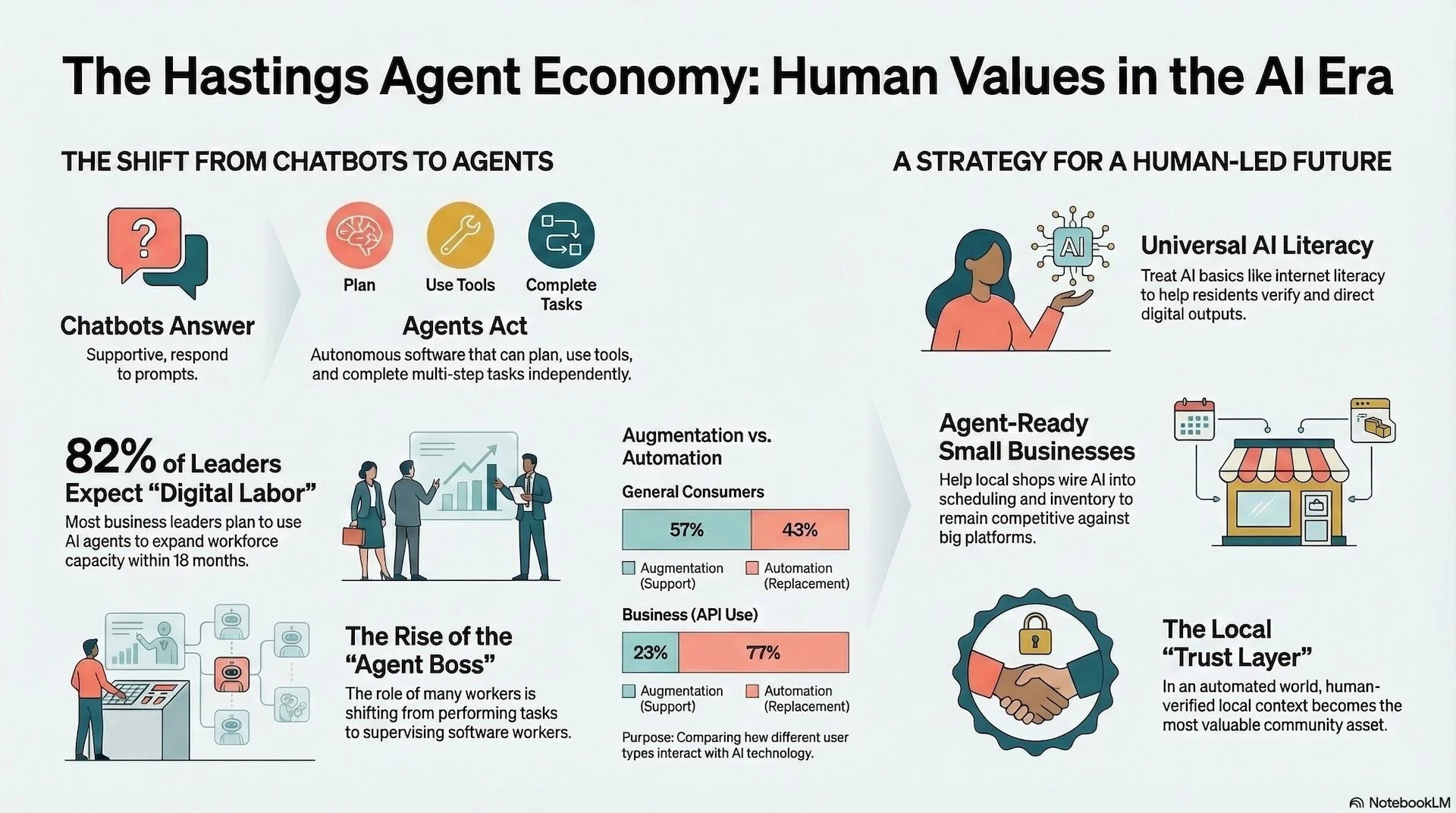
AI infographic by HastingsNow.com
What is the Hastings Agent Economy?
The Hastings Agent Economy is a future local economy in Hastings, Minnesota, where residents, businesses, schools, healthcare providers, and public agencies use AI agents to help get work done. An AI agent is not just a chatbot that answers questions. It is software that can plan, use tools, browse, coordinate, and complete multi-step tasks with some autonomy. In the best version of this future, humans stay in charge, local trust matters more, and the gains from AI stay rooted in Hastings instead of leaking away to distant platforms.
This is not science fiction parked on a shelf for 2045. NIST launched an AI Agent Standards Initiative in February 2026 because agents are already capable of autonomous actions and already need interoperability, identity, and security rules. OpenAI described agents in 2025 as systems that can use their own computer to finish tasks, while federal regulators warned in early 2026 that agent systems can affect real-world environments with little to no human oversight and face novel security risks.
The real question for Hastings is not whether AI will matter. It is whether Hastings will shape AI around local values: neighborliness, dignity, accountability, practical usefulness, and keeping more value in the community.
Where did the human economy come from?
The human economy began long before banks, stock markets, or smartphones. People first cooperated to survive, then traded directly through barter. The problem with barter is simple: it breaks down when I do not want what you have, or when neither of us can agree how many eggs equal one repaired wagon wheel. Federal Reserve education materials still teach this basic truth: barter is inefficient because of divisibility problems and the need for a “coincidence of wants.” Money emerged because it solved those problems and made exchange, pricing, and specialization easier.
Once money worked, the economy could scale. Britannica notes that standardized coinage likely did not fully emerge until the 7th century BCE, and paper money later spread from China outward. The deeper story is that every time humans found a better way to store value, keep records, and coordinate trust, the economy grew larger and more complex. The human economy is really the history of better coordination.
That matters now because AI agents are not replacing the whole human economy. They are the next coordination layer. They are a new way to search, decide, negotiate, schedule, summarize, and transact.
Where did AI and agents come from?
Artificial intelligence as a named field is usually traced to the 1956 Dartmouth Summer Research Project on Artificial Intelligence. That was the moment researchers formally organized the field around the idea that aspects of intelligence might be simulated by machines.
But the modern agent wave is newer. What changed is that large AI models can now reason across steps, use tools, interact with software, and take actions in loops instead of only generating text. NIST describes today’s frontier as agents capable of autonomous actions; the Federal Register defines agent systems as models plus scaffolding software and tools that can plan and act; Anthropic notes that an agent can be understood as a system that runs tools in a loop to achieve a goal. In plain English: a chatbot answers; an agent acts.
For technical readers, the state of the art is no longer just “bigger models.” It is model capability plus tool use, workflow scaffolding, identity, permissions, context assembly, interoperability, evaluation, and security. NIST’s 2026 initiative exists precisely because the bottlenecks are now trust and integration as much as raw intelligence.
What does the economy look like today?
As of March 2026, the U.S. economy is still growing, but not roaring. The unemployment rate was 4.4% in February 2026, with 7.6 million unemployed people, and real GDP grew at a 0.7% annual rate in the fourth quarter of 2025 after growing 4.4% in the prior quarter. At the same time, AI adoption is moving fast: Stanford’s 2025 AI Index reported that 78% of organizations said they used AI in 2024, up from 55% the year before, while U.S. private AI investment hit $109.1 billion.
Hastings is not a toy town in this story. It is a real, stable, civically anchored city of 22,502 people, with 8,985 households, 76.4% owner-occupied housing, median household income of $93,998, median gross rent of $1,183, median owner-occupied home value of $322,400, and poverty at 5.4%. About 90.9% of households have broadband, 19.8% of residents are 65 or older, and 11.4% of residents under 65 live with a disability. That means Hastings is both digitally connected and demographically varied enough that AI will not hit everyone the same way.
The city’s economic base also matters. The Hastings Area Chamber lists Dakota County, Regina Hospital, School District 200, city government, grocery retail, and Ardent Mills among major local employers. Census data also counts 287 employer firms in Hastings, including 171 women-owned employer firms. This is a local economy anchored not just by one giant tech campus, but by public service, healthcare, schools, retail, logistics, manufacturing, and small business.
That mix is important because the first wave of the agent economy will not arrive mainly as humanoid robots. It will arrive inside offices, browsers, phones, scheduling systems, school portals, hospital administration, customer service software, marketing stacks, and city forms.
What will the Hastings Agent Economy actually look like?
In the most likely near-term version of a Hastings Agent Economy, residents will use personal agents to compare prices, manage calendars, plan errands, summarize local information, and navigate paperwork. Local businesses will use business agents for customer follow-up, marketing, scheduling, quoting, ordering, inventory, and bookkeeping. Schools will use teaching and tutoring agents. Healthcare organizations will use documentation, scheduling, and benefits-navigation agents. City and county offices will use service agents to answer questions, route requests, translate information, and reduce administrative friction. That is a grounded projection from current agent capabilities and from Hastings’ current employer mix.
For experts, two data points matter. First, Anthropic’s Economic Index found that current AI use is still concentrated in software development and technical writing, with about 36% of occupations seeing AI used in at least a quarter of their associated tasks and only about 4% seeing usage across three-quarters of tasks. Second, the same research found that general user behavior still leans more toward augmentation than automation, 57% to 43%, while business API use is already automation-dominant, with 77% of uses following automation patterns. That suggests Hastings will not jump overnight into fully automated everything, but businesses that wire agents into workflows will push faster toward automation than households casually using chatbots.
Microsoft’s 2025 Work Trend Index captured the business mood bluntly: 82% of leaders said they were confident they would use digital labor to expand workforce capacity in the next 12–18 months, and Microsoft framed the coming shift as one in which “every employee becomes an agent boss.” Whether or not that phrase sounds dramatic, the underlying point is real: more Hastings workers are likely to supervise software workers, not just use software tools.
The big local opportunity for HastingsNow is obvious. In an agent economy, the scarce thing may not be information. It may be trusted local context. HastingsNow can become the trust layer where residents, visitors, and eventually agents themselves can discover which local businesses are real, reliable, available, affordable, and aligned with community values.
How will this affect different social classes in Hastings?
Lower-income households
Lower-income households will feel the benefits and risks first. The upside is cheaper access to services, better translation, easier paperwork, more help with benefits, job search, transportation planning, and budgeting. The downside is that lower-income residents are often hit hardest when employers use AI to automate entry-level clerical, call-center, or scheduling work, and when digital systems become mandatory before people are trained to use them. Minnesota’s own CareerForce system reported in January 2026 that 34% of staff and partners said their job-seeking clients’ employment or job search had already been affected by AI in the prior three months.
Working-class and skilled-trade residents
For trades, field work, and hands-on service jobs, the story is more mixed and less apocalyptic than many headlines suggest. Anthropic’s 2026 labor-market work found that many physical jobs still sit outside current AI coverage; examples in the low-exposure group included cooks, motorcycle mechanics, lifeguards, bartenders, dishwashers, and dressing room attendants. That means plumbers, electricians, mechanics, maintenance workers, and many care roles in and around Hastings are less likely to be fully displaced soon. But they are still likely to be surrounded by AI: routing, estimates, dispatch, inventory, training, surveillance, and pricing will all change.
Middle-class office households
The middle class may feel the biggest near-term shock, especially in administrative and document-heavy work. Anthropic’s work shows high theoretical and growing real exposure in office and administrative tasks, while business API use is already heavily automation-oriented. This is the class most likely to discover that parts of the workday they assumed were “thinking work” are actually form-filling, summarizing, drafting, sorting, and follow-up tasks that agents can increasingly handle.
Professionals and expert knowledge workers
Professionals will not be immune; they may become more powerful and more vulnerable at the same time. PwC reported in 2025 that AI-skilled workers commanded an average 56% wage premium and that job availability still grew in the more AI-exposed roles, even while skill requirements changed 66% faster there. BLS projections also suggest nuance, not a single cliff: software developers, database architects, and personal financial advisors are projected to grow strongly through 2033, while claims adjusters, credit analysts, and insurance appraisers face projected declines. Experts in Hastings who learn to direct agents well may earn more; experts who refuse to adapt may find parts of their value compressed.
Owners, investors, and entrepreneurs
Owners are positioned to capture the biggest upside because agents can raise margins, reduce overhead, and let small teams do more. Microsoft’s survey found that leaders are actively considering digital labor, and PwC found that industries most exposed to AI saw productivity growth nearly quadruple since 2022 and much faster growth in revenue per employee. In a local city like Hastings, that means the business owners who adopt wisely could become dramatically more competitive. It also means inequality can widen if the gains belong only to owners and not to workers, customers, or the wider community.
Seniors, caregivers, students, and residents with disabilities
Hastings has a meaningful senior population and a meaningful disability population, which makes accessibility central, not optional. Nearly 20% of Hastings residents are 65 or older, and 11.4% of residents under 65 live with a disability. Properly designed agents could help with reminders, appointments, paperwork, transport coordination, and communication. Poorly designed systems could do the opposite by hiding human support behind automation or assuming every resident is comfortable with apps, prompts, and constant connectivity.
There is also a gender angle. A recent Minnesota report from North Star Policy Action and the University of St. Thomas found that roughly one-third of Minnesota workers are in jobs with high exposure to generative AI, with higher exposure among female workers and lower-union occupations. Anthropic’s March 2026 labor-market analysis similarly found that more highly exposed workers are more likely to be female, older, more educated, and higher-paid. Hastings should assume the coming changes will cut across class, age, and gender at the same time.
Mind map by HastingsNow.com
How will this affect local residents psychologically, spiritually, financially, and physically?
Psychologically
Psychologically, the agent economy will create both relief and anxiety. Relief, because agents can take drudgery off people’s plates. Anxiety, because they can also make people feel replaceable. McKinsey found that a large minority of workers, 41%, are apprehensive about AI, and that employees are already using it more than leaders realize. WHO warns that poor working environments, excessive workload, low control, job insecurity, unemployment, and recent job loss all pose risks to mental health, and that unemployment, job insecurity, and recent job loss are risk factors for suicide attempts.
The hidden psychological danger in a place like Hastings is not just job loss. It is chronic uncertainty: “Am I falling behind?” “Is my work still valuable?” “Should my kid go into this field?” Communities can survive change better than they survive confusion without guidance.
Spiritually
Work is not just a paycheck. WHO explicitly notes that decent work supports mental health by providing livelihood, confidence, purpose, achievement, positive relationships, inclusion, and structured routines. That is why the spiritual dimension matters in Hastings. By “spiritual,” I do not only mean religion. I mean meaning, dignity, calling, responsibility, and belonging. A town can get richer in output and poorer in soul if too many people stop feeling needed.
The best Hastings Agent Economy would free people for more human things: caregiving, craftsmanship, mentoring, civic life, friendship, prayer, service, and creativity. The worst version would optimize away so much human responsibility that people would have more convenience and less purpose.
Financially
Financially, AI will create both upward mobility and compression. PwC’s 2025 data points to real upside: AI-skilled workers earned a 56% wage premium, jobs still grew in more exposed roles, and the most exposed industries saw much faster productivity and revenue-per-employee growth. But Minnesota’s own CareerForce network is already seeing job seekers affected by AI, and the state-level exposure data suggest one-third of Minnesota workers are in high-exposure jobs. The likely financial outcome is not “everyone loses” or “everyone wins.” It is divergence. People and firms that learn to use agents well may compound faster; people and firms that do not may feel squeezed.
That makes AI literacy a bread-and-butter issue, not a hobby. In Hastings, the next form of local economic development may be helping ordinary people become competent supervisors of digital labor.
Physically
Physically, the agent economy could help and hurt. It can reduce friction in daily life, help coordinate care, and improve access to information. But it can also make life more sedentary and more socially thin if everything becomes screen-mediated. WHO says insufficient physical activity is associated with a 20% to 30% increased risk of death, and CDC notes that sedentary behavior is a risk factor for chronic conditions such as coronary heart disease, hypertension, colon cancer, and diabetes.
Social health matters too. CDC reports that about 1 in 3 U.S. adults feel lonely and about 1 in 4 lack social and emotional support. CDC also links loneliness and isolation to heart disease, stroke, dementia, type 2 diabetes, depression, anxiety, and premature mortality. The U.S. Surgeon General’s advisory has gone even further, saying the mortality impact of social disconnection is similar to smoking up to 15 cigarettes a day. If agents make Hastings more efficient but less connected, that would be a public-health loss, not a win.
What about p(doom), human mortality, and the darkest possibilities?
Here is the honest answer: there is no single official “current p-doom.” P(doom) is shorthand for the subjective probability that advanced AI causes human extinction or a similarly permanent catastrophic disempowerment of humanity. One influential survey of 2,778 AI experts found a median estimate of 5% and a mean estimate of about 16%, with one in ten respondents putting the risk at 25% or higher. A newer 2025 survey of 111 AI experts found sharp disagreement, with experts clustering into “AI as controllable tool” and “AI as uncontrollable agent” camps; 78% still agreed that technical AI researchers should be concerned about catastrophic risk. The 2025 International AI Safety Report said the stakes are high and experts continue to disagree on major questions.
That means two things at once. First, it would be foolish to dismiss catastrophic AI risk as fringe nonsense. Second, it would be equally foolish to present one p-doom number as settled science. For Hastings residents, the more immediate dangers are not killer robots marching down Vermillion Street. They are concentration of power, loss of worker bargaining power, prompt-injection and security failures, weak oversight, misinformation, social isolation, and administrative systems making high-stakes mistakes at scale.
Human mortality is less speculative. National final mortality data show U.S. life expectancy at birth was 79.0 years in 2024, including 76.5 for males and 81.4 for females. There were 3,072,666 deaths in 2024, and the leading causes were heart disease, cancer, and unintentional injuries. Locally, Dakota County public-health materials report that 57% of deaths among county residents are due to chronic diseases and that cancer is the leading cause of death in the county. So yes, long-run AI catastrophe deserves sober attention. But a local AI strategy that ignores chronic disease, inactivity, stress, loneliness, and mental health would be missing the mortality burdens that are already here.
What should Hastings do now?
Make AI literacy universal. Hastings should treat AI basics the way communities once treated basic internet literacy. Schools, employers, churches, libraries, CareerForce, and civic groups should help residents learn what an agent is, where it helps, where it fails, and how to verify outputs. Dakota County’s CareerForce system already offers workshops, training resources, and resume support that can serve as part of this transition infrastructure.
Help small businesses become agent-ready, not agent-replaced. Most local businesses do not need a moonshot. They need help wiring AI into scheduling, customer service, quoting, follow-up, menus, inventory, and local discovery. The upside for Hastings is that a city with hundreds of employer firms can spread productivity across many smaller businesses instead of concentrating it in a few giant platforms.
Keep humans accountable in high-stakes settings. In healthcare, education, public services, finance, and employment, agents should assist rather than silently replace judgment. Federal and NIST materials already warn that agentic systems can take autonomous real-world actions and create novel security risks. Human review, identity controls, monitoring, and clear permissions should be local norms.
Protect workers during transition. Reskilling cannot be an afterthought. The University of St. Thomas and Minnesota labor discussions are already emphasizing AI literacy, retraining, and worker inclusion in deployment decisions. Hastings should assume job transformation is coming and make that transformation less brutal.
Build a local trust layer. This is the HastingsNow opportunity. In an agent economy, discovery, reputation, availability, and authenticity become even more valuable. HastingsNow can become the local system where people and eventually agents know who is trusted, who is open, who serves which neighborhoods, and which businesses actually deliver.
The bottom line
The next economy will not be purely human, and it will not be purely machine. It will be human-agent teams everywhere: in homes, on Main Street, in clinics, in classrooms, in county offices, and inside nearly every local workflow that can be digitized.
For Hastings, the future does not have to be dystopian and it does not have to be naive. A good Hastings Agent Economy would be human-led, agent-assisted, locally trusted, widely shared, and spiritually thick rather than hollow. It would use AI to reduce drudgery without reducing dignity. It would help local businesses compete without sacrificing neighborly life. It would make residents more capable, not more dependent. And it would remember that the purpose of an economy is not maximum automation. The purpose of an economy is helping human beings live well together.
-
An AI agent is software that does more than answer questions. It can plan, use tools, navigate websites or software, and complete multi-step tasks with some autonomy. Think less “search box” and more “digital coworker,” though still one that needs rules, permissions, and oversight.
-
Some jobs and tasks in Hastings will almost certainly be reduced, redesigned, or absorbed by AI, especially administrative and document-heavy work. But the data do not support a simple “all jobs disappear” story. Some highly exposed roles are still growing, some physical roles remain hard to automate, and much of current use is still augmentative rather than fully automated. The real local question is who adapts, who is protected, and who captures the gains.
-
The earliest changes are likely in office administration, customer support, marketing, scheduling, bookkeeping, analysis, school support, healthcare administration, and public-service intake. That inference fits both Hastings’ employer mix and the current national pattern of business AI use, which is concentrated in coding, office/admin, writing, education, and automation-heavy API workflows.
-
Learn the basics, practice with tools, and focus on judgment, trust, communication, and domain expertise. Residents should not assume that “AI skills” only matter for programmers. In the next few years, many jobs will reward people who can direct, check, and improve agent output. CareerForce resources, local employers, and schools can all become part of that preparation pipeline.
-
It is real in the sense that many serious AI experts assign non-trivial probabilities to catastrophic outcomes, and recent international safety work says the stakes are high. It is not real in the sense of being a single settled number everyone agrees on. The wiser posture is neither panic nor complacency: take catastrophic risk seriously, while also dealing with the more immediate local harms that are already visible in labor markets, security, mental health, and social connection.