
Unions, Through the Generations: Why Working People Still Need Each Other — and Why a Good Website Now Matters More Than Ever
AI image by HastingsNow.com
Every union begins with a sentence too simple to sound revolutionary.
This is not fair.
The hours are too long. The pay is too thin. The schedule is impossible. The injury is too common. The discipline is arbitrary. The voice is too small. A worker says it quietly at first, maybe at a lunch table, maybe on a loading dock, maybe in a break room, maybe in a school hallway after the students are gone. Another worker nods. Then another. And somewhere in that ordinary moment, history starts again.
Because the second sentence is the one that changes everything:
What if we speak together?
That is the origin story of unions in its simplest form. Not a theory first. Not a slogan first. A human need first. Workers join hands because the single voice is fragile, and the shared voice is harder to ignore. Over time, that instinct became institutions: locals, halls, stewards, contracts, constitutions, elections, benefit funds, apprenticeship systems, pension fights, grievance procedures, and a long democratic habit of insisting that working people are not raw material for somebody else’s spreadsheet. The U.S. Department of Labor defines a union as workers joining together to advance common interests such as wages, benefits, schedules, and other terms and conditions of employment; it also emphasizes that unions are membership-driven democratic organizations governed by laws requiring transparency, fair elections, and fair representation.
If you want the broad American arc, the story stretches back through the industrial age and beyond it: mills, mines, railyards, garment shops, foundries, docks, classrooms, hospitals, city garages, postal routes, construction sites, and public offices. The National Park Service’s labor history work and the Library of Congress both trace how organized labor emerged from harsh working conditions and how it grew through struggles involving women workers, immigrant workers, Black workers, farmworkers, miners, and factory hands. One National Park Service labor history timeline notes that the 1824 Pawtucket textile strike is widely credited as the first industrial strike in American history, led by women weavers after a wage cut. The Library of Congress likewise frames organized labor in the United States as a long 19th-century-to-present story, not a short chapter tucked away in some dusty civics book.
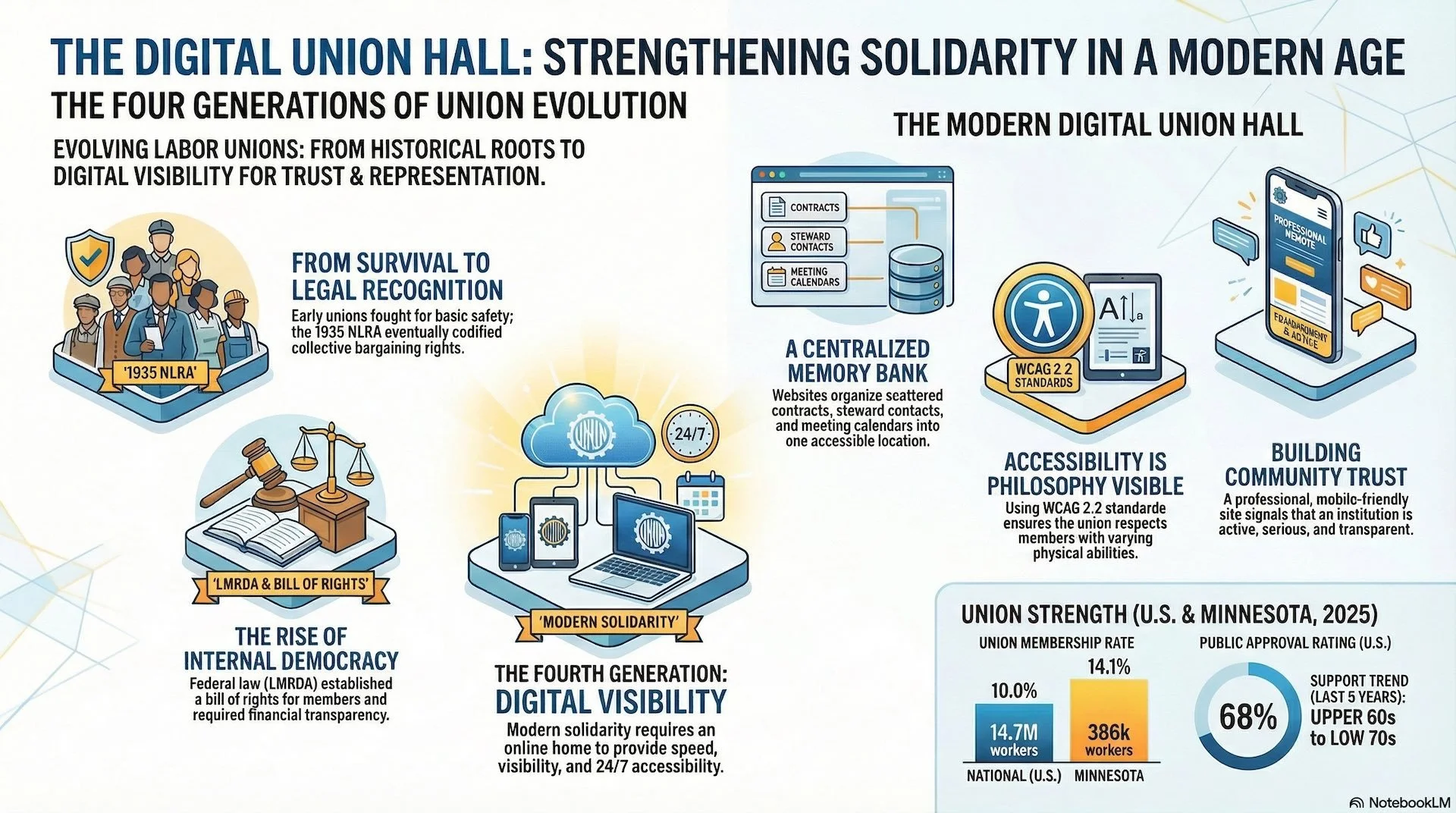
So if you are in Hastings, Minnesota, wondering whether unions are old news, the better answer is this: unions are not old news. They are old institutions in the best sense — old enough to have memory, scar tissue, wisdom, and proof of usefulness — but they are also strikingly current. In 2025, union members made up 10.0% of U.S. wage and salary workers, about 14.7 million people nationwide. Minnesota stood above the national rate, with union members accounting for 14.1% of wage and salary workers, or about 386,000 people. Public approval of labor unions remained strong at 68% in Gallup’s 2025 reading, part of a five-year stretch of support in the upper 60s to low 70s.
That means this is not a niche topic for a handful of specialists. In Minnesota, and in towns like Hastings, unions are not abstractions. They are family members, neighbors, retirees, teachers, tradespeople, public employees, health care workers, and construction crews. Even residents who are not union members often live in the economic weather unions help create.
The generations of unions: from survival, to stability, to visibility
The first generation of unions was largely about survival. Before the law offered much protection, workers organized because the workplace could be brutal, dangerous, and arbitrary. The Library of Congress’s teaching materials on labor and working conditions point directly to why organized labor arose: there was a time when U.S. workers lacked even basic rights such as minimum wage protections or dependable break time.
The second generation was about recognition and structure. The National Labor Relations Act, enacted in 1935, protects the rights of most private-sector employees to organize, join together to improve wages and working conditions, bargain collectively, and engage in protected concerted activity. The National Labor Relations Board also makes clear that many employees can act together regarding pay, safety, and workplace conditions even before a union is formally recognized. During the Great Depression and New Deal years, organized labor expanded dramatically; the Library of Congress notes union membership fell to around 3 million in 1933, then surged in the 1930s as the Roosevelt administration and early New Deal legislation shifted the landscape.
The third generation was about democracy inside the union itself. The Labor-Management Reporting and Disclosure Act established a bill of rights for union members, required certain reporting and financial transparency, protected standards for officer elections, and created safeguards for union funds and assets. The law underscores something important that critics and supporters alike sometimes forget: a union is not merely a protest mechanism. It is supposed to be a democratic institution accountable to its members.
The fourth generation — the one we are living in now — is about visibility, speed, and trust. The union still needs the meeting hall, the bargaining team, the steward, the phone tree, the picket line, and the vote. But it also needs a home on the web. Not because the internet replaced solidarity. Because the internet is now one of the main places people go when they are confused, newly hired, angry, scared, hopeful, or trying to decide whether an institution is real.
That is where the modern union origin story quietly updates itself. Once, the bulletin board mattered. Now the bulletin board still matters, but so does the site that appears when a worker types a local’s name into a phone at 10:47 p.m.
The who, whom, what, where, when, how, and why of unions
Who are unions?
A union is workers, first. Not an abstract “labor body.” Not a logo. Not merely officers or staff. Workers. Members. Apprentices. Stewards. Committees. Bargaining teams. Retirees who still carry the memory of earlier fights. Families who live inside the consequences of wages, benefits, and scheduling. The Department of Labor’s definition centers the union as workers joining together to advance their common interests, while the NLRB emphasizes the protected right of covered private-sector workers to organize, join, assist, or refrain from union activity.
Whom do unions serve?
They serve their members most directly, but they also affect nonmembers, employers, communities, and future workers. Union contracts often shape wage norms, scheduling expectations, and safety culture beyond the bargaining unit itself. The Department of Labor notes that unions help workers pursue higher wages, health insurance, paid sick leave, vacation days, retirement benefits, harassment protections, flexible scheduling, and safer working conditions.
What is a union, in plain English?
It is a democratic organization of workers who act collectively instead of individually. It bargains. It represents. It votes. It keeps records. It elects officers. It files reports. It teaches members how power works in a workplace. And, ideally, it turns private frustration into lawful, organized, strategic action. The NLRB and DOL both describe unions in precisely that framework: collective action, collective bargaining, representation, and member rights.
Where do unions live?
Yes, in halls and meeting rooms. Yes, at the bargaining table. Yes, on job sites, in classrooms, clinics, shops, fire stations, city buildings, and construction trailers. But now also on screens. A union lives wherever members go to understand their rights, their deadlines, their meetings, their contracts, and their next move. In 2026, that includes search results, mobile phones, inboxes, member portals, and accessible public pages.
When do unions matter?
At hiring. At orientation. At open enrollment. When a steward needs to explain a contract article. When a bargaining survey goes out. When a member is disciplined. When a strike vote is possible. When rumors start. When a contract is ratified. When leadership changes. When new workers want to know whether joining is worth it. The NLRB’s materials make especially clear that rights around organizing, wage discussions, protected concerted activity, strikes, and representation matter in concrete moments, not just in theory.
How do unions work?
They work by turning many small voices into one recognized voice. Workers organize. They build majority support. They petition or seek recognition. They bargain. They enforce agreements. They hold elections. They collect dues. They communicate constantly. The NLRB outlines rights around organizing, elections, recognition, bargaining, and strikes; the Department of Labor outlines the internal democratic rules unions must follow under the LMRDA.
Why do unions exist?
Because workers discovered, generation after generation, that dignity needs structure. Goodwill is not enough. A rumor is not a policy. A supervisor’s promise is not a contract. A worker alone can complain; workers together can negotiate. That is the whole philosophy in one line.
Why a union wants a website now
A union wants a website for the same reason a town wants a main street sign, a library wants a catalog, and a church wants doors that open without confusion. A real website makes the institution legible.
Without a website, a union can feel invisible to the newly hired worker, inaccessible to a spouse trying to find benefit information, confusing to a reporter on deadline, and suspiciously out-of-date to younger members who have grown up assuming that every serious institution can explain itself online. With a good website, the union becomes easier to find, easier to trust, and easier to use.
That matters because search is no longer just search. Google’s own guidance increasingly emphasizes helpful, reliable, people-first content, clear authorship, and explicit answers to real questions. Google also supports FAQPage structured data for answered questions, and Squarespace’s current SEO guidance explicitly references visibility not only in classic search but also in AI-powered search engines and chatbots. In other words: if a union wants to be understood by members, journalists, family members, and answer engines, it should publish pages that are clear, current, and structured to answer actual questions.
A website can hold what unions too often scatter across PDFs, Facebook posts, forwarded emails, old bulletin board snapshots, and somebody’s memory. Contracts. MOUs. bargaining updates. Meeting calendars. Scholarship forms. apprenticeship information. Steward contacts. officer directories. grievance pathways. political action disclaimers. strike FAQs. event announcements. press statements. organizing resources. retirement banquet details. The website becomes the union’s front porch, bulletin board, archive, reception desk, and public square at once.
And because so much of modern life is mobile, the site needs to work beautifully on a phone. Not eventually. Immediately.
AI infographic by HastingsNow.com
Why a website can make practical sense for a union
For many unions — especially locals, regional bodies, trades councils, or associations without a large in-house tech team — the point is not to buy the most complex website possible. The point is to publish a website that stays updated, loads cleanly, respects members, and can actually be maintained by real people after launch.
That is where a platform like Squarespace can make sense. Squarespace’s official guidance highlights built-in SEO features, custom domain support, page-level SEO descriptions, social sharing images, a site SEO report tool, redirects, analytics integrations, and verification workflows for Google Search Console and Bing Webmaster Tools. It also offers member-site features for gated content, calendar pages for meetings and events, form blocks for contact forms and surveys, and integrated email campaigns for branded member communications.
For a union, that means practical wins:
A public-facing layer can explain who the union is, what it has won, what it believes, who to contact, and how to join or get involved.
A member-only layer can hold more sensitive or internal materials, such as training resources, bargaining explainers, officer packets, or member meeting materials.
A calendar layer can list meetings, trainings, elections, rallies, and public events.
A forms layer can handle scholarship applications, organizer interest forms, volunteer signups, and general inquiries.
An email layer can help the union send consistent updates from the same brand members already recognize on the site.
That does not mean every union should use Squarespace. But it does mean a union does not need a giant custom build to become much more usable and trustworthy online.
And if the site is designed by local people who understand local tone — say, a HastingsNow.com team that knows how Hastings residents read, search, judge credibility, and respond to plainspoken useful information — the result can feel less like outsourced corporate vapor and more like a real community institution.
Best practices for a union website in 2026
The first best practice is simple: build for members, not for committee vanity.
Google’s search guidance is blunt in the best way: create helpful, reliable, people-first content; make authorship clear; explain how content was produced when that matters; and make sure the “why” of the content is to help people, not merely attract search traffic. That is almost a perfect editorial rule for unions too. The site should answer the questions members actually have. Not the questions leadership wishes they had.
The second best practice is clarity of structure. A good union site should make it easy to find: contracts, leadership, steward contacts, calendar, benefits resources, join/contact information, news, and FAQs. Squarespace and Google both emphasize clear headings, readable titles, descriptive page summaries, useful internal linking, and organized content. For GEO and AEO in the practical sense, this means pages with straightforward names like “Contract,” “Bargaining Updates,” “How to Contact a Steward,” “Meeting Calendar,” and “Frequently Asked Questions.”
The third best practice is accessibility. WCAG 2.2 remains the key W3C accessibility standard, organized around content being perceivable, operable, understandable, and robust. Squarespace’s own accessibility resources highlight built-in keyboard focus outlines, semantic structure, ARIA landmarks, alt-text support, color-contrast controls, captions, and audio transcripts. A union site should not lock out older members, blind members, low-vision members, members navigating on a cracked phone screen, or members who simply need cleaner design and plain language. Accessibility is not a decorative virtue. It is union philosophy made visible.
The fourth best practice is public pages and private pages should be different on purpose. Not everything belongs in public search results. Public pages should explain the union clearly and honestly. Members-only pages can contain deeper internal material where appropriate. Squarespace’s Member Sites feature gives organizations a way to gate content when needed, and its calendar tools can support both public and members-only event communication.
The fifth best practice is security, especially for admin accounts. CISA’s guidance for organizations says MFA matters, and its MFA resources are explicit that phishing-resistant MFA is the strongest standard organizations should aim for, with FIDO/WebAuthn emphasized as the only widely available phishing-resistant option. Even a modest union website can expose member trust if a site admin uses weak passwords, shared logins, or no MFA. The public website may be simple; the admin discipline should not be.
The sixth best practice is answer-engine readiness. Use FAQ sections. Add clear question-and-answer blocks. Mark up FAQ pages properly where appropriate. Publish pages that directly answer queries such as “How do I contact my steward?”, “Where can I read the contract?”, “When is the next union meeting?”, “How do dues work?”, or “How do I become a member?” Google’s FAQPage documentation exists for exactly this kind of content.
The seventh best practice is keep it alive. Squarespace’s SEO checklist recommends continuing to update content, add new content strategically, fix broken links with redirects, verify with Google Search Console and Bing Webmaster Tools, and monitor analytics. A dead union website sends the worst possible message: nobody is steering. An active site signals the opposite.
How a good website changes the lives of union members
Not every benefit of a good website shows up on a spreadsheet.
Financially, a good site saves money and protects opportunity. If members can quickly find the contract, benefits information, training or apprenticeship dates, scholarship forms, or bargaining updates, they miss fewer deadlines and make fewer costly mistakes. And because unions bargain for wages, benefits, paid leave, retirement, and safer conditions, the easier it is for members to understand and use their union, the easier it is to actually realize those gains.
Mentally, a good site lowers the temperature of confusion. Workers live under enough uncertainty already. They should not have to wonder where to find the meeting date, whether a rumor is true, or which PDF from three years ago still controls. A good site reduces cognitive clutter. It replaces “I heard” with “I checked.”
Psychologically, it gives members a feeling many institutions accidentally deny them: that their time matters. When information is easy to find, written in plain language, and updated promptly, the member experiences something deeper than convenience. They experience respect.
Philosophically, a good union website teaches democracy by practice. It says: here are the officers, here are the bylaws, here are the notices, here are the dates, here is the process, here is the contact path, here is the record. The LMRDA’s union-member-rights framework is, in essence, a reminder that union life should be visible enough for members to participate in it intelligently. A good website helps make that visibility real.
Spiritually — if by “spiritually” we mean the inner life of dignity, belonging, and moral seriousness — a good union site can do something surprisingly tender. It can tell a tired worker, “You are not crazy. You are not alone. There is a structure here. There are people here. There is memory here. There is somewhere to begin.”
That is not small.
Why this matters in Hastings
Hastings is the kind of place where reputation still travels by human voice. People talk. Families overlap. A workplace story can become a community story by supper. That is exactly why a union website matters in a place like this.
In a community-scale setting, trust is not built by volume. It is built by coherence. Does the institution look real? Does it explain itself clearly? Does it seem active? Does it sound like it knows the difference between ordinary people and jargon? Does it respect readers enough to answer practical questions without making them feel ignorant for asking?
A good union site for Hastings-area readers should feel local, useful, and unpretentious. Not stripped-down to the point of looking careless. Not bloated with slogans and mystery navigation. Just clear, handsome, mobile-friendly, and alive. A place where a spouse, a new hire, a retiree, a reporter, or a skeptical twenty-three-year-old can say, “Okay. I see what this is. I see who it serves. I see how to reach someone.”
That alone can change the relationship between a union and its own community.
The future of unions: not less human, but more legible
The future of unions is not a robot substitute for solidarity. It is not an app that magically replaces organizing. It is not a chatbot standing in for courage.
The future is more human than that, not less.
It is unions that remain rooted in face-to-face trust while becoming far more legible online. It is organizing that still depends on conversation, but is supported by cleaner communication systems. It is bargaining updates that do not vanish into inboxes. It is contract language that can actually be found. It is multilingual pages where needed. It is accessible design. It is member portals where appropriate. It is archives that honor the past and FAQs that welcome the future. It is content written so clearly that both a tired member and an answer engine can understand it.
And it is unions remembering that their website is not separate from their mission. It is part of their mission. If the union exists to give workers voice, then the website is one of the places that voice must now live.
The unions that thrive over the next generation will not be the ones that merely “have a website.” They will be the ones that understand what the website is: a digital union hall, a civic memory bank, a trust signal, a member service desk, a recruiting door, a media kit, a campaign base, a public record of seriousness, and, on the best days, a quiet form of dignity.
A final word
Unions were born because working people learned that isolation is expensive.
That lesson has not expired.
If anything, the digital era has made it newly urgent. A worker can be surrounded by information and still feel alone. A union’s job is to make sure that does not happen. In the twentieth century, that meant halls, notices, stewards, and contracts. In the twenty-first, it means all of that — plus a website worthy of the people it serves.
A good union website will not win a contract by itself. It will not replace an organizer, a steward, a vote, or a line held in bad weather. But it can make a union easier to trust, easier to join, easier to understand, easier to defend, and easier to love.
And that is no small thing.
For local unions, labor groups, worker associations, and member-driven organizations in Hastings and greater Minnesota, that may be the real opportunity now: not merely to “get online,” but to build a digital home that is as democratic, disciplined, and useful as the union hopes to be in real life.