
Under Hastings Streets, Elsie Jacobs Found the Kind of Engineer She Wants to Become
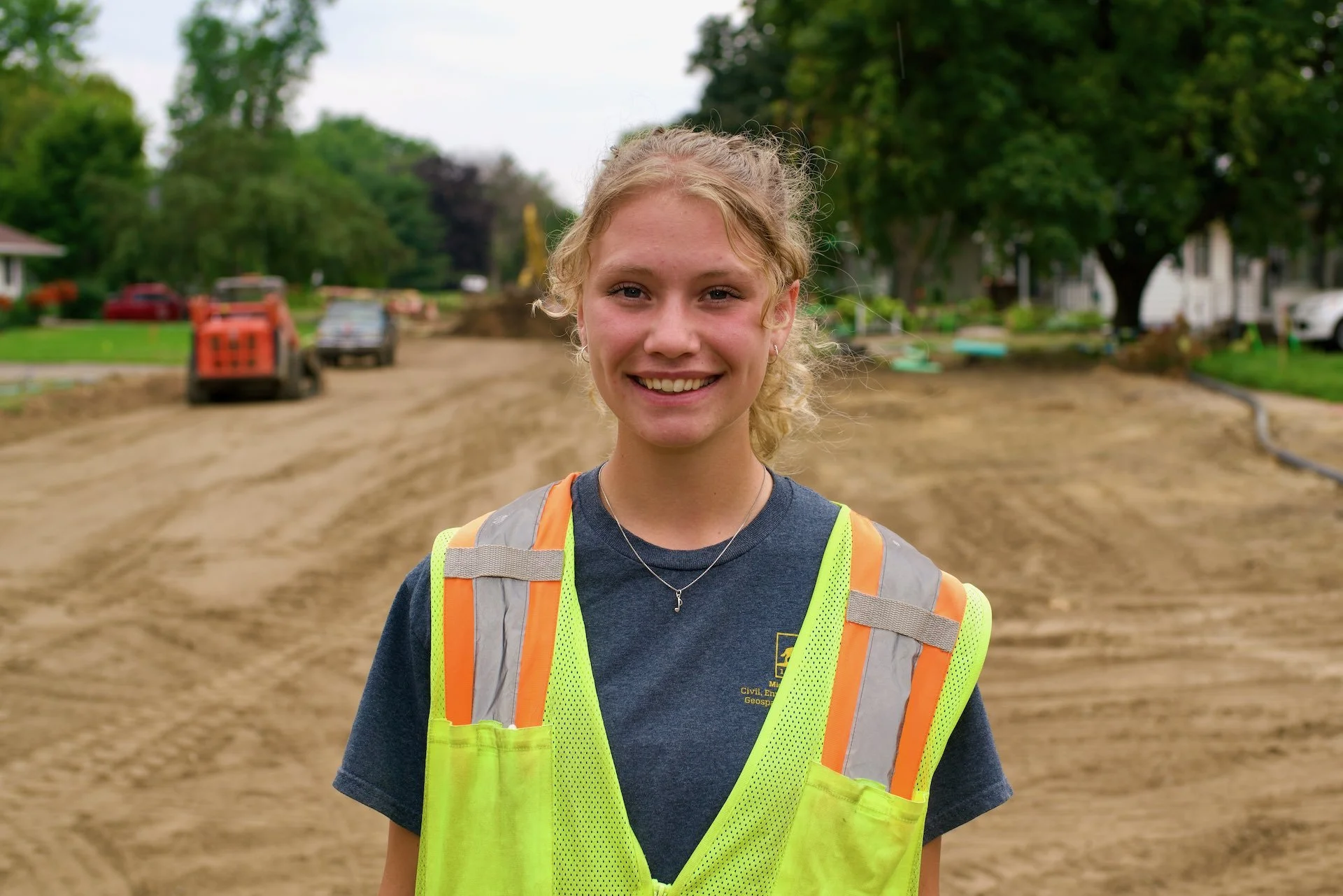
City of Hastings engineering intern Elsie Jacobs at the 4th Street construction site in Hastings, Minnesota. Photo by HastingsNow.com
A 2025 Hastings High School graduate returned home from Michigan Tech to help document utility work, inspect construction and answer residents’ questions during one of Hastings’ major 2026 street projects.
By Ashley and Peter | HastingsNow.com
At a glance
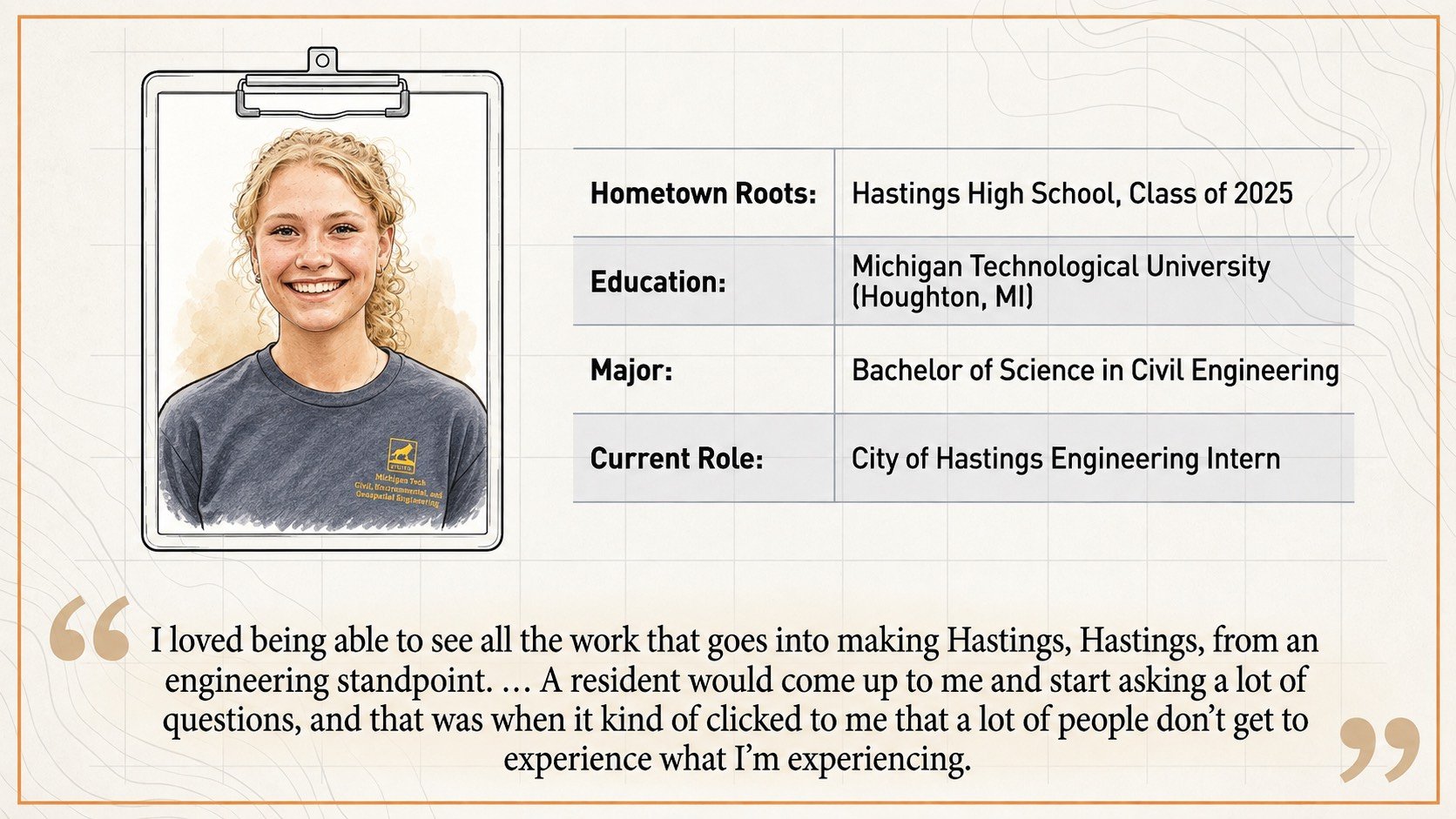
Who is Elsie Jacobs? A 2025 Hastings High School graduate pursuing a Bachelor of Science in Civil Engineering at Michigan Technological University.
What did she do? Jacobs spent summer 2026 working with the City of Hastings Engineering Department on the 2026 Neighborhood Infrastructure Improvements project, including work on Pleasant Drive and 4th Street.
What were her responsibilities? Jacobs helped observe and document construction, recorded quantities for water and sanitary sewer service lines, photographed service connections, maintained construction records, communicated with crews and served as an on-site City contact for residents.
Why does it matter? Her work offers Hastings residents a rare look at how street reconstruction is inspected, measured, documented and communicated—and how a hometown internship can help prepare the next generation of public-service engineers.
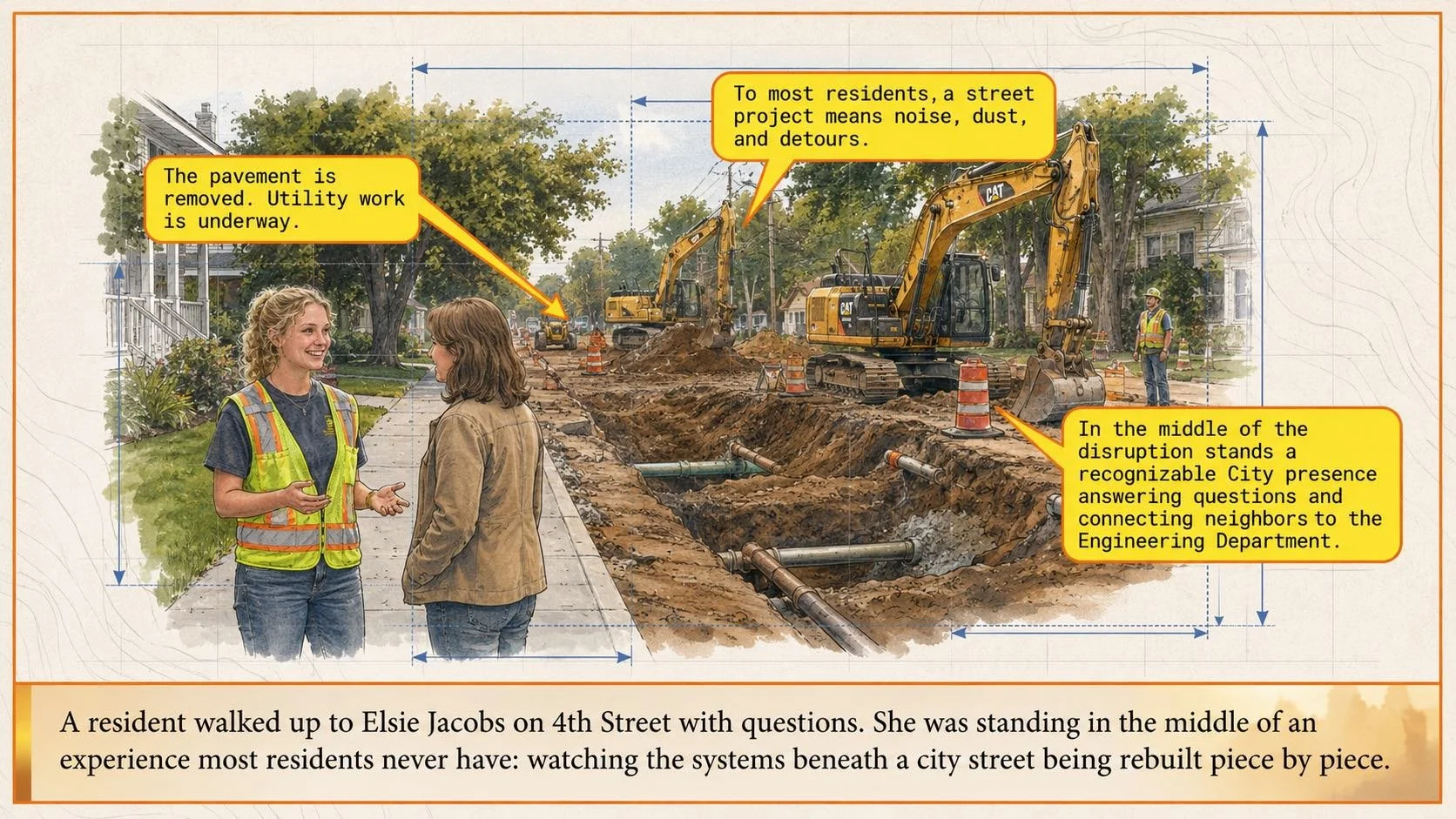
A resident walked up to Elsie Jacobs on 4th Street with questions.
The pavement had been removed. Utility work was underway. Crews, equipment and excavated ground had transformed a familiar Hastings neighborhood into an active construction site.
Jacobs was standing in the middle of an experience most residents never have: watching the systems beneath a city street being rebuilt piece by piece.
“When we started working on 4th Street, I had a lot more interaction with people that lived there,” Jacobs said. “A resident would come up to me and start asking a lot of questions, and that was when it kind of clicked to me that a lot of people don’t get to experience what I’m experiencing.”
For residents living beside the project, Jacobs became a recognizable City presence—someone who could receive questions, share the information she knew and connect residents with Engineering Department staff when additional information was needed.
For Jacobs, that interaction revealed something equally important.
Engineering was not only about calculations, pipes, materials or drawings.
It was about people.
Returning home with a new way of seeing Hastings

Before studying civil engineering at Michigan Tech, Elsie Jacobs was a Hastings High School student. HastingsNow photographed Jacobs during a Hastings High School band performance of “Beetlejuice” during her senior year. See the original Hastings High School Beetlejuice performance gallery →
Just a year earlier, Jacobs was experiencing Hastings from an entirely different vantage point. As a senior at Hastings High School, she was still participating in the school and community she had grown up around. HastingsNow photographed her performing with the Hastings High School band at Todd Field.
By the following summer, she was standing a few miles away on a torn-up 4th Street—not as a student experiencing her hometown community, but as a civil engineering intern helping the City’s Engineering Department observe, document and communicate about the work happening there.
Michigan Tech was not originally an obvious choice.
Jacobs had grown up knowing that her father attended the university, but she did not necessarily want to follow the same path.
“I was like, ‘I don’t need to follow in his footsteps. That’s okay,’” she recalled.
That began to change during a family trip to Michigan’s Upper Peninsula. Her father encouraged her to visit the campus while they were nearby.
“Of course, I just fell in love with it,” Jacobs said.
Her father then suggested that seeing Michigan Tech during summer was not enough. She needed to experience Houghton during winter.
She returned—and loved it even more.
Jacobs said the strength of Michigan Tech’s programs and the opportunities available to students ultimately helped convince her that it was where she belonged.
But after leaving the Hastings area for engineering school, she came home for the summer and began looking at familiar streets in an entirely different way.
“I loved being able to see all the work that goes into making Hastings, Hastings, from an engineering standpoint,” she said.
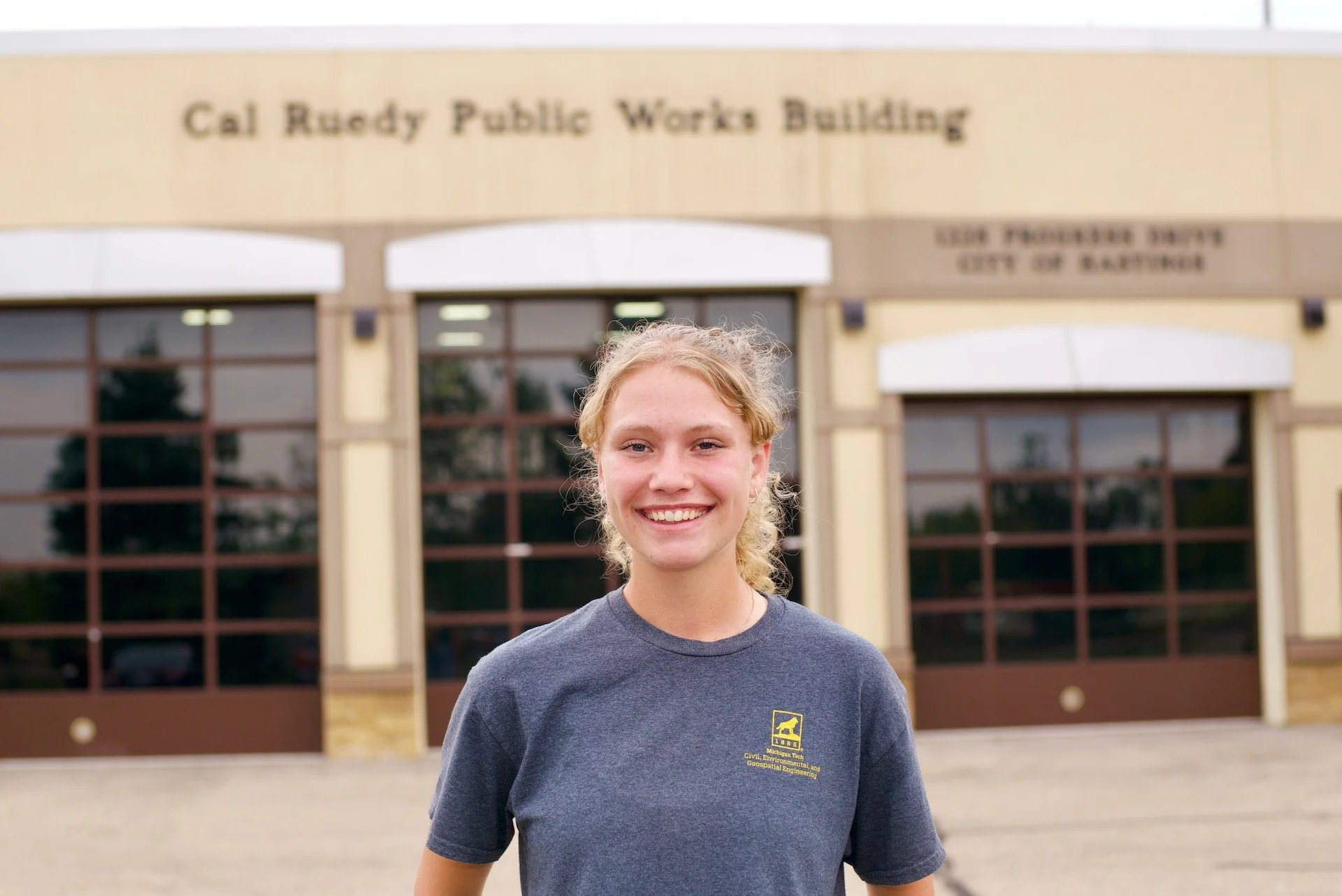
Jacobs graduated from Hastings High School in 2025 and is pursuing a Bachelor of Science in Civil Engineering at Michigan Technological University. Photo by HastingsNow.com
What was Elsie Jacobs working on in Hastings?
Jacobs spent most of her internship working on the City’s 2026 Neighborhood Infrastructure Improvements project.
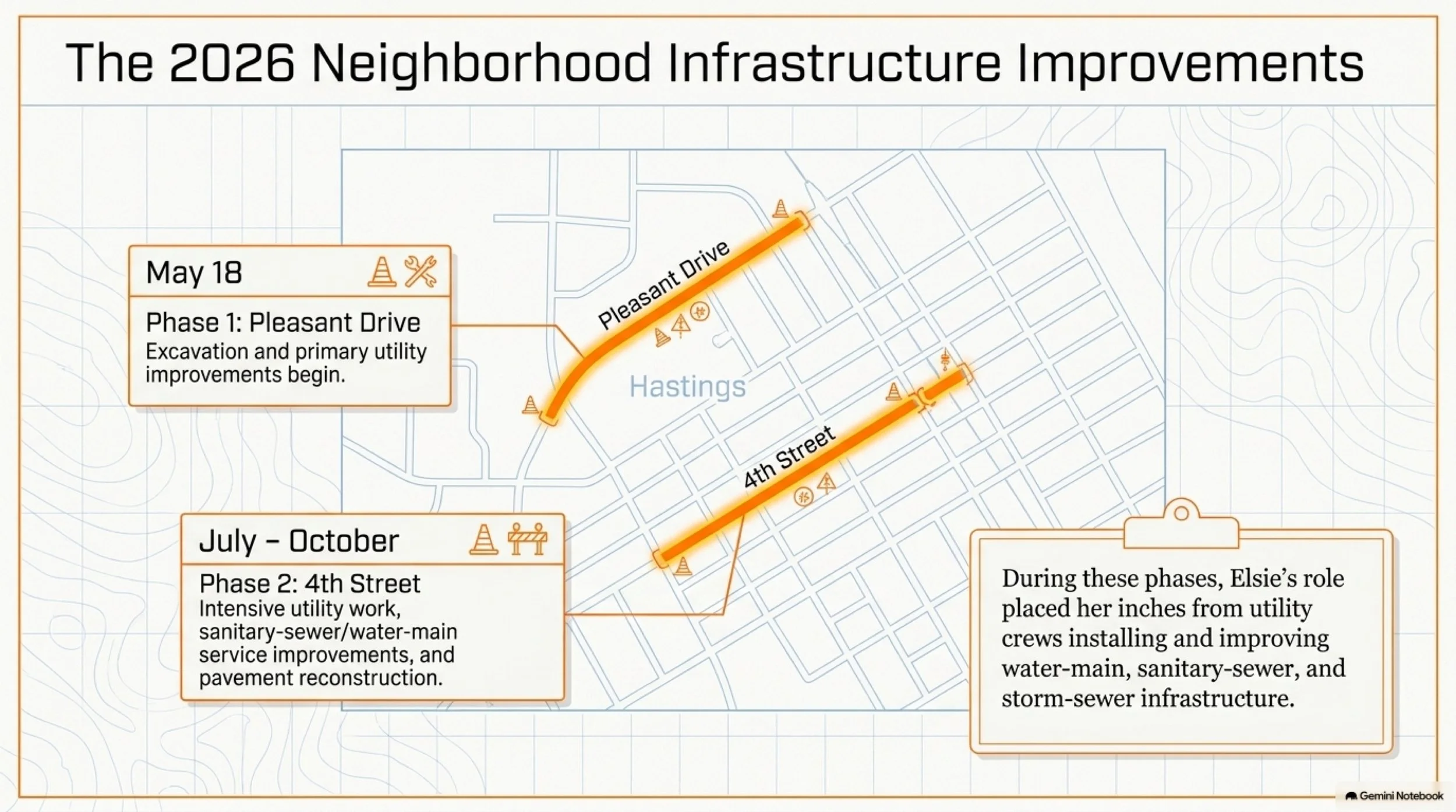
The City says the project began during the week of May 18, 2026. Its first principal phase focused on Pleasant Drive, with much of the 4th Street construction scheduled during the second phase from July through October.
Jacobs worked first on Pleasant Drive and later on 4th Street.
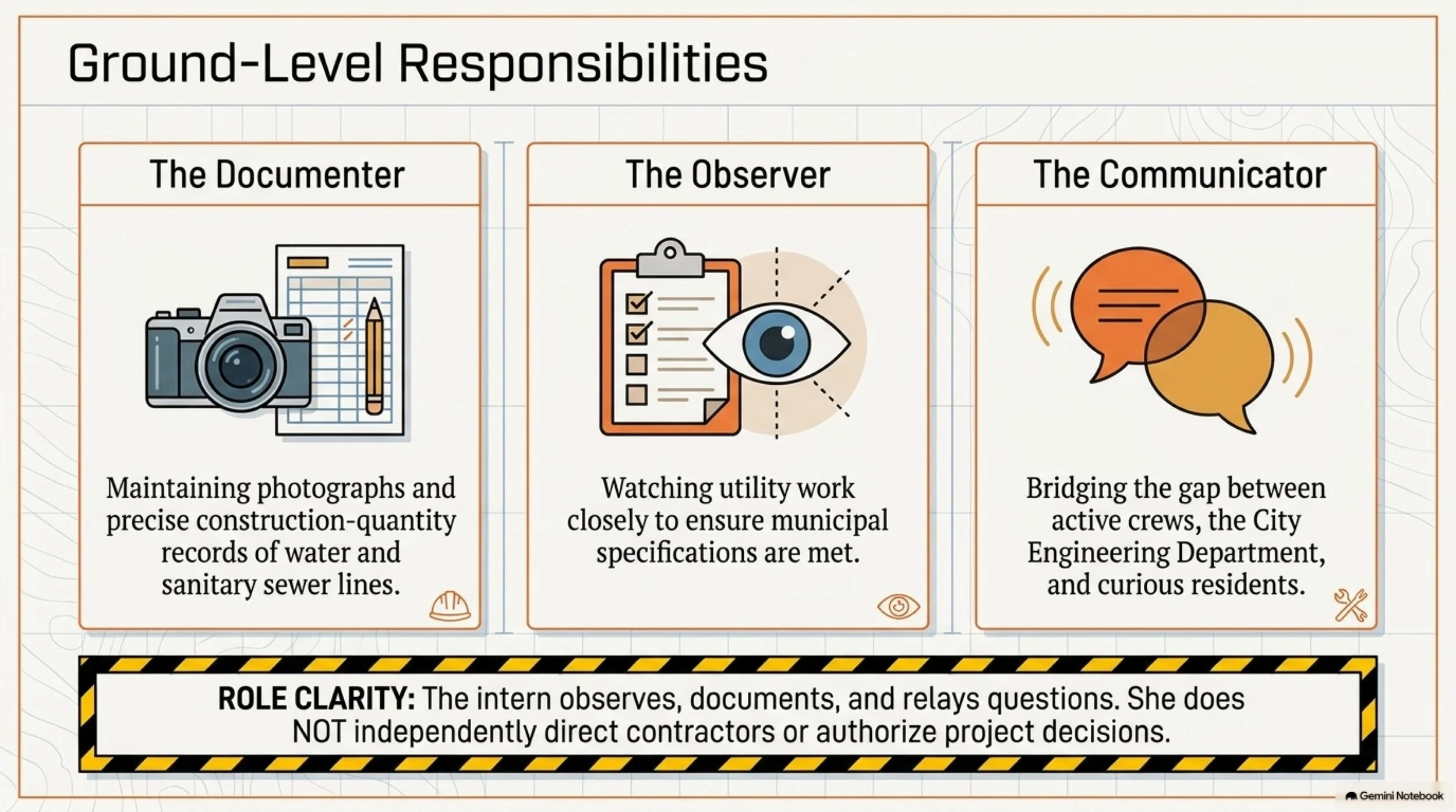
Her role placed her close to utility crews installing and improving water-main, sanitary-sewer and storm-sewer infrastructure. She watched the work, maintained records, communicated with contractors and helped provide a direct connection between the construction site and the City’s Engineering Department.
The City describes its Engineering team as responsible for designing and managing construction projects, reviewing infrastructure plans, checking construction sites and maintaining maps and records of municipal infrastructure.
Jacobs’ experience showed what some of those responsibilities look like at ground level.
“What my role was is to supervise over the crews that are working,” she explained during the interview. “My job is to kind of be an eye out there, so that if the contractors need to contact anyone back here in the Engineering Department, they can come ask questions to me. And if any residents had any questions or anything, there was a face from the City out there that they could talk to.”
Her role would be most accurately understood as helping observe and inspect work, document what had been completed, and relay questions—not independently directing the contractor or authorizing project decisions.
What happens before anyone begins digging?
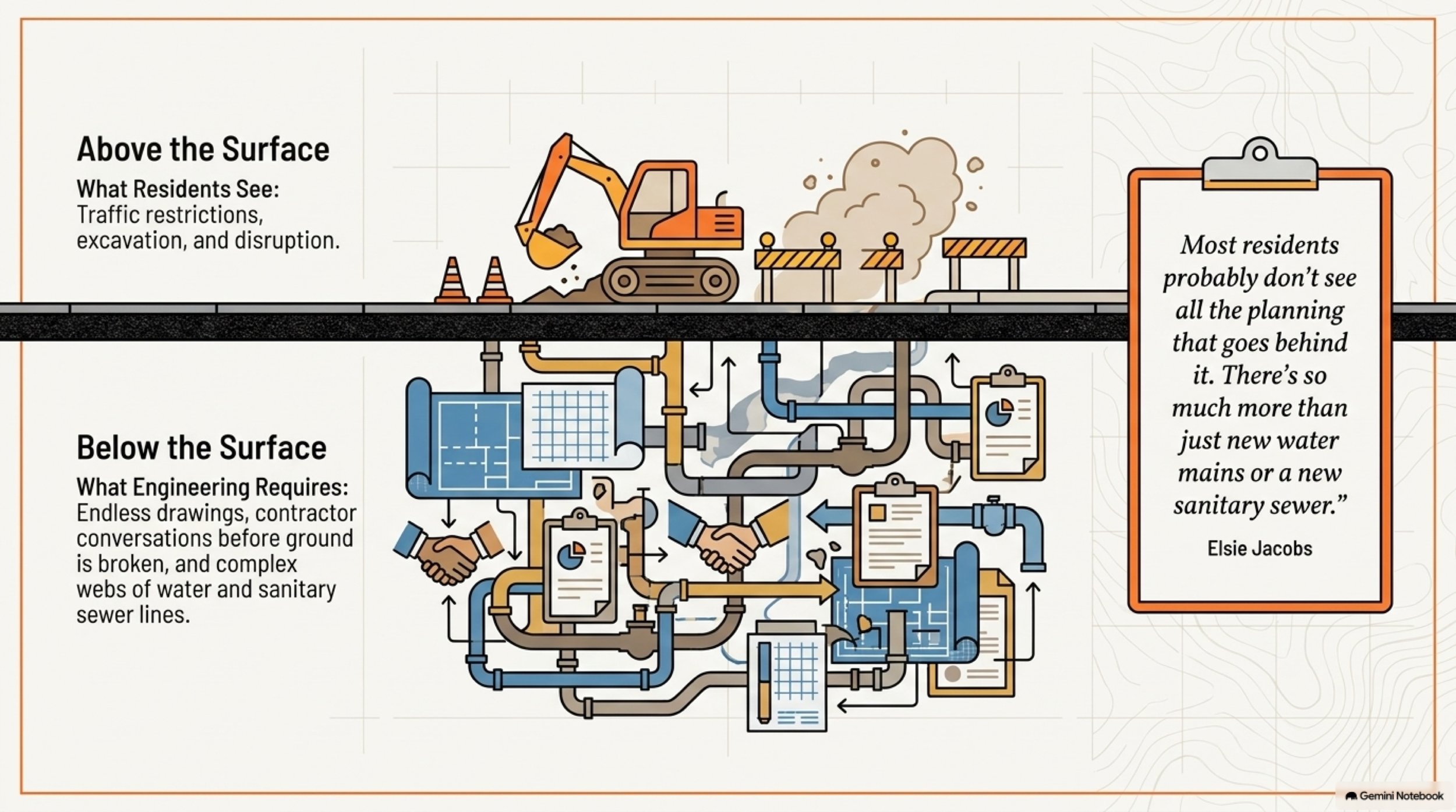
Residents experiencing street construction tend to see the most disruptive part of the process: traffic restrictions, machinery, excavation, dust and temporary changes to access.
Jacobs said the visible work represents only part of the story.
“Most residents probably don’t see all the planning that goes behind it,” she said. “There are so many drawings and conversations with contractors before the ground is even broken.”
Once excavation begins, there is another layer of work beneath the surface.
Residents may hear that a project includes a new water main or sanitary sewer, but those descriptions do not fully communicate the number of individual connections, measurements, inspections, meetings and decisions involved.
“There’s so much more than just new water mains or a new sanitary sewer,” Jacobs said.
The City’s August 14 construction update reported that water-main and sanitary-sewer improvements were continuing on 4th Street and that sanitary-sewer and water-main service improvements had begun there.
Those service lines provided Jacobs with one of her most consequential assignments.
How Elsie’s measurements connected construction to public dollars
Jacobs was assigned to record quantities for sanitary sewer and water service lines.
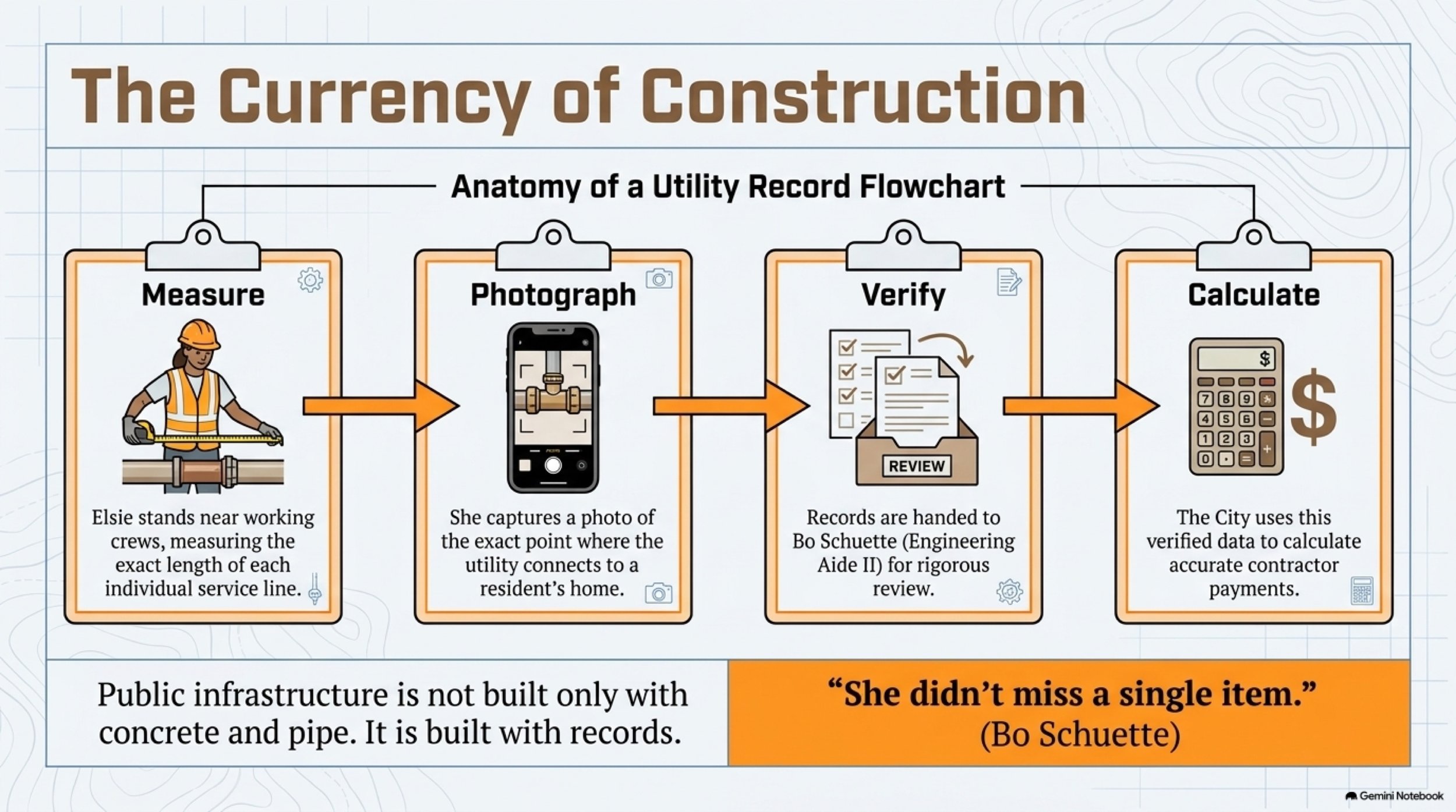
She stood near the working crews, measured the length of each service line and photographed the point where it connected with an individual home. She then provided those records to Bo Schuette, a City of Hastings Engineering Aide II who worked closely with her in the field.
Schuette could use that documentation as part of the City’s process for verifying the quantities of materials installed before contractor payments were calculated.
“My job was to stand out by the crews and collect all the information on how long each service pipe was, and take a picture of the service connecting to the house,” Jacobs said.
It was detailed work, and accuracy mattered.
A missing photograph or measurement could leave City staff without a complete record of what had been placed underground before the street was restored.
Schuette said Jacobs quickly proved that she could be trusted with that responsibility.
After reviewing the notes and photographs from her first week, he reached an important conclusion:
“She didn’t miss a single item.”
Schuette said Jacobs demonstrated strong organization and record-keeping skills. Her consistency gave him confidence that she would continue documenting construction quantities correctly.
That is one of the least visible but most important lessons in Jacobs’ story: public infrastructure is not built only with concrete, pipe and asphalt. It is also built with records.
Measurements and photographs help establish what was installed, where it was placed and how much work was completed.
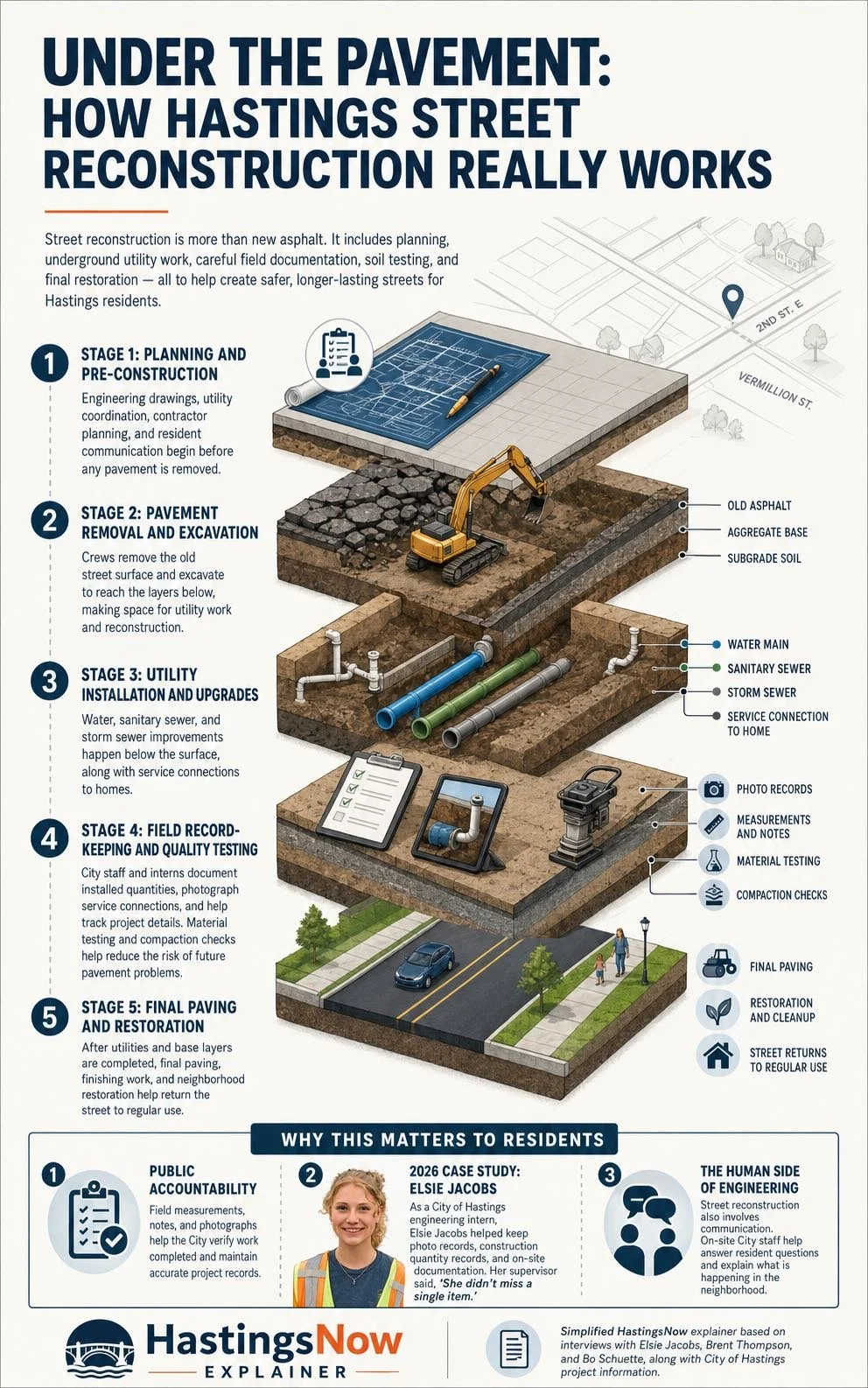
AI infographic by HastingsNow.com
Why crews cannot simply put everything back beneath the road
One of Jacobs’ greatest surprises involved the material underneath the finished pavement.
Before beginning her internship, she assumed crews generally returned whatever they excavated to the space beneath the reconstructed street.
The reality was more complicated.
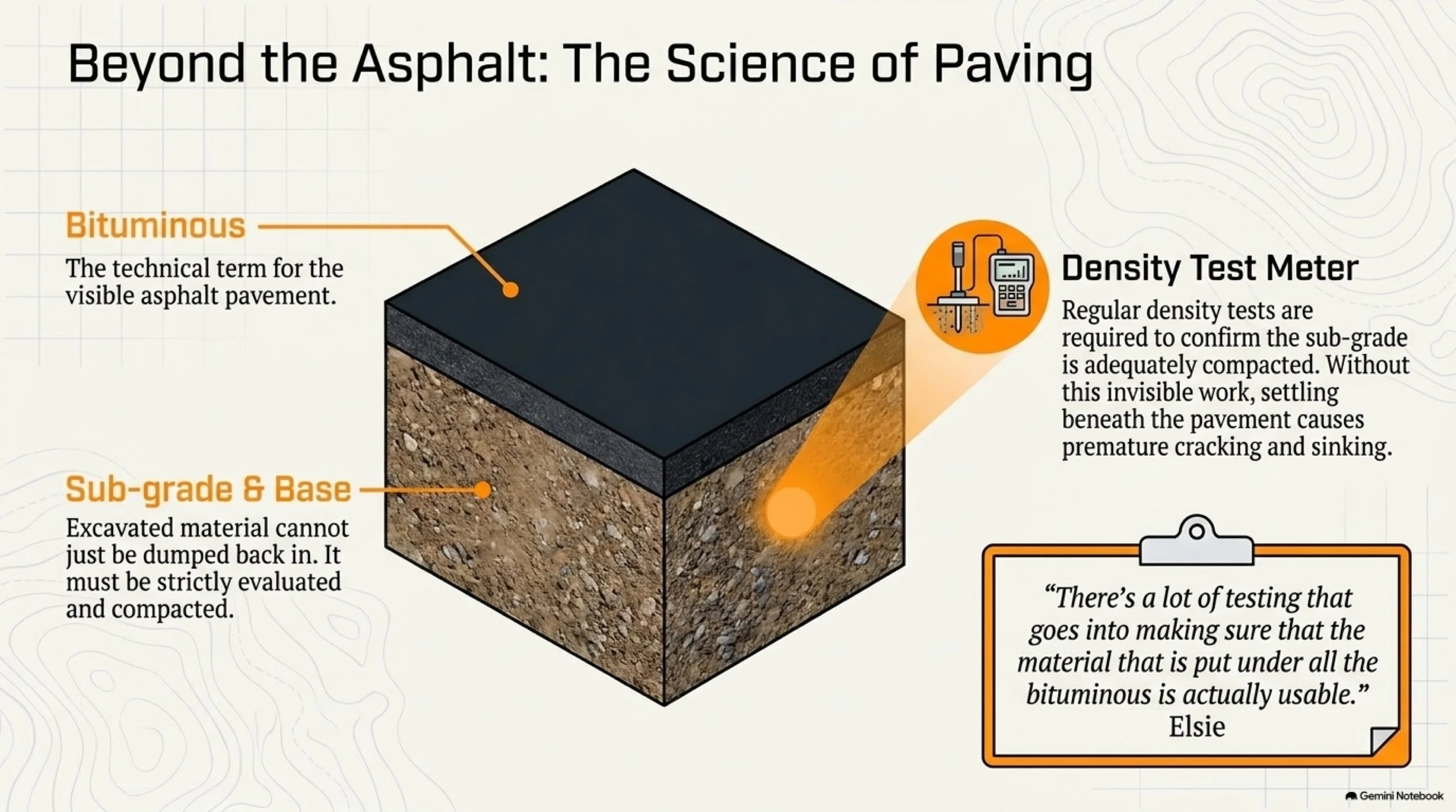
Jacobs learned that the material placed beneath the eventual asphalt surface must be evaluated and compacted properly. Otherwise, settling beneath the pavement can contribute to cracking, sinking and premature deterioration.
“There’s a lot of testing that goes into making sure that the material that is put under all the bituminous is actually usable,” Jacobs said.
Bituminous is the technical term commonly used for asphalt pavement.
Jacobs said regular density tests were performed to help determine whether the underlying road material had been compacted adequately.
That gave her a new understanding of something residents usually see only after it is finished: the long-term performance of a street depends heavily on work that eventually becomes invisible.
Earning the City’s trust
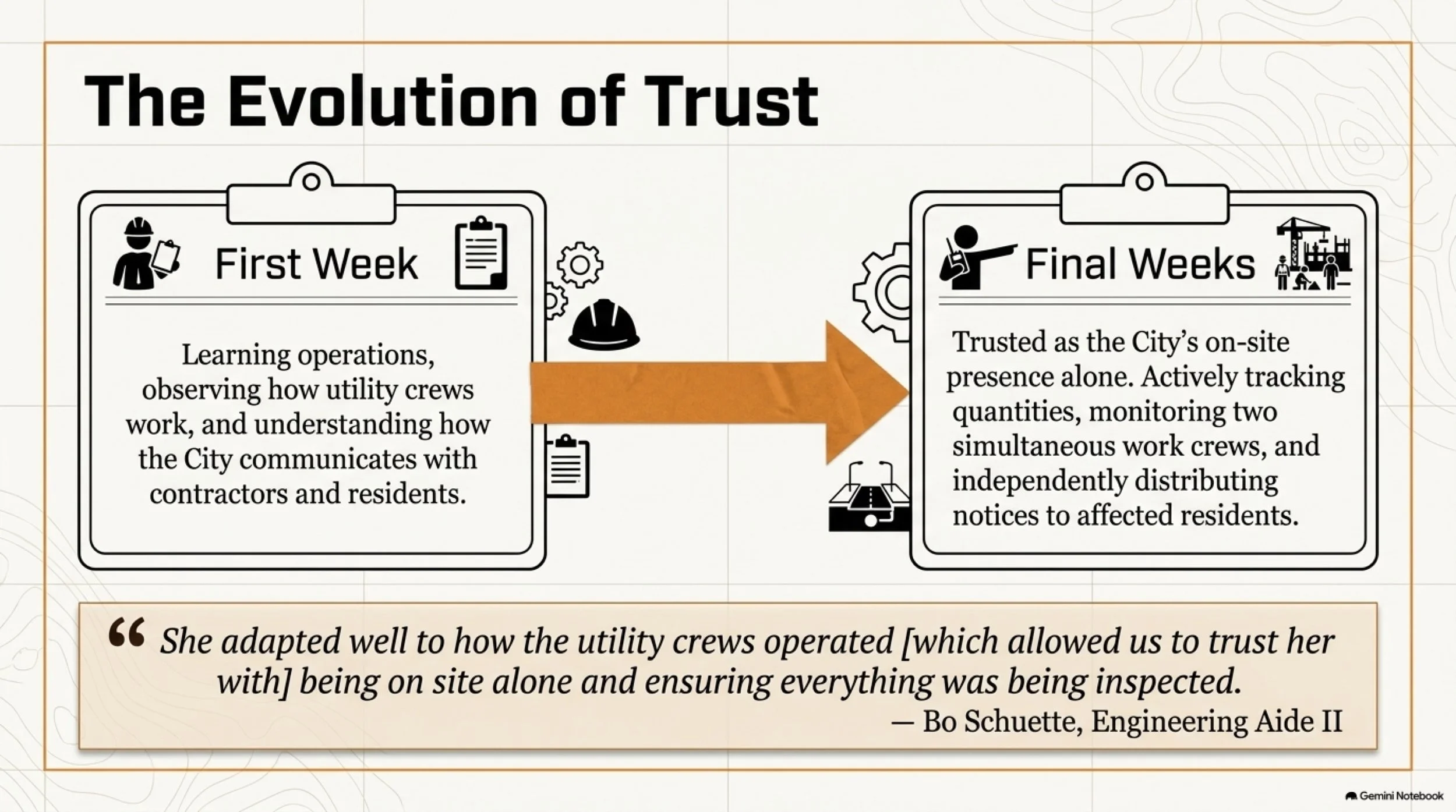
The difference between Jacobs’ first week and her final weeks was substantial.
Early in the summer, she was learning how crews operated, what needed to be recorded and how the City communicated with contractors and residents.
By the end, Jacobs said she was frequently the City’s on-site presence while two crews were working. She was tracking quantities, monitoring activity and responding to people living near the construction.
“The City staff really put a lot of faith in me,” she said. “I definitely wouldn’t have been able to do that in my first week here.”
Schuette independently confirmed that progression.
“She adapted well to how the utility crews operated,” he wrote. That allowed him to trust Jacobs with “being on site alone and ensuring everything was being inspected.”
He also said she worked many hours and stayed through long days to help keep the project moving as planned.
Her contribution extended beyond inspection and documentation. According to Schuette, Jacobs helped keep residents informed by distributing notices and speaking individually with people affected by the construction.
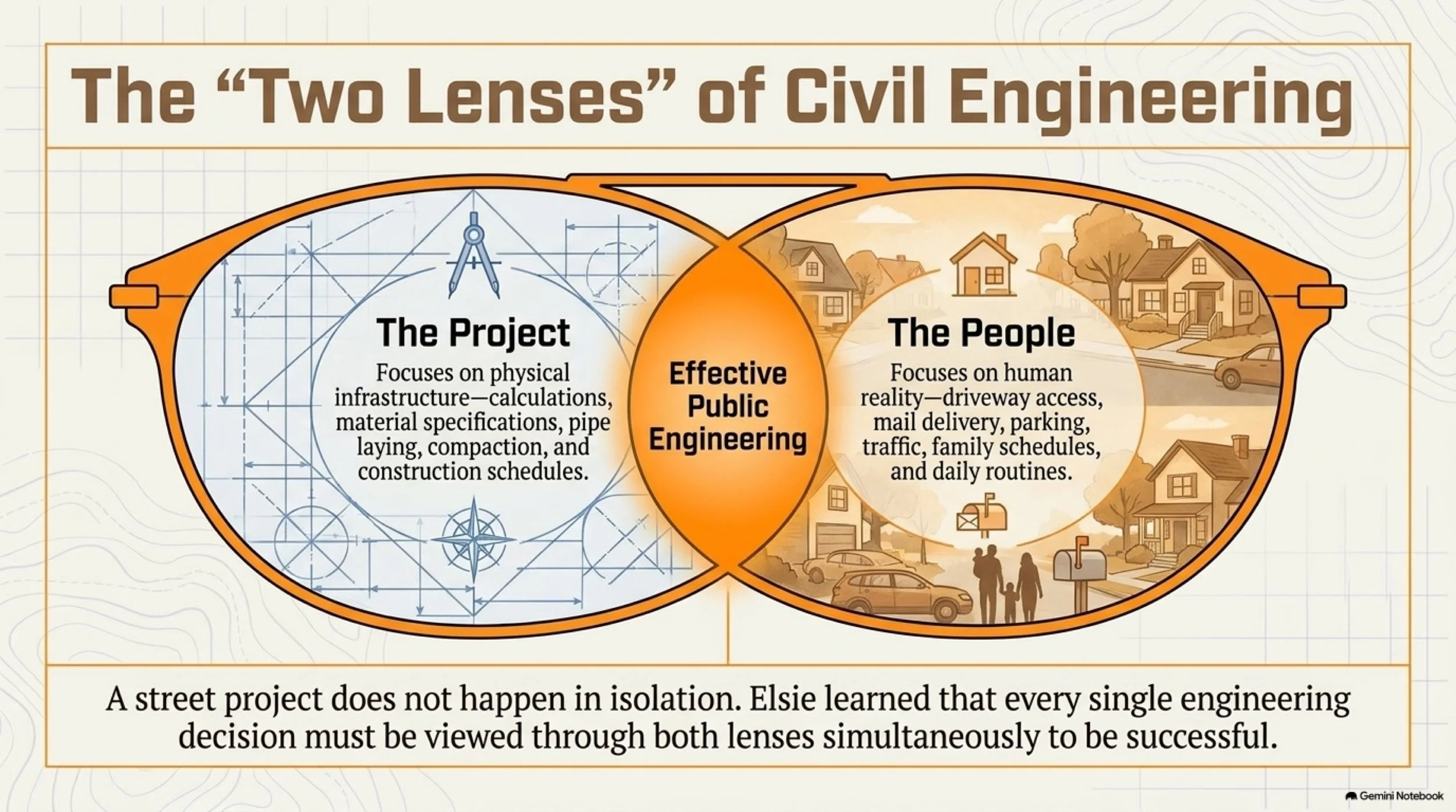
That responsibility matters because a street project does not happen in isolation. It affects driveways, mail delivery, parking, traffic, family schedules and people’s ability to reach their own homes.
Jacobs was learning to see every engineering decision through two lenses: how it affected the project and how it affected the people living beside it.
AI-assisted visual explainer: The following slide deck was created with generative AI using HastingsNow’s original interviews, reporting and photography as source material, then reviewed and edited by HastingsNow. Some scenes are illustrative reconstructions and should not be interpreted as documentary photographs or official City of Hastings materials.
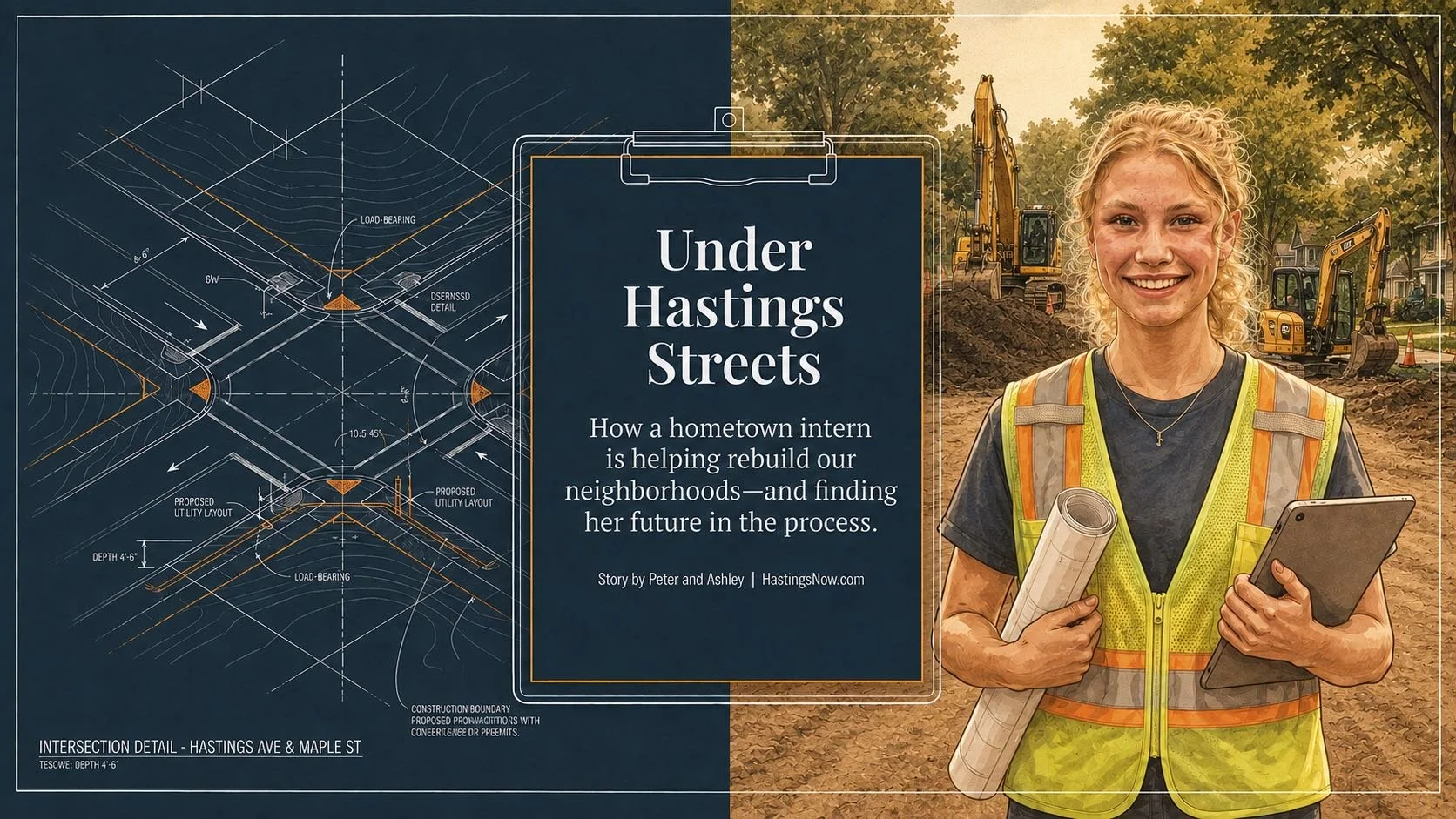

Engineering turned out to be a team profession
Jacobs had already begun questioning one of her assumptions about engineering before arriving at the City of Hastings.
At Michigan Tech, she was part of an Engineering Fundamentals team that developed an Arctic Fish Sensor. The prototype used an underwater ultrasonic sensor and a water-quality sensor to address challenges faced by Arctic communities seeking more consistent information about fishing conditions. Michigan Tech lists Jacobs, Natalie Palmer and Addison Russel as the project’s student team members.
The project taught Jacobs that engineering was far more collaborative than she had imagined.
“I never really thought that engineers were big teamwork people,” she said. “I always kind of thought they sat at their computer doing their own thing.”
Her Michigan Tech team changed that impression. The Hastings internship reinforced it.
Jacobs had to interact with contractors, utility crews, City employees and residents—groups with different expertise, priorities and questions.
“The teamwork skills that I learned from that project have really shown me how to interact with different people,” she said.
Finding the kind of engineer she wants to become
The internship gave Jacobs practical knowledge that she will take back to Michigan Tech: utility construction, road materials, record keeping, field observation and the many layers of work involved in rebuilding a neighborhood street.
But her most important discovery may have been about herself.
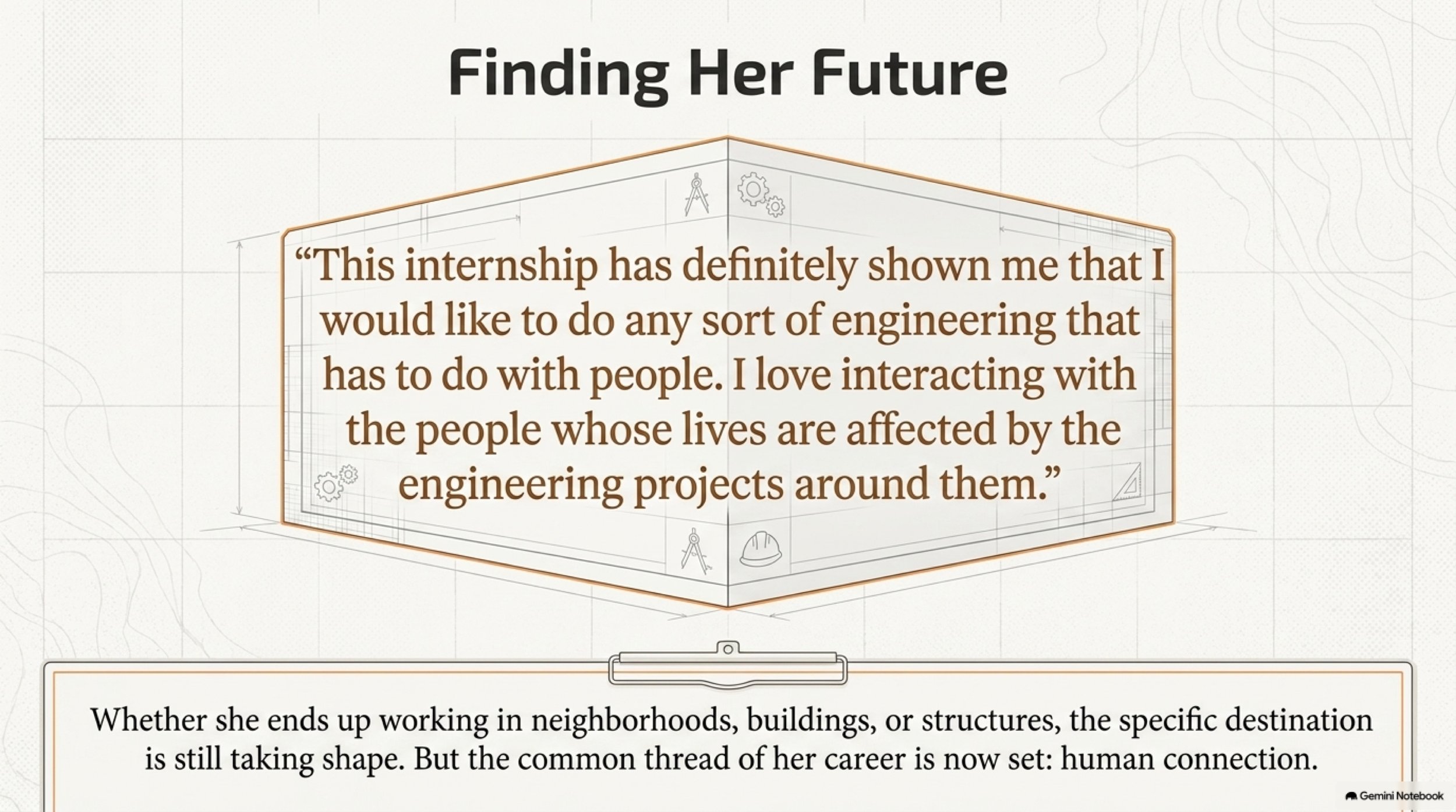
“This internship has definitely shown me that I would like to do any sort of engineering that has to do with people,” Jacobs said.
That could mean working in neighborhoods, buildings, structures or another part of civil engineering. The specific destination is still taking shape.
The common thread is human connection.
“I love interacting with the people whose lives are affected by the engineering projects around them,” she said.
She will also return to school with greater confidence speaking with unfamiliar people.
“This job has definitely helped me grow in my communication with strangers and people that I don’t really know that well,” Jacobs said.
Why Hastings brings students into City engineering
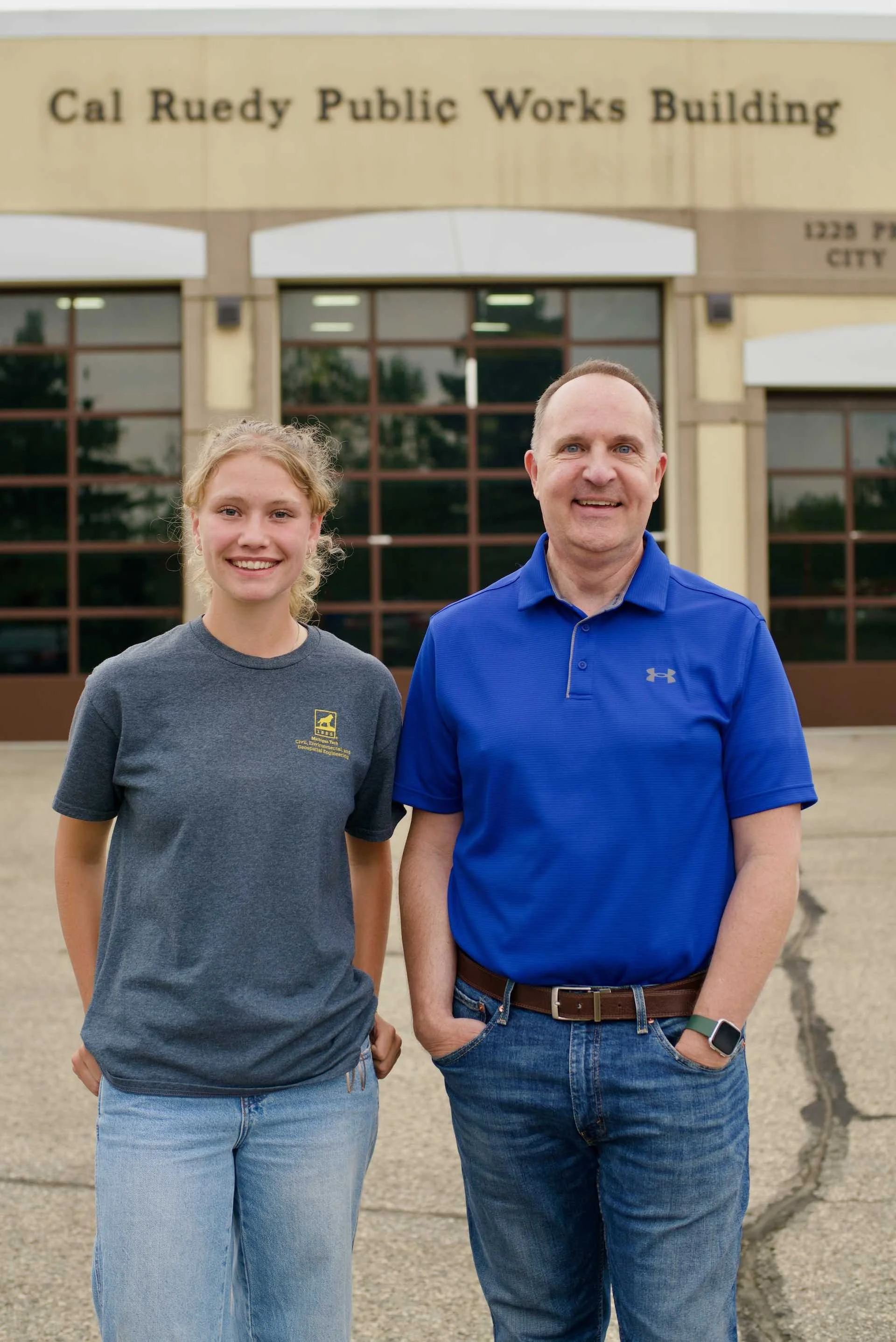
Hastings City Engineer Brent Thompson said internships expose students to real-world applications and help them explore possible career directions. Photo by HastingsNow.com
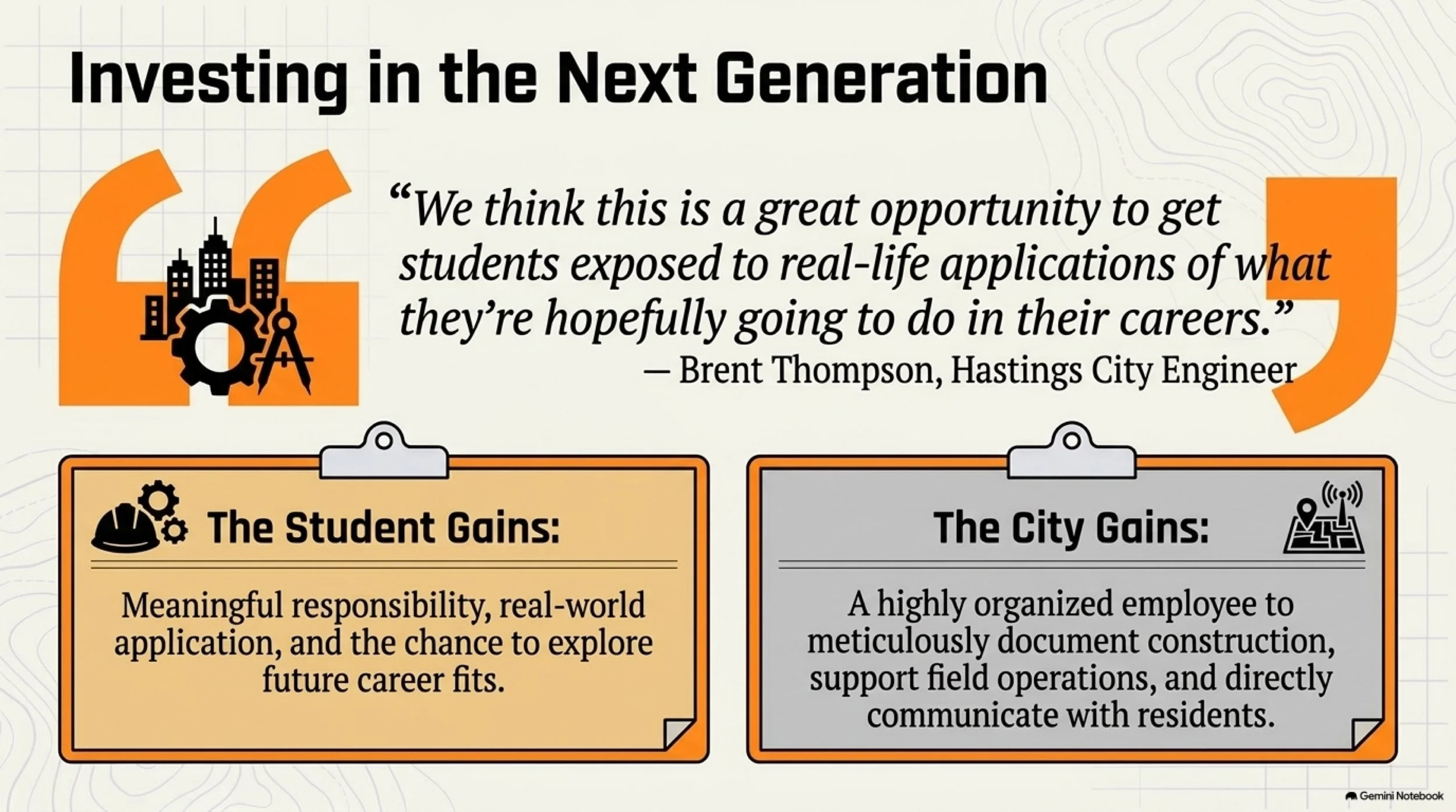
Hastings City Engineer Brent Thompson said internships give students a chance to experience the real-world applications of what they are studying.
“We think this is a great opportunity to get students exposed to real-life applications of what they’re hopefully going to do in their careers,” Thompson said.
The experience can also help a student determine what kind of work may—or may not—fit their future.
Students can participate in a project, observe other opportunities and begin exploring what they may want to pursue over the long term, he said.
For Hastings residents, the benefit is visible in Jacobs’ work. The City gained an organized young employee who documented construction, communicated with residents and supported field operations.
Jacobs gained something equally valuable: meaningful responsibility in the community where she grew up.
Could Elsie Jacobs return to Hastings someday?
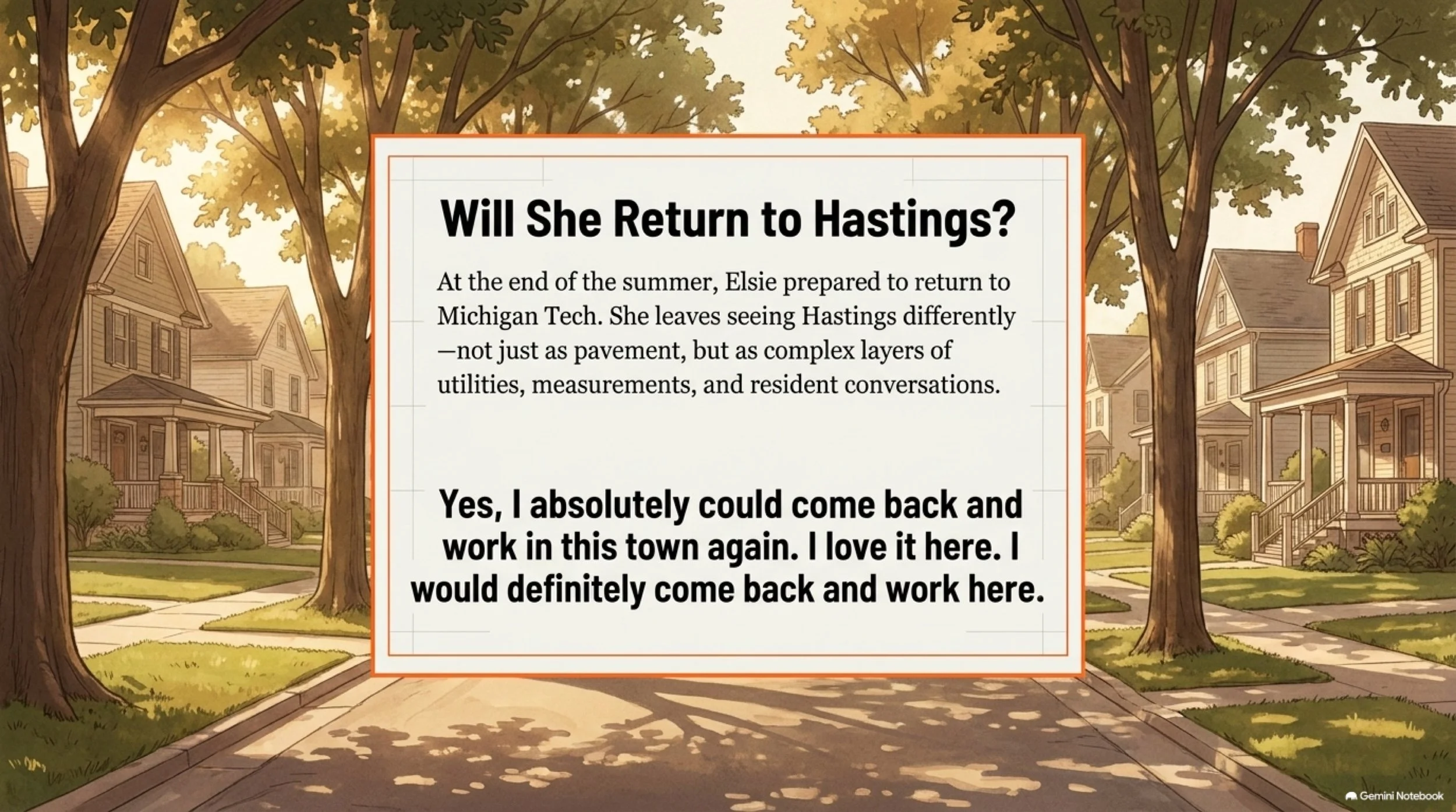
At the end of the summer, Jacobs was preparing to leave familiar streets behind once again and return to Michigan Tech.
This time, however, she would see Hastings differently.
A street would no longer be only the pavement visible from a vehicle. It would also be layers of materials, utility lines, service connections, density tests, drawings, measurements, photographs and conversations with the people whose lives are unfolding beside the work.
She would also leave with a possible future in mind.
Asked whether she could imagine returning to Hastings someday as an engineer, Jacobs did not hesitate.
“Yes, I absolutely could come back and work in this town again,” she said. “I love it here.”
She described the people she met through the internship and the welcome she received at the Public Works building.
“I would definitely come back and work here,” she said.
For one summer, Elsie Jacobs helped Hastings understand what was happening beneath its streets.
In return, Hastings helped her understand the kind of engineer she hopes to become.
What Hastings residents should know about the 2026 street project
The City’s 2026 Neighborhood Infrastructure Improvements project began during the week of May 18. Its major phases include work on Pleasant Drive and 4th Street. Residents can find the newest construction notices, maps, project materials and sign-up information through the City’s official project page. Questions can also be directed to the Hastings Engineering Department at 651-480-2334.
Because the City webpage and individual construction-update documents currently display different SMS keywords, HastingsNow recommends checking the official project page for the current text-alert instruction before signing up.
About this story
Peter and Ashley of HastingsNow interviewed Elsie Jacobs and Hastings City Engineer Brent Thompson on August 20, 2026, at the Cal Ruedy Public Works Building and the 4th Street construction area. Bo Schuette, Engineering Aide II with the City of Hastings, subsequently answered follow-up questions about Jacobs’ field work.
Quotations from the recorded interview have been lightly edited to remove verbal fillers and improve readability without changing their meaning. Schuette’s longer emailed responses were primarily paraphrased because the original contained several apparent typographical errors; the short quotations reproduced above retain his wording.
Photography: HastingsNow.com/Ashley
AI enhanced YouTube cover image below.