
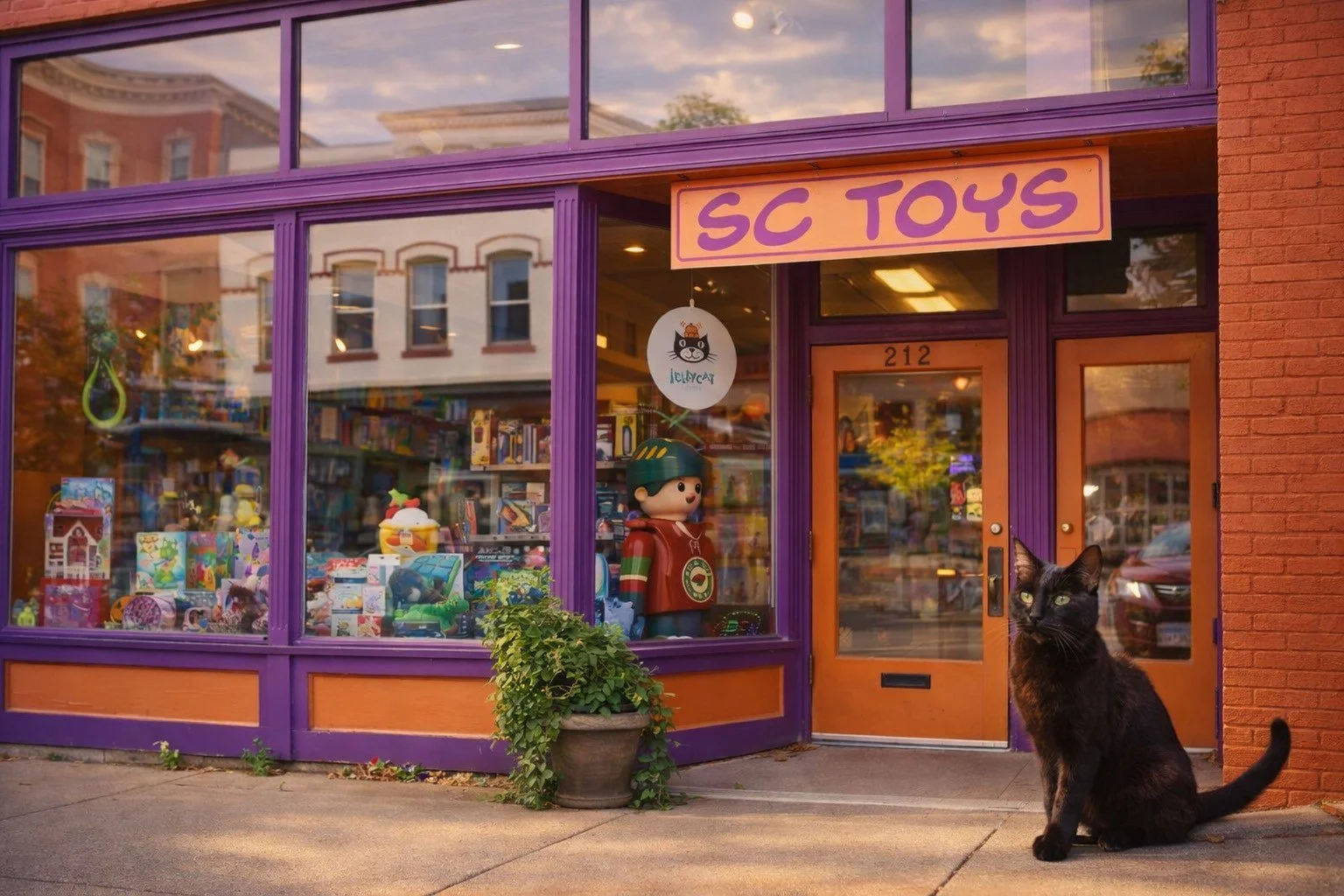
Barb Hollenbeck and SC Toys: Why a Local Toy Store Still Matters in Hastings, Minnesota
In downtown Hastings, SC Toys is more than a toy store. It is Barb Hollenbeck’s longtime belief that children learn best through play, curiosity, and hands-on discovery. From first dolls and bath toys to screen-free activity books and family-building sets, SC Toys has become a local destination for gifts that are thoughtful, educational, and fun.
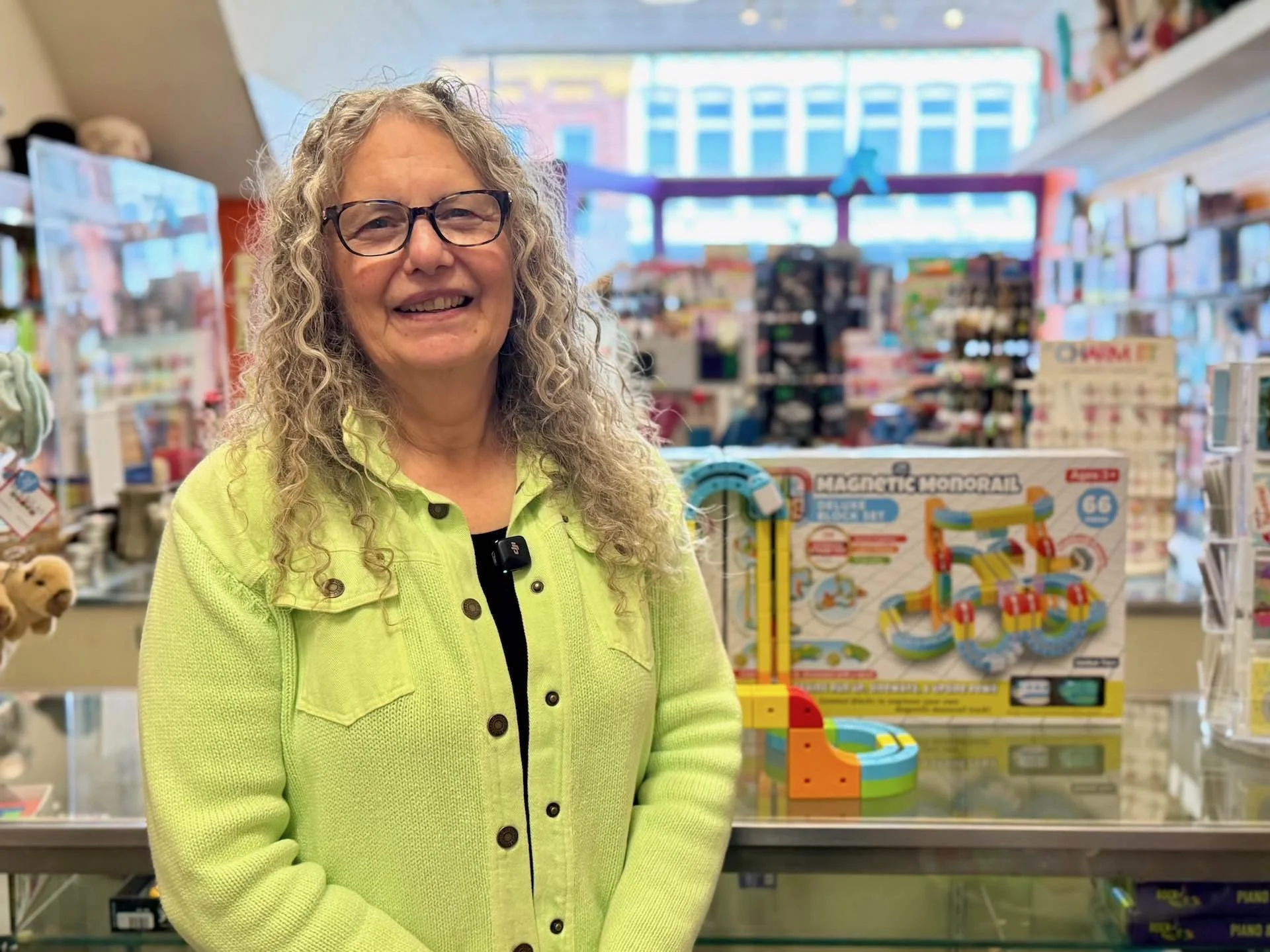
Barb Hollenbeck visits with HastingsNow.com at SC Toys, located in historic downtown Hastings, Minnesota.
In historic downtown Hastings, SC Toys carries an old idea into the present: that a toy store can still be a place for first dolls, family projects, screen-free afternoons, and the kind of learning that feels like fun. Officially, the shop calls itself a family-owned “destination for fun.” In practice, it is Barb’s long-running argument for imaginative play, better buying, and stronger community life.
At 212 2nd Street East, SC Toys stands inside a downtown that already knows how to tell a story. Hastings tourism officials call the district the heart of the city, and city preservation records describe East Second Street as one of Minnesota’s most intact historic main streets, with commercial buildings reaching back to the 1860s. In that setting, a toy store does not feel disposable. It feels right at home.
That matters, because toy stores have always been about more than inventory. Long before apps, big-box chains, and algorithmic shopping feeds, toy shops were built around display, delight, and discovery. Hamleys in London dates to 1760. Philadelphia was manufacturing toys by 1838. And historians of American retail note that specialty toy stores were already appearing in major U.S. cities by the 1860s, even as many children still encountered toys in department and dime stores. The idea of a toy shop as a place of wonder is old. SC Toys is one small-town continuation of that very old retail promise.
Barb’s version of that promise is unusually clear. In interview materials provided for this story, she says she began with vintage dolls and toys before migrating into toys more broadly. Her goal was not simply to sell what was cute or trendy. She wanted parents to have tools for building a learning environment at home. “The kids are learning and they don’t know it,” she says. That sentence is as close as SC Toys gets to a manifesto. The store’s public language mirrors it, describing the shop as family-owned, educational, developmental, and fun.
There is another layer to Barb’s story that gives the feature real texture. In the interview materials, she says she is a veteran of the United States Army, having served from 1978 to 1981 as a 96 Bravo intelligence analyst in Germany. She describes studying Soviet strengths, weaknesses, likely routes, units, and equipment. That background does not need to be overstated to feel relevant. Even in the store, Barb comes across as someone who watches carefully, listens for patterns, and makes decisions by paying attention. That is an inference from the interview, but it fits the way she talks about buying for the shop.
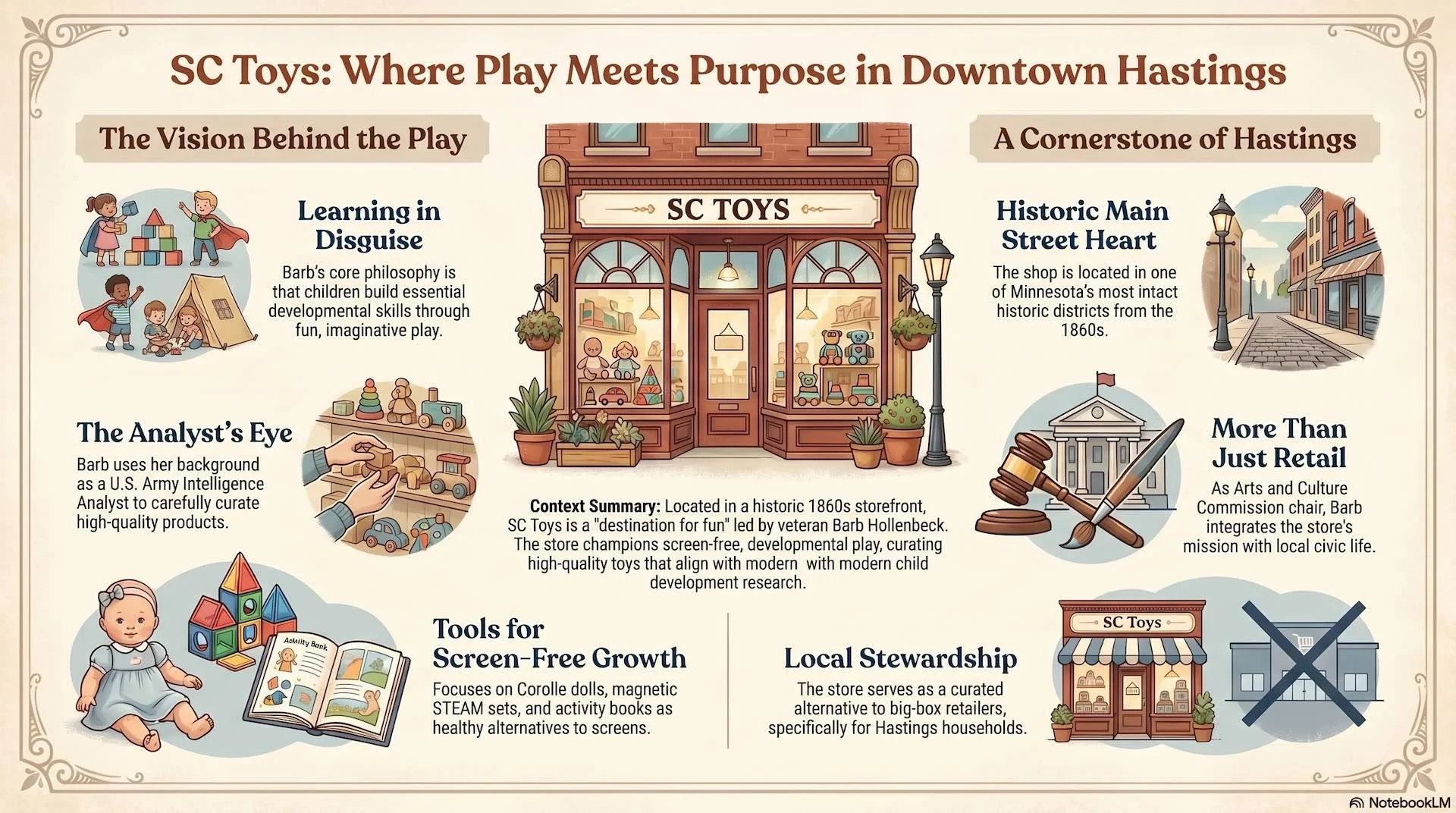
Infographic by HastingsNow.com
When Barb explains how she chooses products, the key word is listening. She listens to parents, kids, sales reps, and the specialty market. She asks whether a toy makes sense for a Hastings household, whether it adds to learning and family fun, and whether it is actually well made. That instinct aligns closely with guidance from the American Academy of Pediatrics and the National Association for the Education of Young Children. The AAP says the best toys match developmental abilities and help children build new skills, while NAEYC emphasizes that open-ended materials support sensory, creative, and dramatic play and are especially powerful when children and families use them together.
You can see that philosophy in the products Barb chooses to spotlight. One day it is Corolle dolls, which the brand itself markets with first-doll options for young children and baby dolls with sleeping eyes. Another day it is a magnetic monorail set, the kind of hands-on STEAM toy built around designing and rebuilding three-dimensional tracks. Then Barb pivots to activity books, which she frames as practical alternatives to screens for restaurant trips, car rides, and plane rides. And when she highlights bath toys, she talks less about clutter and more about fresh adventures in the tub. Even the bubble bath whisk she likes is designed to let children make foam with a crank while building coordination and motor skills.
What is striking is how consistent that outlook has been. Older store posts still refer to the business as Second Childhood Toys, and some of Barb’s own video copy used the phrase “Second Childhood Toys or SC Toys.” Across those earlier posts, the through-line is unmistakable: developmental toys for infants and toddlers, art and craft kits, tactile toys, classic play patterns, and a recurring effort to give children something they can touch, build, tell stories with, or do together. In one older store post, Barb explicitly said she was seeing parents and grandparents look for ways to get kids away from screens and had expanded science kits in response.
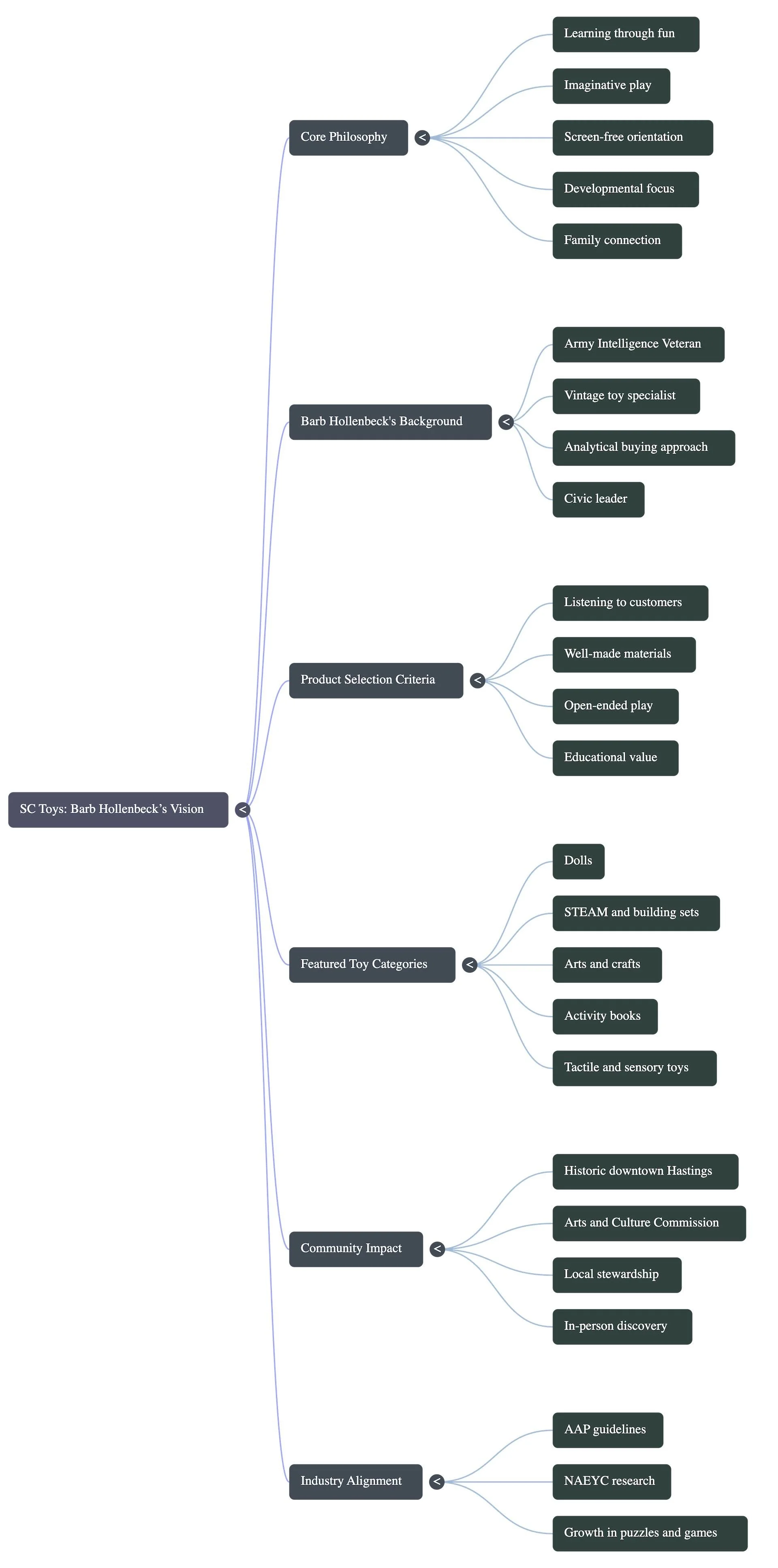
SC Toys mind map by HastingsNow.com
That screen-free, hands-on orientation is not just sentimental. It maps onto what play experts keep finding. HealthyChildren.org, the American Academy of Pediatrics’ public-facing site, says play enriches a child’s brain, body, and life, and notes that traditional categories such as dolls, trains, puzzles, books, crayons, and coloring materials build language, creativity, problem solving, and fine motor development. NAEYC’s toy research likewise argues that simple, classic, open-ended toys often produce stronger thinking, social interaction, and creativity than the toys adults find most dazzling at first glance. In that light, SC Toys is not quaint. It is unusually well aligned with what the evidence says children actually benefit from.
And then there is Hastings itself. Downtown retail in Hastings is not just commerce; it is part of the town’s identity. Visit Hastings describes downtown as a mix of retail, arts, dining, and community activity connected to the river and Levee Park. SC Toys fits that ecosystem especially well because it serves both visitors and regulars: grandparents hunting for a first-birthday gift, parents looking for a better rainy-day option, and local families who still want their children to experience the pleasure of choosing a toy in person instead of watching one arrive in a cardboard box.
Barb’s investment in the town reinforces the point. Official city pages list her as chair of the Arts and Culture Commission, and city records show her helping shape the original Arts Task Force and supporting Rec + Art + Police programming. That matters because it suggests the store is not separate from Barb’s civic vision. The same person who wants more creativity in the home also wants more creativity in the parks, in public programming, and in the cultural life of downtown. SC Toys is one storefront expression of a bigger local philosophy.
The timing for this story is also good. The U.S. toy industry returned to growth in 2025, according to Circana data shared by The Toy Association, with games and puzzles up sharply and building sets posting strong gains as well. Those national trends help explain why categories Barb naturally gravitates toward, such as family play, building toys, crafts, and hands-on learning, continue to resonate. But trend alignment is only part of the story. Barb’s real skill is not catching every fad. It is editing the giant toy marketplace for one particular hometown audience. The Toy Association
That is why SC Toys still matters. Not because it is trying to out-big the biggest retailers. Not because it is chasing every screen, license, or gimmick. It matters because Barb has spent years making a case that toys can still help a child imagine, a family connect, and a downtown feel a little more alive. In Hastings, that is not just retail. It is a kind of local stewardship.