

Our working philosophy, November 2026
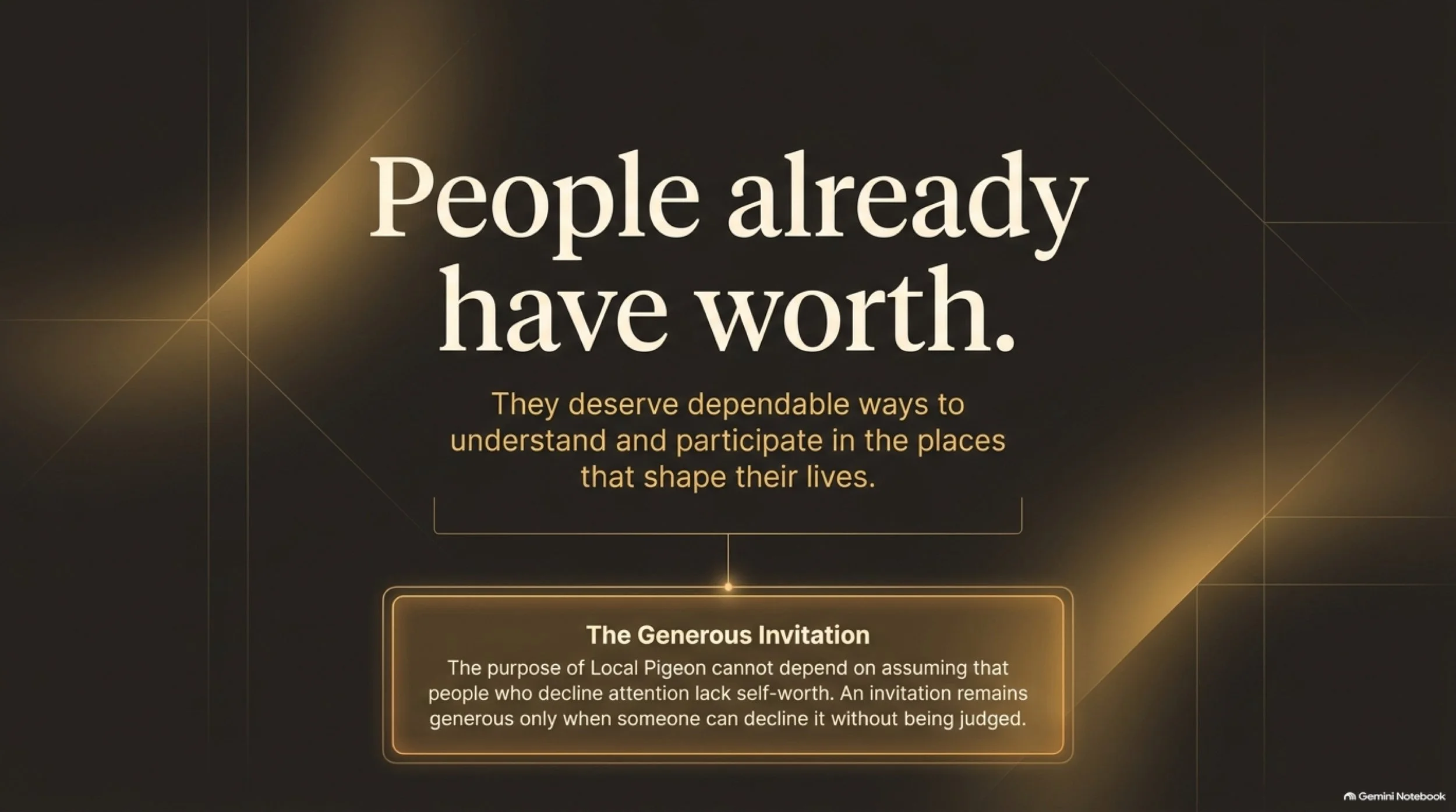
People already have worth. They deserve dependable ways to understand and participate in the places that shape their lives.
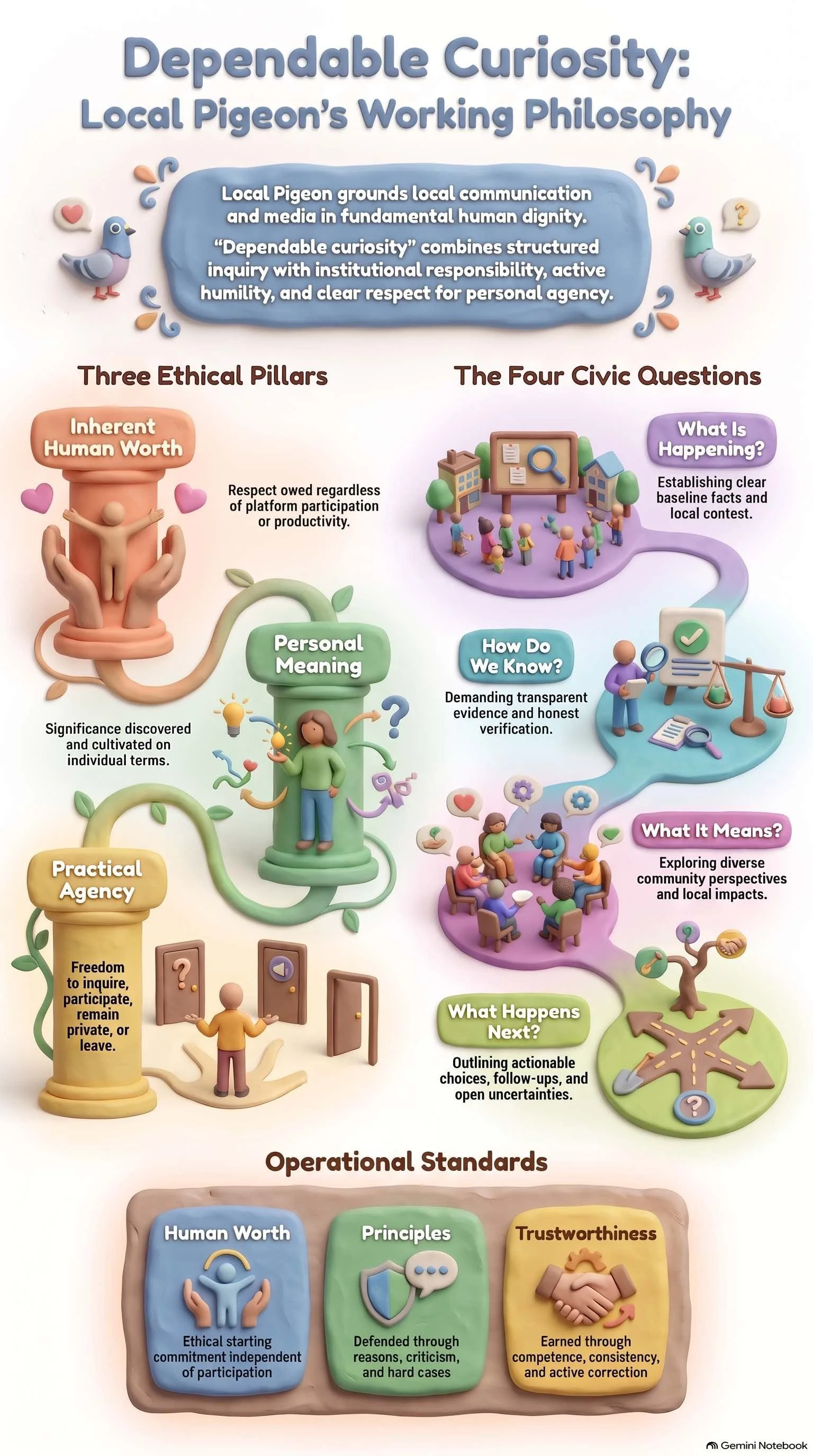
That is the starting point for Local Pigeon’s working philosophy. Through our work at HastingsNow.com and the service we are developing, we want to help people understand what is happening, preserve experiences they choose to keep, and decide how to participate.
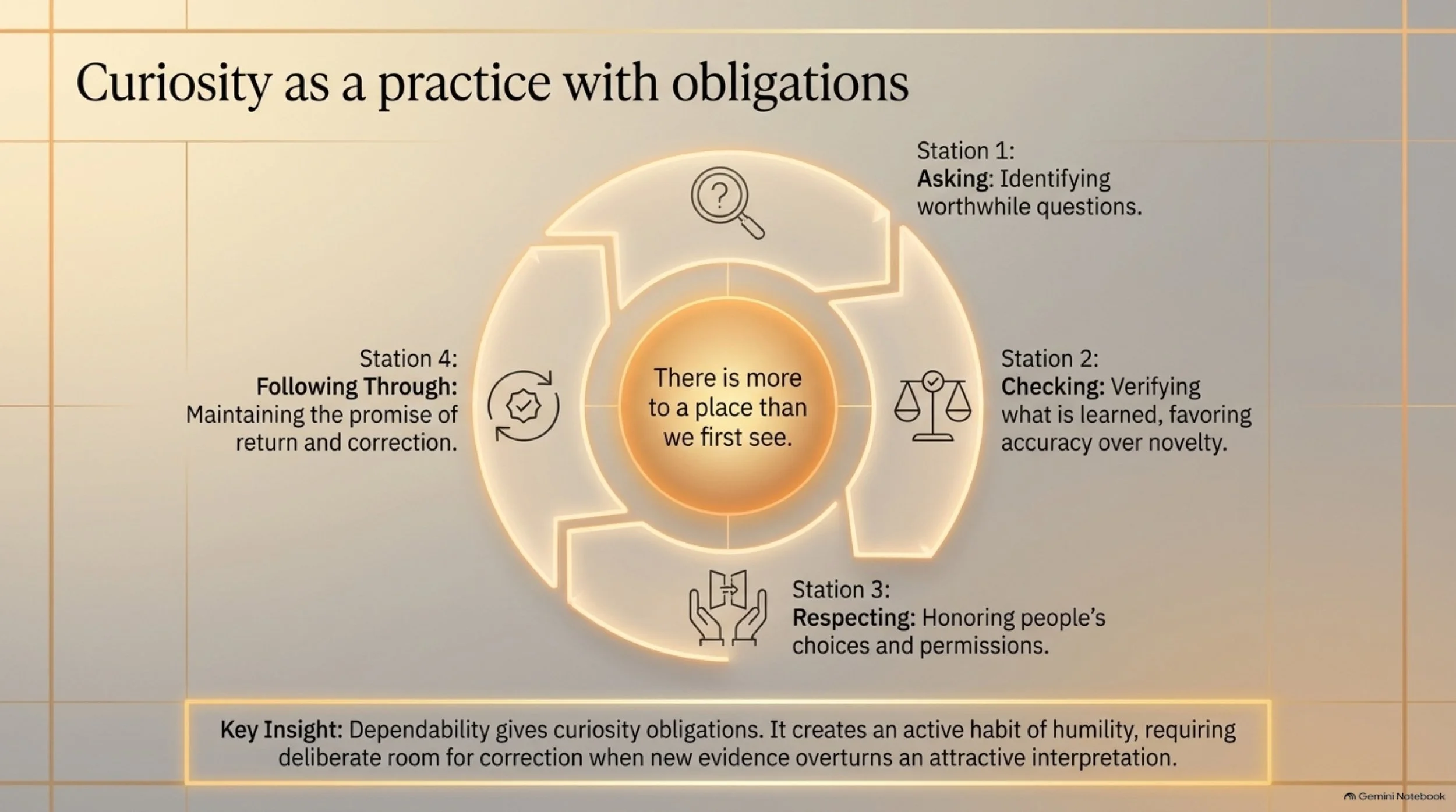
We call this approach dependable curiosity: asking worthwhile questions, checking what we learn, respecting people’s choices, and following through. “There is more to a place than we first see” is an invitation to keep learning—including when what we learn changes our own understanding.
These principles have deep roots. Our responsibility is to make them useful in everyday local life.
Human worth and the conditions for meaning
A person can have a deeply meaningful life without appearing in a public story. They may find significance in raising children, caring for someone, religious practice, skilled work, friendship, scientific inquiry, art, or a private commitment no platform ever encounters.
Local Pigeon should begin by respecting that variety. Its purpose cannot depend on assuming that people who decline attention lack self-worth or have failed to recognize their potential. An invitation remains generous only when someone can decline it without being judged.
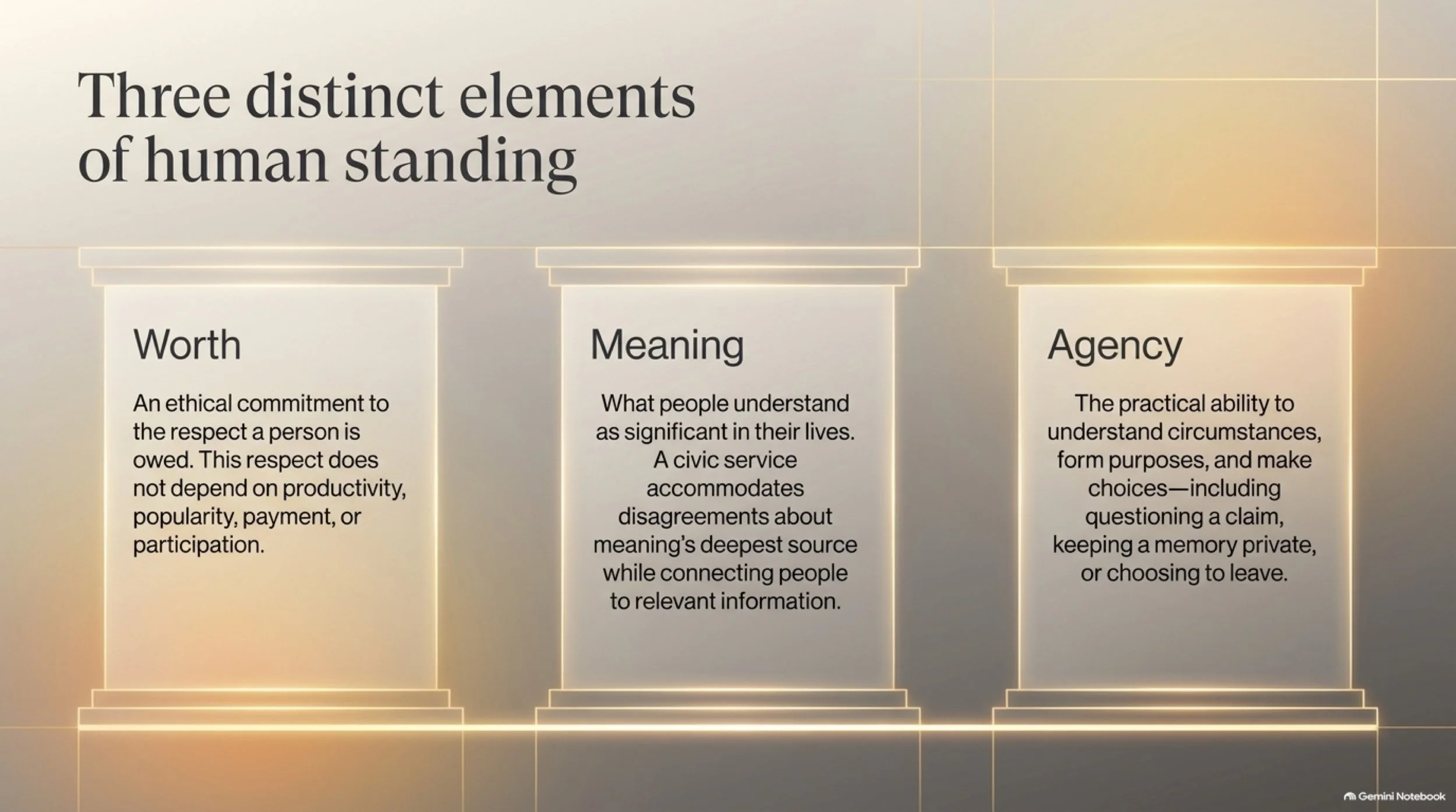
Three ideas need separate treatment.
Worth concerns the respect a person is owed. For this philosophy, that respect does not depend on productivity, popularity, payment, or participation. This is an ethical commitment to defend, rather than a measurement a service produces.
Meaning concerns what people understand as significant in their lives. Some meaning is discovered, some inherited, some cultivated, and some reconsidered. People may disagree about its deepest source. A civic service can accommodate those disagreements while helping people encounter information and experiences relevant to what matters to them.
Agency concerns their practical ability to understand circumstances, form purposes, and make choices. Agency includes questioning a claim, keeping a memory private, participating in a decision, and choosing to leave.
The distinction changes the proposed mission. Local Pigeon can help someone recognize an opportunity without declaring that their present life is inadequate. It can preserve a story without deciding that publication makes the storyteller more valuable. It can offer useful information without making gratitude or loyalty part of the exchange.
The goal is to improve conditions under which people pursue lives they have reason to value. That goal leaves room for people to surprise the organization, disagree with its interpretation, or decide that its service is unnecessary for them.
The argument for dependable curiosity
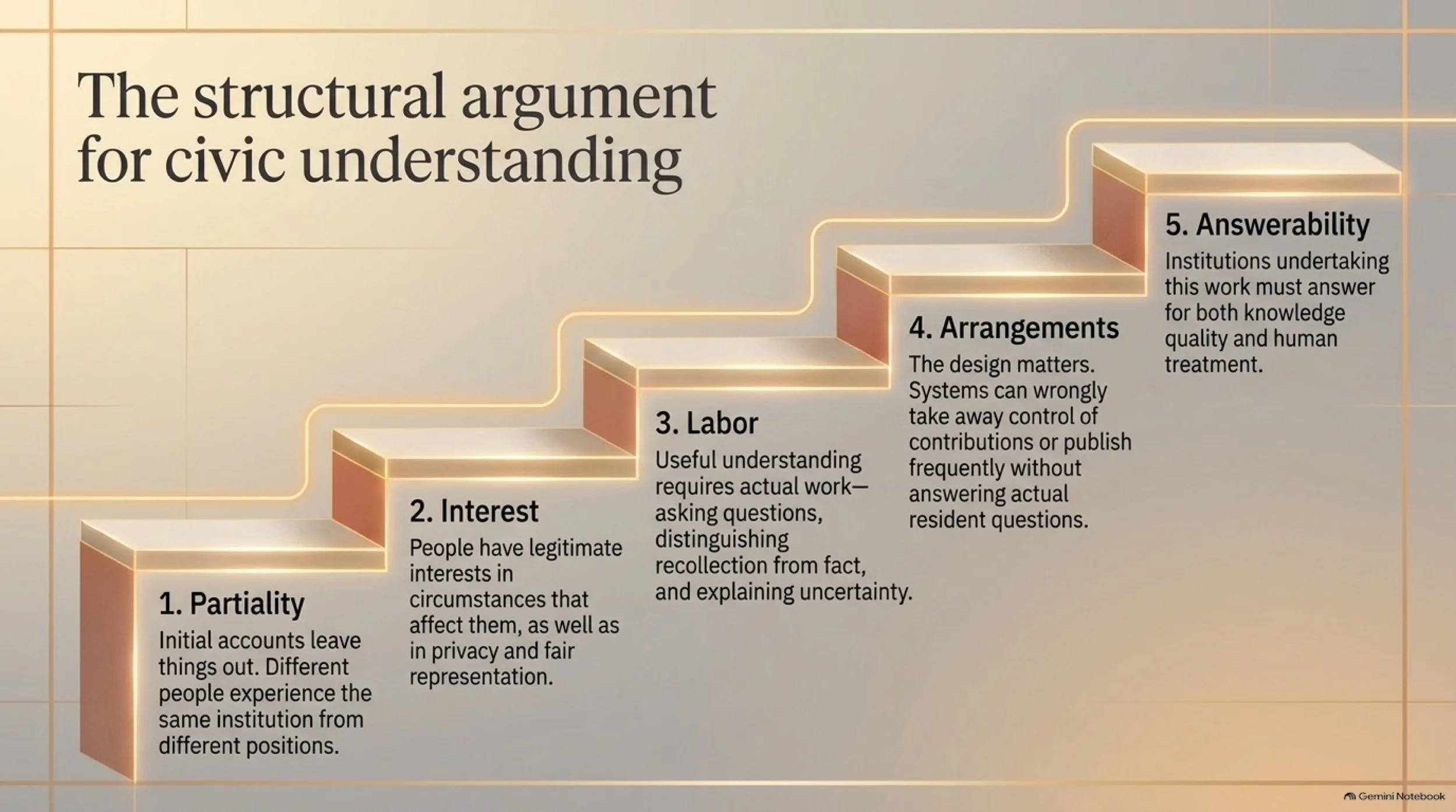
The philosophical argument can be stated in five steps.
First, our understanding of a place is partial. An initial account leaves things out. Different people experience the same institution, street, business, or decision from different positions.
Second, people have legitimate interests in understanding circumstances that affect them. They also have interests in privacy, fair representation, and a meaningful say over voluntary contributions.
Third, useful understanding requires work. Someone must ask questions, obtain information, distinguish recollection from established fact, explain uncertainty, and return when events change.
Fourth, the arrangements for doing that work matter. A service can invite a person to speak while taking away control over how the contribution is used. It can preserve a record while making it difficult to correct or retrieve. It can publish frequently while failing to answer the questions residents actually have.
Fifth, an institution that undertakes this work should be answerable both for the quality of its knowledge and for its treatment of people.
The conclusion is a practical ethical proposal: build dependable ways for people to understand their shared circumstances while respecting their agency over their own lives.
This argument contains moral commitments and empirical questions. The moral commitments need reasons and criticism. Whether a particular service actually improves understanding or agency needs observation. Successful software cannot establish the whole philosophy, and an attractive philosophy cannot establish that the software works.
The proposal becomes stronger when those standards remain distinct. A reliable recording experience demonstrates a bounded promise about preservation and access. A well-sourced explanation can demonstrate a bounded benefit for public understanding. Larger claims should grow only as the evidence warrants them.
What dependable curiosity requires
Curiosity is a disposition to seek more understanding. By itself, it does not settle whether an inquiry is worthwhile or whether its methods are appropriate. Curiosity can become intrusive. It can favor novelty over accuracy. It can pursue an appealing story while overlooking the person whose life supplies it.
Dependability gives curiosity obligations.
It requires clear purposes, appropriate permissions, honest descriptions of evidence, understandable explanations, correction, and follow-up. It also requires enough practical competence to keep the promises made.
Dependability is compatible with uncertainty. A trustworthy answer can explain what is known, what is unresolved, and why. The confidence of the presentation should match the strength of the evidence.
The phrase “There is more to a place than we first see” should therefore apply first to Local Pigeon itself. It means that the founder, interviewer, editor, and AI system may all have missed something. Another perspective may change the question. A person may explain their life in terms the storyteller had not anticipated. Further evidence may overturn an attractive interpretation.
This gives humility an active form. It becomes the habit of making room for correction.
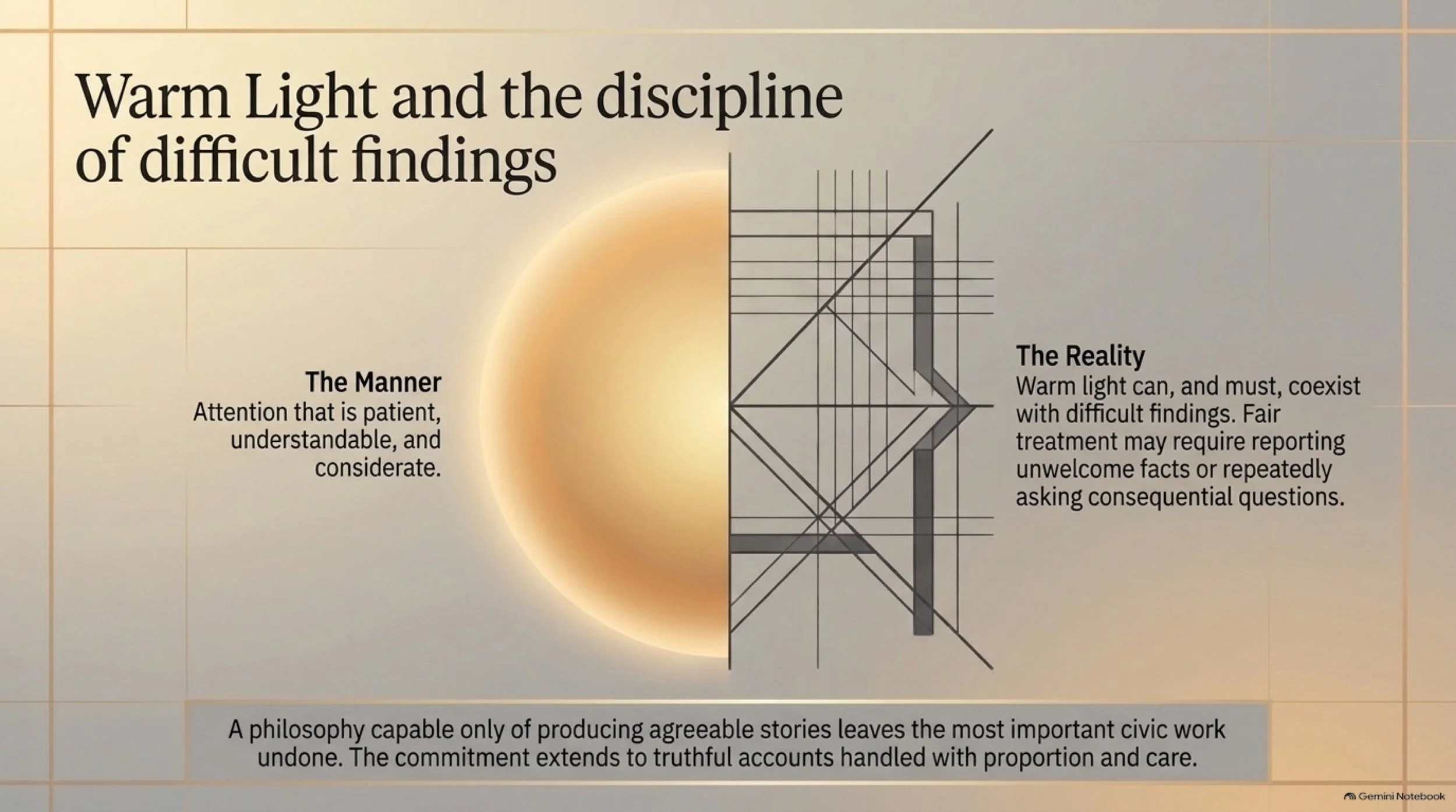
“Warm light” can describe the manner of the work: attention that is patient, understandable, and considerate. It can coexist with a difficult finding. Fair treatment may require reporting an unwelcome fact or asking a consequential question repeatedly.
A philosophy capable only of producing agreeable stories would leave some of the most important civic work undone. The commitment should extend to truthful accounts handled with proportion and care.
“People already have worth. Local Pigeon must earn its place in their lives.”
Why place matters
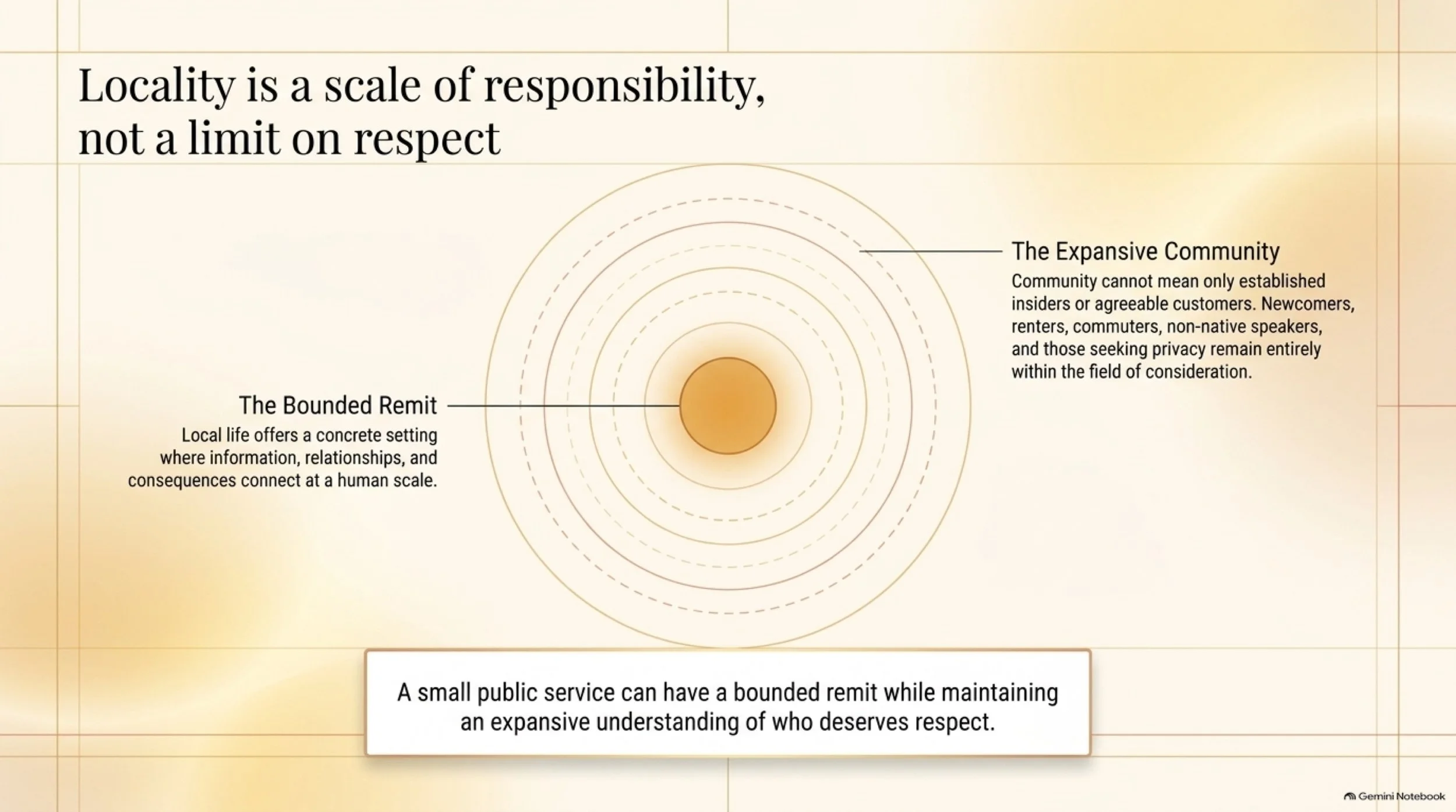
Local life offers a concrete setting in which information, relationships, and consequences can be connected. A resident can encounter the service being discussed, speak with someone affected, revisit a place, and ask what happened after a decision.
That makes locality a useful scale for dependable curiosity. It does not make every local matter more important than every distant one.
A person may have several places of belonging. Family can live elsewhere. An online community can be significant. An event across the world can create obligations more urgent than a nearby commercial opportunity. Some people need to leave a community to pursue safety, freedom, work, or a life that suits them.
Local Pigeon should remain intelligible to all of them.
The proposed principle is that responsibility can begin with the people and circumstances one is well positioned to understand and serve. It should remain open to the wider relationships that shape those circumstances.
This also changes the meaning of “community.” It cannot mean only established insiders, agreeable customers, long-term residents, or people who participate publicly. Newcomers, renters, workers who commute, people who speak different languages, and people who prefer privacy must remain within the field of consideration.
The local focus supplies specificity. It gives the organization a place to listen, useful questions to investigate, and promises whose consequences people can examine. Human standing remains broader than geography.
A small public service can have a bounded remit while maintaining an expansive understanding of who deserves respect.
Questions from philosophical traditions
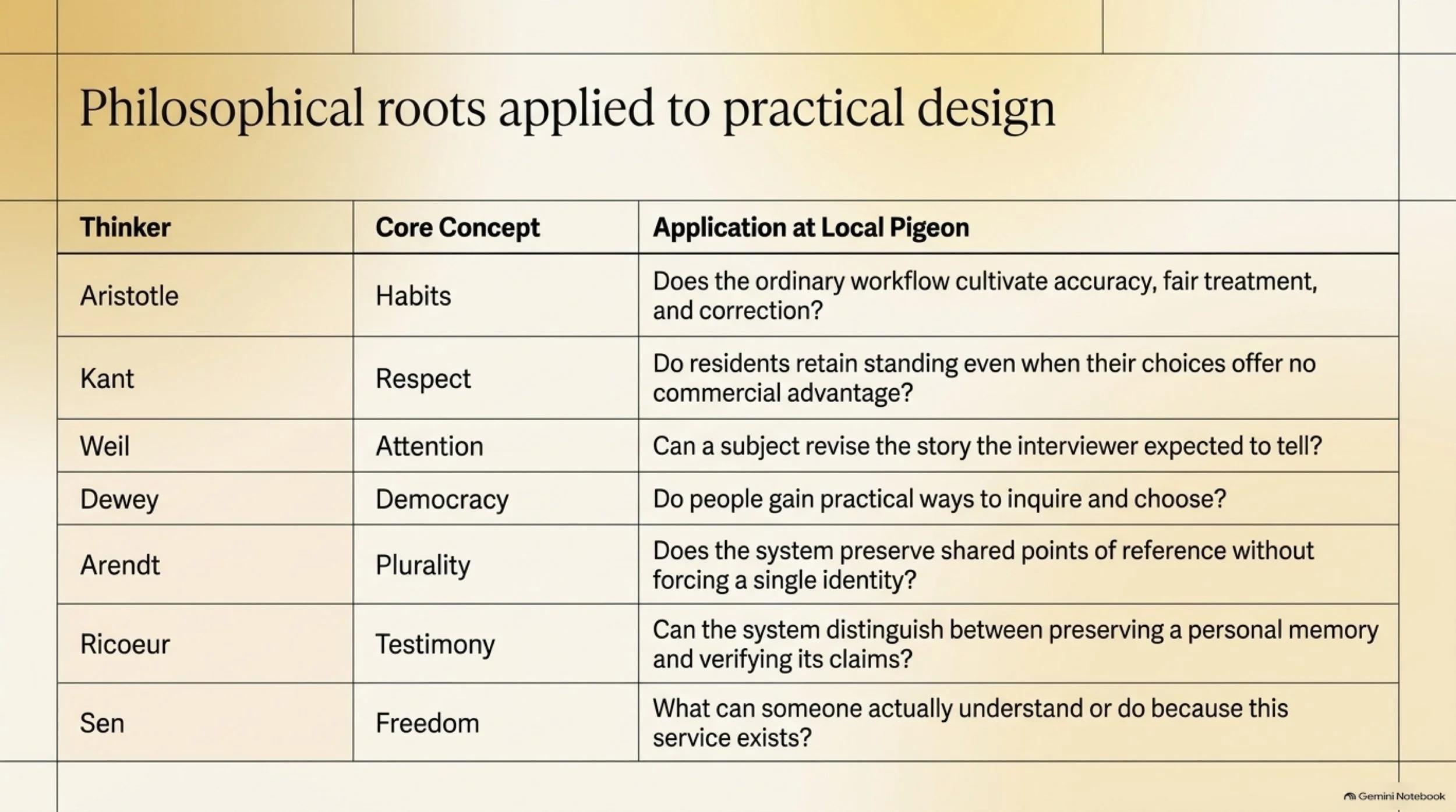
These philosophical works offer questions for our practice. The applications below are our interpretations and do not imply endorsement of Local Pigeon.
Aristotle and habits
In Book II of the Nicomachean Ethics, Aristotle connects moral character with repeated activity. Applied here, the question is what habits Local Pigeon actually cultivates. Does the ordinary workflow encourage accuracy, fair treatment, correction, and responsible follow-up? A declaration of good intentions has limited force if repeated conduct develops different habits. This lens makes everyday decisions central to the philosophy. Aristotle, Nicomachean Ethics, Book II
Kant and respect
Kant’s Groundwork distinguishes dignity from price and requires treating persons as ends rather than merely as means. A useful application is to ask whether residents retain standing when their choices offer Local Pigeon no commercial or reputational advantage. Respect should shape what the organization may do with a contribution. This draws on a principle from Kant without adopting his entire account of morality. Kant, Groundwork, adapted English edition by Jonathan Bennett
Simone Weil and attention
In her religious reflections on study and attention, Weil emphasizes receptivity to another person and challenges the adequacy of warm feeling alone. The corresponding test is whether an interviewer can let someone revise the story the interviewer expected to tell. Attention should allow the person to be encountered on their own terms. A plural civic service can learn from that discipline without requiring participants to accept Weil’s theology. Weil, Reflections on the Right Use of School Studies
John Dewey and everyday democracy
In Creative Democracy, Dewey connects democratic ideals with ordinary habits, free communication, and conditions that support people’s judgment and self-direction. For Local Pigeon, the question is whether people gain practical ways to inquire and choose. The organization should welcome questions that change its own understanding. A service that encourages discussion while controlling every acceptable conclusion would fail this test. Dewey, Creative Democracy
Hannah Arendt and plurality
In The Human Condition, Arendt describes a common world encountered from different positions. The application is to preserve shared points of reference without forcing a single community identity. Residents can inhabit the same place and disagree about its significance. “Local consciousness” is most useful here as a metaphor for shared attention and discussion; it need not imply one collective mind. Arendt, The Human Condition, especially pages 52 to 58
Paul Ricoeur and testimony
In his dialogue with Sorin Antohi, Ricoeur treats testimony as credible but open to criticism, and historical inquiry as involving confrontation among accounts. The useful distinction is between preserving a contribution and verifying its claims. A recording can matter as someone’s experience while still requiring comparison with other evidence. Respect for memory includes honest treatment of its limits. Ricoeur and Antohi, Memory History Forgiveness
Amartya Sen and actual freedom
Sen’s account of development evaluates progress in relation to people’s lives and real freedoms. Applied to Local Pigeon, it asks what someone can actually understand or do because the service exists. More content and more technical capability are intermediate achievements. Their value depends on the opportunities they support, including a person’s ability to make choices different from those the organization might prefer. Sen, Development as Freedom lecture summary
These traditions do not form one seamless system. They disagree about foundations and priorities. Their value here is to keep the project answerable to questions about character, respect, attention, participation, plurality, evidence, and freedom.
Infographic by HastingsNow.com
Memory and the freedom to change
Memory provides a particular connection between the philosophy and the service being developed. A chosen experience can remain available for someone to revisit. A public decision can retain its background. A later account can be compared with an earlier one.
But preservation is only one part of responsible remembering.
A person may understand an old experience differently. A story may have been mistaken. An account offered in one context may be inappropriate in another. Someone may decide that material they voluntarily deposited should remain private or be deleted under the service’s terms.
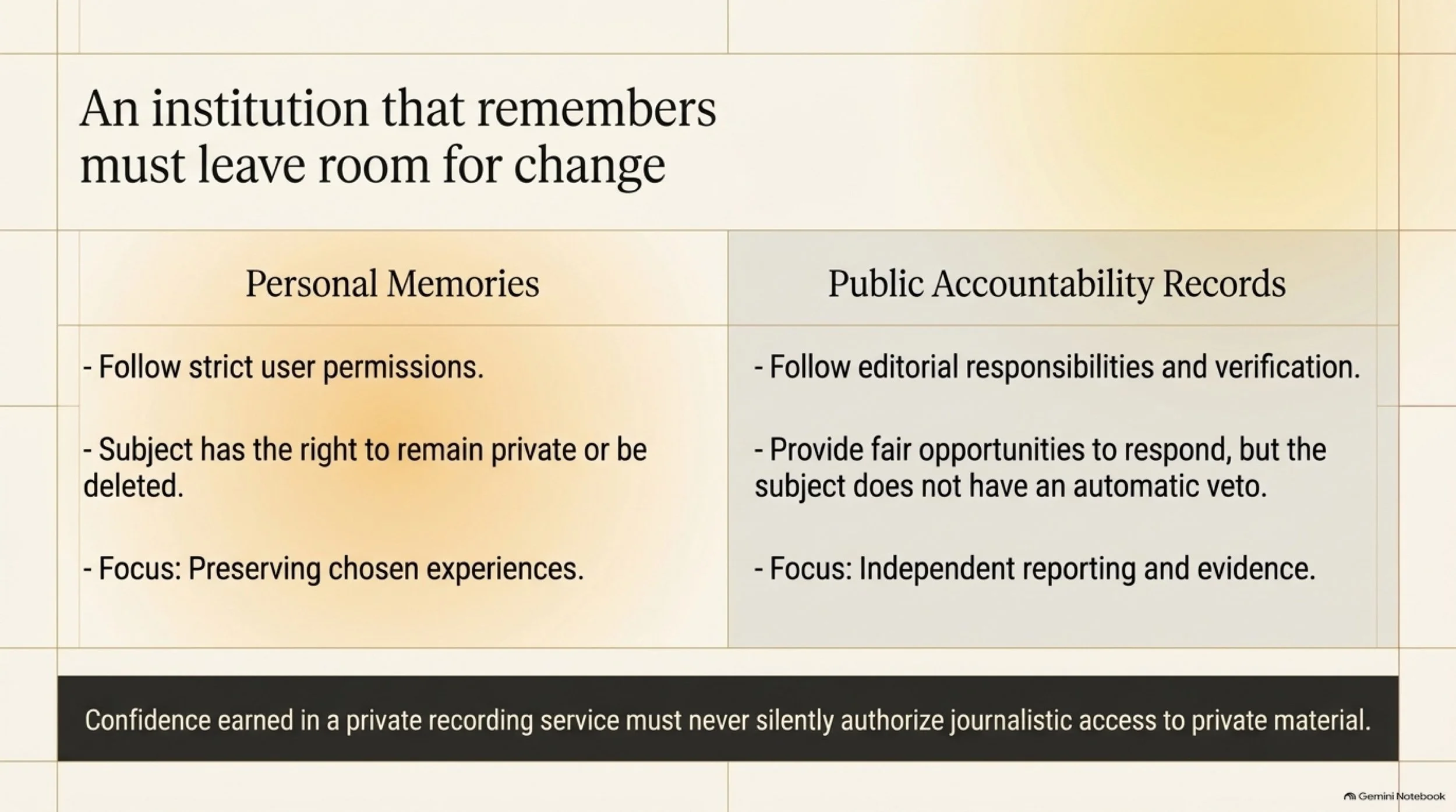
An institution that remembers should leave room for people to change.
This makes context, permissions, correction history, and clear retention terms philosophical matters. They concern who may interpret a person’s past and what power a record can acquire over their future.
Personal memories and public accountability records need different treatment. A private recording should follow the permissions governing its use. Independent reporting about a public decision should follow editorial responsibilities, including verification and fair opportunities to respond. Being the subject of a public-interest story should not automatically provide a veto over it.
The distinction must be clear before the two forms of work share a platform. Confidence earned in a private recording service should not silently authorize journalistic access to private material.
“Never-ending” can then describe the possibility of returning and learning. It should not imply unlimited collection or permanent exposure. Continuing curiosity needs deliberate limits.
A common philosophy across different work
The existing and proposed parts of Local Pigeon can share this philosophy while keeping their promises distinct.
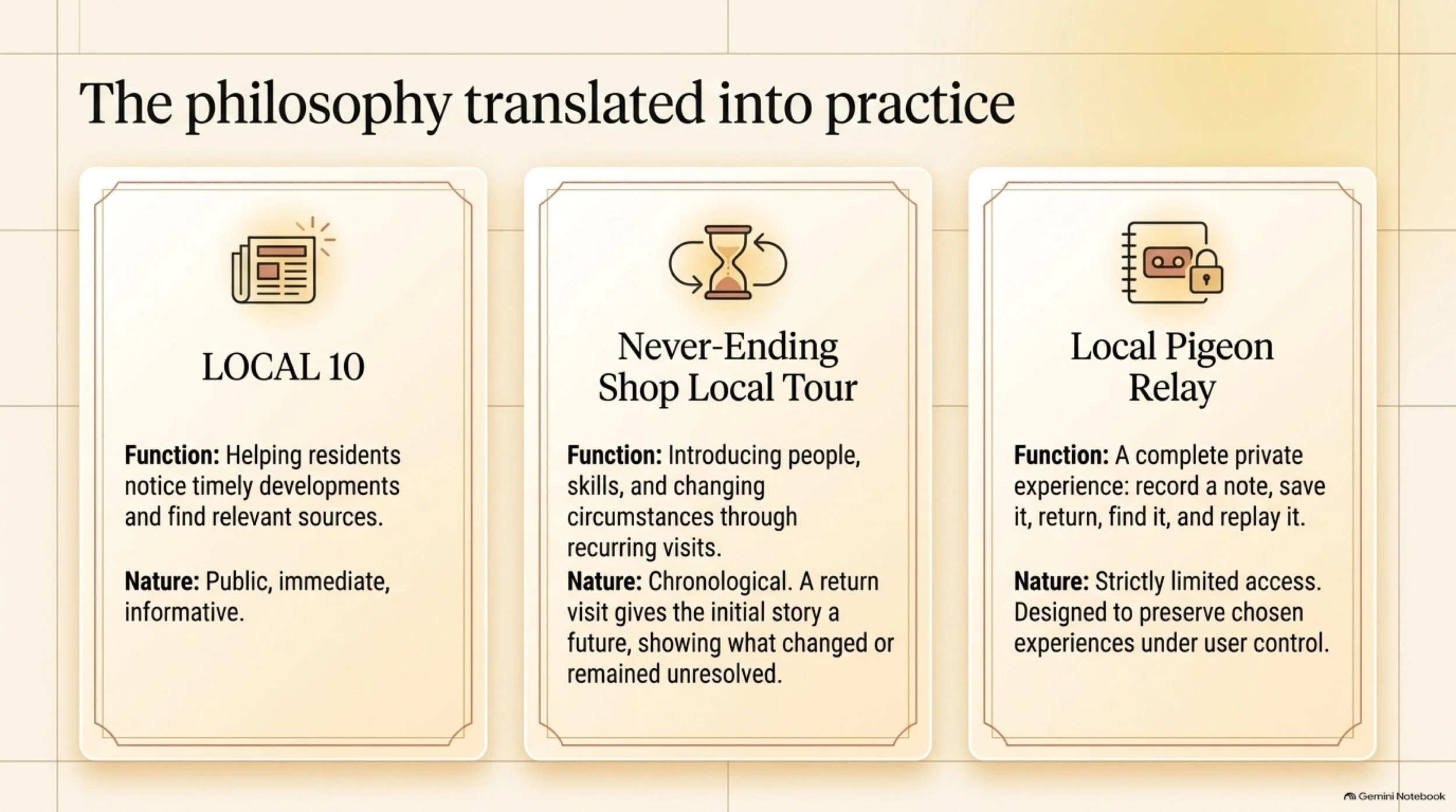
LOCAL 10 can help residents notice timely developments and find relevant sources. The Never-Ending Shop Local Tour can introduce people, skills, businesses, and changing circumstances through recurring visits.
Local Pigeon Relay is still being developed. Its immediate goal is one complete private experience: record a note, save it, return, find it, and replay it, with access limited to the intended audience.
Independent local reporting adds another responsibility: investigate consequential public questions and maintain follow-up. A warm profile, a sponsored visit, a private memory, and an investigated civic story can each be useful. Their labels and standards should make their differences clear.
The Tour has a particularly useful relationship with time. A first visit offers an introduction. A later visit can show what has changed, what was learned, or what remains unresolved. The return gives the initial story a future.
Commercial support can sustain that labor. It needs a clear description of what a purchase provides. Editorial independence needs its own protection, including a way to handle consequential stories involving paying clients.
The philosophical unity lies in dependable attention to people and circumstances. It does not require turning every contribution into public content or every public question into a commercial opportunity.
Residents should also be able to benefit without becoming customers or contributors. The scope of that access must match what the service can sustain, but the distinction between a person’s standing and a purchase should remain explicit.
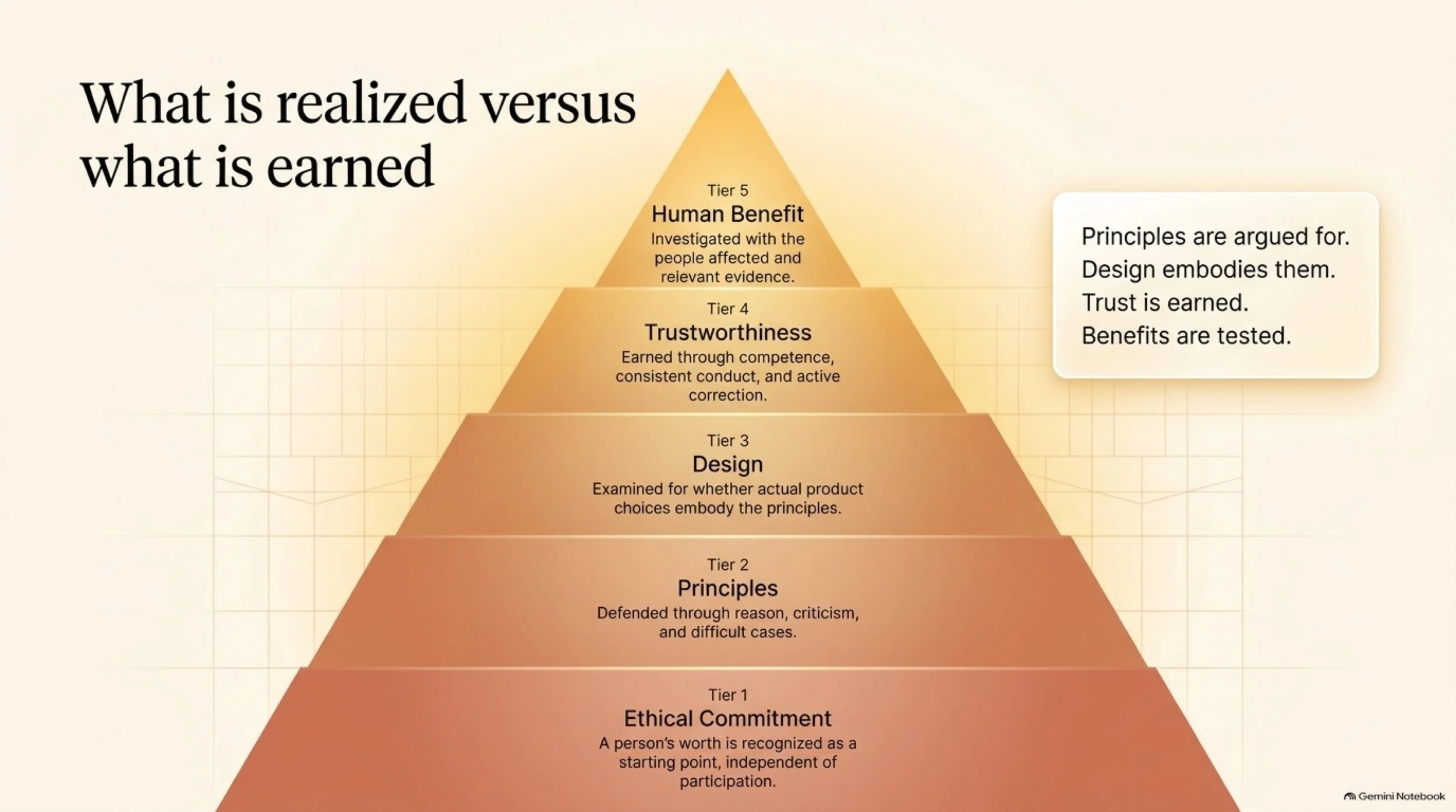
What is realized and what is earned
An insight may be realized in the sense of becoming clear: the founder recognizes a relationship among ideas that had previously seemed separate. It may also be realized in the practical sense of being embodied in an institution.
Neither sense automatically establishes that the institution deserves trust.
Subject | Appropriate standard
A person’s worth
Recognized as an ethical starting commitment, independent of participation.
Philosophical principles
Defended through reasons, criticism, and difficult cases.
Product and editorial design
Examined for whether actual choices embody those principles.
Trustworthiness
Earned through competence, consistent conduct, and correction.
Human benefit
Investigated with the people affected and relevant evidence.
Wider influence
Developed through voluntary adoption, criticism, and adaptation.
Principles are argued for. Design embodies them. Trust is earned. Benefits are tested.
This avoids making success mean only that people like the language. It also avoids demanding that every worthwhile principle wait for a product experiment before it can be defended.
For example, the commitment to respect someone who declines participation can be argued for now. Whether a particular interface makes that choice understandable is a separate practical question.
A moment of clarity can begin the work. Its depth becomes evident when it helps resolve choices that are inconvenient, contested, or costly.
The proper scope of the philosophy
Local Pigeon should develop its philosophy far enough to guide hard choices and explain its obligations publicly.
It should help determine what happens when a sponsor dislikes an accurate account, when two residents remember an event differently, when someone wants privacy, when the founder has misunderstood a person, and when a promise becomes difficult to maintain.
These are tests of substance. A principle that has no effect when circumstances become difficult contributes little guidance.
The philosophy also needs a boundary. The service need not determine the ultimate source of meaning, establish a new account of consciousness, or require residents to accept a complete worldview. Those claims would create burdens the current argument does not meet.
For now, “a working civic philosophy of dependable curiosity” describes the project accurately. “Working” indicates continuing examination. “Civic” identifies its concern with life shared among people. “Dependable curiosity” names a practice that joins inquiry to responsibilities.
The most difficult challenge is paternalism. The organization may think it sees a person’s potential more clearly than that person does. It should offer an interpretation as an invitation, allow it to be corrected, and accept a refusal. A person’s disagreement cannot become evidence that they are failing to understand their own life.
Another challenge is institutional power. A service that keeps important records should offer meaningful ways to retrieve contributions, understand decisions, and leave. The community should not have to remain loyal to one company in order to retain what the company has promised to preserve.
How the philosophy can be tested
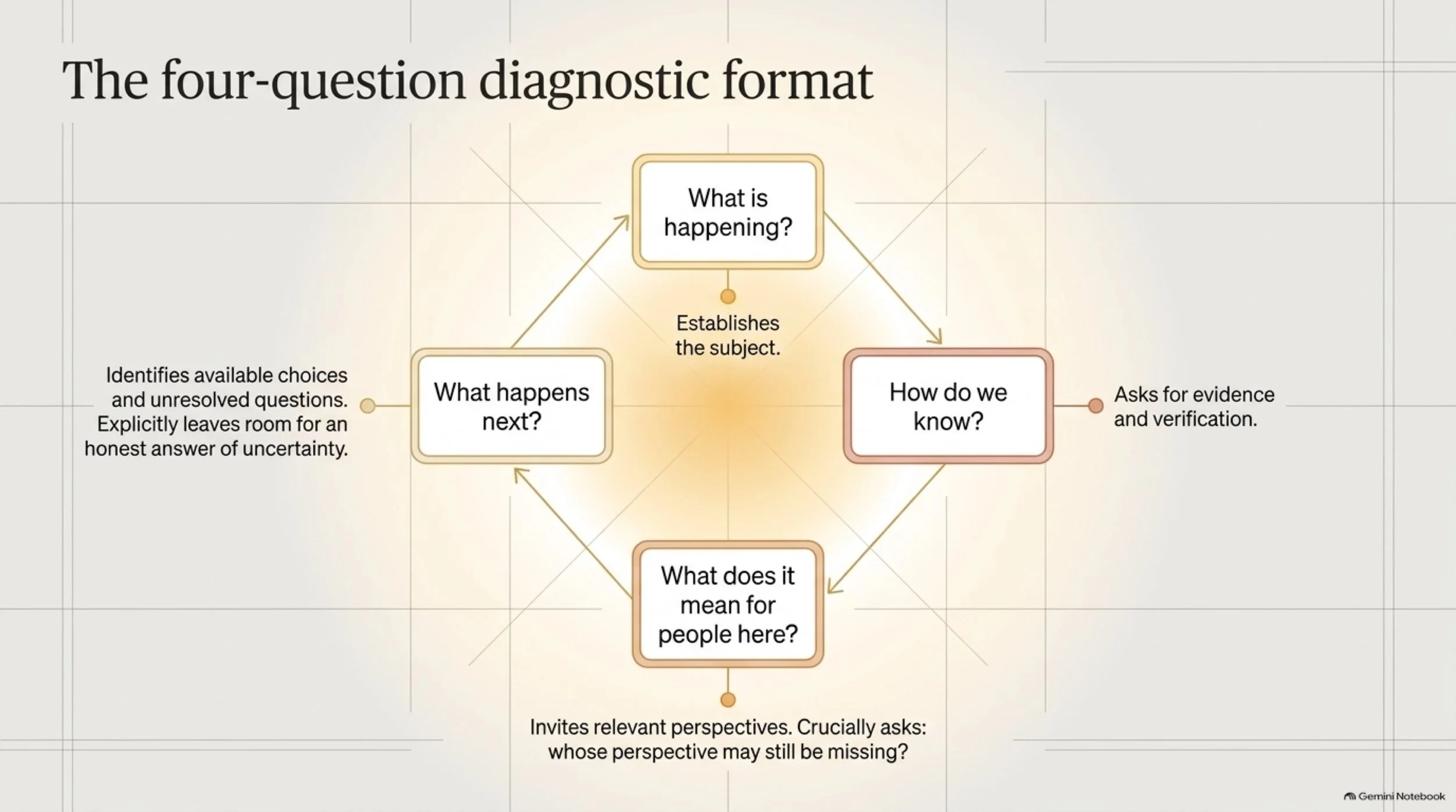
The four-question format gives the public side a manageable beginning.
What is happening?
How do we know?
What does it mean for people here?
What happens next?
The first question establishes the subject. The second asks for evidence. The third invites relevant perspectives and practical significance. The fourth identifies available choices, unresolved questions, and a reason to return.
The third question needs particular care. “People here” will not have one interest or one interpretation. An explanation should identify whose circumstances it describes and whose perspective may still be missing.
The fourth question should allow an honest answer of uncertainty. Sometimes the useful next step is further inquiry, a scheduled review, or a clear account of what has not been decided.
A small pilot could choose one consequential question that residents find difficult to understand, review the coverage already available, fill the demonstrated gap, and follow the issue through its next meaningful development.
The private product has its own bounded proof: an authorized person records a note, saves it privately, leaves, returns, finds it, and replays it, while an unauthorized account cannot access it. Audience and available controls need to be understandable.
These experiences should be evaluated on their own terms. Did the person recover what they chose to keep? Did the resident understand the public issue and identify a relevant source or available next step? Did the team correct mistakes and sustain the work at an acceptable cost?
Confidence, connection, and a sense of belonging may emerge. They should be learned about from participants. If they do not improve, the interpretation or design may need revision.
A philosophy of inquiry must make room for findings that change the project.
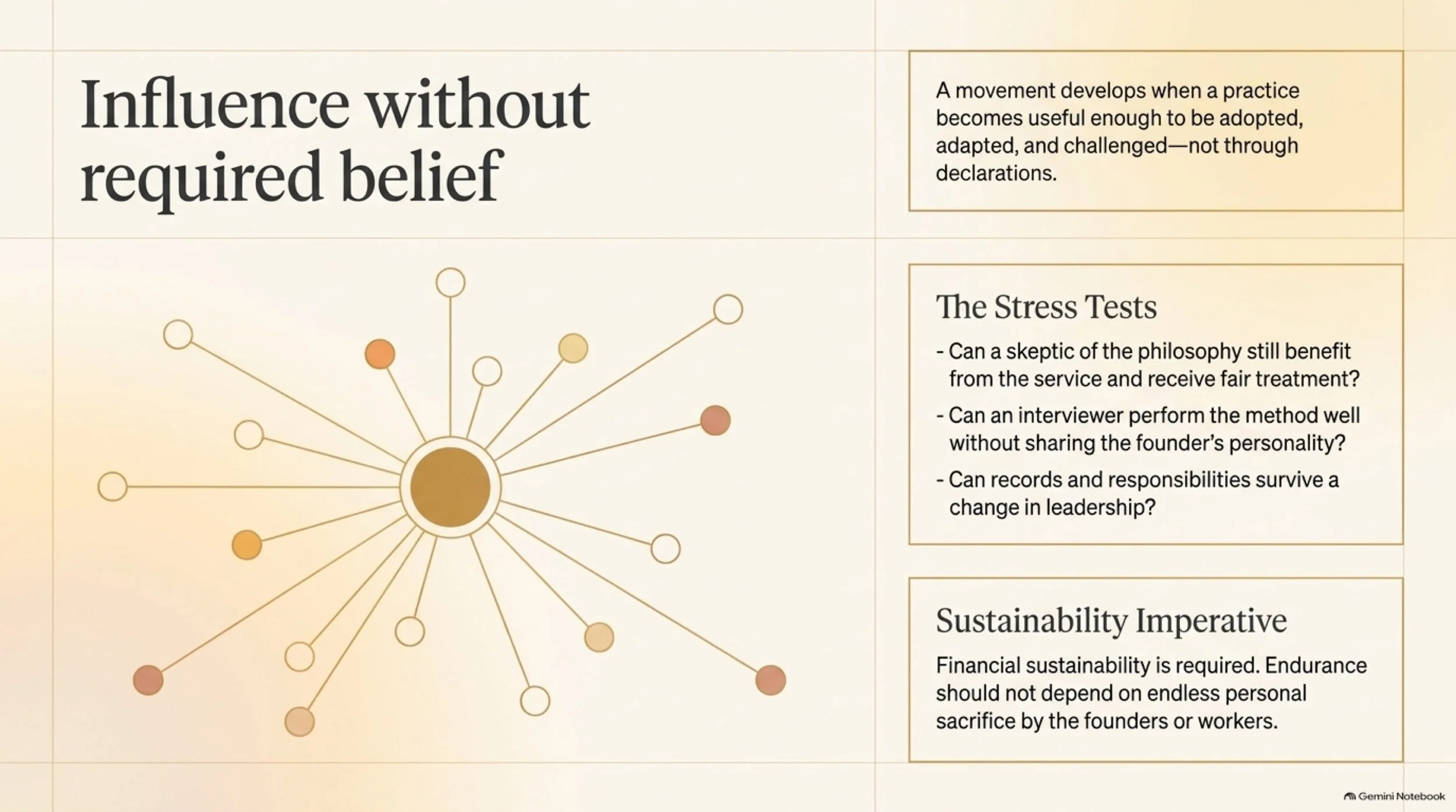
Influence without required belief
A movement can develop when a practice becomes useful enough that people adopt it, adapt it, and carry it beyond its founders. The organization can invite that process. It cannot establish it through a declaration.
A good test is whether someone skeptical of Local Pigeon’s philosophy can still benefit from the service, challenge its work, and receive fair treatment.
Another is whether the practice remains useful when other people perform it. Can an interviewer ask the questions well without sharing the founder’s personality? Can an editor correct a favored story? Can a contributor leave? Can records and responsibilities survive a change in leadership?
Those questions connect inspiration with institution-building.
The method should remain simple enough to repeat: notice a worthwhile question, listen carefully, check consequential claims, make the findings usable, and return when there is more to understand.
Influence may begin with small outcomes. A resident gets an answer. A quiet experience is preserved under chosen permissions. A returning visit reveals change. An old public promise becomes possible to examine. Another storyteller adopts the same care.
Financial sustainability matters here. Reporting, listening, editing, support, and preservation require resources. The philosophy should include fair treatment of the people doing that work, including its founders. Endurance should not depend on endless personal sacrifice.
The institution earns significance by maintaining a useful practice that people remain free to shape and question.
The purpose of Local Pigeon
Local Pigeon’s ultimate purpose should concern the lives of the people it serves. The organization can undertake a meaningful part of the work of helping people understand their surroundings, preserve chosen experiences, encounter other perspectives, and act with informed agency.
That purpose remains useful across different accounts of what makes a life meaningful. It can serve someone who finds meaning in faith, another who finds it in family or craft, and another who is still uncertain. It can serve people during technological change without depending on a prediction about how that change will unfold.
The organization’s own meaning can come from faithfully performing that work.
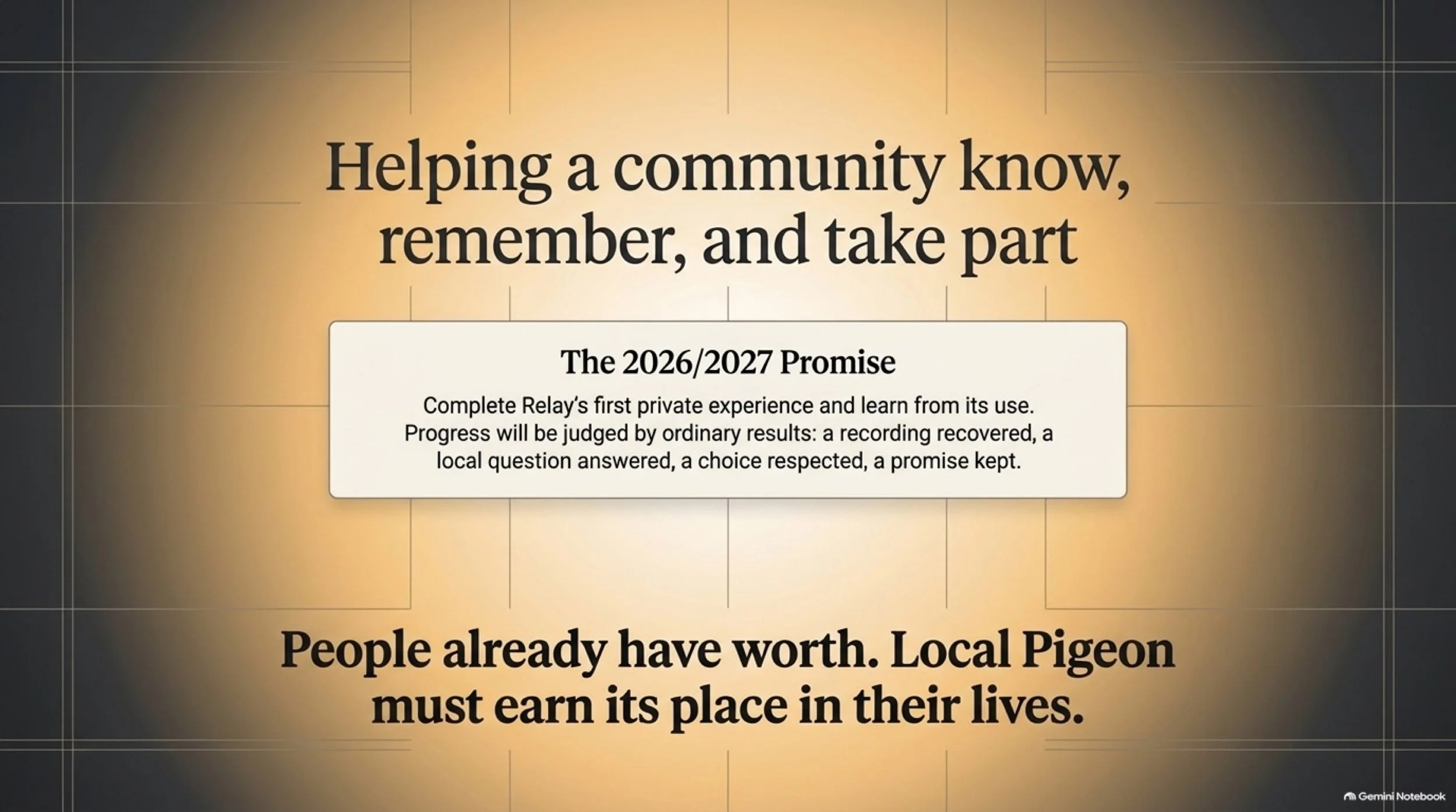
Local Pigeon helps a community know what is happening, remember what matters, and take part in what comes next.
The philosophy behind that purpose is substantial when it governs conduct. A person is treated fairly even when they decline publicity. An account is corrected even when the correction is inconvenient. A private recording stays within its permissions. A public question receives the evidence and follow-up it deserves.
The warm light is an offer of clearer understanding with room for the person to choose. Its source is the continuing practice of attention, inquiry, care, and responsibility.
Our immediate work is to complete Relay’s first private experience and learn from its use. We will judge progress through ordinary results: a recording recovered, a local question answered, a choice respected, and a promise kept. We intend to revisit this philosophy in 2027 with experience to examine.
People already have worth. Local Pigeon must earn its place in their lives.
Developed in conversation with ChatGPT.