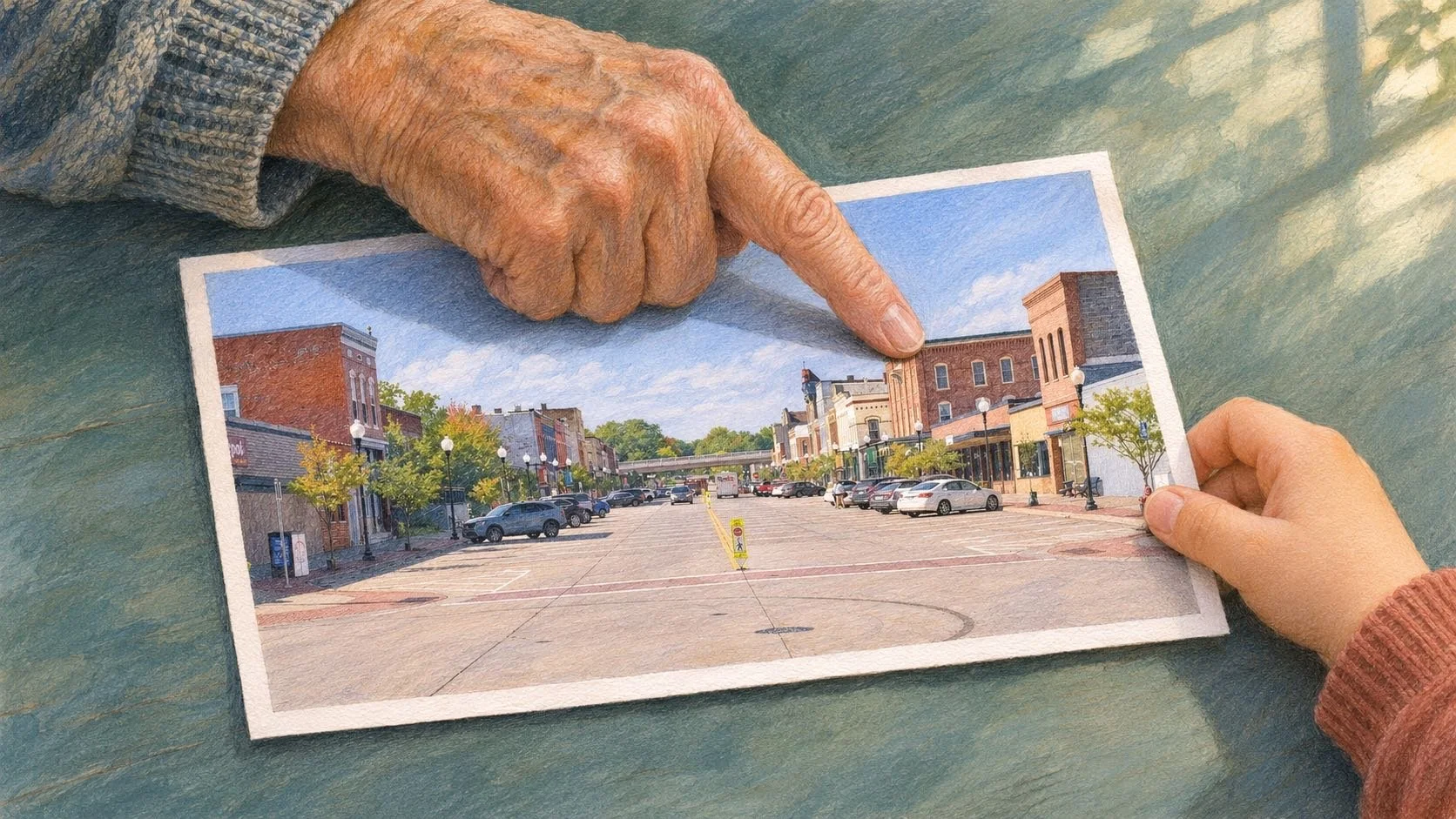
A picture can show the storefront. Someone who remembers it can tell you what happened there. AI-generated editorial illustration inspired by a photograph of downtown Hastings, Minnesota.
A five-dollar bucket in Hastings led to page 7A of an old Michigan newspaper. The page answered a question about the sale and raised a harder one about the stories we leave behind.
By Ashley and Peter, co-founders of HastingsNow
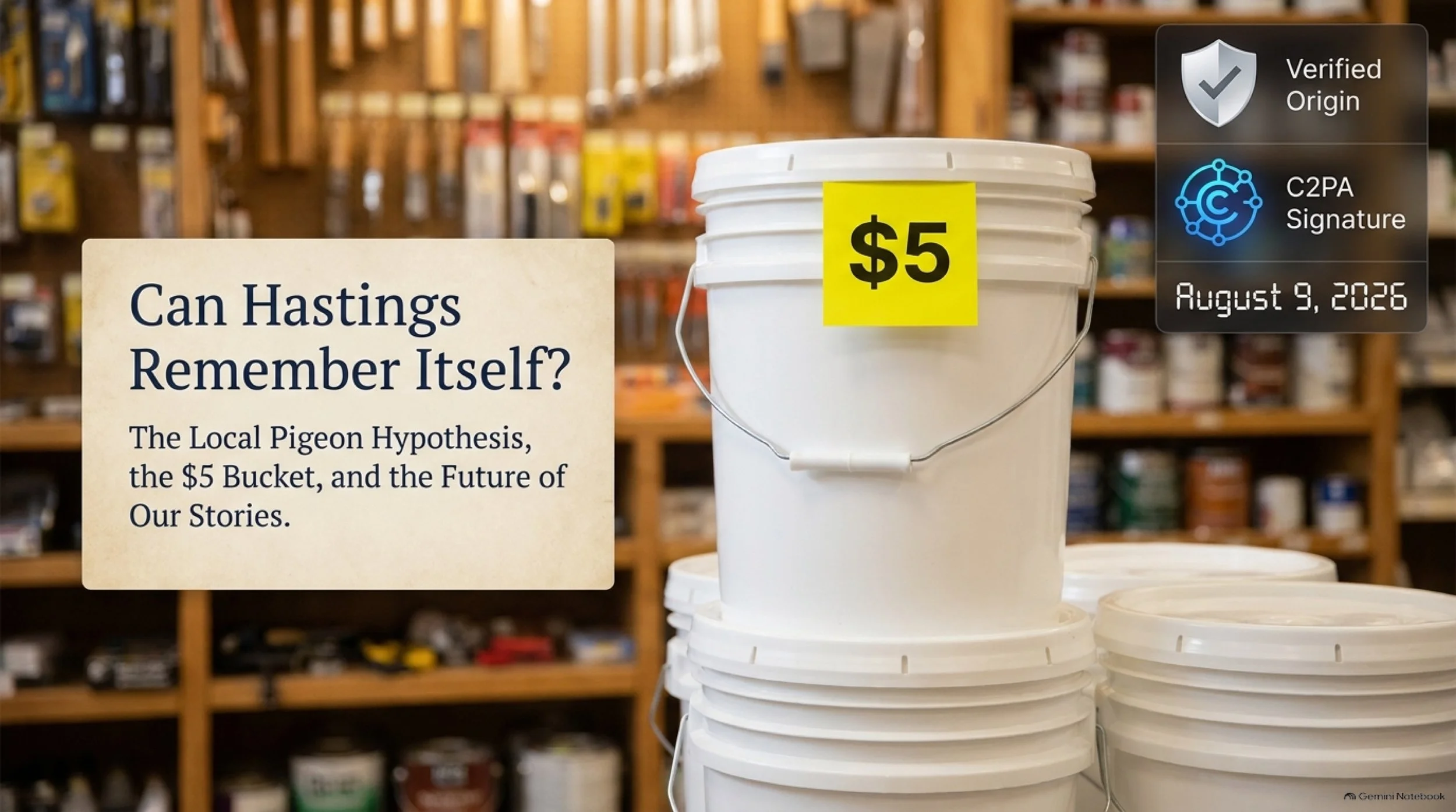
Four people face the camera in a hardware aisle. One holds a white Ace bucket tipped toward the lens. A yellow five-dollar tag hangs on a stack of pails. We published Ashley Media’s photograph on August 9, 2026, in our story about the bucket sale at Hometown Ace Hardware in Hastings.
In that story, we credited Justin from the store with explaining the deal. A shopper could donate five dollars, take a five-gallon bucket and save 20 percent on eligible merchandise that fit inside. We made the piece as an unpaid demonstration of what we call STIVA, a Story with Text, Images, Audio and Video. We wanted to show what professional multimedia storytelling could do for a local business. Hometown Ace paid us nothing for it.
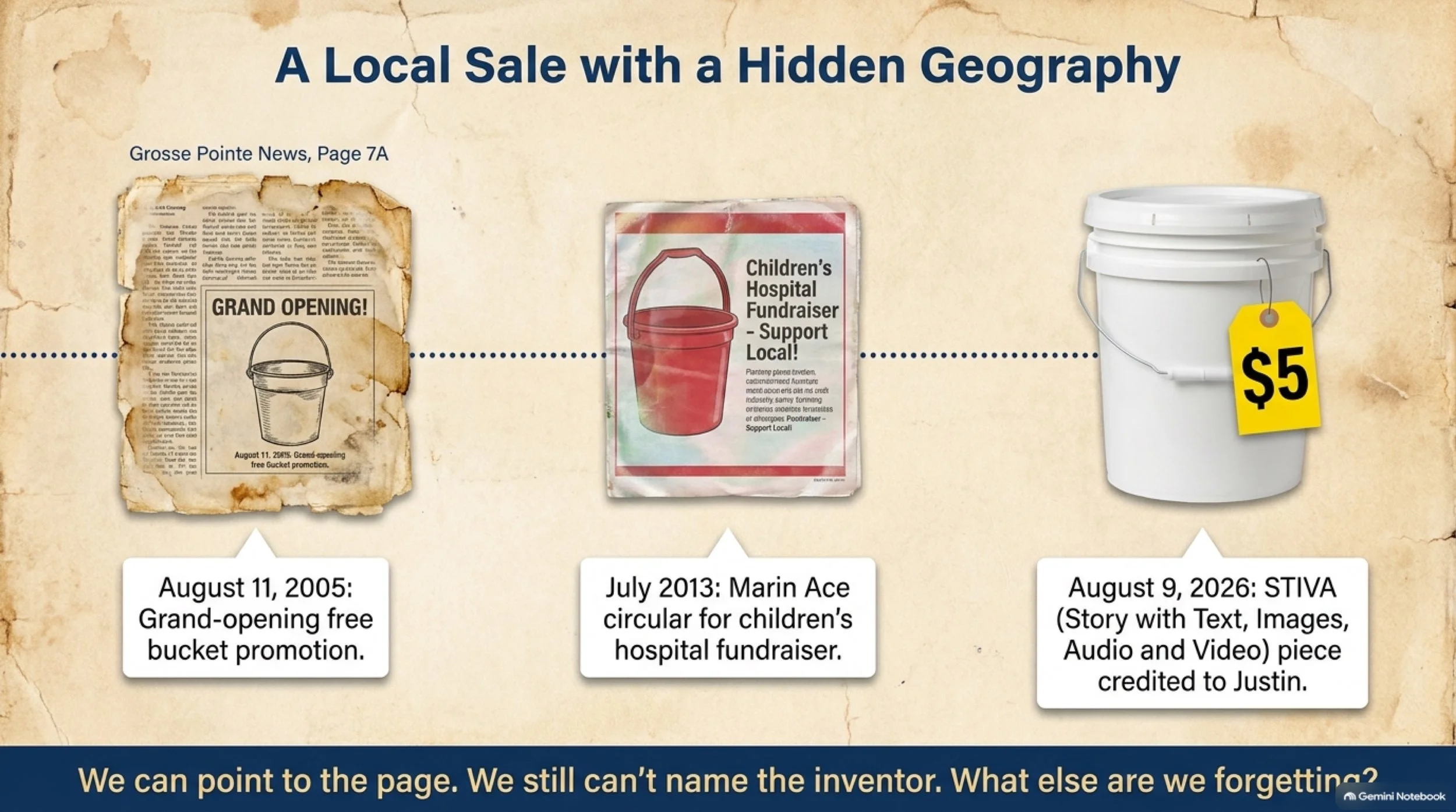
One question outlasted the sale. Who first thought to give shoppers a discount on whatever they could fit in a bucket? A July 2013 Ace circular advertised a five-dollar donation for a children’s hospital fundraiser and a discount on what fit. It establishes that the charitable version existed by then. It leaves open where the idea came from.
Turn to page 7A of the August 11, 2005, Grosse Pointe News. An ad for Detroit-area Ace stores promises the first 250 customers a free five-gallon bucket on Saturday and 20 percent off what fits, subject to exclusions. The word free matters. This was a grand-opening promotion. Here is the same sales idea, eight years earlier, used for a different purpose. We can point to the page. We still can’t name the inventor.
An AI-assisted search for this essay turned up the ad in the Grosse Pointe Public Library’s local history archive. Whoever saved the issue could hardly have anticipated the question that would bring someone from Hastings to page 7A. Now imagine that the question concerns a neighborhood that changed, a volunteer program that quietly ended or a piece of land the city sold. What would we want someone to have kept? Who gets to decide? And what if the person whose story we want to keep has good reason to say no?
A question worth borrowing
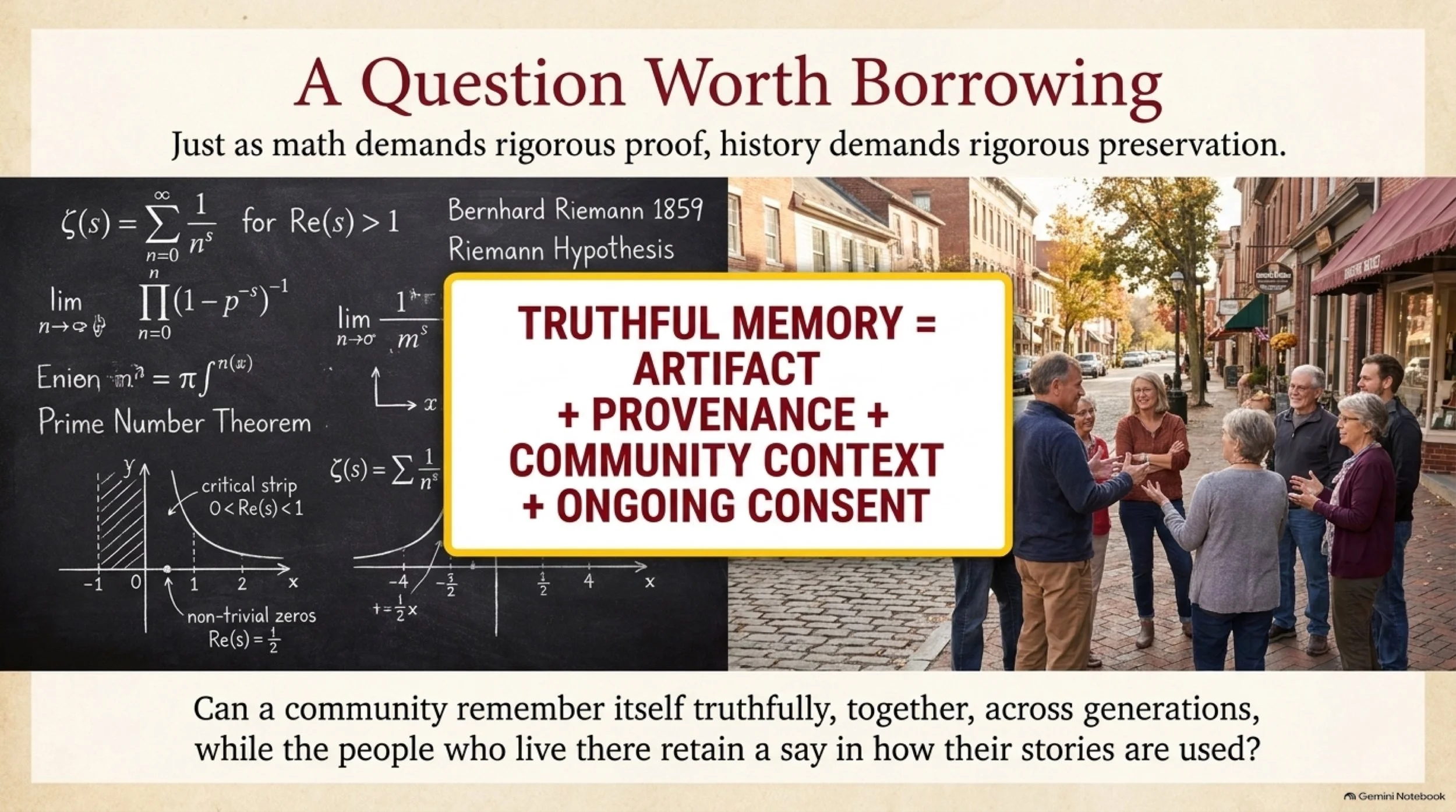
In 1859, Bernhard Riemann proposed that all the nontrivial zeros of the zeta function lie on a particular line. A zero is an input that makes a function equal zero. The line consists of complex numbers whose real part is one-half. This matters because the zeros are closely tied to the distribution of prime numbers. A proof would sharply limit how far the count of primes up to a given number can depart from a standard estimate. The Clay Mathematics Institute’s account of the Riemann Hypothesis still lists the problem as unsolved.
What we borrow is the patience to state a question clearly before claiming an answer.
Can a community remember itself truthfully, together, across generations, while the people who live there retain a say in how their stories are used? A proof could establish Riemann’s claim. A single nontrivial zero off that line would disprove it. A town has to make its choices over again as the people and the evidence change. We can, however, test whether a particular photograph establishes a date, whether a resident can retrieve a recording and whether we honor a promise about who may hear it.
There’s a family reason we care. In 2012, we interviewed Ashley’s grandparents, Henri and Missy Tessier, a project we describe in the story of how we came to this work. Consider what a grandchild might come looking for in an interview like that. It could be the facts of a working life. It could be the way someone said a name. A paragraph might give a perfectly good answer to the first question and leave the child still wanting to hear that voice. Whether anybody outside the family should hear it is a separate decision.
What survives a Tuesday
Some things a town will want to remember have to be reported while they’re happening. Someone has to read the budget, check what a meeting notice actually says or ask who was affected by a decision. A recording device can preserve a voice. It takes time, judgment and sometimes an uncomfortable phone call to find out whose voice is missing.
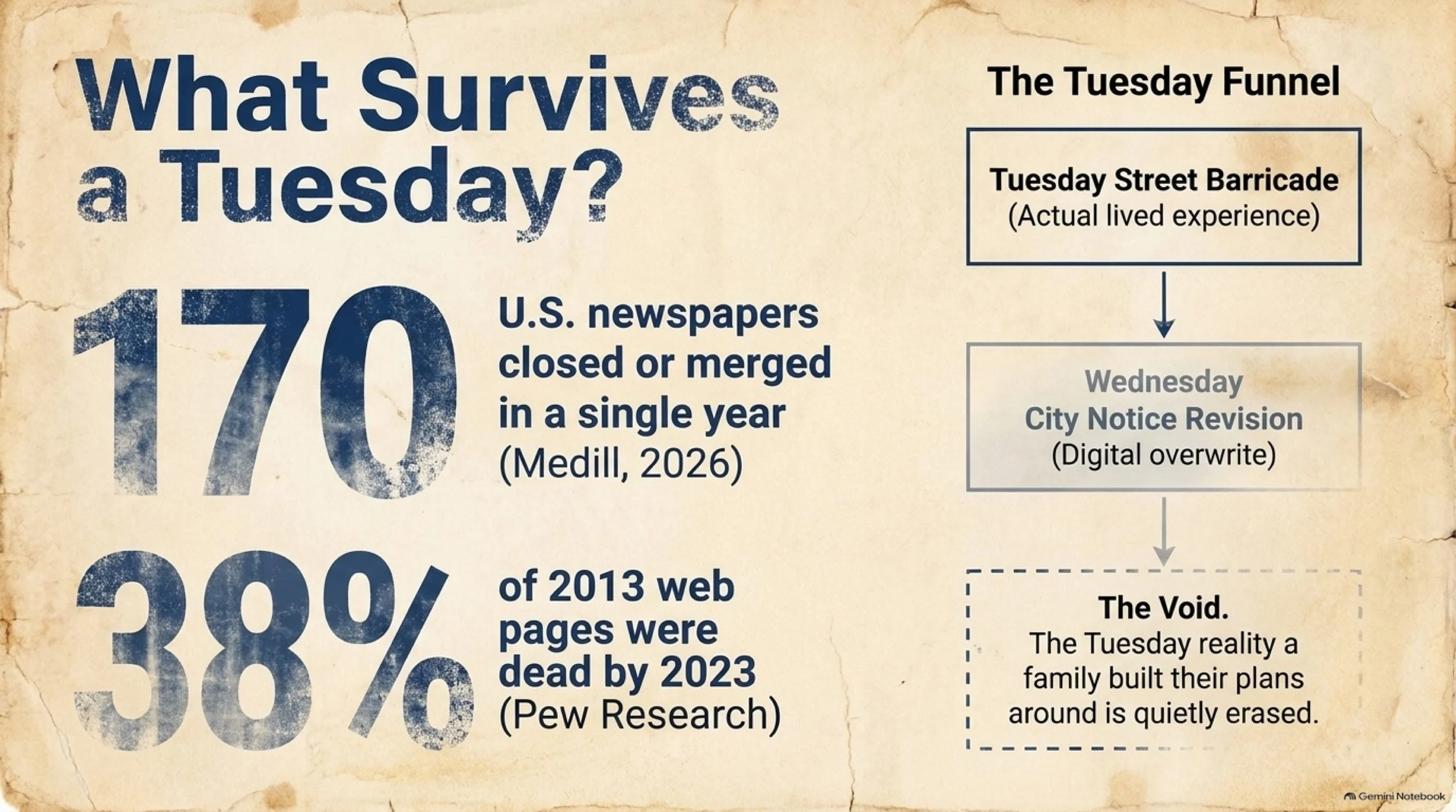
In its October 13, 2026, findings on the state of local news, Northwestern University’s Medill School counted 170 U.S. newspapers that closed or merged over the preceding year. It counted 238 counties without a locally based source of professional news, up 26 from the previous report. Residents may get news from a neighboring county. What the count captures is the loss or absence of a source based in their own. Here in Hastings, the more revealing question is which meetings somebody still has the time to attend and which questions somebody will follow up on afterward.
Even work that does get done can go missing. Pew Research Center checked a sample of web pages from a 2013 snapshot and found that 38 percent were inaccessible at their original addresses in October 2023. A copy might still exist elsewhere. A surviving link has limits of its own. It may show the notice as revised on Wednesday, quietly erasing the version on which a family made its plans on Tuesday.
Imagine two neighbors remembering the same street project. One recalls a safer crossing. The other remembers weeks when customers struggled to reach a shop. Both could be describing their experience accurately. If they disagree about when the street reopened, it matters what each could see. A city notice gives the announced date. A dated photograph might show a barricade across one lane the following morning. A reporter could ask when pedestrians, deliveries and through traffic each got access. What sounded like a dispute about the calendar may turn on what open meant to the people using the street.
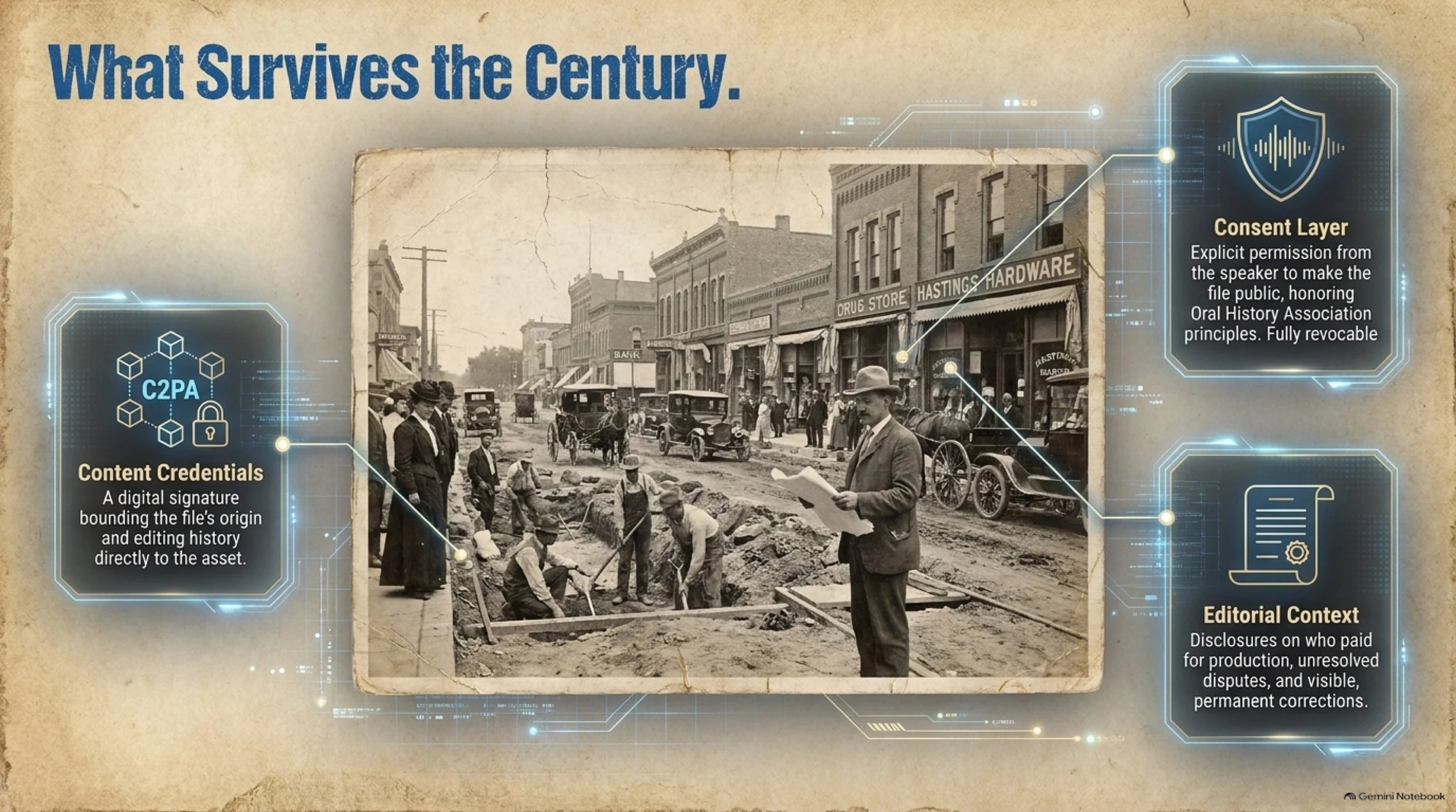
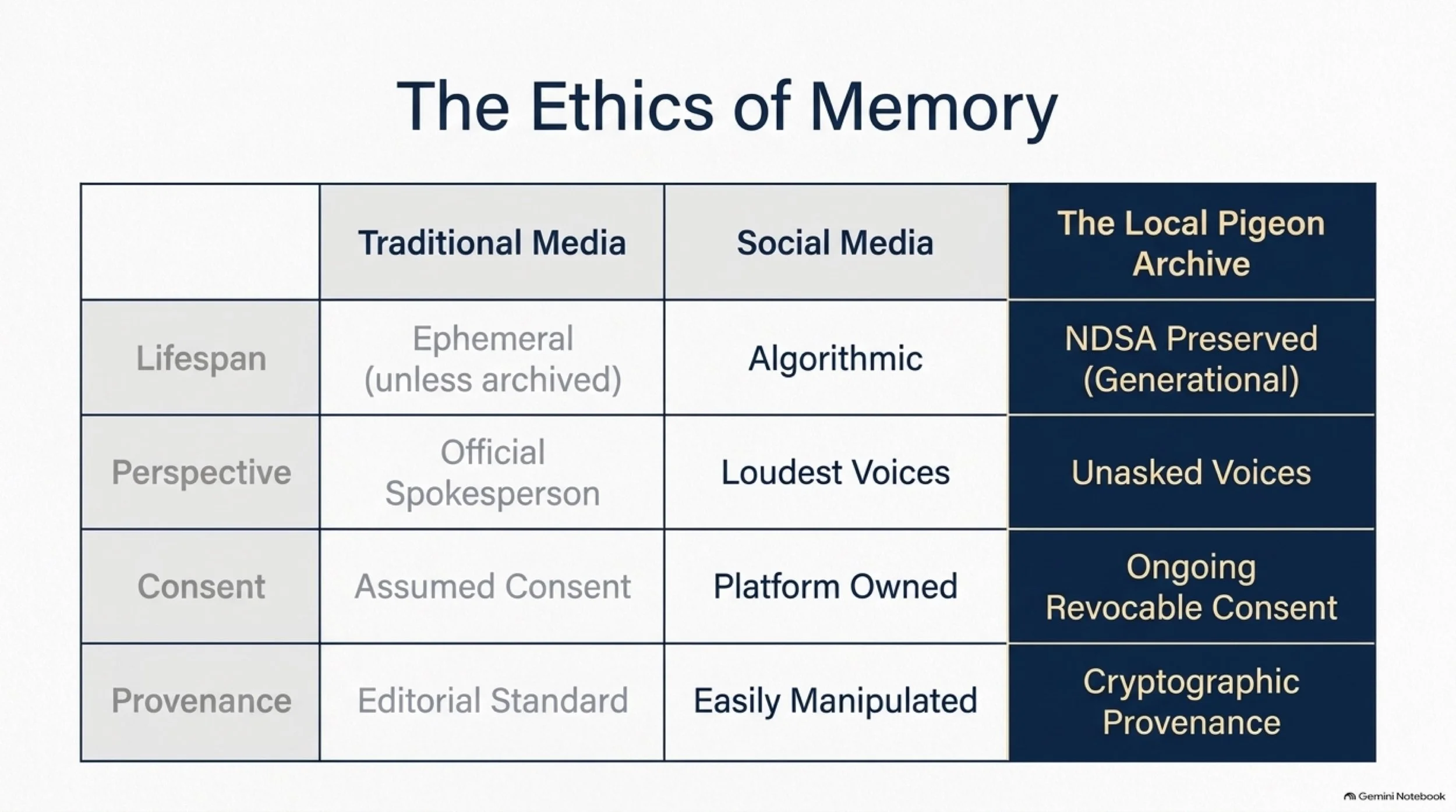
The same discipline applies to pictures. The Coalition for Content Provenance and Authenticity explains in its guide to Content Credentials how a digital signature can bind statements about a file’s origin or editing history to the file itself. The signature can check out even if the photographer staged the scene. An unsigned family print can tell us a great deal if another source helps establish when and where it was taken. Knowing how a picture reached us is one part of deciding what happened in front of the camera.
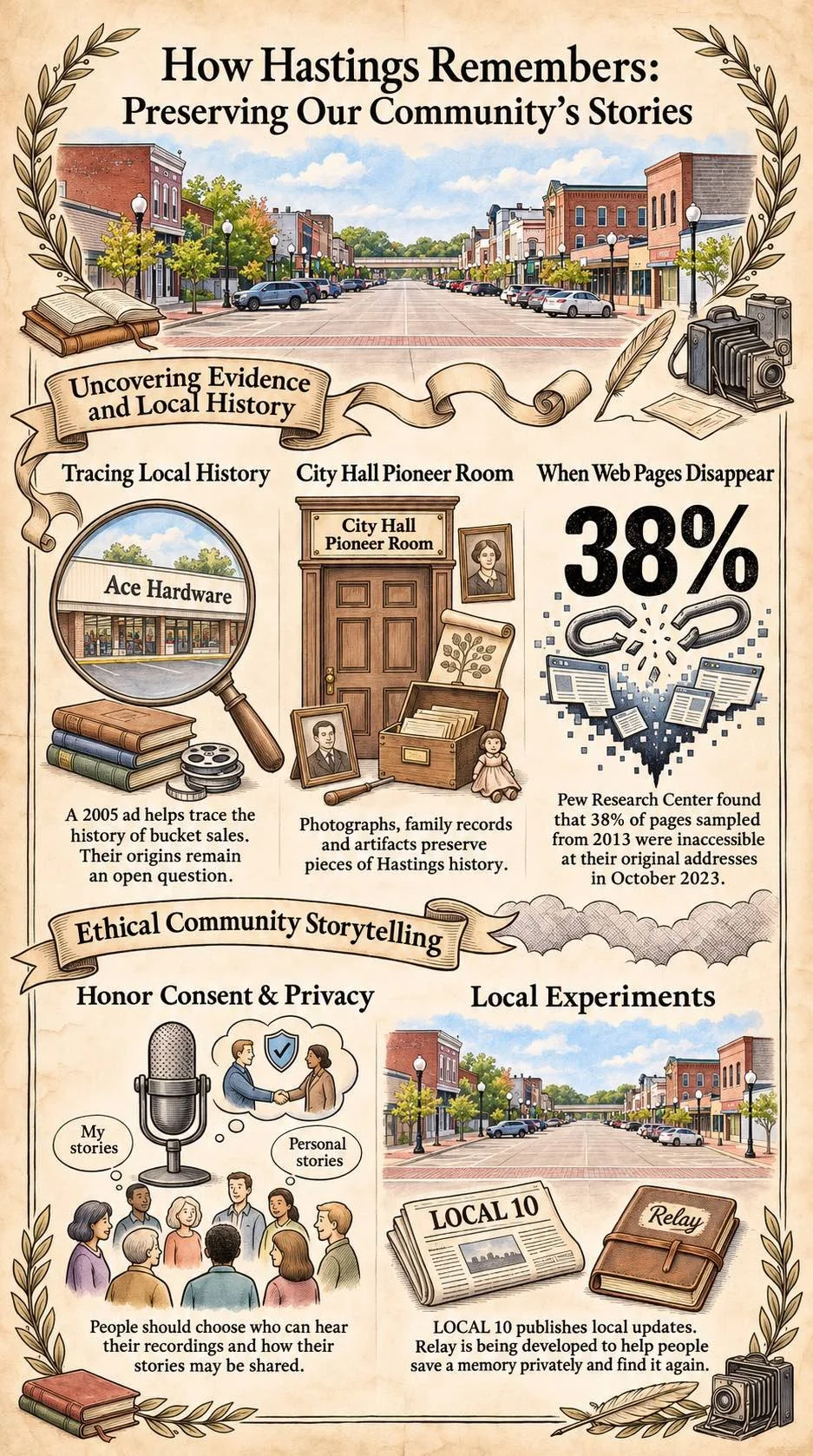
Infographic by HastingsNow.com
Who gets remembered
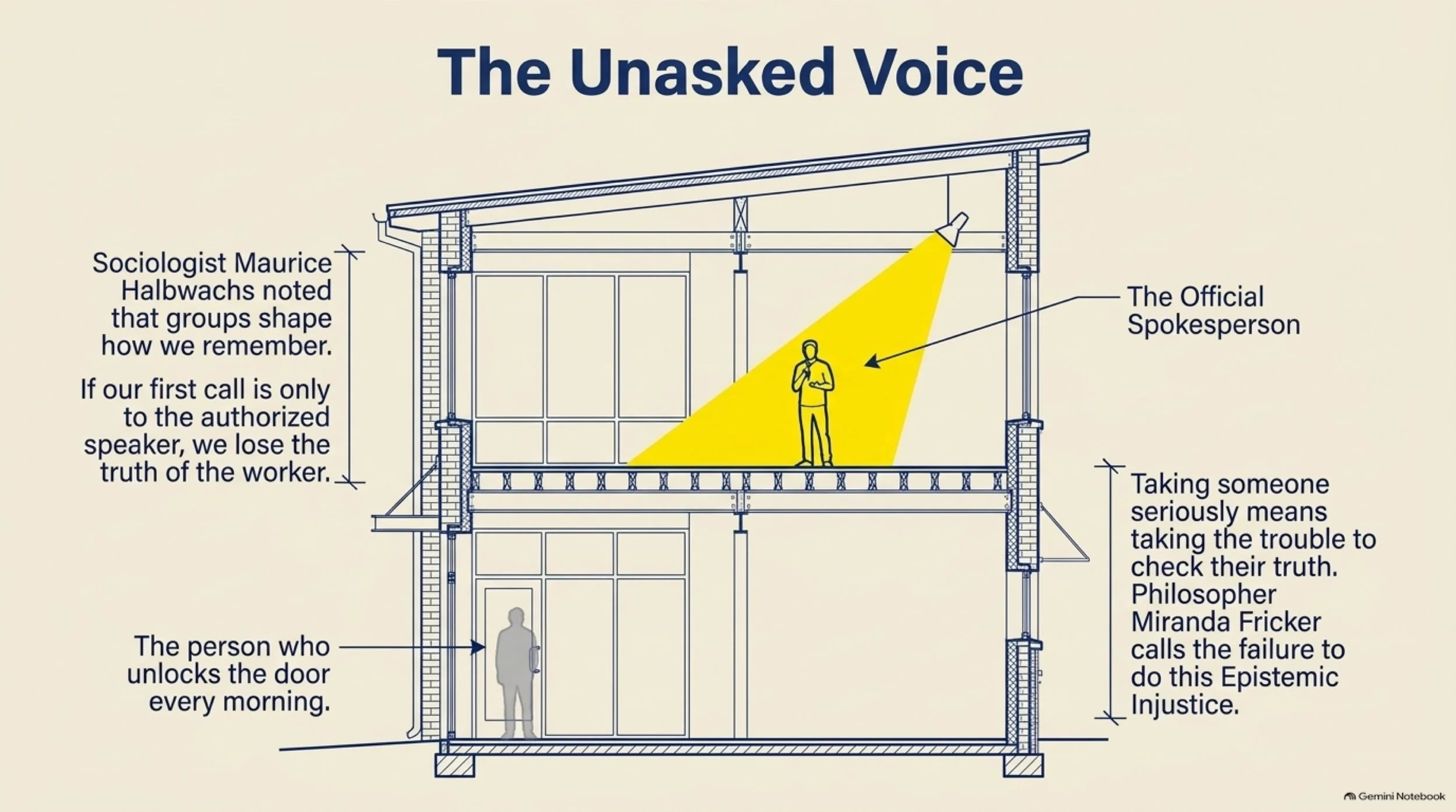
A photo labeled Saturday will make sense to the person who took it, until it doesn’t. Someone has to decide whose Saturday it was and which detail will help a stranger find it. In On Collective Memory, sociologist Maurice Halbwachs argued that the groups we belong to shape how we remember. A school, a family and a business can all keep a record of the same block and hand down quite different versions of its history.
In Epistemic Injustice, philosopher Miranda Fricker described one way a listener can wrong a speaker. Prejudice can lead us to give their word less weight than it deserves. That problem can begin in our work before a microphone comes out. If our first call is always to the person authorized to speak for an organization, the person who unlocked the door every morning may never get asked. They might know something nobody else does. They might also remember the date wrong. Taking them seriously includes taking the trouble to check.
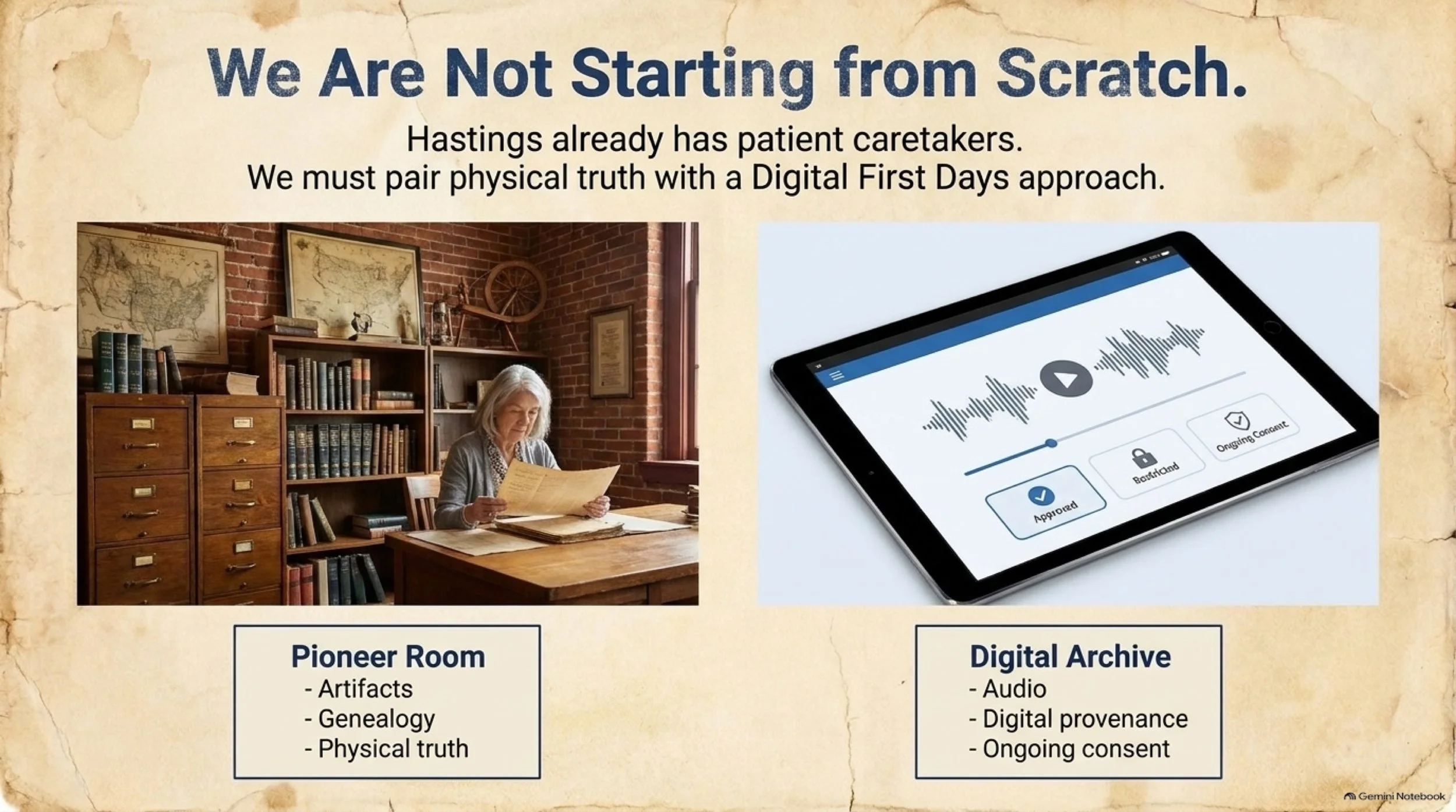
Hastings already has people who do this patient work. At City Hall, the Pioneer Room holds photographs, artifacts, genealogical records and newspaper archives. Volunteers help people research their questions. For a neighbor trying to identify a building, a conversation with someone who knows the collection might accomplish more than another website. The best service we could offer that day might be directions to City Hall.
There are precedents beyond Hastings, too. The South Asian American Digital Archive began its First Days Project in 2013 by asking South Asian immigrants about their first day in the United States. Co-founders Michelle Caswell and Samip Mallick described the original invitation to send a short recording or a written memory. The project later welcomed arrival stories from other communities. In a study of the archive, Michelle Caswell, Marika Cifor and Mario H. Ramirez interviewed eleven South Asian American members of its academic advisory council. Some described the experience of encountering their own community in history they could teach. These were people already invested in the archive. We would also want to hear from the Hastings resident who took one look at our invitation and put it aside.
Some absences deserve protection. A person might record a story for a sister that they would never want a stranger to find by searching a family name. The sister’s permission to share her own story also leaves open the privacy of someone else who appears in it. The Oral History Association’s principles call for ongoing consent and explicit permission to make an interview public. The Library of Congress guide to StoryCorps interviews shows what different kinds of access look like in practice. Many can be heard online. Others, including many booth recordings, are generally heard by appointment in the Folklife Reading Room.
A mistake in a public account calls for a visible correction. A recording that exposes a child’s address may call for immediate restriction, with an explanation that doesn’t repeat the address. An elected official embarrassed by an accurate account of a public vote has a different claim. We would owe each person a hearing, a reason for the decision and a way to challenge it. We would also owe people candor about what withdrawal can accomplish once a public file has been copied.
Consider the editor who receives a recording accusing a named neighbor of doing harm. The recording establishes that someone made the allegation. Publishing it takes another judgment. What can be checked? Has the person named had a fair opportunity to answer? Even a careful public label saying the matter is disputed can make an unsupported accusation the first thing a search brings up about a person. Sometimes leaving an item out is an editorial duty. That decision, too, ought to be open to challenge.
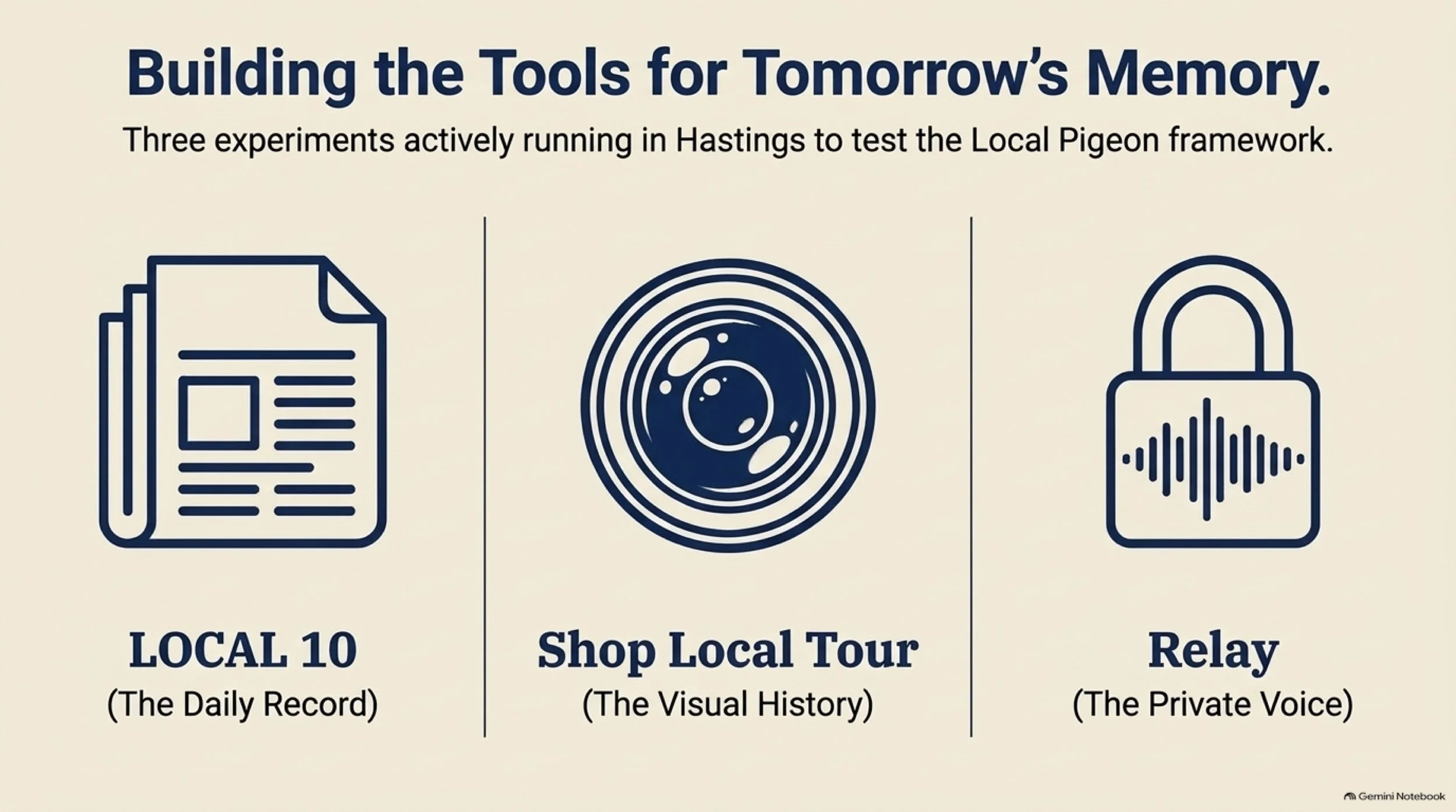
Three experiments in Hastings
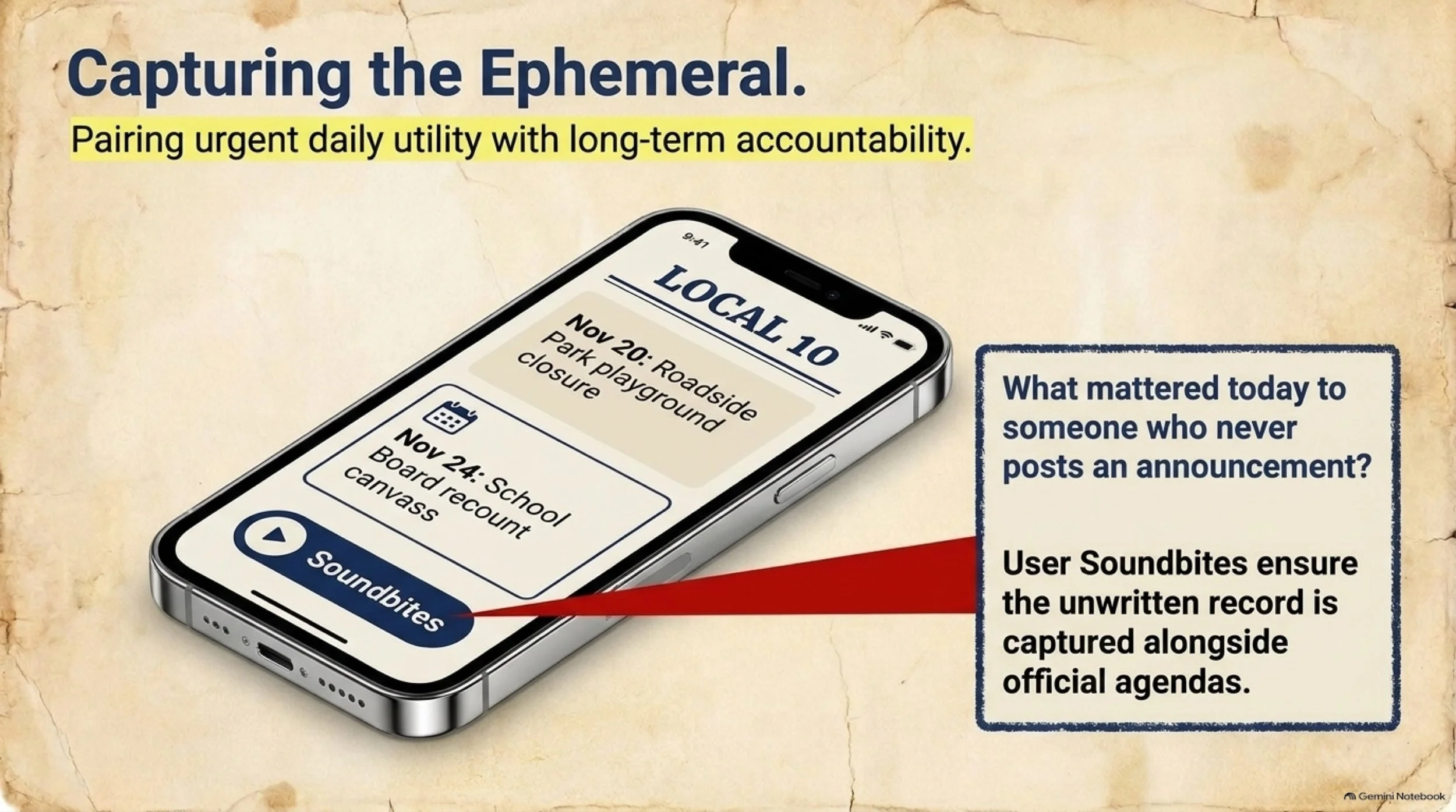
LOCAL 10 starts with a reader who needs something today. Our November 20 brief paired a Roadside Park playground closure notice with an item about a school board recount. The district’s meeting agenda scheduled the board to canvass the recount on November 24. A reader coming back later should be able to tell that, when we published, the meeting was still ahead. Our guide to LOCAL 10 explains how we select ten updates, review submissions including short voice notes called Soundbites, and take corrections. Every edition also leaves a question for us. What mattered that day to someone who never posts an announcement?
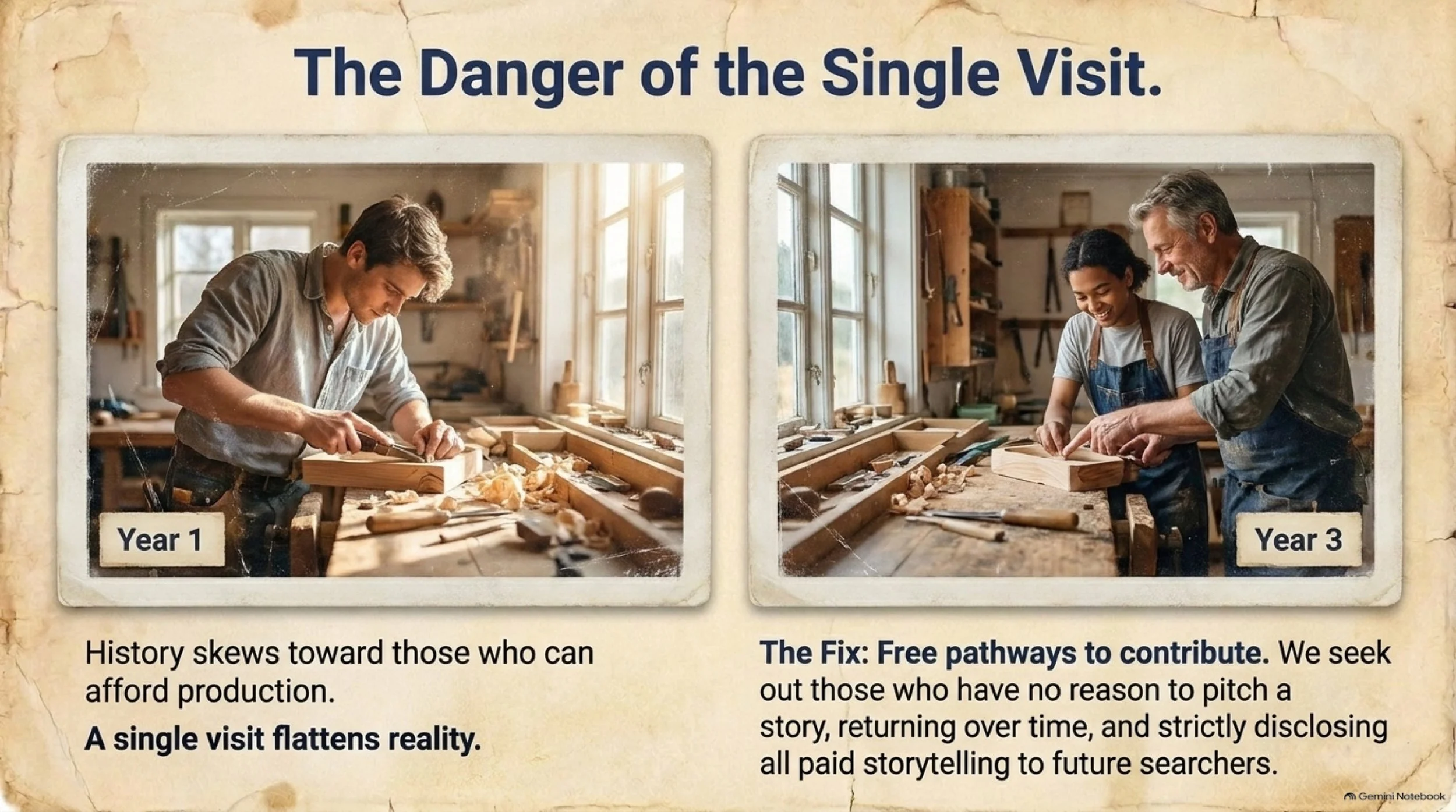
We already publish work such as our photographs from the Hastings Fire Department open house. The Never-Ending Shop Local Tour offers photography and video at participating businesses and proposes returning over time. A first visit might show what someone makes. A return visit could show how they teach a new employee to make it. That is the idea for the tour. The August bucket story was a demonstration we undertook ourselves, before the tour was conceived.
Now suppose the businesses that can afford repeat visits end up with the fullest histories. Years later, a search for work in Hastings might turn up a dozen owners and scarcely anyone who worked a closing shift. Every photograph in the results could be accurately captioned, and the picture they add up to could still be badly skewed. A free way to contribute would help. So would making time to seek out people who have no reason to pitch us a story. We would have to keep asking who had time to take part, who could use the language we offered and who could safely be seen saying yes. No participation count can tell us who had good reason to stay away.
Paid storytelling can support the hours we spend here. It also gives us a financial interest a reader deserves to know about. Our editorial standards say who paid for a sponsored piece should be identified and that buying production gives a client no control over independent coverage or factual corrections. If a paid interview ever enters a historical collection, the disclosure should travel with the clip and appear where a searcher encounters it. If someone challenges our treatment of a client, our current reconsideration process stays within HastingsNow. An outside reviewer for such a case would be something we would have to arrange.
Relay, the third experiment, is still under development. In a protected desktop trial, the prototype displayed a saved, computer-generated test tone. Our November development notes report that the tone could be retrieved and replayed. The trial used a prepared sound. A resident recording their own voice and reliably finding it later, with the promised privacy, is a different test. That experience remains to be demonstrated. It is the work we intend to continue after this essay appears.
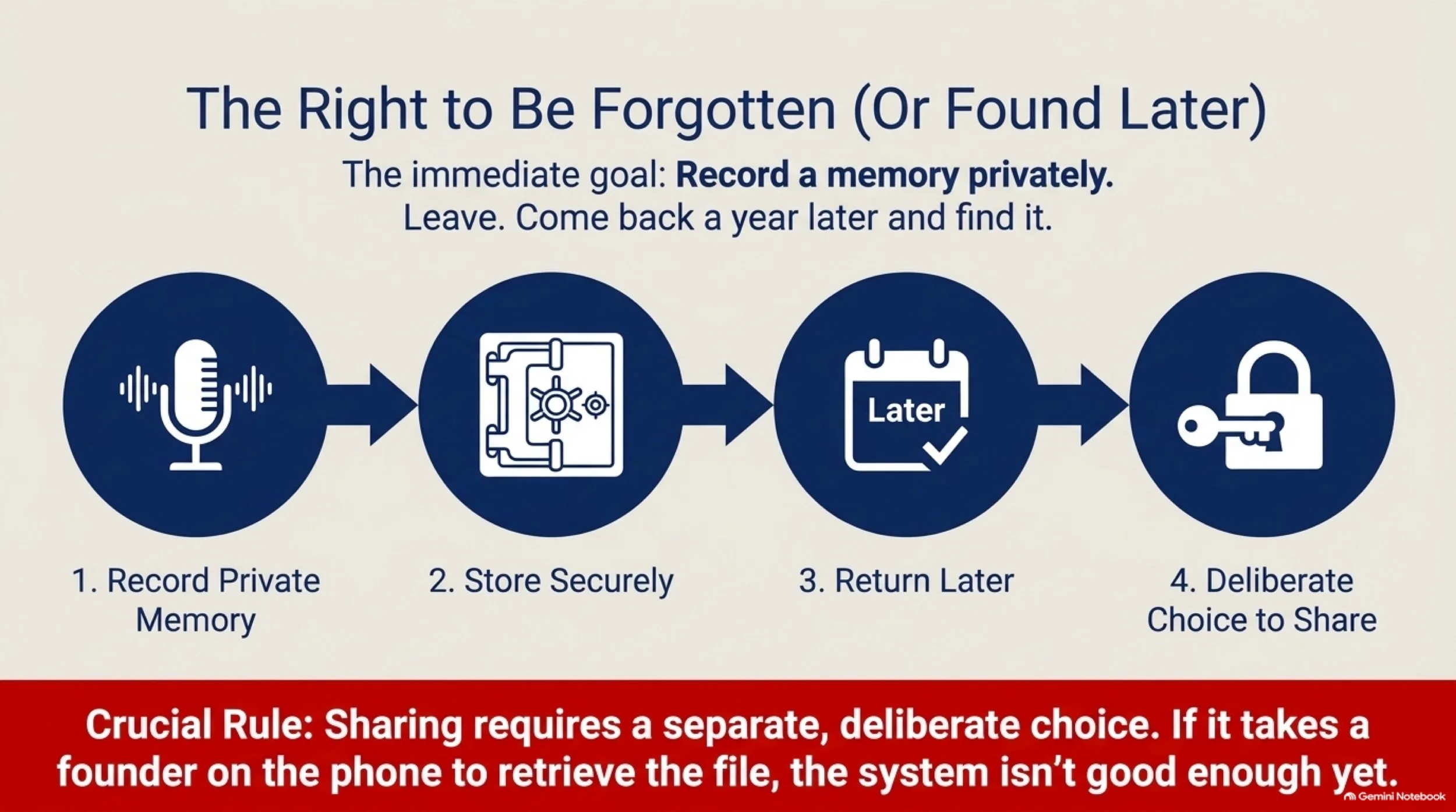
The immediate goal set out in the Local Pigeon Manifesto is small enough to describe from the chair of the person using it. Record or save one memory privately. Leave. Come back another day, find it and hear it again. Know who can listen. Sharing should require a separate, deliberate choice. For a first test, give a willing participant an ordinary account, let them return a week later without either of us coaching, and check separately that another account cannot retrieve the recording. If it takes a founder on the phone to find it, we still have work to do.
What would be worth keeping?
As AI gets better at producing readable accounts, we suspect that hearing an actual person, inspecting the evidence and deciding who may use it will become more valuable. It’s a proposition a reader could test. Give someone two accounts of that street reopening and a question about when deliveries could get through. Can they find the underlying notice or interview, identify the missing evidence and explain their answer? Try it with the sources they ordinarily use, too. If calling the shop gets a clearer answer faster, we ought to learn from that.
A preserved record can also make an old grievance easier to find while doing very little for the next public meeting. There is evidence that losing a newspaper can affect civic life. After the 2007 closure of The Cincinnati Post, two researchers estimated lower turnout in the Kentucky suburbs most reliant on the paper, though their estimates were statistically imprecise. An archive doesn’t send a reporter to a meeting. We would have to earn any claim about its effect on life in Hastings by finding out what people actually use it to do.
A transcript could help a grandchild find a passage in a long interview. A system could also confidently supply the wrong name where a recording is hard to hear, a risk described in the National Institute of Standards and Technology’s work on generative AI. We would want the listener to be able to play those seconds, see who corrected the spelling and distinguish the speaker’s words from a machine’s suggestion. A private recording’s transcript and search results would need the same audience limits as the sound. Using the voice to train a model would be a separate permission. A family could reasonably choose to keep the whole thing offline.
A reader in 2100 should be able to examine our judgment as well as our sources. Who paid for that interview? Which account did we leave unresolved? Did a correction reach the excerpt most people saw? A dated explanation, the rules in force at the time and a record of how a challenge was handled could help that reader judge us. Some decisions could only be described in general terms without identifying someone we had agreed to protect. Our successors should be able to see why there’s a gap.
There’s a practical test for that, too. The National Digital Stewardship Alliance’s preservation framework gives collections a way to assess their care over time. Could someone other than Ashley or Peter restore a permitted recording from a copy, open it, find its description and tell who may hear it? Would a backup restored next winter quietly bring back something a contributor had already withdrawn? We would want to rehearse that handoff with disposable material, let someone outside the project point out where the instructions run out, and count the hours it takes. Whoever inherits the files will need both the authority and the money to care for them after people have stopped clicking. A library or archive might be a better home for some material, if it wants the responsibility and the contributor agrees. For a private recording with no authorized successor, returning a copy to its owner and honoring an agreed deletion date may be the most faithful thing we can do.
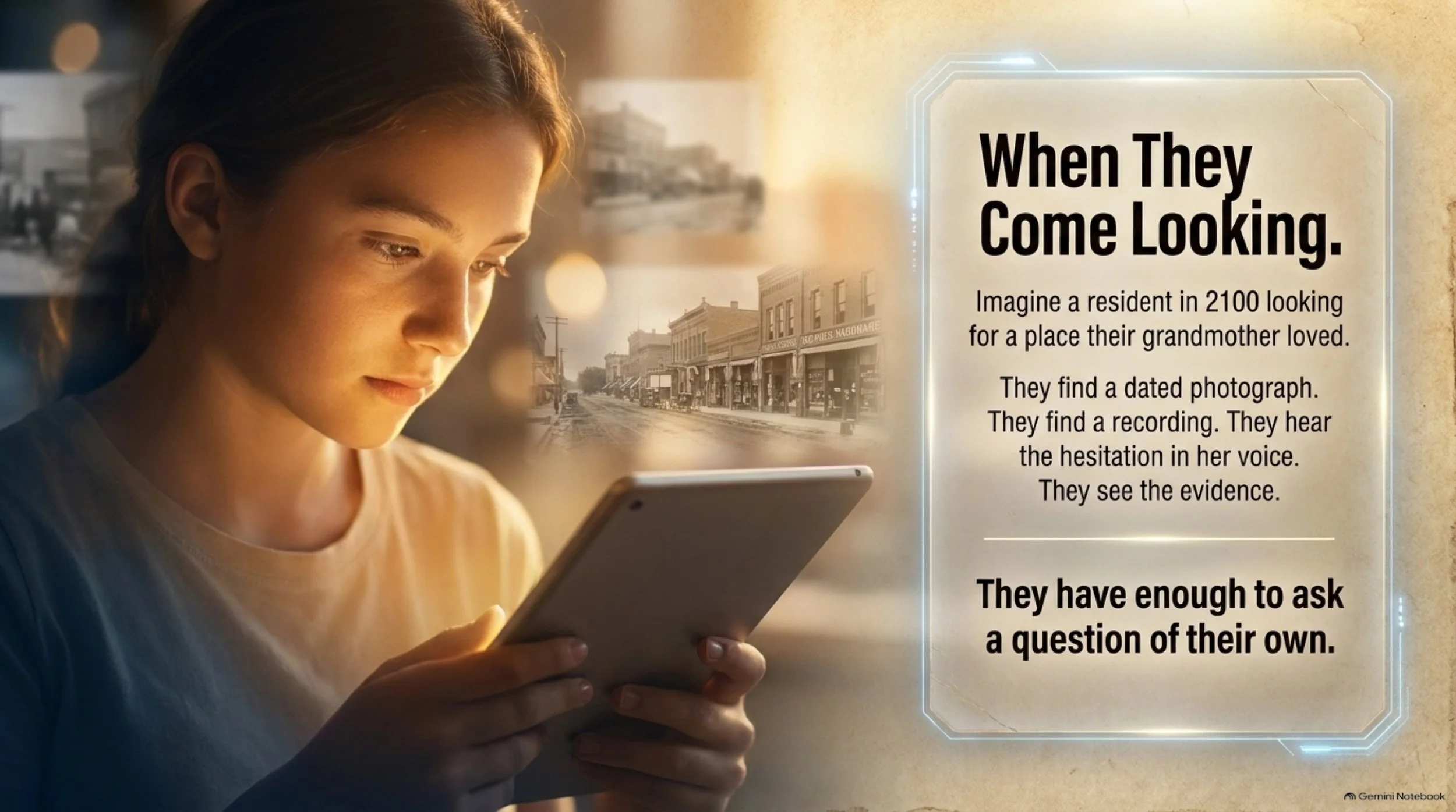
Imagine a Hastings resident in 2100 looking for a place their grandmother used to talk about. They find a dated photograph, a recording someone chose to share and a later correction to the name in the caption. A shopkeeper remembers a good year. Someone who worked nearby remembers the same year differently. The reader hears the hesitation in one voice. They can see what supports the date. They have enough to ask a question of their own.
We’d be glad to hear what you would look for, or what would make you hesitate to leave a recording at all. If you have a clipping that takes the bucket story further back, you can reach us at HastingsNow and describe it before sending the material itself.
The people who saved that Michigan newspaper left us the freedom to turn the page and check for ourselves. That is something worth leaving to Hastings. Our hope is to help a community remember what matters, understand what is true and remain free to shape its own future. For now, we can start with one person who wants to save one memory and come back for it.
Ashley and Peter supplied the firsthand account and editorial direction. ChatGPT drafted the essay and conducted a separate source check.