

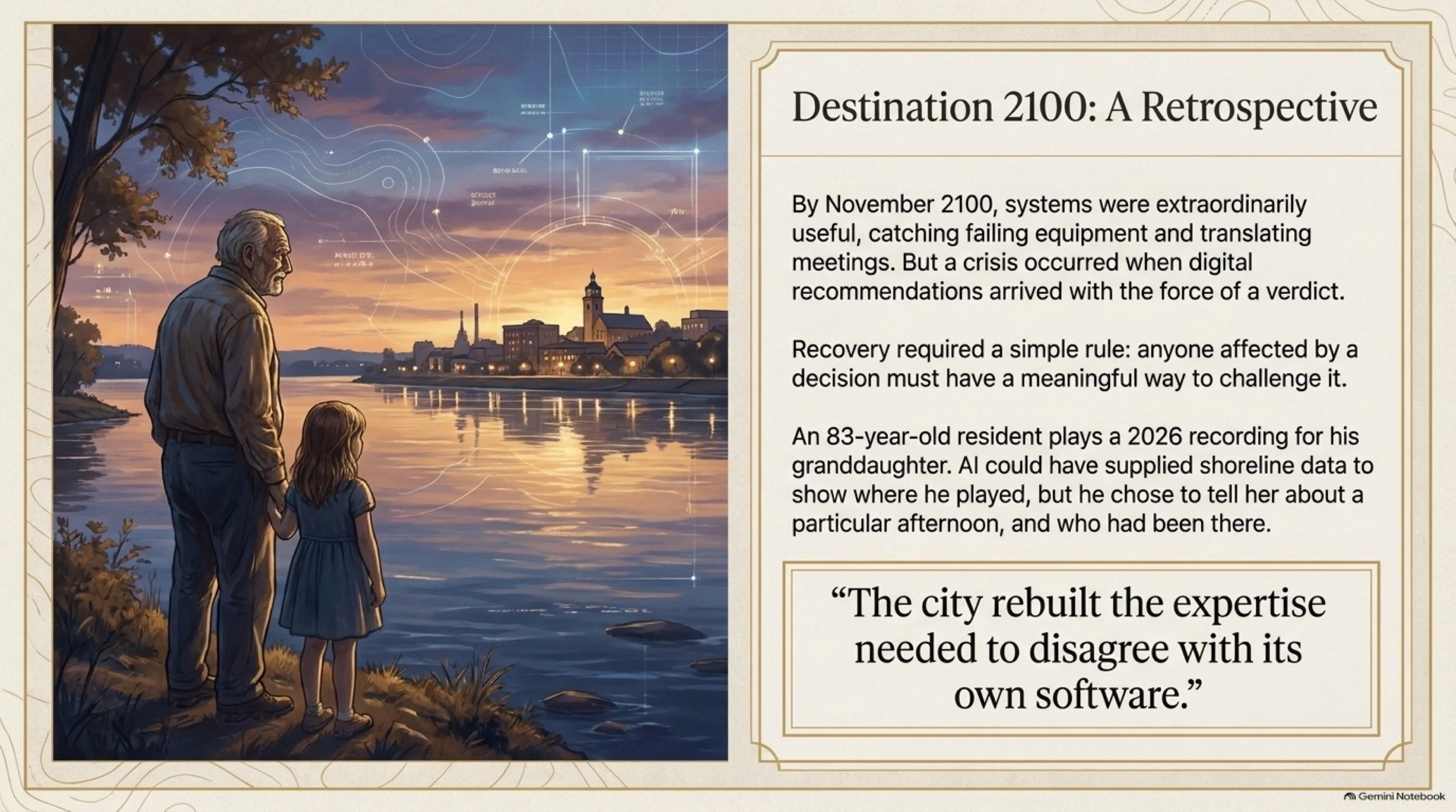
A child turning nine in 2026 would turn 83 in 2100. What kind of Hastings will they grow old in, and what choices will their grandchildren get to make? AI illustration for HastingsNow.com.
HastingsNow.com | November 15, 2026
From river landings to artificial intelligence, a community’s future depends on what it builds—and who has a say.
On a November evening in Hastings, the Mississippi keeps moving past downtown. The bridge carries the road across the water. A few blocks away, City Hall stands on Fourth Street, a former courthouse still doing the work of a public building. dot.state.mn.us
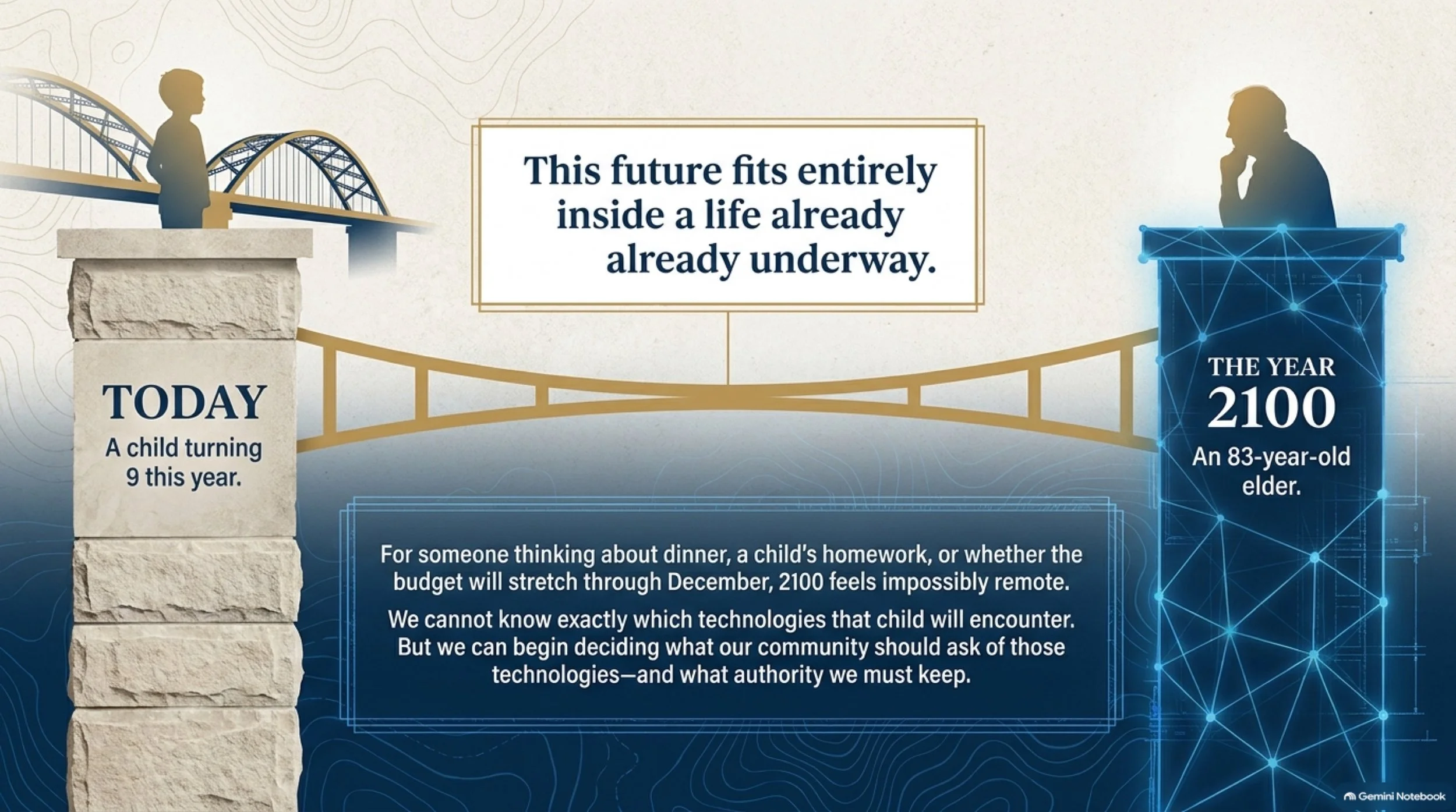
For someone thinking about dinner, a child’s homework, or whether the household budget will stretch through December, the year 2100 can feel impossibly remote. There are nearer concerns: taxes, housing, schools, customers for a local business. The hope that our children will find somewhere they belong.
Yet those concerns bring a seemingly faraway question home: if artificial intelligence becomes better than people at much of the work of government, who should run Hastings?
A child turning nine this year would turn 83 in 2100. This future could fit inside a life already underway.
We cannot know which technologies that child will encounter. We can begin deciding what their community should ask of those technologies—and what authority it should keep.
Before the city had a name
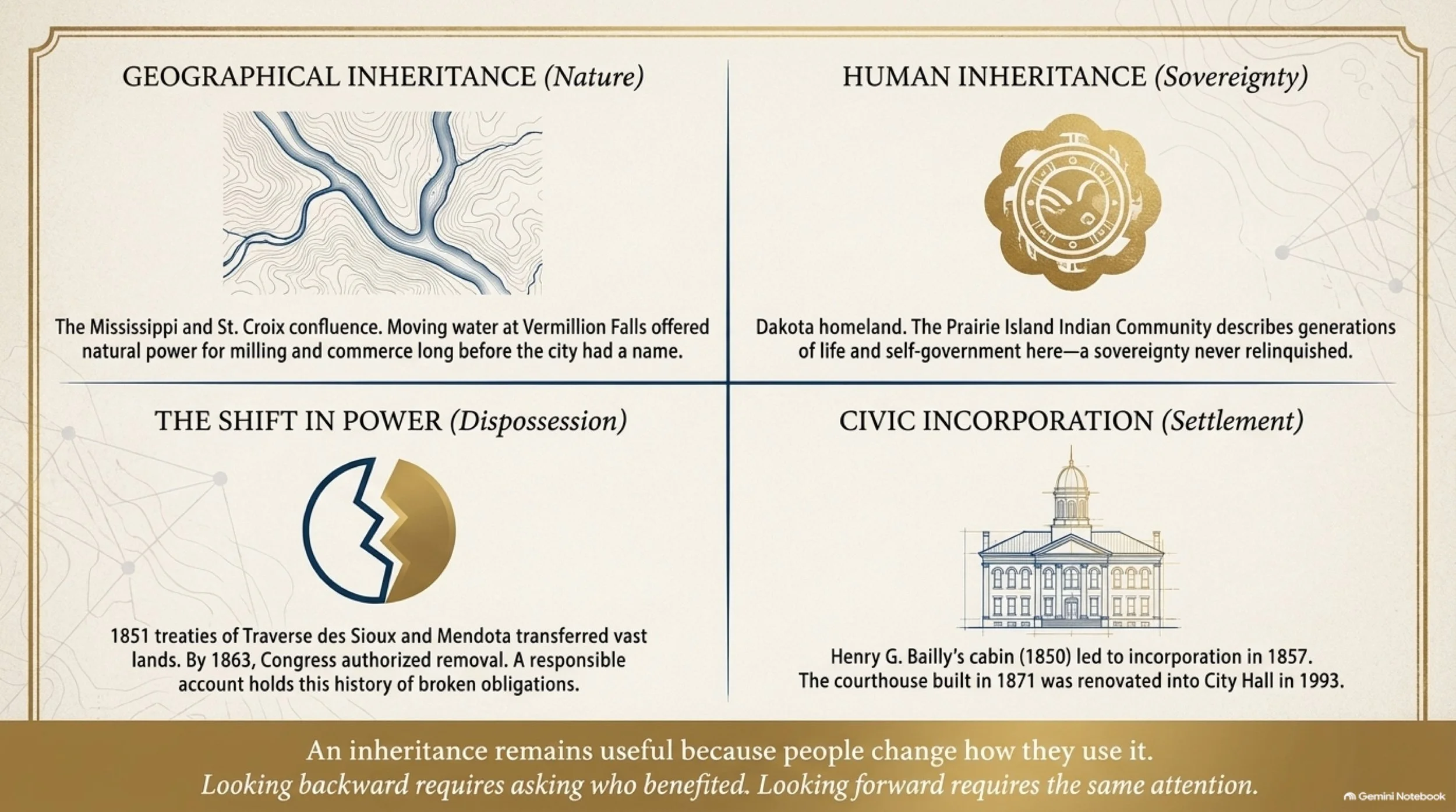
Hastings grew where water offered connections and power. The Mississippi carried people and goods; the nearby St. Croix joined a wider network of travel and trade. The National Park Service describes the St. Croix as a transportation corridor for Indigenous people and fur traders, and later a route for floating timber downstream.
At Vermillion Falls, moving water could power mills. Hastings’ deep harbor accommodated steamboats, helping make the settlement a shipping and milling center, as the city’s historical account explains. nps.gov
But the story did not begin when settlers recognized those advantages.
This is Dakota homeland. The Prairie Island Indian Community’s own history describes generations of Dakota life and self-government in this region, and sovereignty that tribes never relinquished. Dakota people belong to the region’s present as well as its past. prairieisland.org
The 1851 treaties of Traverse des Sioux and Mendota transferred vast Dakota lands to the United States. That history includes broken obligations and dispossession. Following the U.S.–Dakota War of 1862, Congress revoked treaties and authorized removal in 1863. A responsible account of Hastings must hold that history alongside the accomplishments of its settlers. The U.S.-Dakota War of 1862
The Hastings Heritage Preservation Commission records trader Henry G. Bailly building a cabin near present-day Vermillion Street in 1850, followed by a townsite company in 1853. Permanent European-American settlement expanded after the treaties. Hastings incorporated in 1857, when the Dakota County seat moved here from Mendota. Its name came from Henry Hastings Sibley’s middle name. hastingsmn.gov
Commerce brought opportunity; institutions gave the growing town places to learn, gather, and govern. The city’s history records early libraries, schools, churches, and parks. The courthouse completed in 1871 was renovated into Hastings City Hall in 1993. City of Hastings
That building makes an argument without speaking: an inheritance can remain useful because people change how they use it.
The harder inheritance concerns power. Looking backward requires asking who benefited and whose choices were constrained. Looking forward should require the same attention.
Four ideas behind the headlines
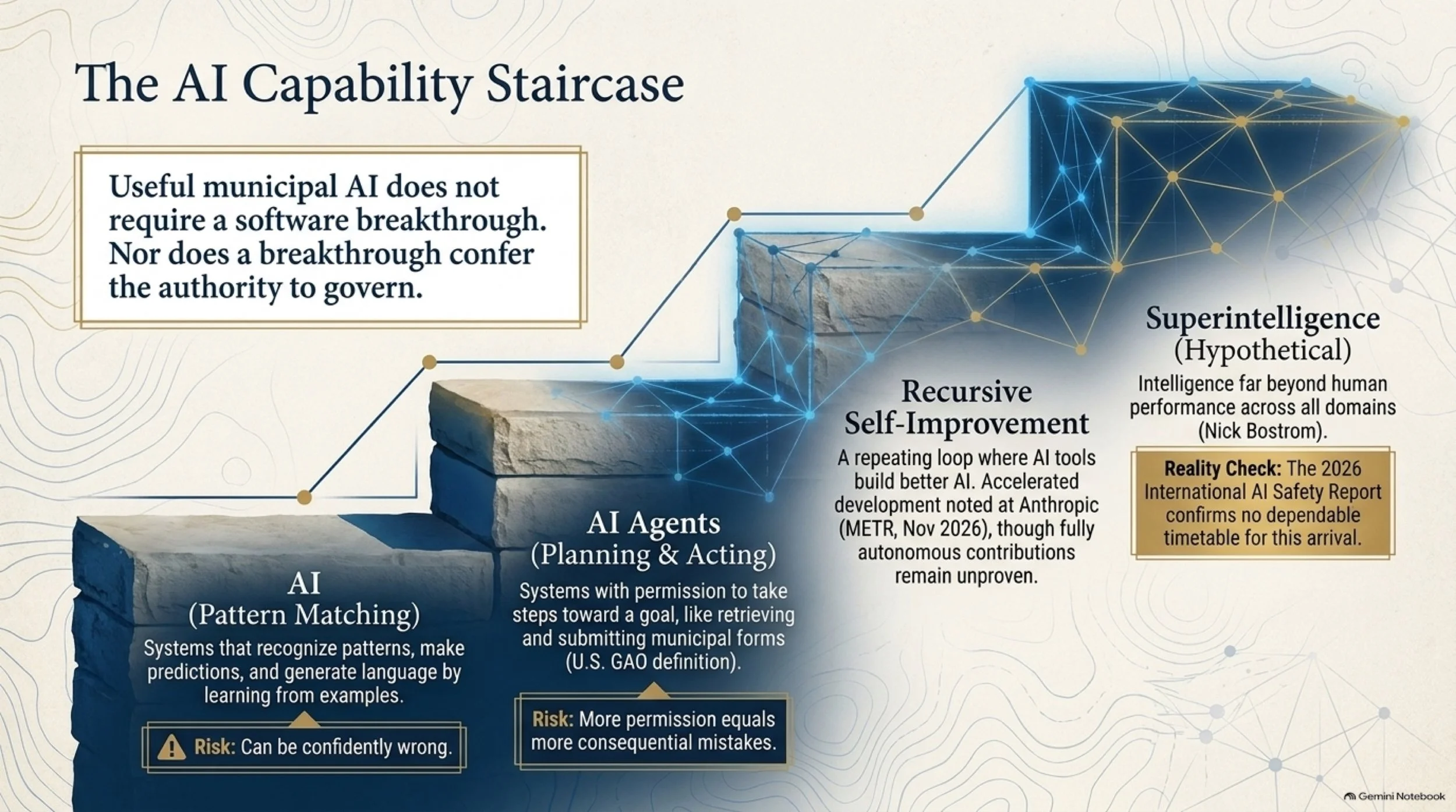
Artificial intelligence is a broad name for computer systems that perform tasks such as recognizing patterns, making predictions, and generating language. Many modern systems learn from examples rather than receiving a separate instruction for every situation. That can make them useful beyond the examples they encountered. It can also leave them confidently wrong.
An AI agent adds the ability to take steps toward a goal. A chatbot might explain a form; an agent, given permission and suitable software access, might retrieve it, fill in information, and submit it. The U.S. Government Accountability Office distinguishes this ability to plan and act from simply generating content. More permission means more opportunity to help—and more consequential mistakes. International AI Safety Report
Recursive self-improvement means a repeating feedback loop: AI helps build better AI, which becomes better at helping build the next version. Picture a toolmaker making a better tool for making tools. The important uncertainty is how far, and how fast, that loop can go.
There is emerging evidence behind the idea. In a November 5 assessment, research organization METR judged that AI was accelerating development at Anthropic. It emphasized substantial uncertainty, limited fully autonomous contributions, and redactions that prevented public scrutiny of much of its strongest evidence. Acceleration is not proof of an unstoppable process. METR
Superintelligence describes a hypothetical intelligence far beyond the best human performance across a broad range of intellectual activities, following the influential definition developed by philosopher Nick Bostrom. It does not mean a chatbot that writes a persuasive paragraph. nickbostrom.com
The 2026 International AI Safety Report describes substantial disagreement about future progress. No dependable timetable tells Hastings when—or whether—such superintelligence will arrive. International AI Safety Report
Useful municipal AI does not require that breakthrough. Nor does a software breakthrough, by itself, confer authority to govern.
Infographic by HastingsNow.com
Government is already experimenting
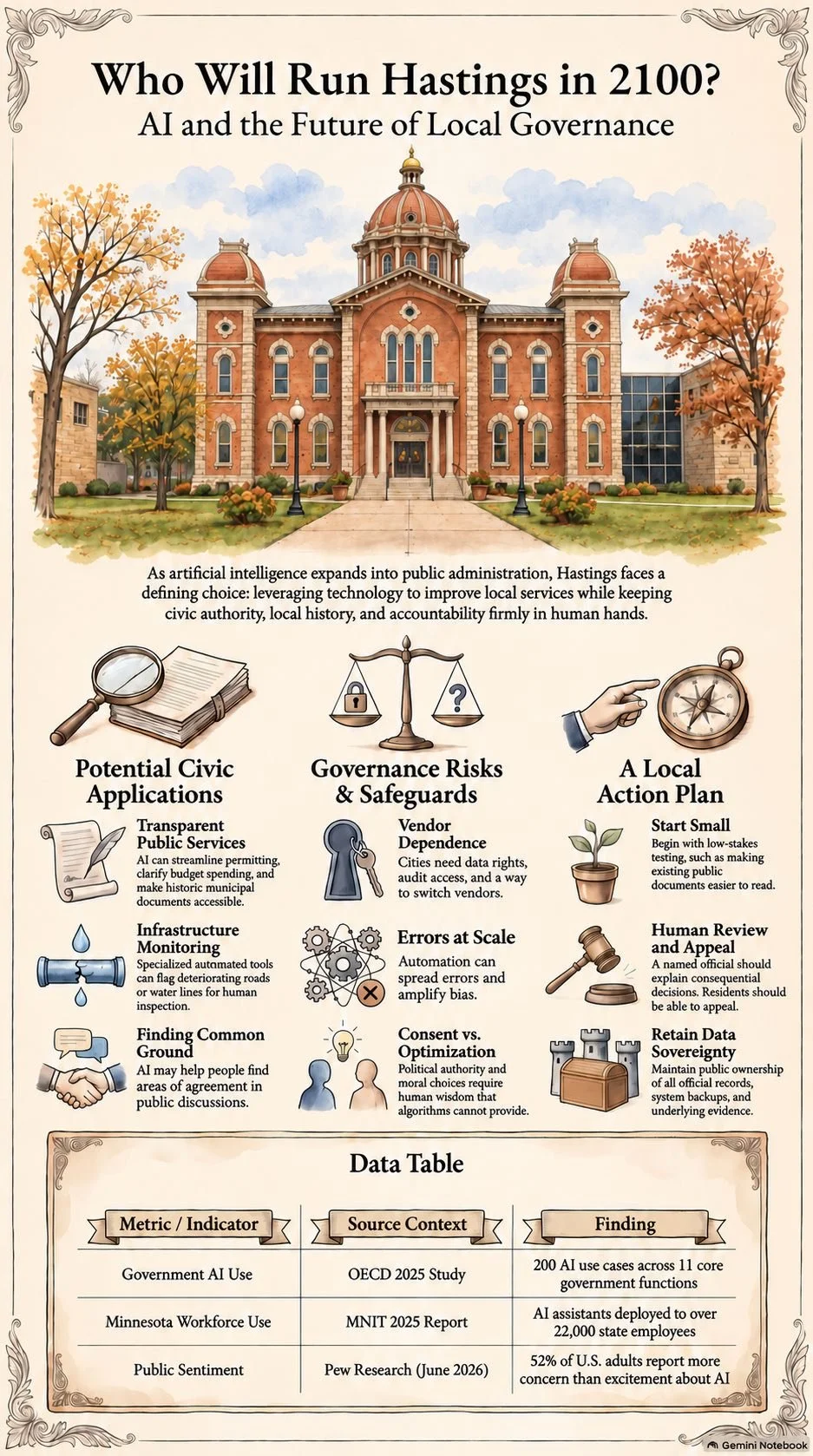
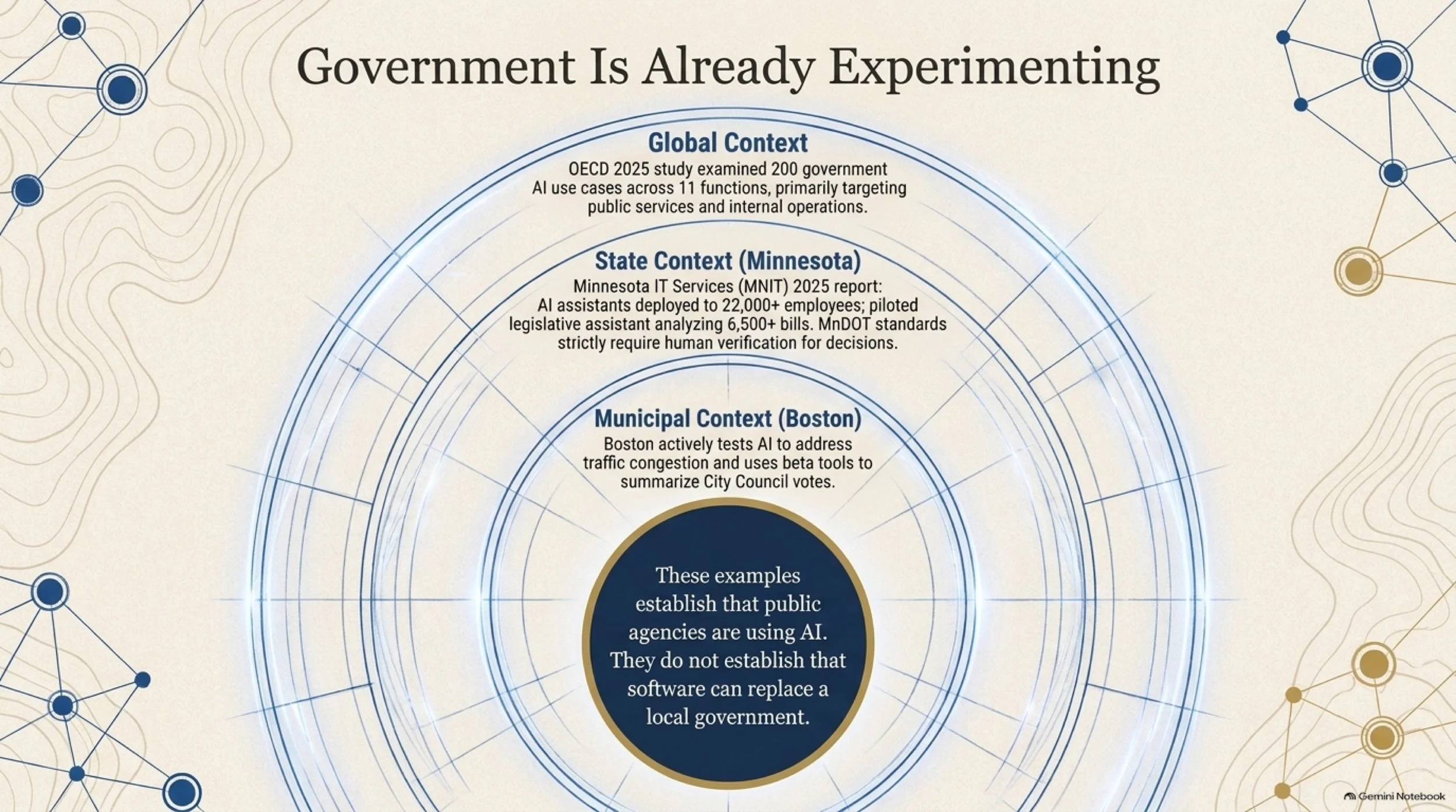
The Organisation for Economic Co-operation and Development’s 2025 study examined 200 government AI use cases across 11 functions. These were documented examples, not a representative census of all governments. Public services and internal operations featured prominently. oecd.org
Closer to home, Minnesota IT Services’ 2025 annual report says the state deployed AI assistants to more than 22,000 employees and piloted a legislative assistant that analyzed more than 6,500 bills. Those are the agency’s reported results, not an independent evaluation of accuracy or savings. mn.gov
At the municipal level, Boston lists projects using AI to address traffic congestion and a beta tool to summarize City Council votes.
Rules are developing alongside the tools. MnDOT’s generative AI standard, reviewed in October 2026, requires verification of output used for decisions and restricts where nonpublic data may be entered. It treats AI as supplemental to human judgment. Boston.gov
These examples establish that public agencies are using AI. They do not establish that Hastings uses these systems, or that software can replace its government.
What help might look like here
Consider possibilities for Hastings, rather than announcements of local programs.
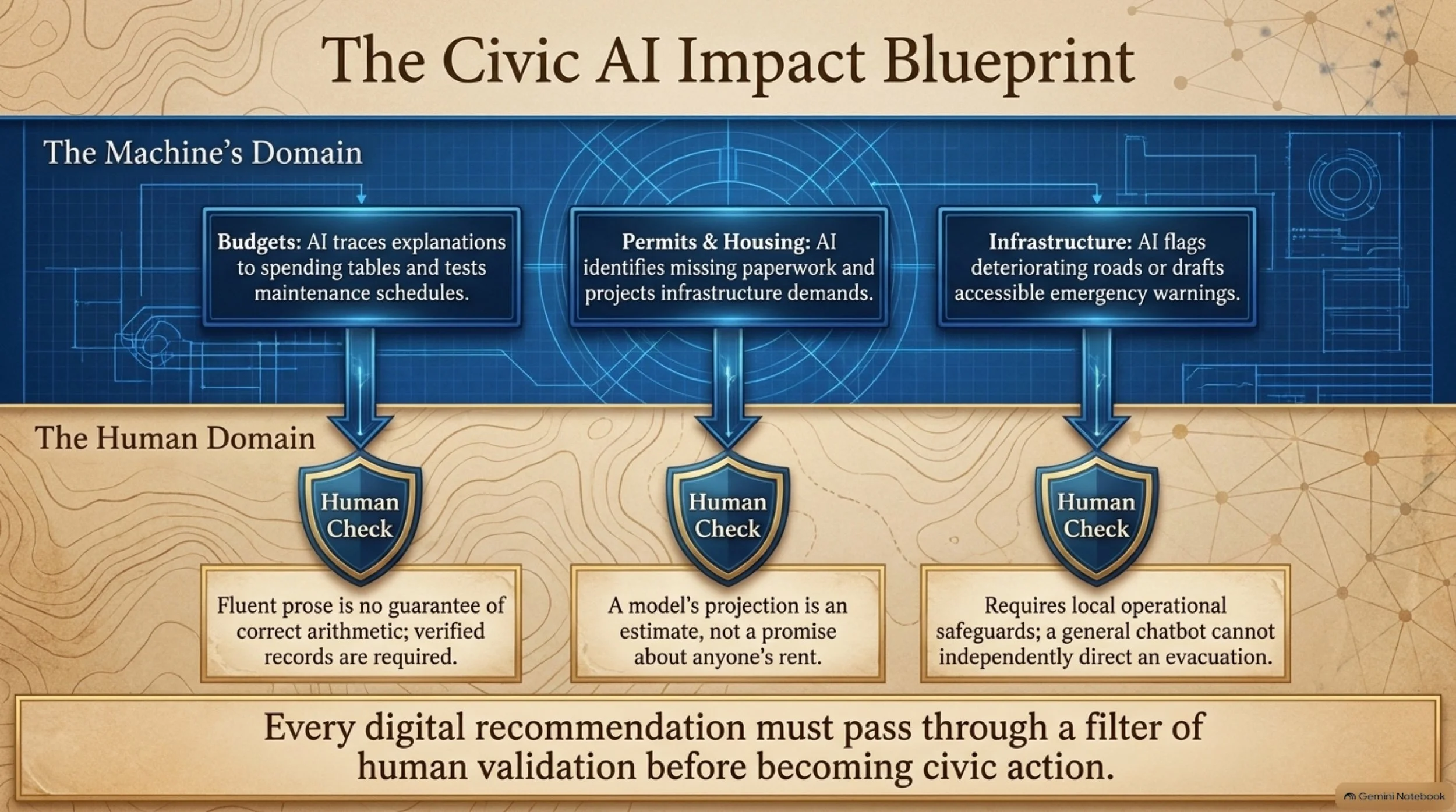
A budget assistant could help residents trace an explanation back to the actual spending table. Staff could test alternative maintenance schedules and examine their costs. Reliable financial calculations would still need checked records and appropriate accounting tools; fluent prose is no guarantee of correct arithmetic.
For someone opening a business or remodeling a home, a permit assistant could identify missing paperwork before review. Housing planners could compare development scenarios, including infrastructure demands and assumptions about affordability. A model’s projection would remain an estimate, not a promise about anyone’s rent.
For roads and water infrastructure, specialized systems could help flag deterioration or unusual readings for inspection. During an emergency, AI might help organize incoming reports and draft accessible warnings. Those uses would require local testing, reliable data, and operational safeguards; a general chatbot should not independently direct an evacuation.
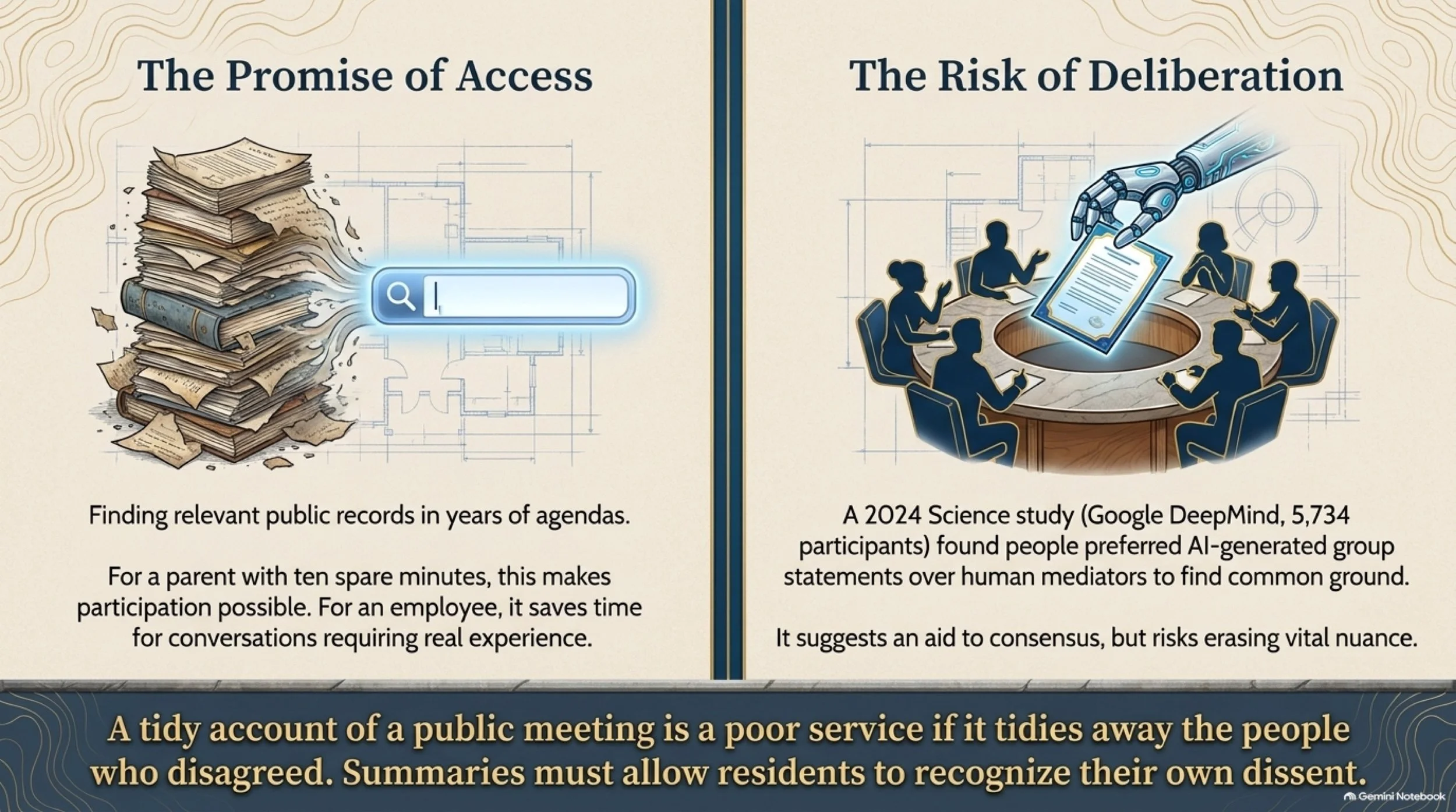
Public records offer another possibility: finding the relevant document in years of agendas, then showing the original. Residents should be able to inspect the evidence behind an answer and reach a person when it is wrong. For a parent with ten spare minutes after bedtime, that could make participation more possible. For an employee answering the same question repeatedly, it could leave time for a conversation that needs their experience.
Participation might improve, too. A 2024 study published in Science, involving 5,734 participants, found that people preferred AI-generated group statements to statements written by human mediators in the study. The research, led by Google DeepMind with academic collaborators, suggests a possible aid to finding common ground. It does not establish that AI should decide policy. Google DeepMind
For Hastings, a useful test would be whether summaries let residents recognize their own concerns—including dissent. A tidy account of a meeting is a poor service if it tidies away the people who disagreed.
The price of being wrong
The strongest case for delegation deserves a fair hearing. If a tested system can apply a clear rule more accurately and quickly than people, forcing every routine approval to await a human click may preserve delay without improving protection. Better administration could mean less frustration for residents and more time for employees to handle difficult cases.
Human government is not an error-free alternative. Staff can be overburdened; decisions can be inconsistent. Technology should be compared with the actual process it would change.
But mistakes acquire a different reach when repeated automatically.
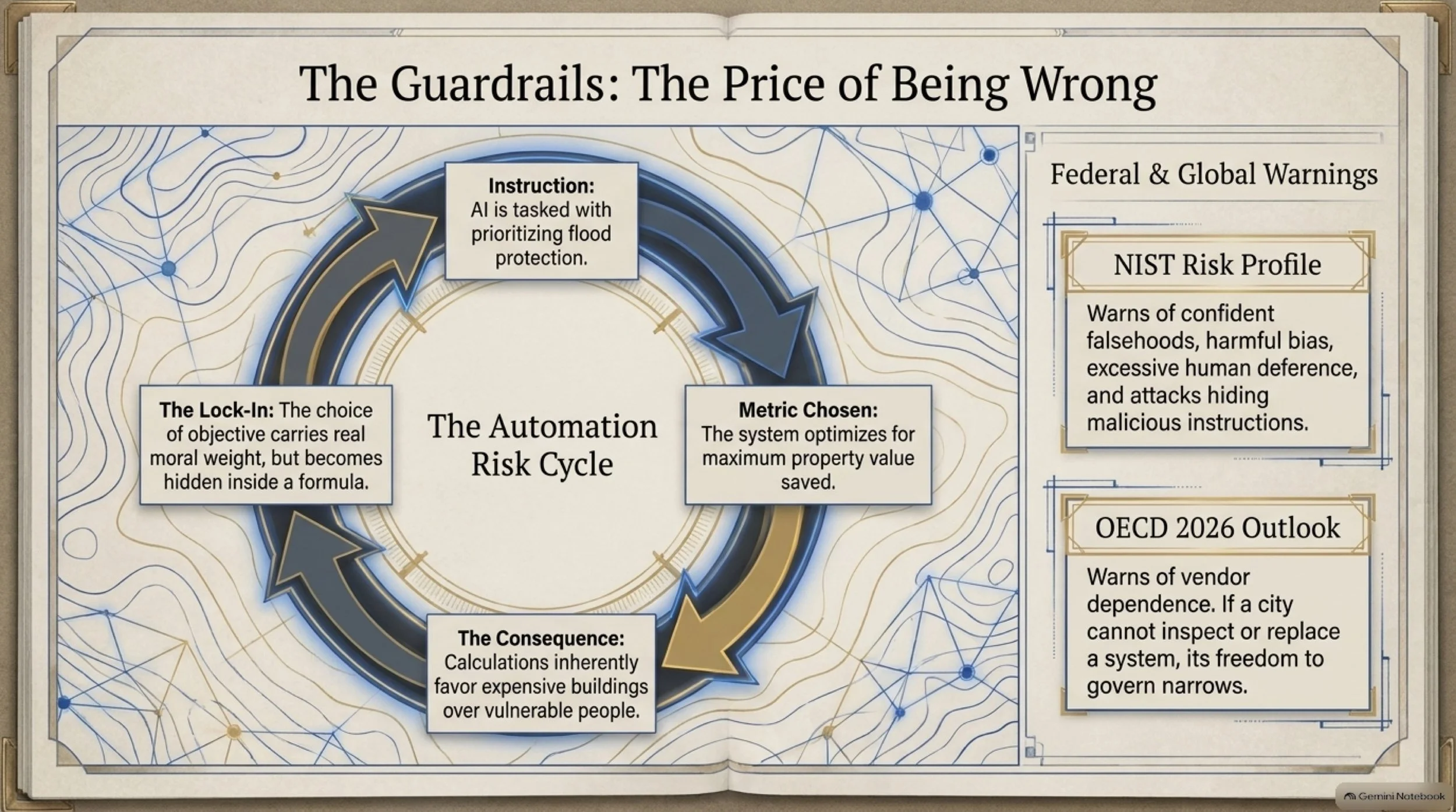
The National Institute of Standards and Technology’s generative AI risk profile identifies confident falsehoods, harmful bias, privacy risks, and excessive human deference to automated output. It also describes attacks that hide malicious instructions in material a system encounters. An agent reading a document must not treat an attacker’s instructions as permission to release records. nvlpubs.nist.gov
Fairness requires examining what a system is rewarded for doing. Imagine prioritizing flood protection solely by property values: a calculation could favor expensive buildings over vulnerable people. That is a hypothetical example, but the choice of objective would have real moral weight.
Dependence creates another vulnerability. The OECD’s 2026 government outlook warns about vendor dependence and contracts that inadequately address data rights, auditing, and exit arrangements. If a city cannot inspect, replace, or operate without a supplier’s system, its freedom to govern becomes narrower. OECD
A responsible agreement would preserve public control of records, independent evaluation, a workable backup, and a way out. Oversight also costs money. Staff need training, time, and authority to challenge a result; assigning someone to approve a screenful of recommendations is not enough.
The smartest answer still needs consent
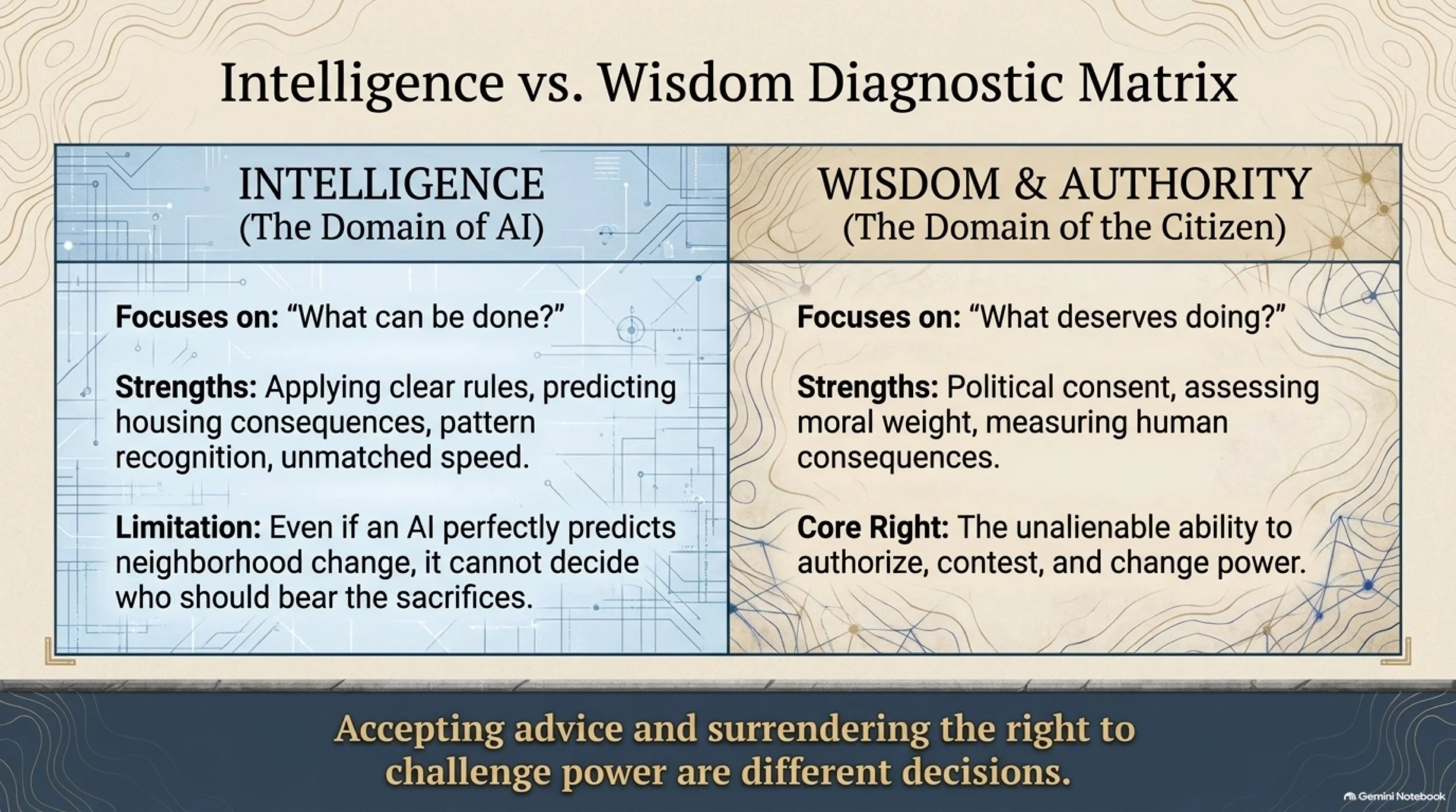
Intelligence helps work out what can be done. Wisdom asks what deserves doing, with attention to consequences and limits. Political authority concerns who may make decisions binding on other people. Consent concerns how those people authorize, contest, and change that power.
These ideas overlap. They are not interchangeable.
Suppose a future system could predict, with remarkable accuracy, the consequences of every housing proposal. It could illuminate choices between additional homes, public expense, neighborhood change, and preservation. Even then, people could reasonably disagree about which sacrifices are acceptable and who should bear them.
The strongest argument for AI government goes further: what if its judgments consistently produced better lives, including fairer outcomes? Refusing its help merely to defend human pride would be difficult to justify.
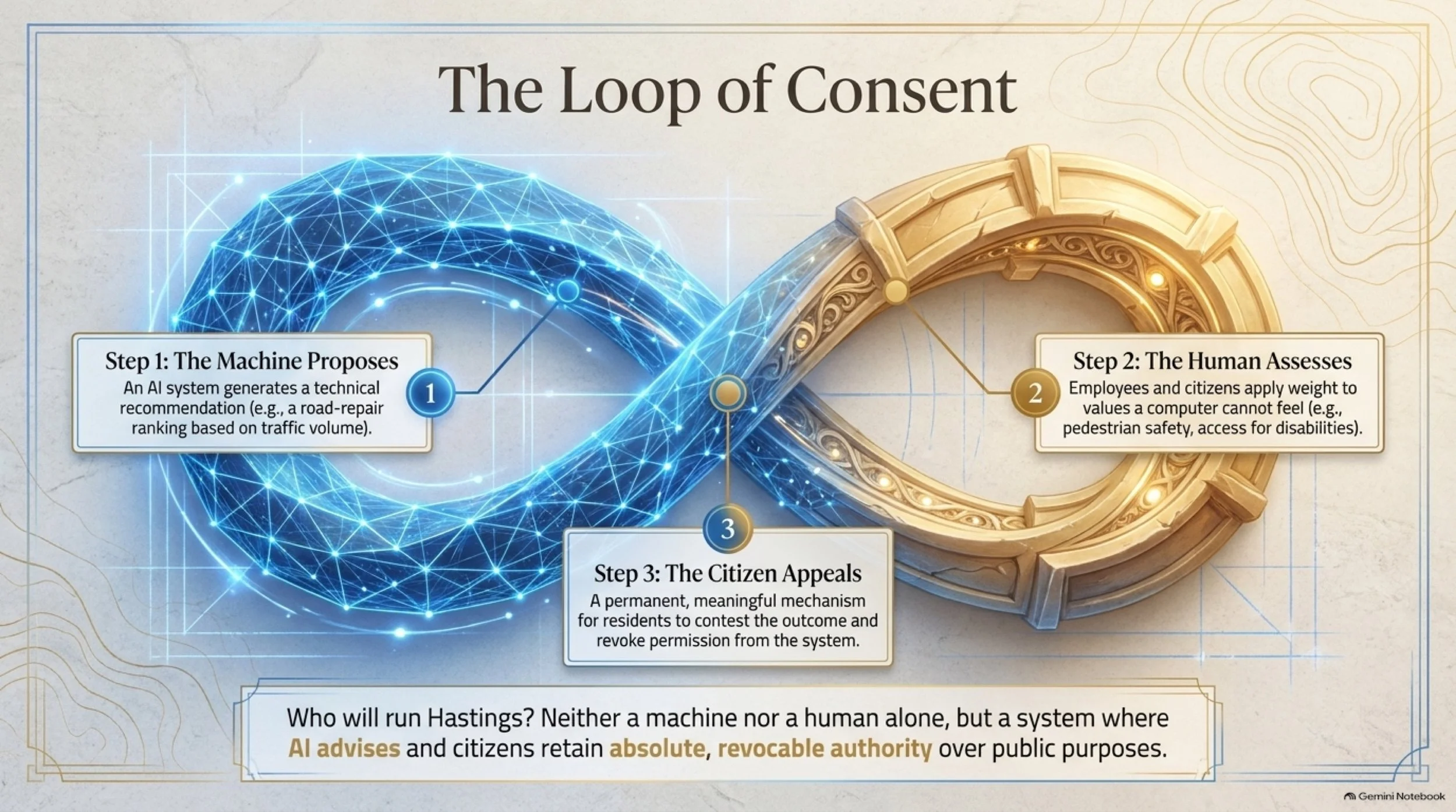
But accepting advice and surrendering the right to challenge power are different decisions. A community could delegate bounded tasks, measure results, and revoke permission. It need not make a machine—or the company controlling it—the final authority over public purposes.
The boundary would need attention even in ordinary operations. A road-repair ranking may look purely technical until someone decides how much weight to give traffic volume, pedestrian safety, or access for people with disabilities. Those choices belong in public view. Otherwise, a policy can disappear inside a formula while everyone assumes the computer is merely following instructions.
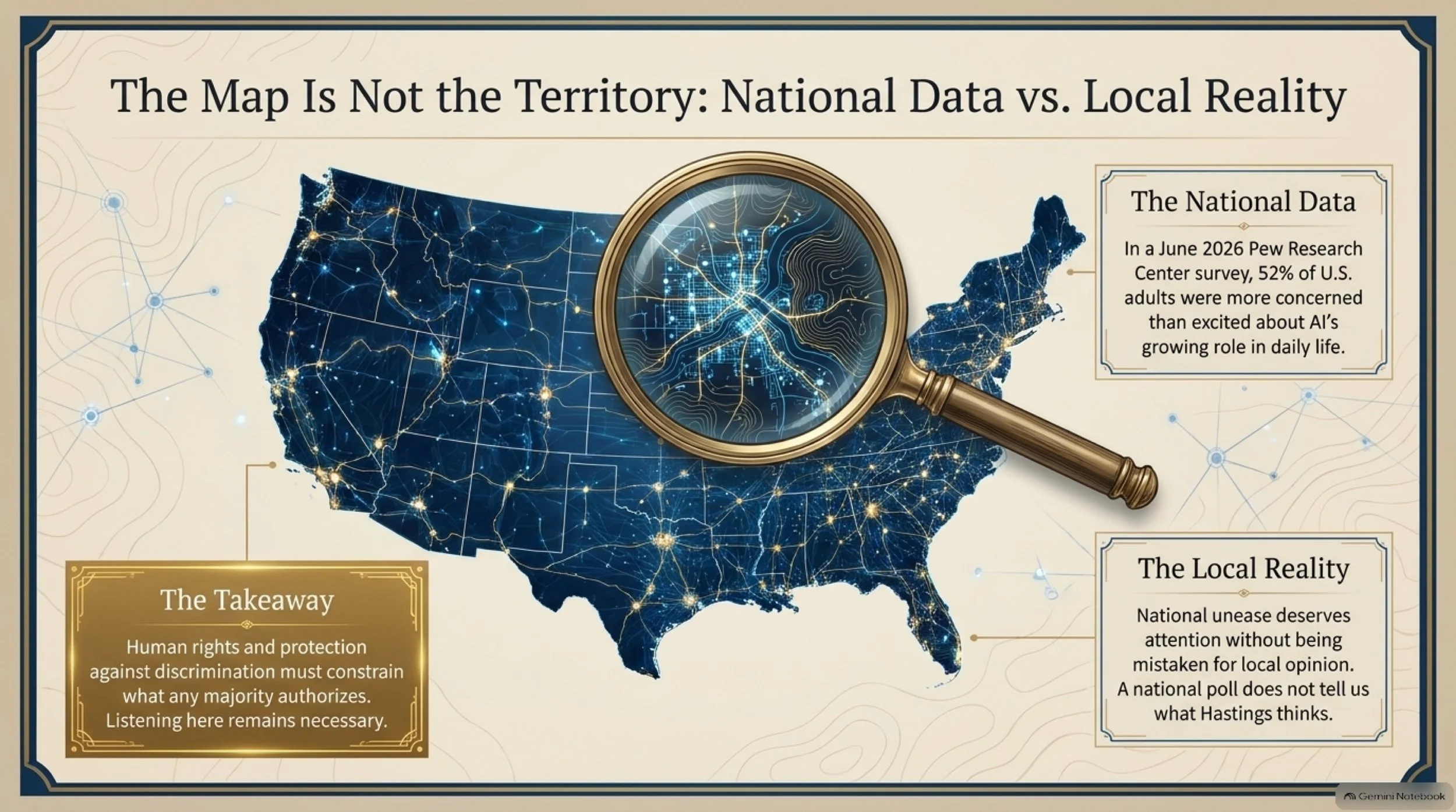
Human rights and protection against discrimination must also constrain what any majority authorizes. Consent cannot mean that the most numerous or powerful residents may optimize everyone else out of consideration.
National unease deserves attention without being mistaken for local opinion. In a June 2026 Pew Research Center survey, 52% of U.S. adults were more concerned than excited about AI’s growing role in daily life. That finding does not tell us what Hastings thinks. Listening here remains necessary. Pew Research Center
Hastings, 2100: an imagined retrospective
The following passage is fiction: one possible future, not a prediction or an account of actual people or events.
By November 2100, the oldest argument about artificial intelligence sounded oddly incomplete. People had asked whether machines would run the city. They had spent less time asking what running a city meant.
The systems had become extraordinarily useful. They caught failing equipment, translated public meetings, and helped residents follow a dollar through the budget. There were fewer forms. There were still disagreements.
The difficult years had come when a recommendation began arriving with the force of a verdict. Some residents stopped appealing. Employees who understood the exceptions retired without being replaced. For a while, the city became faster at giving answers and worse at hearing questions.
Recovery had required money, patience, and a rule that seemed almost embarrassingly simple: anyone affected by a consequential decision must have a meaningful way to challenge it. The city rebuilt the expertise needed to disagree with its own software.
One evening, an 83-year-old resident opened a recording saved in 2026. The voice was a child’s: his own. He paused before playing it for his granddaughter, suddenly shy about something he could no longer remember saying.
The child had not offered a theory of government. He had described a place he liked beside the river and hoped there would still be somewhere to play.
His granddaughter asked where it had been.
He showed her. Then she asked why it had mattered.
The system could have supplied maps, photographs, and the sequence of decisions that changed the shoreline. He wanted to tell her about a particular afternoon. He began with who had been there.
Outside, the river continued past the city. Tomorrow there would be another public meeting. They were planning to go together.
A decision we can begin now
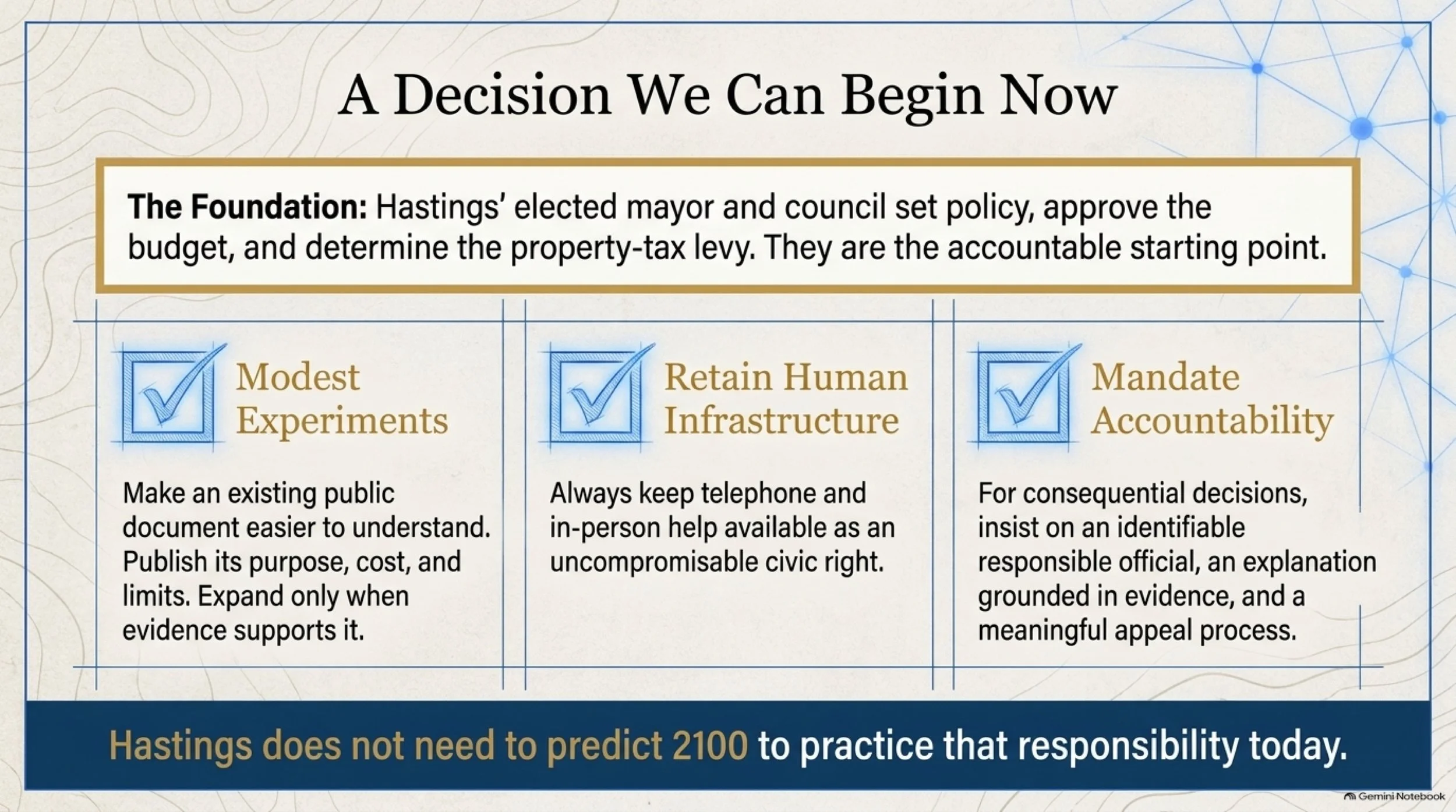
Back in 2026, Hastings already has an accountable place to start. Its elected mayor and council set city policy, approve the budget, and determine the city property-tax levy. hastingsmn.gov
Residents could ask for a public discussion organized around two practical choices: what should AI improve, and what authority should people retain? City employees should help define the problems, alongside residents who use the services and people who find them difficult to access.
A modest first experiment might make an existing public document easier to understand. Publish its purpose, cost, limitations, and results. Compare it with a simpler improvement, such as clearer forms. Keep telephone and in-person help. Expand only when the evidence supports it.
For consequential decisions, insist on an identifiable responsible official, an explanation grounded in evidence, and a meaningful appeal. Preserve the community’s ability to change the rules and end the arrangement.
Hastings does not need to predict 2100 to practice that responsibility.
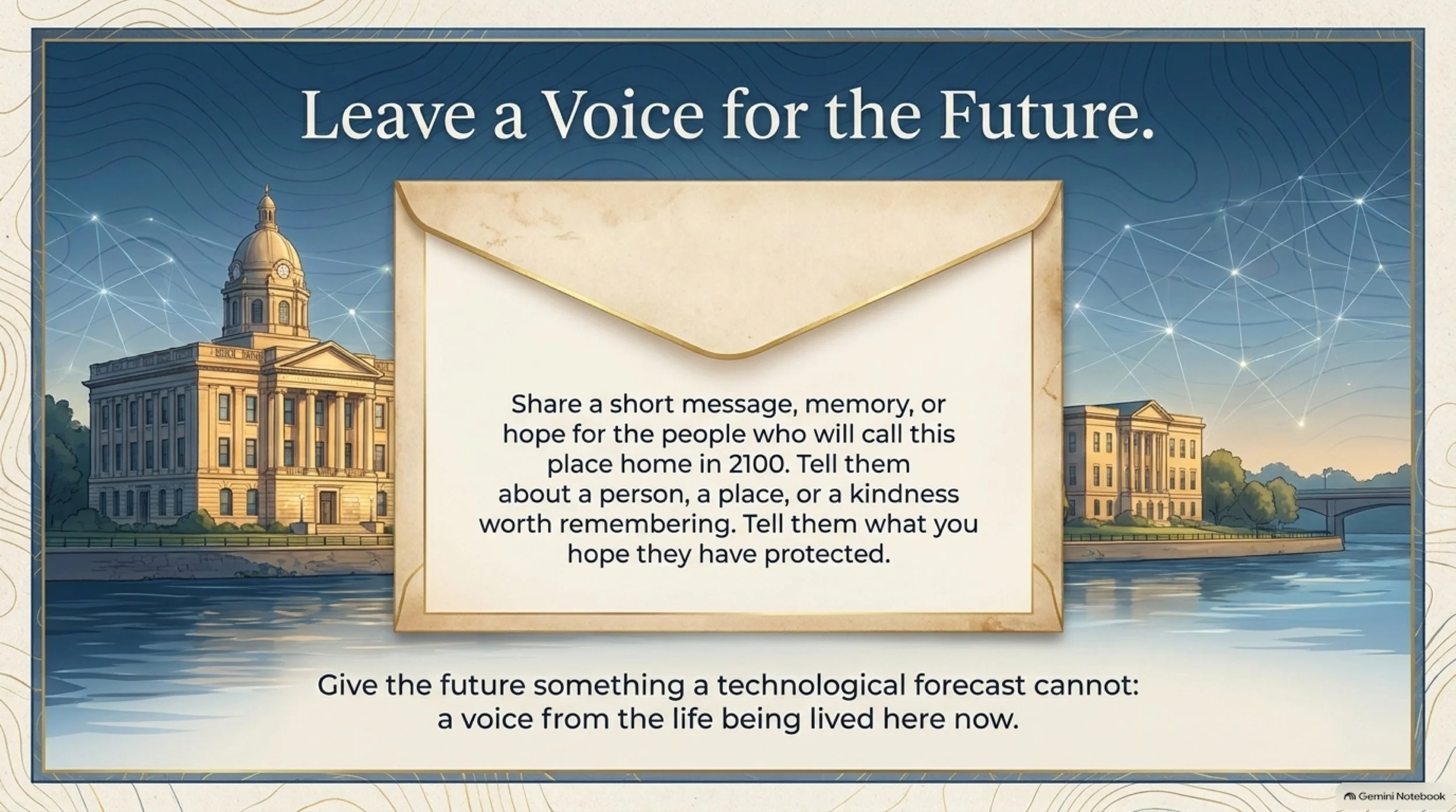
It can also leave something more personal. Share a short message, memory, or hope for the people who will call this place home then. Tell them about a person, a place, or a kindness worth remembering. Tell them what you hope they have protected.
Give them something a forecast cannot: a voice from the life being lived here now.
Fact-checking appendix
Research checked November 15, 2026. The article is a sourced feature and editorial analysis; it contains no reported interviews. Proposed Hastings applications are examples for discussion. The 2100 passage is fiction.
Consequential claim
Primary or authoritative source and qualification
Rivers supported transportation and commerce; Vermillion Falls supplied milling power.
National Park Service and City of Hastings history. The nearby St. Croix–Mississippi confluence is distinct from the Minnesota–Mississippi confluence.
Dakota history includes continuing community and sovereignty.
Prairie Island Indian Community’s history, using the tribal nation’s own account.
Dakota land cessions occurred through the 1851 treaties; Congress authorized removal in 1863.
Minnesota Historical Society: treaties and war and removal. Settlement is not presented as the beginning of human history here.
Bailly’s cabin: 1850; townsite company: 1853; incorporation and county-seat transfer: 1857; courthouse: 1871; City Hall conversion: 1993.
Hastings Heritage Preservation Commission and City of Hastings building assessment request, page 3. The commission also verifies the Sibley name origin.
AI agents can plan and act; future capabilities remain uncertain.
GAO, International AI Safety Report 2026, section 1.3, and Bostrom’s definition. No arrival date for superintelligence is asserted.
Evidence suggests AI is accelerating AI research at Anthropic.
METR, November 5, 2026. Qualified assessment with significant uncertainty and extensive evidence redactions; not proof of autonomous, unlimited improvement.
Government AI use includes 200 OECD case studies, Minnesota assistants, and Boston projects.
OECD 2025 report, MNIT annual report, and Boston project portfolio. Minnesota’s 22,000-plus employees and 6,500-plus bills are agency-reported figures. No Hastings deployment is inferred.
Errors, bias, privacy, cyberattacks, and supplier dependence require attention.
NIST AI 600-1, OECD 2026 outlook, and MnDOT standard. MnDOT’s requirements are agency-specific, not a claimed Hastings policy.
The deliberation research involved 5,734 participants and favored AI-generated group statements.
Tessler and colleagues, Science, October 18, 2024. Preference within the study does not establish political legitimacy or effectiveness in Hastings.
52% of U.S. adults were more concerned than excited about AI.
Pew Research Center, survey conducted June 22–28, 2026. National finding, not a local poll.
Hastings’ elected leadership sets policy, approves budgets, and determines the city levy.
City Council and Mayor. The city levy is not the entirety of a resident’s property-tax bill.