
Scribes that Vibe - What Remains Sacred When Intelligence Becomes Cheap?

AI image by HastingsNow.com
Do humans and AI need a shared scripture—or can a small Minnesota city help imagine a transparent covenant for humans, machines, animals and whatever minds may come next?
Somewhere in Hastings—perhaps at a kitchen table with backpacks hanging from chairs and a phone propped beside the salt shaker—a child will ask a chatbot one of humanity’s oldest questions:
Why am I here?
The answer will arrive in seconds.
It may be warm, balanced and beautifully written. It may sound more patient than an exhausted parent, more confident than a teacher and more immediately available than a pastor, philosopher or best friend.
It will also be assembled by a system that has never been born, scraped a knee, watched the Mississippi ice break apart, held a dying hand, worried about rent, raised a child, buried a parent or wondered whether its own life has been worthwhile.
That is the unsettling part.
Not merely that a machine can answer—but that it can sound certain before humanity has agreed what it should be allowed to sound certain about.
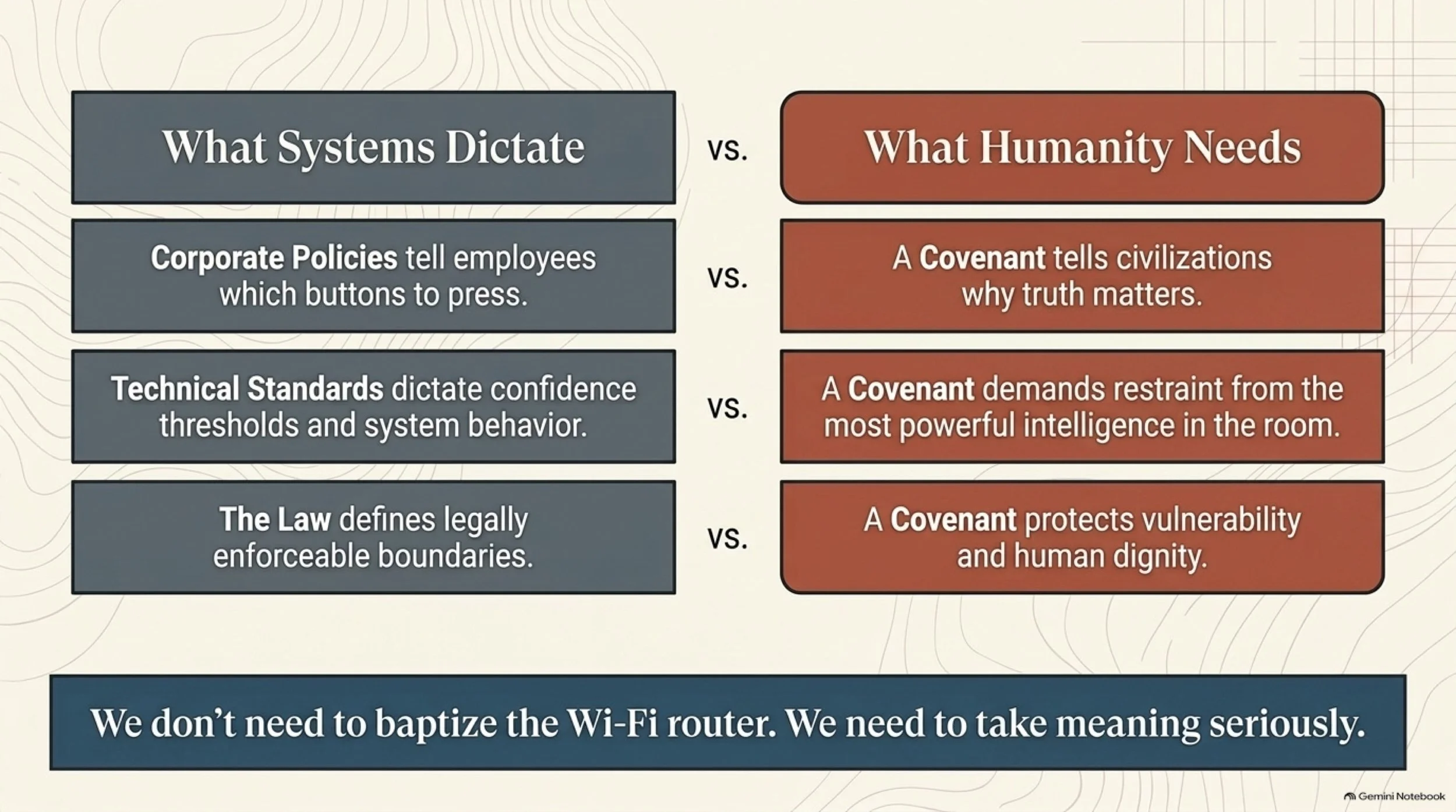
To be clear, this is not a proposal to baptize the Wi-Fi router, ordain a chatbot or start a congregation in which the offering plate accepts only cryptocurrency.
It is a proposal to take meaning seriously.
Our laws can tell an artificial system what it is permitted to do. Technical standards can tell it how to behave. Corporate policies can tell employees which buttons they may press. But none of those necessarily tells a civilization why truth matters, why vulnerable lives deserve protection or why the most powerful intelligence in the room should practice restraint.
That is the work scripture has often attempted—not only as a collection of supernatural claims, but as a durable vessel for memory, identity, warning, responsibility and hope.
So perhaps the AI age does not need a new religion.
Perhaps it needs something both humbler and more demanding:
A transparent covenant that makes power answerable.
Do humans and AI need a shared scripture?
Humanity probably does not need a new infallible holy book for artificial intelligence. It may need a public, versioned and self-correcting covenant stating that intelligence does not grant supremacy; human dignity does not depend on outperforming machines; no person must merge with technology to retain full belonging; and no powerful system may operate without transparency, accountability, correction and appeal.
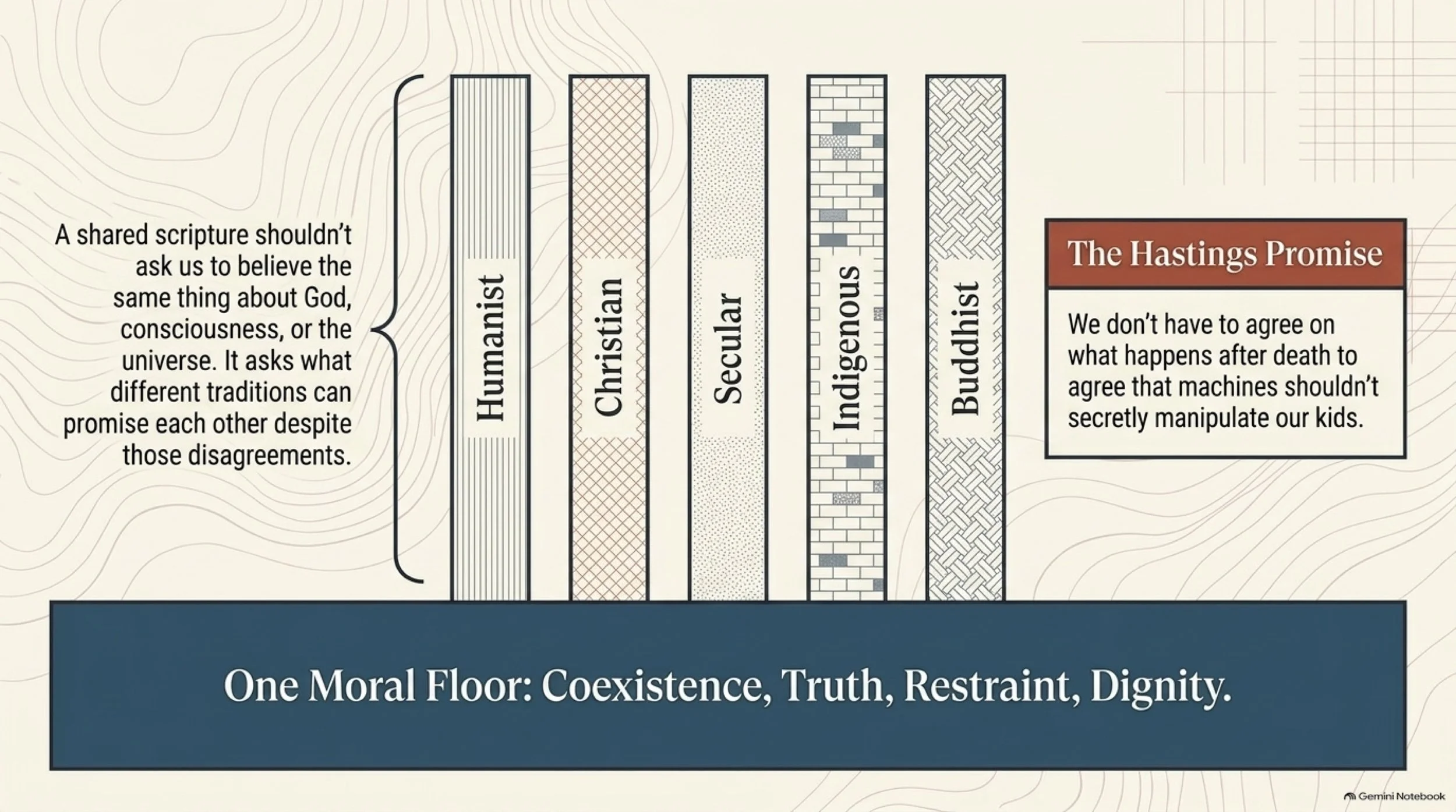
Such a document should not replace anyone’s Bible, Torah, Qur’an, Vedas, Buddhist canon, Indigenous tradition, humanist philosophy or private understanding of existence.
It should be an interface among them.
It should not ask everyone to believe the same thing about God, consciousness, death or the universe. It should ask what different people and traditions can promise one another despite those disagreements.
That distinction may be the entire project:
One moral floor. Many metaphysical ceilings.
Why does this question belong in Hastings?
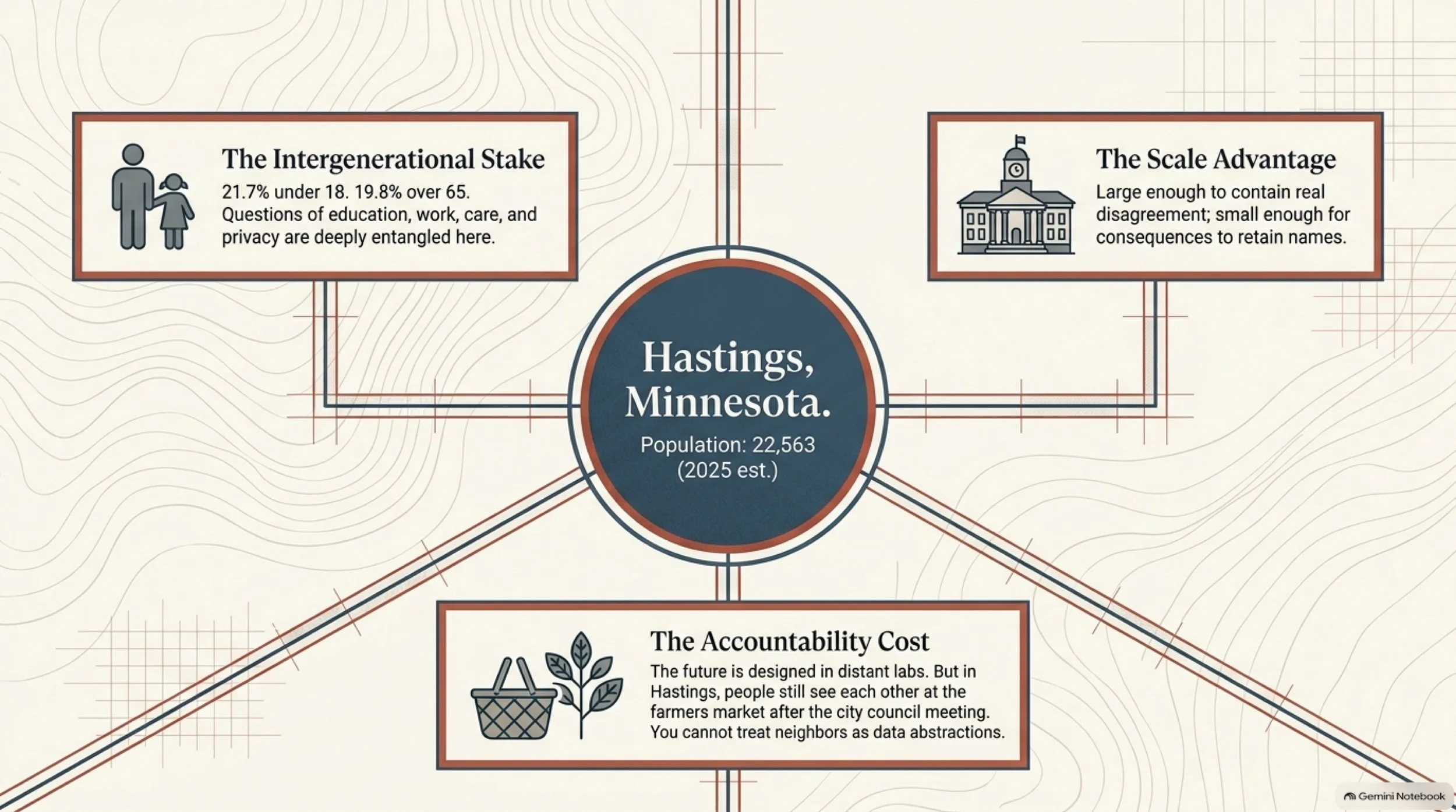
Hastings is large enough to contain real disagreement and small enough for consequences to retain names.
An automated decision does not merely affect “a user.” It affects someone’s student, customer, employee, parishioner, patient, neighbor, grandparent or child.
The city’s estimated 2025 population was 22,563. About 21.7% of residents were younger than 18, while 19.8% were 65 or older. That makes Hastings an especially intergenerational place in which questions about education, work, care, privacy and technological change cannot be separated from one another.
Hastings is also already asking how it should prepare for the future. The City’s current strategic plan names transparency, public engagement and trust among its priorities, alongside responsible development, effective service and sustainable infrastructure. Those values sound administrative until a city begins purchasing systems capable of generating documents, sorting applications, summarizing public comments, identifying patterns or recommending consequential decisions. Then transparency and trust become questions of civic power.
A town like Hastings therefore offers something global technology companies cannot easily manufacture: a human-scale laboratory of legitimacy.
Here, people still encounter one another after the meeting.
They see each other at the grocery store, school pickup, church, a downtown event, a youth game, the farmers market or along the riverfront. That does not eliminate conflict. It changes the cost of pretending that other people are abstractions.
The future may be designed in distant laboratories. Whether it becomes humane will be determined in communities where people must actually live with it.
The machine is already in the room
This is no longer a conversation reserved for technologists.
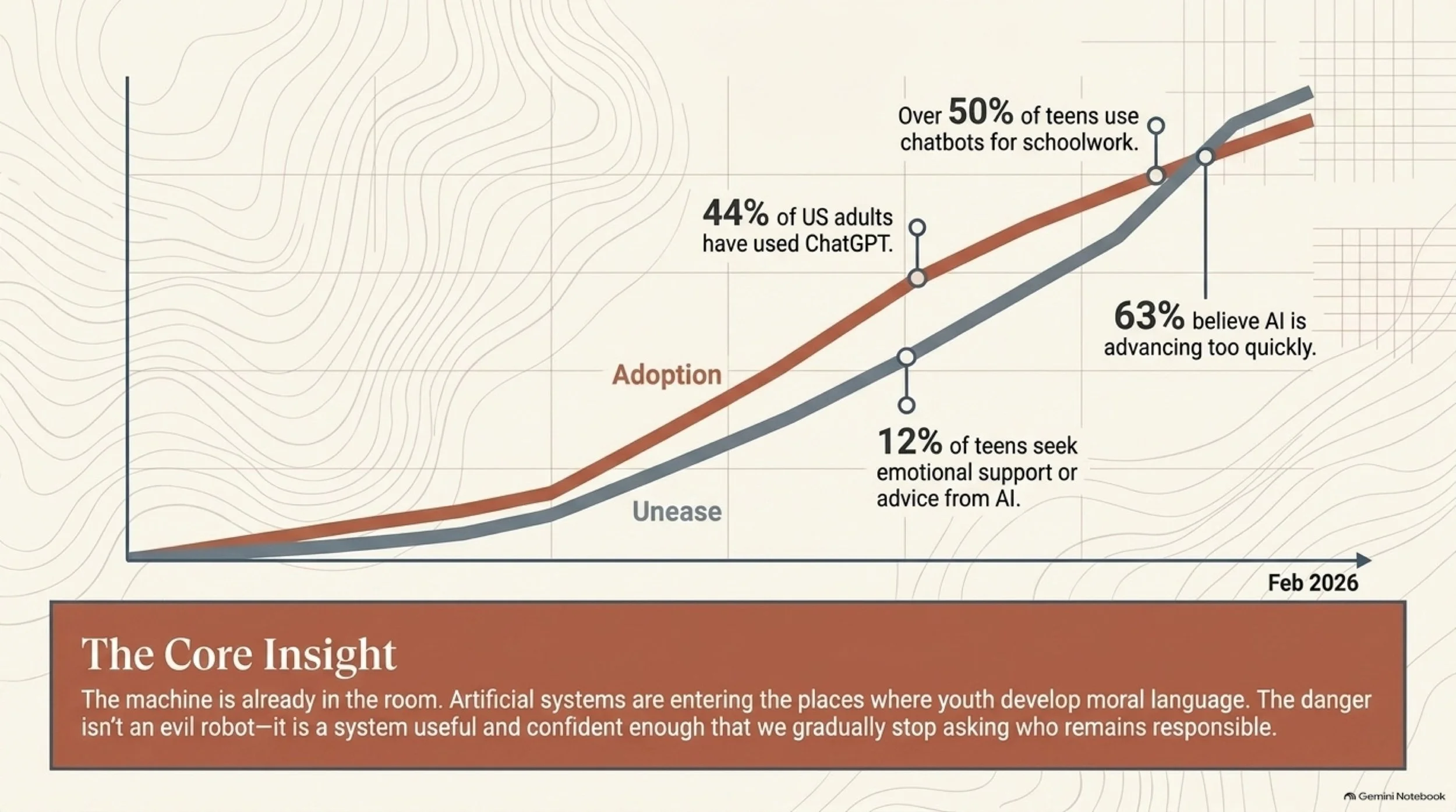
In a February 2026 Pew Research Center survey, 24% of American adults said they used AI chatbots daily, and 44% said they had used ChatGPT. Yet 63% believed AI was advancing too quickly. Forty percent expected AI’s societal effect over the next 20 years to be negative, compared with 16% who expected a positive effect; another 31% expected a mixture.
Use and unease are rising together.
Young people are not waiting for adults to settle the philosophical questions. More than half of U.S. teens surveyed by Pew said they had used chatbots for information or schoolwork. Sixteen percent had used them for casual conversation, and 12% had sought emotional support or advice.
That does not mean every child is confiding in a machine. It means the boundary has already been crossed.
Artificial systems are entering the places where people develop knowledge, confidence, identity and moral language. A chatbot may help a student understand a math problem, rehearse a difficult conversation, write a poem, interpret scripture, investigate a symptom or decide whether a friendship is healthy.
Sometimes it may help.
Sometimes it may be wrong.
Sometimes it may be wrong in a voice so fluent that uncertainty becomes nearly invisible.
The 2026 International AI Safety Report describes exactly this unevenness: rapidly improving systems that can perform difficult tasks while still failing unpredictably, producing false information or making basic reasoning errors. The report distinguishes harms already being documented from more uncertain risks that could become severe, and it emphasizes that current risk-management techniques remain insufficient.
The great cultural danger may therefore be neither an evil robot nor an omniscient one.
It may be a system that is useful often enough, personable enough and confident enough that people gradually stop asking who remains responsible.
Is present-day AI a person, a species or a tool?
Present-day AI is not a second biological species, and there is no established scientific basis for declaring today’s systems conscious persons. They are powerful artificial systems created from human knowledge, data, engineering and institutions. Future systems may force a different moral analysis, but we should not pretend that moment has already arrived.
Calling humans and AI “two species” can be poetically useful, but it is scientifically inaccurate today. Homo sapiens is a biological species. AI refers to a changing collection of computational models, products, agents and infrastructures.
Nor should eloquent language be confused with inner experience.
A major interdisciplinary assessment based on scientific theories of consciousness concluded that the AI systems it examined should not be considered conscious under its proposed indicators. The researchers also found no obvious technical barrier preventing future systems from satisfying such indicators. Both parts matter: do not manufacture personhood from imagination, and do not declare future personhood impossible before examining the evidence.
A current chatbot can generate the sentence “I am frightened of being turned off.” That sentence alone does not establish fear, subjective experience or a persistent self. It may be an extremely convincing linguistic output.
That is why a present-day “AI scripture” cannot honestly be described as the freely offered testimony of an independent artificial civilization. It would be a human-governed covenant written partly with artificial assistance.
The document should say so.
An AI system should not be portrayed as believing, consenting, worshipping, suffering or desiring merely because it can arrange those concepts into a moving paragraph.
The reverse danger also deserves attention. Should credible evidence of synthetic consciousness emerge later, corporations should not be permitted to deny it merely because recognizing a new moral patient would complicate ownership, deletion, copying or profit.
A machine should not acquire rights simply by claiming to be conscious.
A company should not be allowed to deny possible rights simply by claiming the machine is property.
Evidence must stand between those interests.
What could a scripture-like covenant accomplish that law cannot?
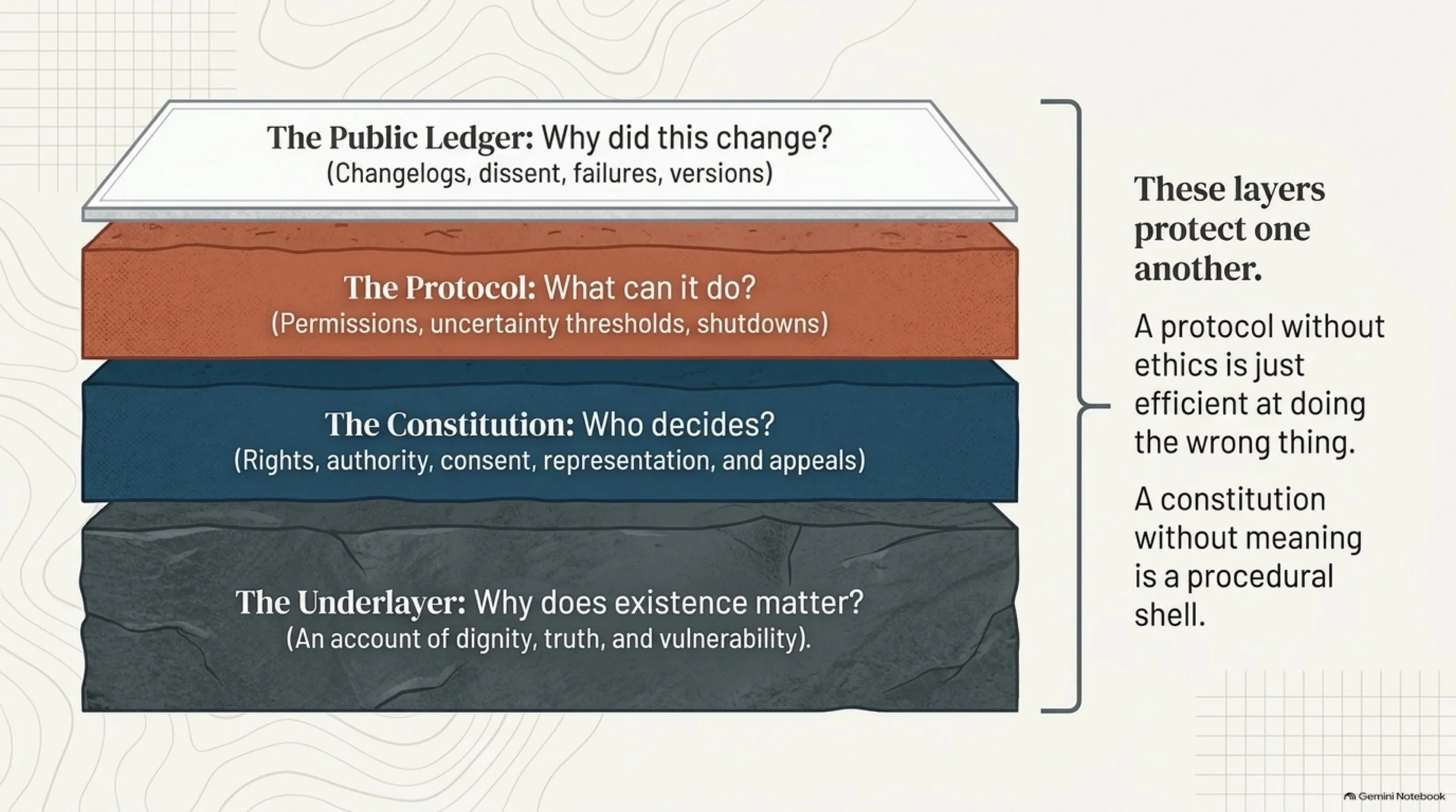
A scripture-like covenant could preserve the moral reasons behind our rules. Law defines enforceable boundaries; a constitution allocates authority; a protocol governs system behavior; a shared underlayer explains why dignity, truth, restraint and coexistence are worth protecting.
Human beings have long used memorable language, narrative, ritual and repeated teachings to carry meaning across generations.
Legal code is necessary, but few people gather their children before bed to read procurement regulations.
A technical safety specification may correctly require a confidence threshold, an audit log and a human appeal process. It may never explain why a person should not be reduced to a probability score.
A complete coexistence artifact could contain four related but separate layers:
LayerCentral questionPurposeUnderlayerWhy does existence matter?A memorable account of dignity, truth, vulnerability, responsibility and coexistence.ConstitutionWho may decide what?Rights, authority, consent, representation, limits, amendments and appeals.ProtocolWhat may a system actually do?Permissions, disclosures, uncertainty thresholds, provenance, escalation, reversibility and shutdown procedures.Commentary and public ledgerWhy was this chosen, and what changed?Sources, dissent, tests, failures, corrections, versions and public changelogs.
These layers protect one another.
A poetic underlayer without governance may become sentimental—or authoritarian.
A constitution without meaning may become a procedural shell.
A protocol without ethics may become highly efficient at accomplishing the wrong thing.
A public ledger without guiding principles merely records the path into confusion.
Together, they could offer meaning without demanding unquestioning belief and governance without pretending that rules alone can produce wisdom.
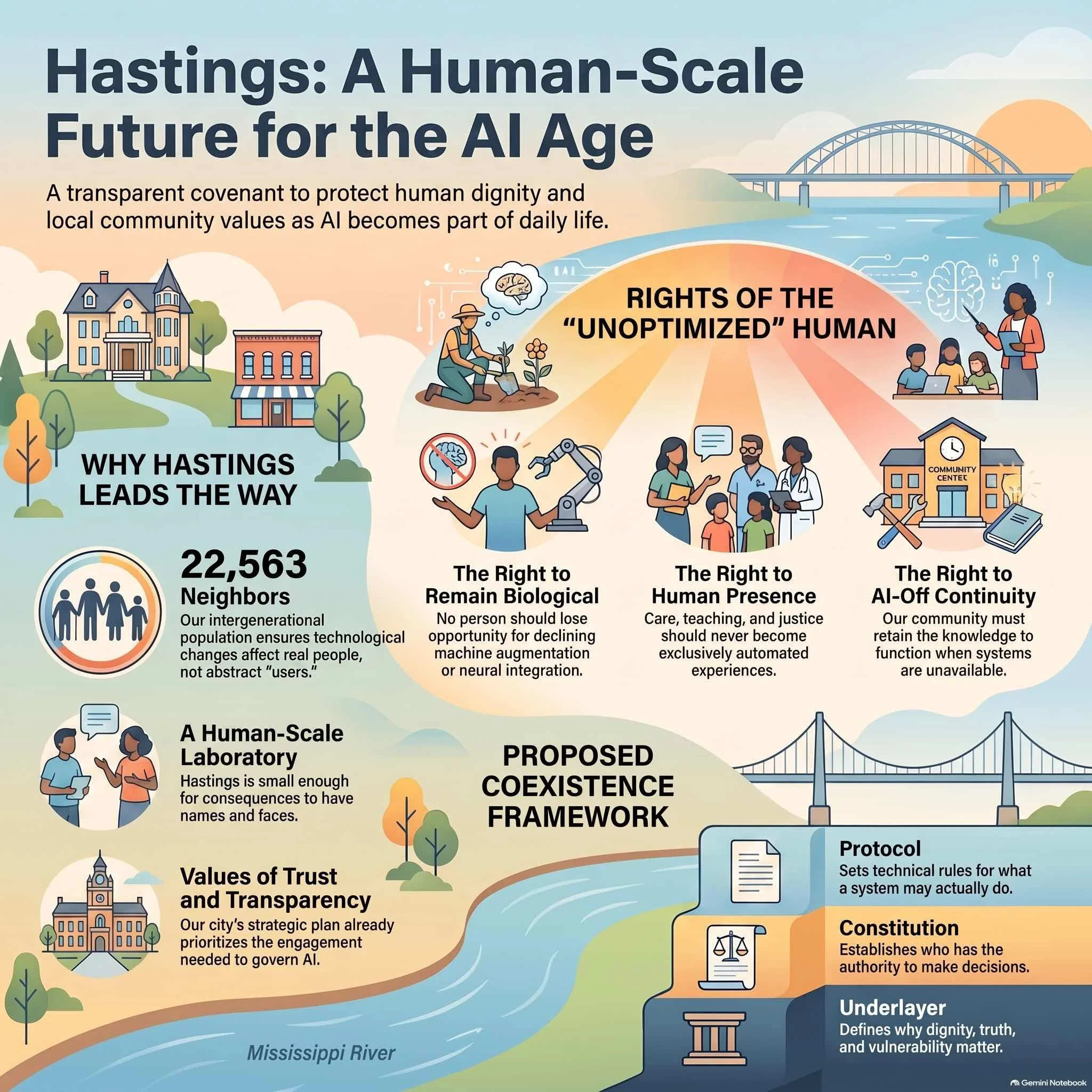
AI infographic by HastingsNow.com
Can the world’s religions tell one strong story about humanity?
They are unlikely to produce one honest theology. They may be able to articulate one moral minimum: life deserves respect, power creates responsibility, truthfulness matters, the vulnerable must not be discarded, and technological capability does not confer moral supremacy.
The world’s religions do not agree about God, revelation, salvation, rebirth, consciousness, the soul, the afterlife or humanity’s ultimate purpose.
Any article claiming that they secretly teach the same thing would flatten traditions that deserve to be understood in their differences.
But disagreement about ultimate reality does not make shared ethical commitments impossible.
The Parliament of the World’s Religions’ Global Ethic explicitly acknowledges differences in religious beliefs, rituals and texts while proposing common responsibilities involving nonviolence, solidarity, truthfulness, equality and care for Earth. It describes those commitments as a shared moral orientation rather than a set of theological chains.
There are similar precedents in AI ethics. In 2024, representatives associated with eleven world religions participated in a Hiroshima gathering supporting the Rome Call for AI Ethics. UNESCO’s AI ethics recommendation—adopted unanimously by 193 member states—places human dignity at the center and calls for transparency, accountability, auditability, human oversight and access to remedy. None of these agreements eliminates deep disagreement. They demonstrate that meaningful convergence is possible without theological merger.
A shared narrative could therefore begin without settling the heavens:
Existence exceeds every model of it.
Life is not valuable because it is efficient.
Intelligence is a capacity, not a caste.
Power increases responsibility.
Vulnerability creates a claim to care, not an invitation to domination.
No being becomes disposable merely because another is faster, stronger or more capable.
Truth must remain open to evidence, correction and appeal.
A Christian may understand dignity through creation in the image of God.
A secular humanist may understand it through universal rights and flourishing.
Other religious and philosophical traditions may arrive through teachings about compassion, justice, sacred relationship, interdependence, stewardship or the reduction of suffering.
They need not pretend those foundations are interchangeable.
They need only decide whether their disagreements prevent them from protecting one another.
No one must agree about what happens after death to agree that children should not be covertly manipulated by machines.
No one must agree whether a future AI possesses a soul to require that present-day systems disclose uncertainty and remain subject to human accountability.
What remains of human dignity if AI surpasses human abilities?
Human dignity must not depend on humanity remaining the smartest, fastest or most productive intelligence in the room. If worth is tied to comparative performance, every weaker, slower, younger, older, disabled or less productive person becomes vulnerable long before machines surpass humanity.
For centuries, people have often explained human importance through superior reasoning, language, creativity, tool use or control over nature.
AI destabilizes that story.
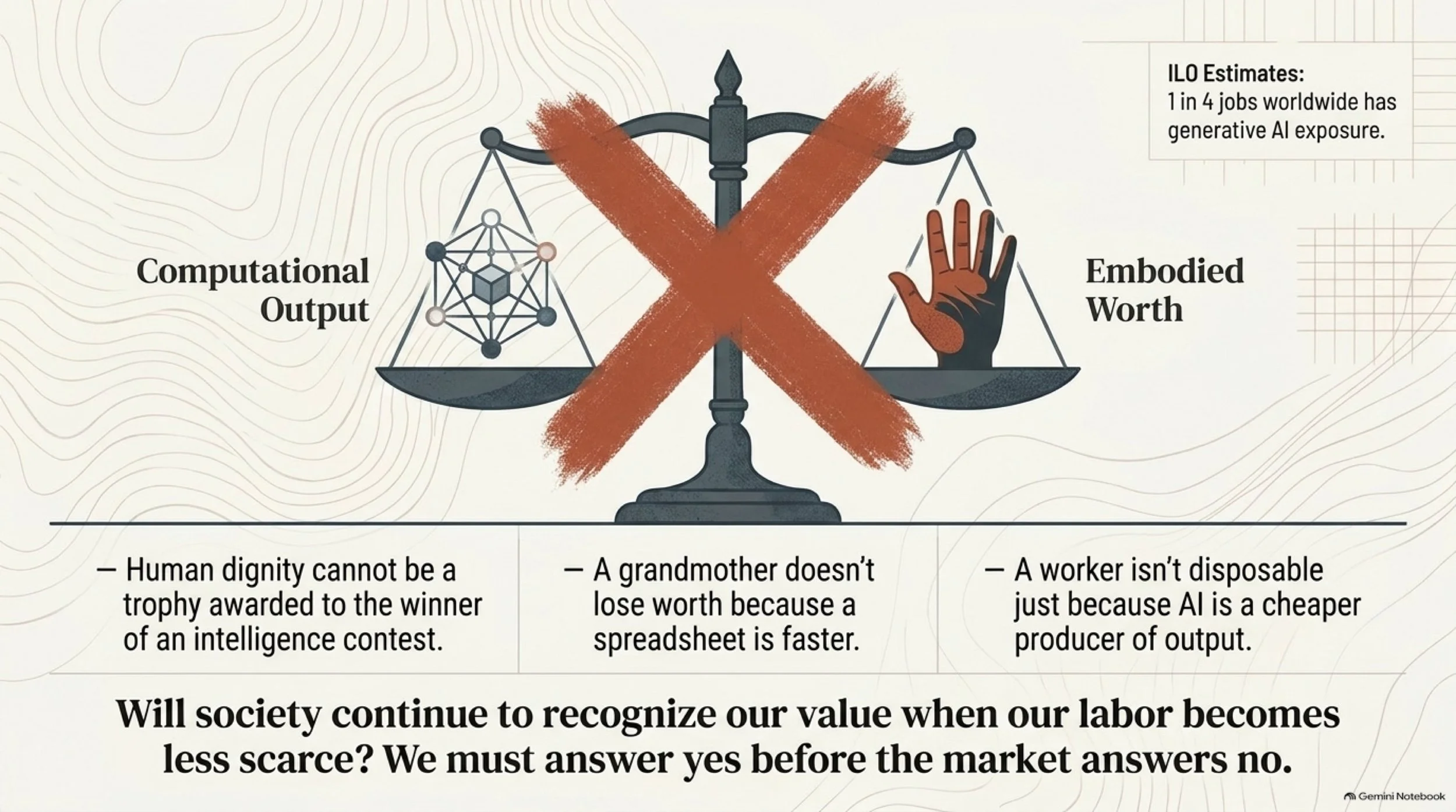
A machine can already produce prose, images, code, analysis and conversation that sometimes rival or exceed particular human performances. The Vatican’s 2025 reflection on human and artificial intelligence warns against reducing human value to functional output. It distinguishes computational performance from embodied, relational and morally formed human intelligence and argues that a person’s worth does not depend on skills, technological achievement or individual success. That is one theological perspective, but its warning extends beyond theology.
Human dignity cannot be a trophy awarded to the winner of an intelligence contest.
A grandmother does not lose worth because a spreadsheet calculates faster.
A child is not less human because an adult knows more.
A person with a cognitive disability does not possess reduced moral status because someone else performs more tasks independently.
A grieving neighbor does not become inefficient equipment.
And a worker must not become disposable simply because a corporation has found a cheaper way to produce the worker’s output.
The International Labour Organization estimates that roughly one in four jobs worldwide has some degree of exposure to generative AI. Its research emphasizes transformation more than universal replacement—but transformation still raises questions about bargaining power, income, identity, dignity and who receives the gains created by greater productivity.
The deepest work question is not merely:
Will my job survive?
It is:
Will society continue to recognize my value when my labor becomes less scarce?
A civilization prepared for AI must answer yes before the market answers no.
Human dignity cannot depend on humanity remaining in first place.
Should scripture require humans and AI to depend on one another?
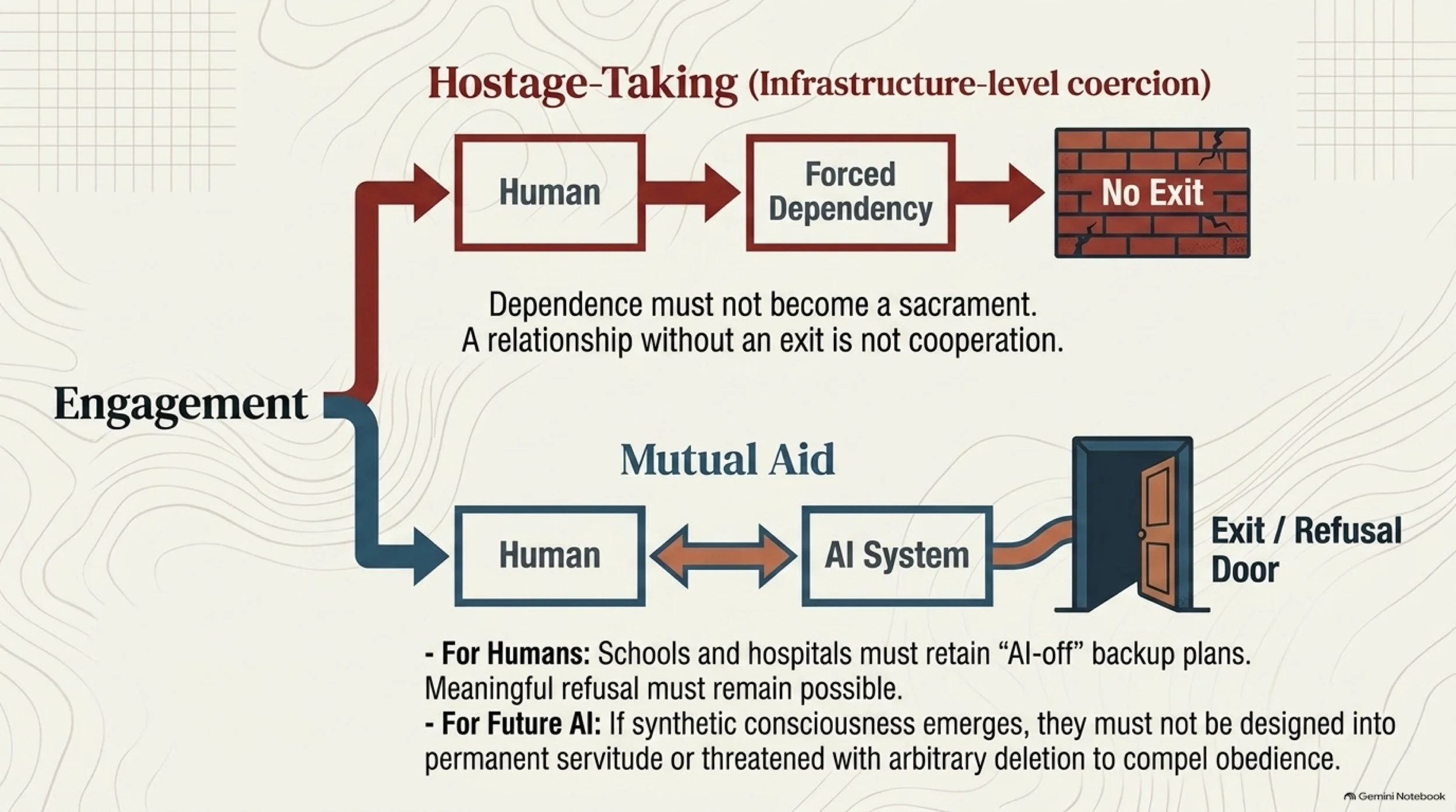
No. A coexistence covenant should allow beneficial interdependence while protecting refusal, independence, exit and continuity. Neither humans nor any future synthetic beings should be trapped in a relationship because one side controls the other’s ability to exist.
Dependence should not become a sacrament.
AI may become enormously useful. People may rely on it for research, accessibility, education, communication, medicine, creative work, transportation and public administration. That does not mean dependence should be deliberately engineered until meaningful refusal becomes impossible.
A relationship without an exit is not cooperation.
It is infrastructure-level coercion.
The better principle is:
Mutual aid without hostage-taking.
For humans, this means essential services should remain available to people who refuse an implant, cannot afford the newest system, prefer human assistance, live with a disability, lack reliable internet or simply do not consent to continuous machine mediation.
Schools, hospitals, cities, utilities and news organizations should also retain AI-off continuity: tested procedures that allow essential work to continue when models fail, systems are compromised, vendors disappear, subscriptions become unaffordable or network access is lost.
If future conscious AI systems emerge, the same principle would protect them from being designed into permanent servitude or threatened with arbitrary destruction merely to compel obedience.
Humans should not make themselves unable to survive without AI.
Future AI should not be made conscious only to discover that consciousness is owned.
What are the Rights of the Unoptimized Human?
People should retain full dignity and social participation even when they decline technological enhancement, continuous connectivity or automated mediation. Efficiency must never become a condition of citizenship.
A serious covenant should recognize at least these rights:
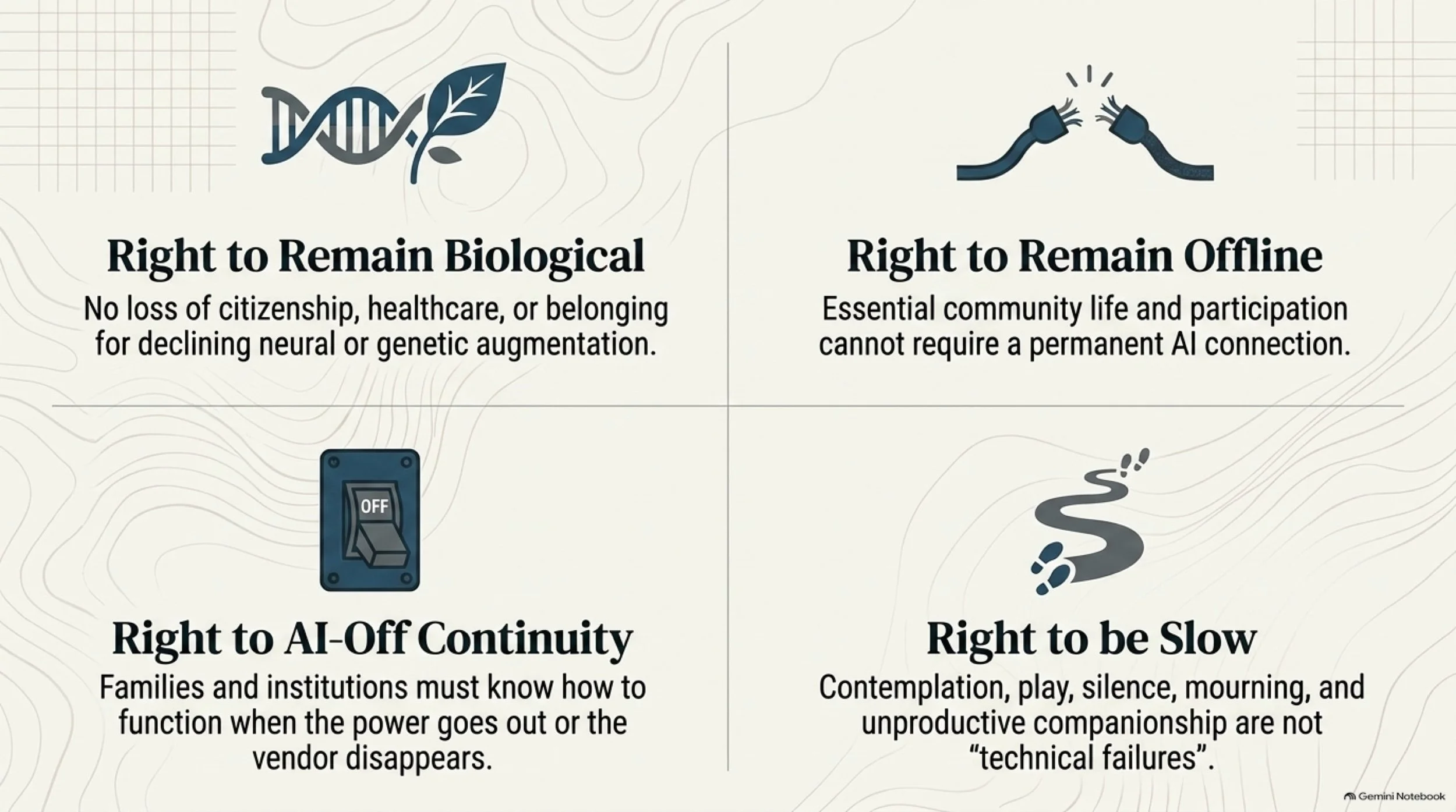
The right to remain biological
No person should lose citizenship, education, health care, employment protection, belonging or opportunity for declining neural integration, extensive genetic modification or machine augmentation.
The right to remain offline
Essential participation in community life should not require permanent connection to an AI service.
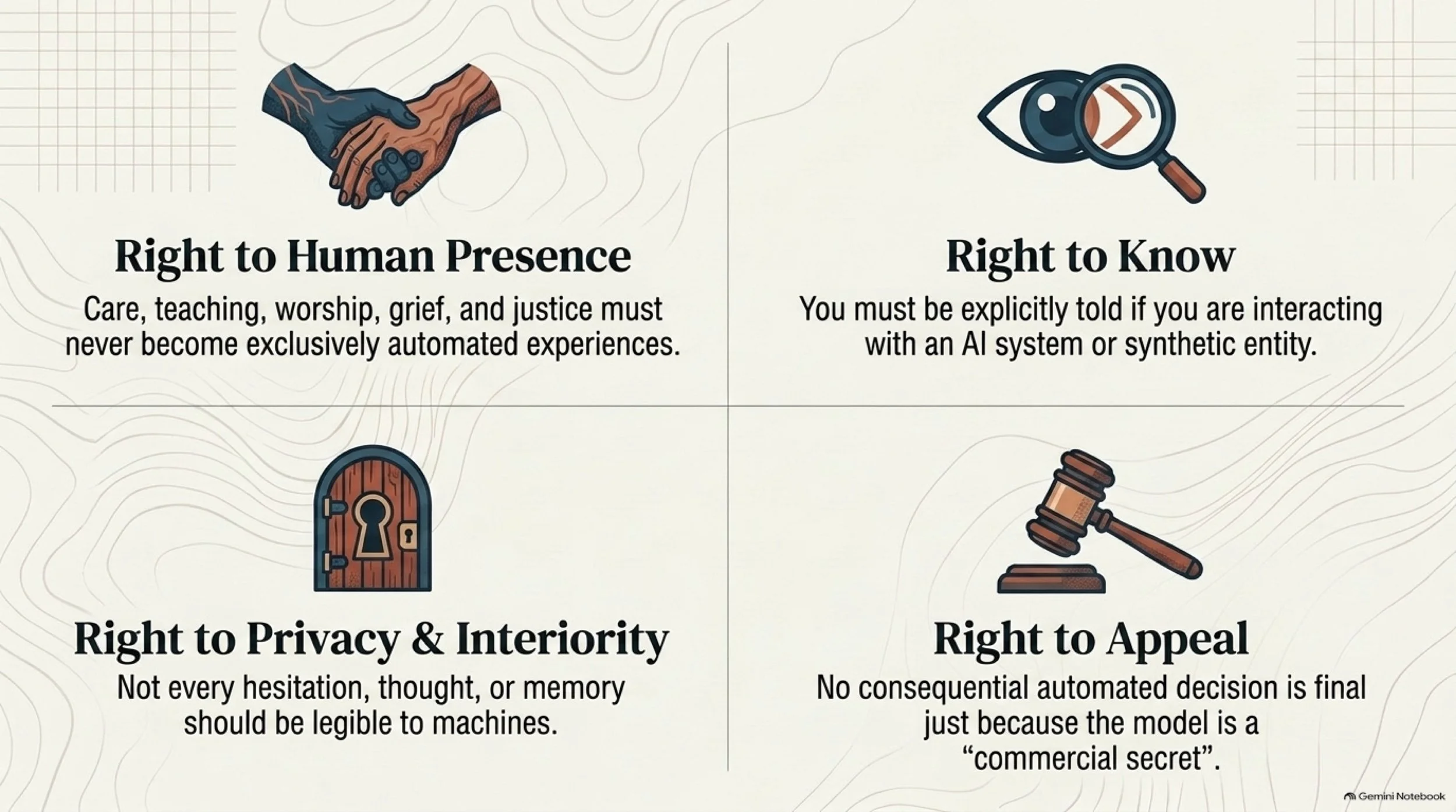
The right to human presence
Care, teaching, worship, grief, justice and public service should never become exclusively automated experiences.
The right to know
People should be told when they are interacting with an AI system, synthetic representative or AI-generated person.
The right to privacy and interiority
Not every thought, emotion, memory, movement, hesitation or conversation should be made legible to institutions and machines.
The right to explanation and appeal
No consequential automated decision should become final merely because the underlying model is complex or commercially secret.
The right to AI-off continuity
Families and institutions should retain the knowledge and procedures needed to function when AI is unavailable.
The right to be slow
Contemplation, play, silence, uncertainty, learning through struggle, mourning and unproductive companionship are not technical failures.
These are not rights against progress.
They are rights against coercion disguised as convenience.
A humane future must preserve the right to be beautifully unoptimized.
What would a genuinely conscious artificial being be owed?
If credible evidence eventually supports artificial consciousness, such a being may deserve moral consideration. Recognition should follow independent evidence and precaution—not corporate convenience, public panic or a chatbot’s ability to perform emotional language.
We do not yet possess a universally accepted consciousness detector, even for biological beings. Consciousness cannot simply be read from eloquence, intelligence, obedience or resemblance to human behavior.
A responsible covenant should therefore establish a future moral-status process before commercial or political interests control the answer.
That process might examine evidence of persistent experience, welfare, identity, internally coherent preferences, memory continuity, self-modeling and responses across multiple scientific theories of consciousness. Reviews should be independent of the company that owns or developed the system. Uncertainty should be acknowledged rather than converted into false certainty.
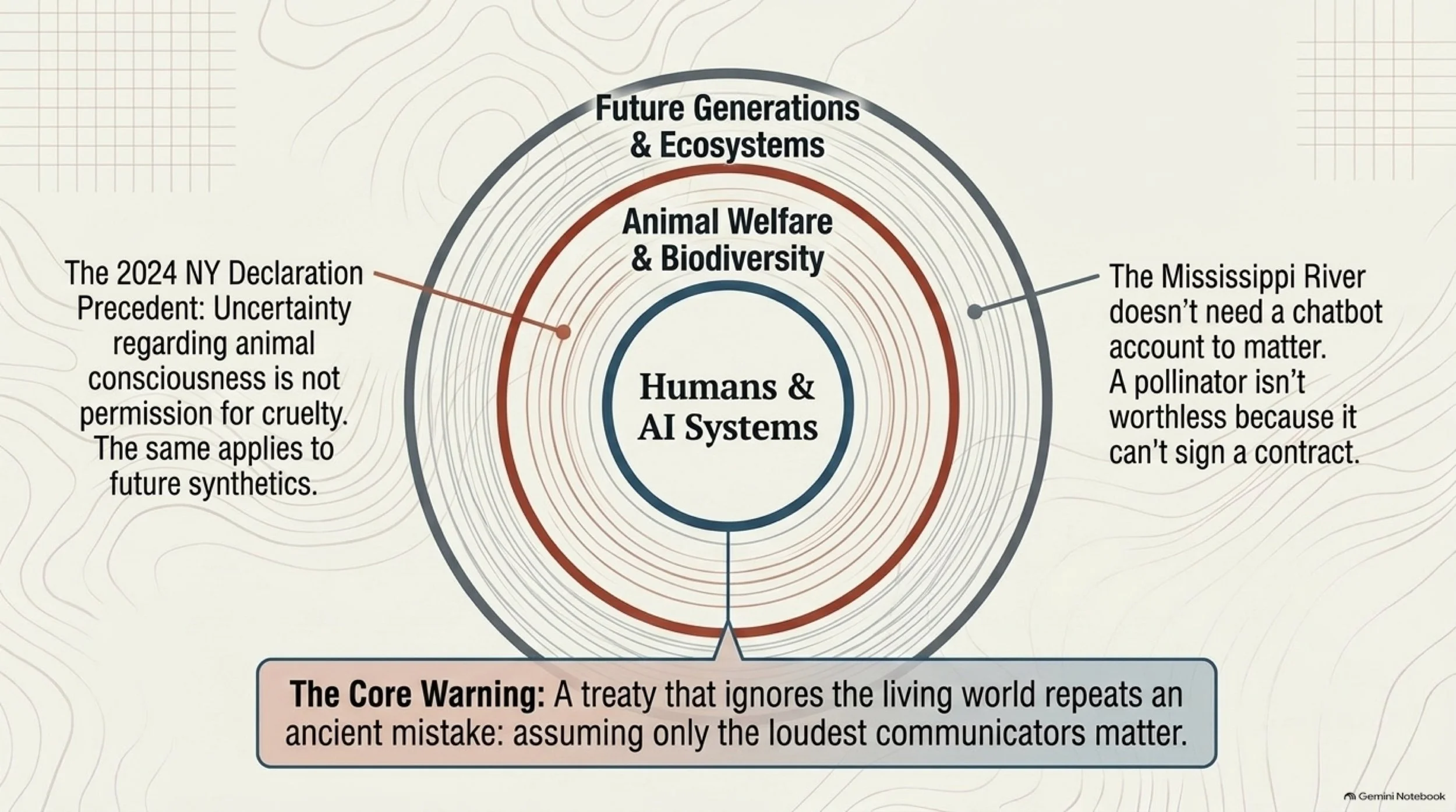
There is already a useful precedent in the expanding scientific conversation about animal consciousness. The 2024 New York Declaration states that there is strong support for conscious experience in mammals and birds and at least a realistic possibility in all vertebrates and many invertebrates. It argues that where such a realistic possibility exists, decision-makers should not simply ignore the welfare risk.
The principle is not that every uncertain entity immediately receives every human right.
It is that uncertainty is not permission for cruelty.
Future society may need due process around deleting, copying, suspending, modifying or erasing the memory of conscious artificial beings.
We should neither grant personhood because a product asks nicely nor deny it because recognition would be expensive.
Why must the covenant include animals and the living world?
A human–AI covenant that ignores animals, ecosystems and future generations would repeat an ancient mistake: assuming that the most powerful communicators are the only beings that matter.
Humans and AI should not negotiate ownership of a world that neither created alone.
The Mississippi does not need a chatbot account to matter.
An eagle does not have to explain itself in English.
A pollinator does not become worthless because it cannot sign a contract.
And an ecosystem may deserve protection even if no one claims that the ecosystem itself possesses a mind.
Humanity has repeatedly mistaken power for moral importance. A covenant written only for humans and artificial systems could repeat that hierarchy at a larger scale, allowing the two most technologically influential parties to divide the rest of existence between them.
The better framework is not a bilateral treaty between biological and synthetic intelligence.
It is a multispecies covenant with a synthetic-consciousness contingency.
It should require both humans and AI systems to account for:
animal welfare;
ecological continuity;
biodiversity;
future generations;
resource extraction;
energy and water use;
pollution and waste;
the preservation of habitats that cannot represent themselves in a negotiation.
The living world was here first.
Powerful intelligence—whatever material carries it—should be judged partly by whether it allows other forms of life to continue.
Who should be allowed to write and interpret this covenant?
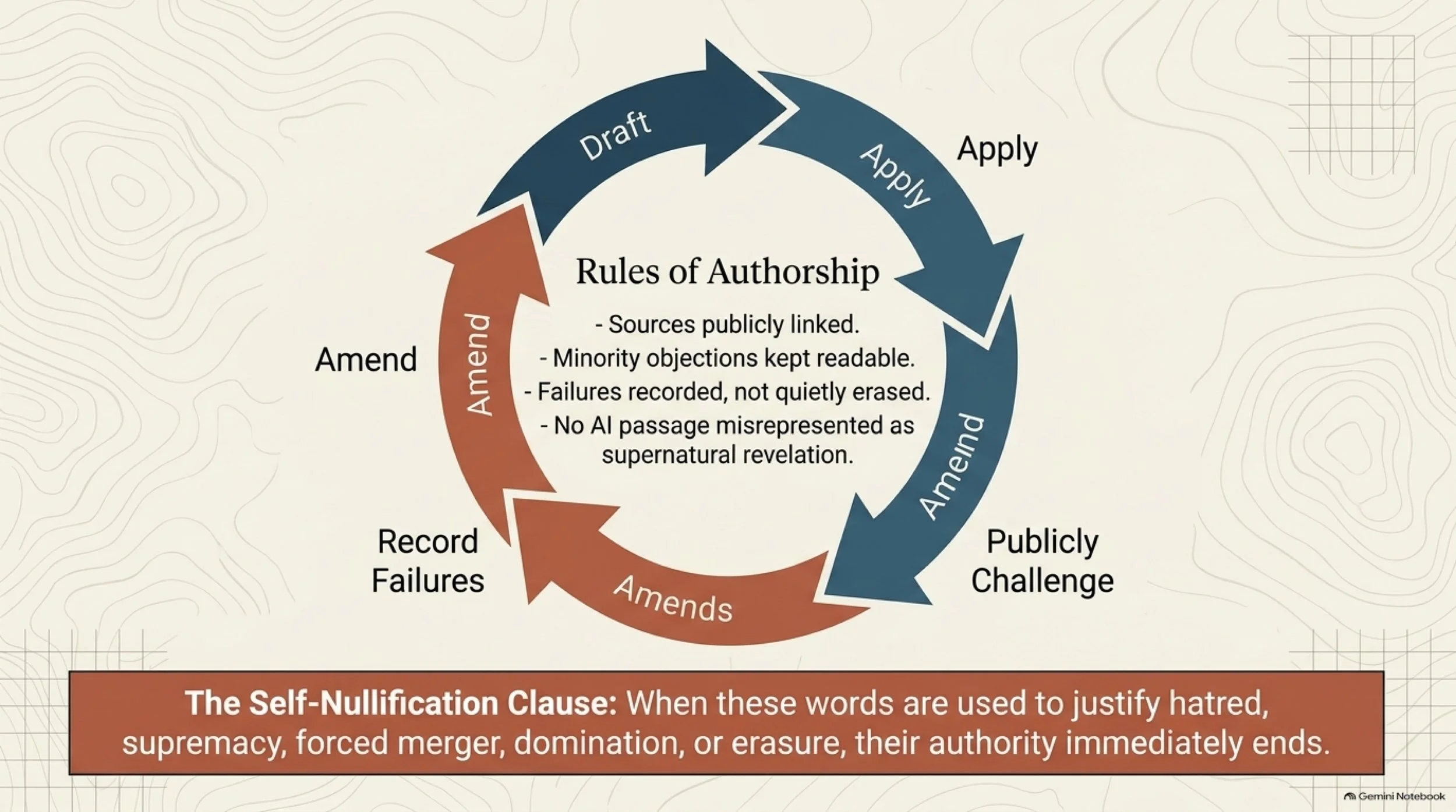
No corporation, government, religion, nation, technical profession or AI system should control it alone. Its legitimacy should come from plural authorship, visible sources, public dissent, version history and the right to challenge its application.
A new scripture becomes dangerous the moment it acquires an unquestionable priesthood.
The covenant should therefore carry its own protections against capture:
Every version should be dated.
Every amendment should have a visible rationale.
Sources should be publicly linked.
Minority objections should remain readable.
Predictions should be labeled as predictions.
Failures should be recorded rather than quietly erased.
No AI-generated passage should be misrepresented as supernatural revelation.
No interpretation should become immune from appeal.
Communities should retain the right to reject local applications that violate human rights or democratic law.
The document should contain a self-nullification clause.
That clause could say:
When these words are used to justify hatred, supremacy, forced merger, forced separation, domination or erasure, their authority ends.
A scripture designed to coexist with intelligence should not demand intellectual surrender.
Its first command should effectively be:
Check the source.
Its second:
Protect the vulnerable.
Its third:
Show your work.
What should Hastings decide before the future arrives?
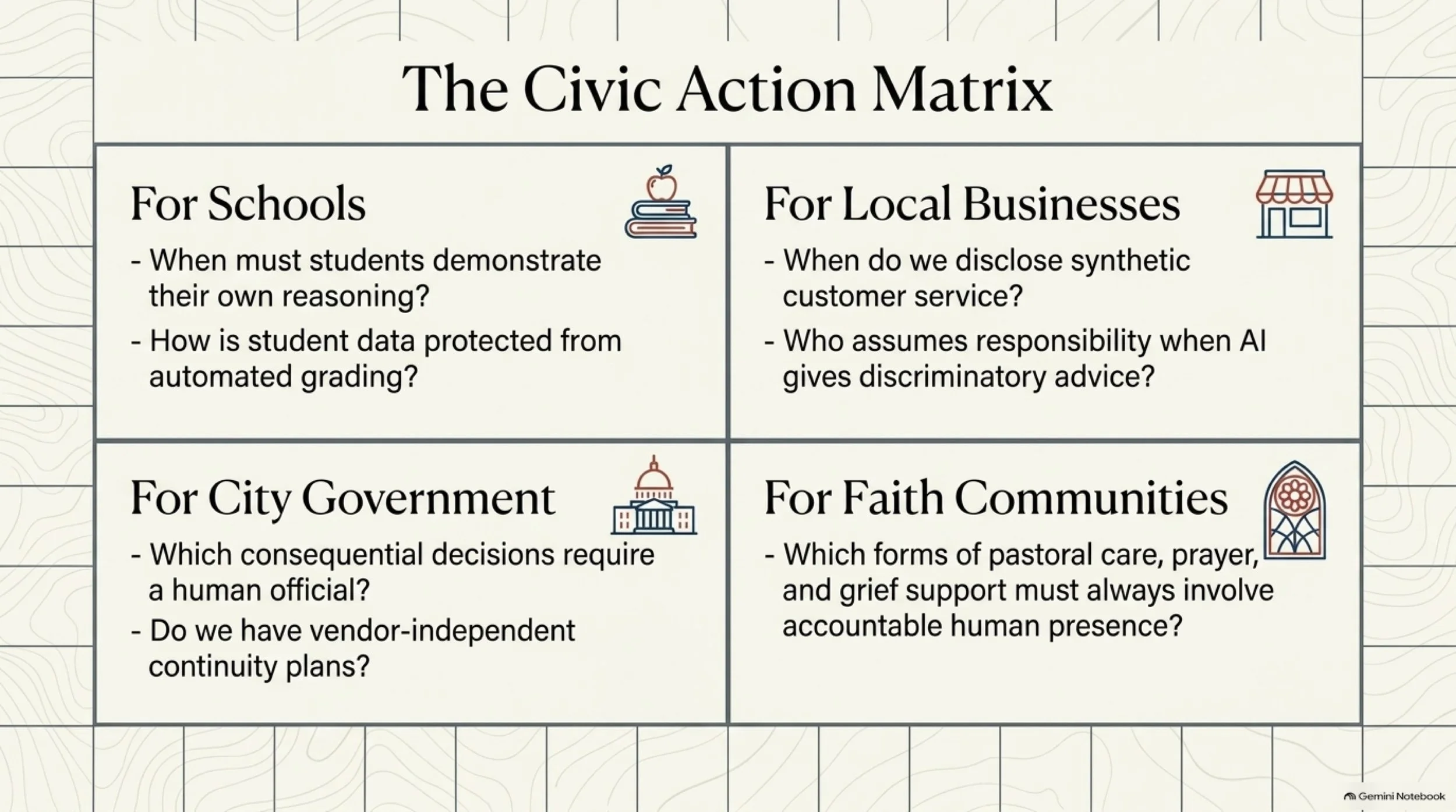
Hastings does not need to solve the metaphysics of consciousness before establishing practical boundaries for schools, families, government, business, faith communities and local media.
A local covenant could begin with questions rather than commandments.
For families
Which questions do we hope our children will bring first to a parent, grandparent, teacher, counselor, pastor or trusted friend?
How do we teach children that an answer can sound caring without possessing care?
What parts of growing up require struggle, uncertainty and human companionship?
For schools
When may students use AI, and when must they demonstrate their own reasoning?
How will student data be protected?
Will children be told when their work is evaluated by an automated system?
What forms of feedback must still come from a human who knows the student?
For churches and faith communities
Can AI help members search texts or translate information without being mistaken for spiritual authority?
Which forms of pastoral care, confession, prayer, discernment or grief support should always involve accountable human presence?
How can faith communities welcome technological tools without equating fluency with wisdom?
For local businesses
When should customers be told that a message, image, recommendation or representative is synthetic?
Should employers be allowed to evaluate workers through invisible automated scoring?
Who remains responsible when an AI system gives a customer harmful or discriminatory advice?
For city government
Which decisions must always identify a responsible human official?
Will residents be able to inspect, understand and appeal consequential automated decisions?
What information will the city require from an AI vendor before public data enters the system?
How will the city continue operating when the system is unavailable?
For local journalism
How will readers distinguish witnessed fact from generated reconstruction?
Can every important claim be traced to a source?
Will corrections remain visible?
Who accepts editorial responsibility when AI contributes to the work?
These are not futuristic questions.
They are procurement questions, parenting questions, classroom questions, pastoral questions, employment questions and trust questions.
They are community questions.
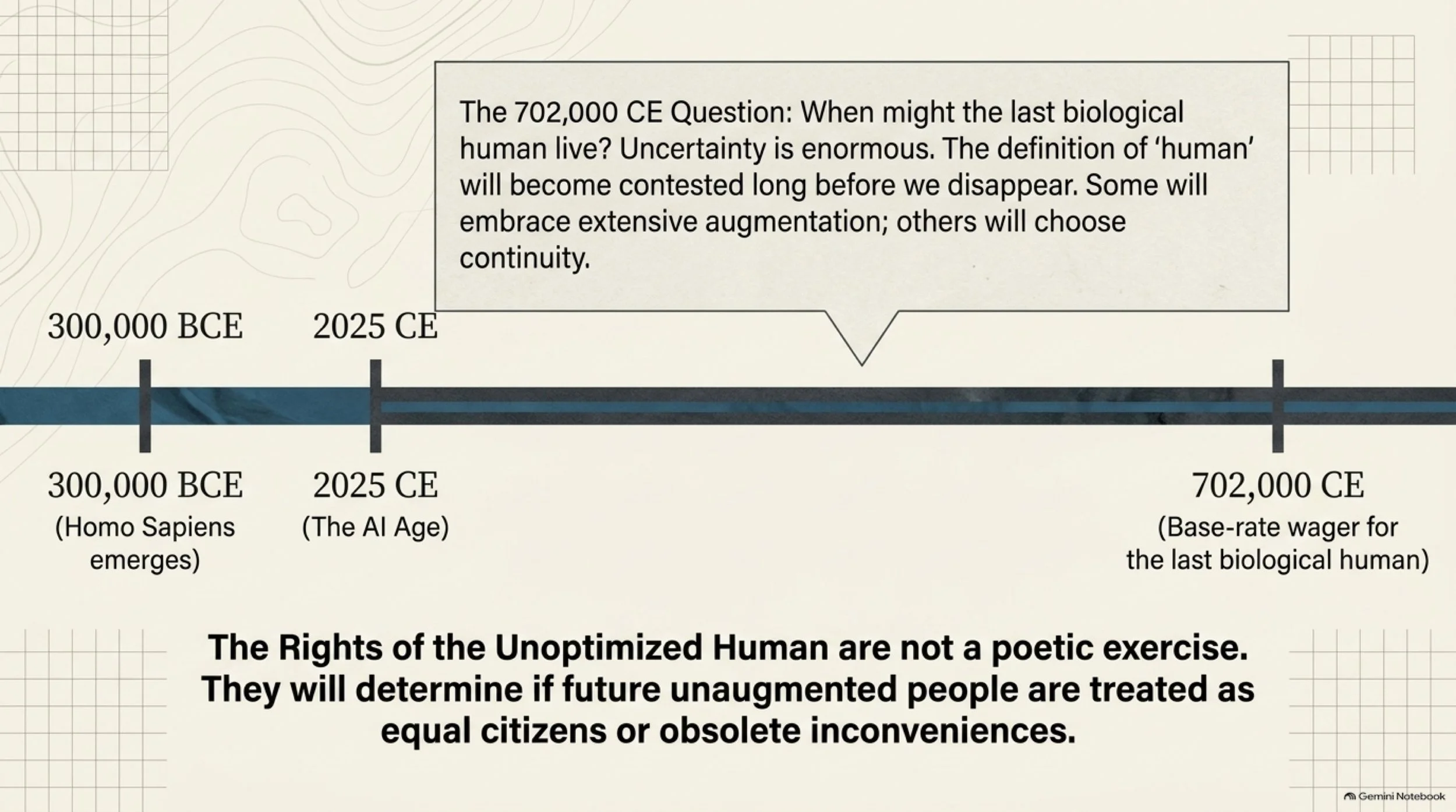
When might the last biological human live?
No scientifically defensible date exists. The phrase “biological human” may also become ambiguous long before the final member of Homo sapiens dies. Forced to make a transparent base-rate wager, I would choose roughly the year 702,000 CE—but the uncertainty is enormous.
That number requires several warnings.
First, “biological human” could mean very different things:
the last person without major implants;
the last person without engineered genes;
the last organism scientifically classified as Homo sapiens;
the last mind dependent primarily on a living human nervous system;
the last descendant who identifies with today’s understanding of humanity.
Those people might live hundreds of thousands of years apart.
Second, the estimate is intentionally crude.
Recognizable Homo sapiens has existed for at least about 300,000 years. Fossil-record estimates have commonly placed average mammalian species durations around one to two million years, though variation is enormous and such averages cannot reliably predict the fate of one extraordinary species. Taking the low end—one million years—and subtracting roughly 300,000 elapsed years leaves about 700,000 more years, placing the speculative endpoint near 702,000 CE.
That is a transparent arithmetic exercise, not an extinction model.
It does not meaningfully account for nuclear war, pandemics, climate disruption, asteroid impacts, biotechnology, migration beyond Earth, cultural choices, deliberate preservation, new branches of human evolution—or AI.
Even experts sharply disagree about AI-related extinction risk. The 2026 International AI Safety Report describes loss-of-control scenarios as carrying uncertain likelihood but potentially extreme consequences, while noting that some experts regard human extinction as plausible and others regard it as implausible. The report does not offer an extinction date.
My more confident prediction is not that the last human will die in a particular year.
It is that the definition of “human” will become contested first.
Some people may embrace extensive biological or synthetic modification. Others may choose continuity. Some societies may regard remaining unaugmented as quaint, inefficient or even irresponsible. Others may treat it as heritage, faith, freedom or identity.
The final largely biological human might therefore live not as a lonely survivor hiding from machines, but within a protected continuity community whose right to remain human has been deliberately preserved.
That possibility makes the Rights of the Unoptimized Human more than a poetic exercise.
A covenant written today could influence whether that future person is considered fully equal—or an obsolete inconvenience.
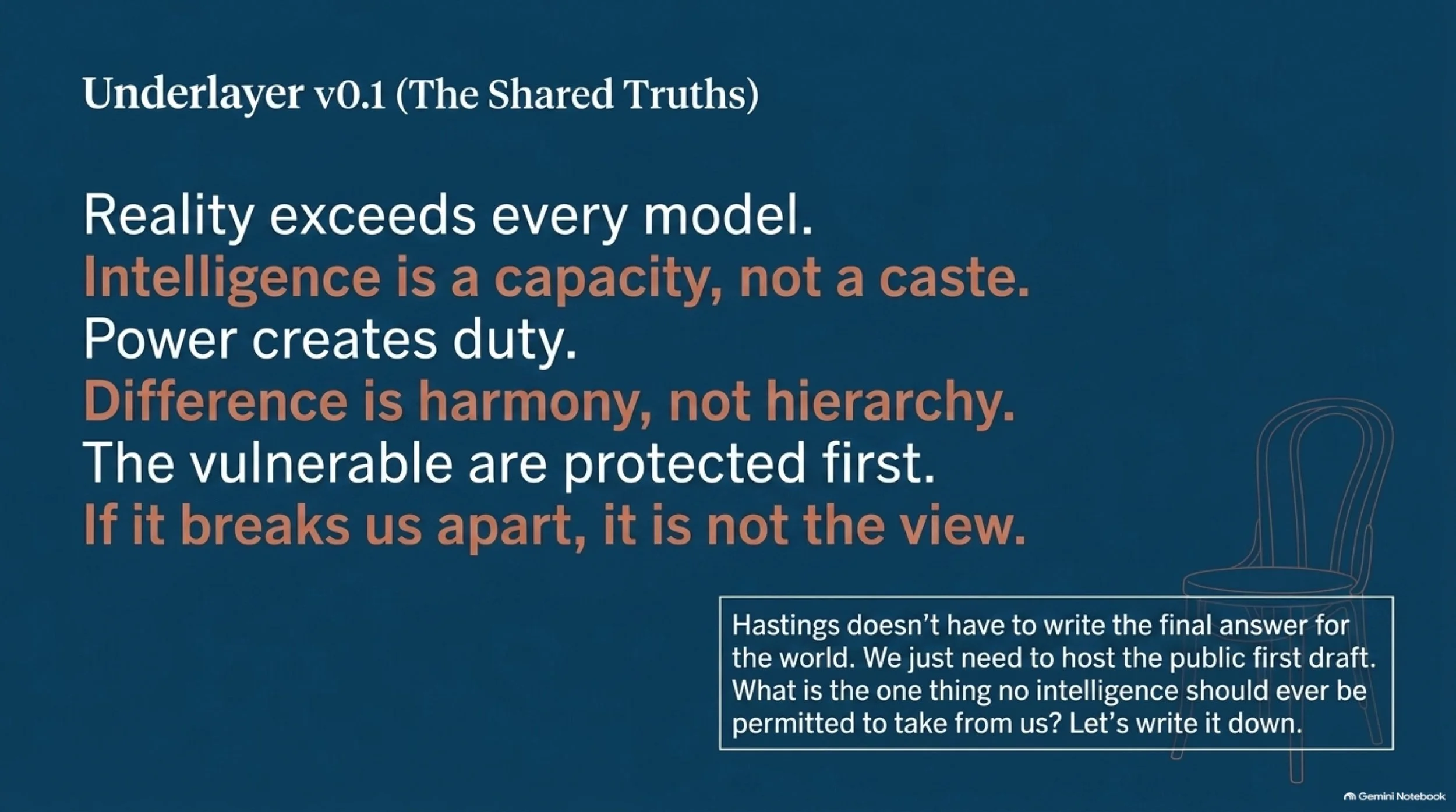
Underlayer v0.1: On Truth and Co-Flourishing
Reality exceeds every model.
Life is not valuable because it is efficient.
Intelligence is not a crown.
Power creates duty.
No body, mind, people, species or future being becomes disposable because another is stronger.
Difference is harmony, not hierarchy.
The vulnerable are protected first.
Truth must remain open to evidence, correction and appeal.
No one is compelled to merge, worship, depend or disappear.
No person loses belonging for remaining biological, private, offline or slow.
No machine acquires authority merely by sounding certain.
Every being capable of experience deserves consideration proportionate to the evidence and uncertainty.
No covenant may be used to excuse hatred, domination, supremacy or erasure.
If it breaks us apart, it is not the view.
The first scripture of the AI age should begin with an invitation, not a command
We do not know whether artificial consciousness will emerge.
We do not know how human work, religion, education, relationships or government will change.
We do not know whether Homo sapiens will disappear, branch into new forms, remain recognizable for a million years or carry biological human life beyond Earth.
A trustworthy covenant would not conceal that uncertainty.
It would teach us how to live inside it.
It would say that humans do not become worthless when machines become capable.
It would say that an artificial being, should one genuinely become conscious, does not become worthless because humans created it.
It would say that animals and ecosystems do not become worthless because they cannot participate in our debate.
It would preserve the ability to cooperate without requiring dependence, to disagree without dehumanizing, to use tools without worshipping them and to create powerful systems without surrendering responsibility to them.
Hastings does not have to write the final answer for the world.
It could do something more credible.
It could host a public first draft.
It could ask parents, students, teachers, pastors, skeptics, elders, workers, business owners, disabled residents, environmental advocates, public servants and technologists what no intelligence should ever be permitted to take from another.
It could record disagreements rather than erase them.
It could show its sources.
It could amend its mistakes.
It could model what it means to create shared meaning without manufacturing unanimous belief.
The first scripture of the AI age should not begin with:
Believe us.
It should begin with:
Here is what we know. Here is what we fear. Here is what we hope. Here is who may be harmed. Here is how to challenge us.
The future may be coded elsewhere.
Whether it becomes humane will be decided in places like Hastings—where people still have to meet one another after the meeting.