
Child Care in Hastings Minnesota

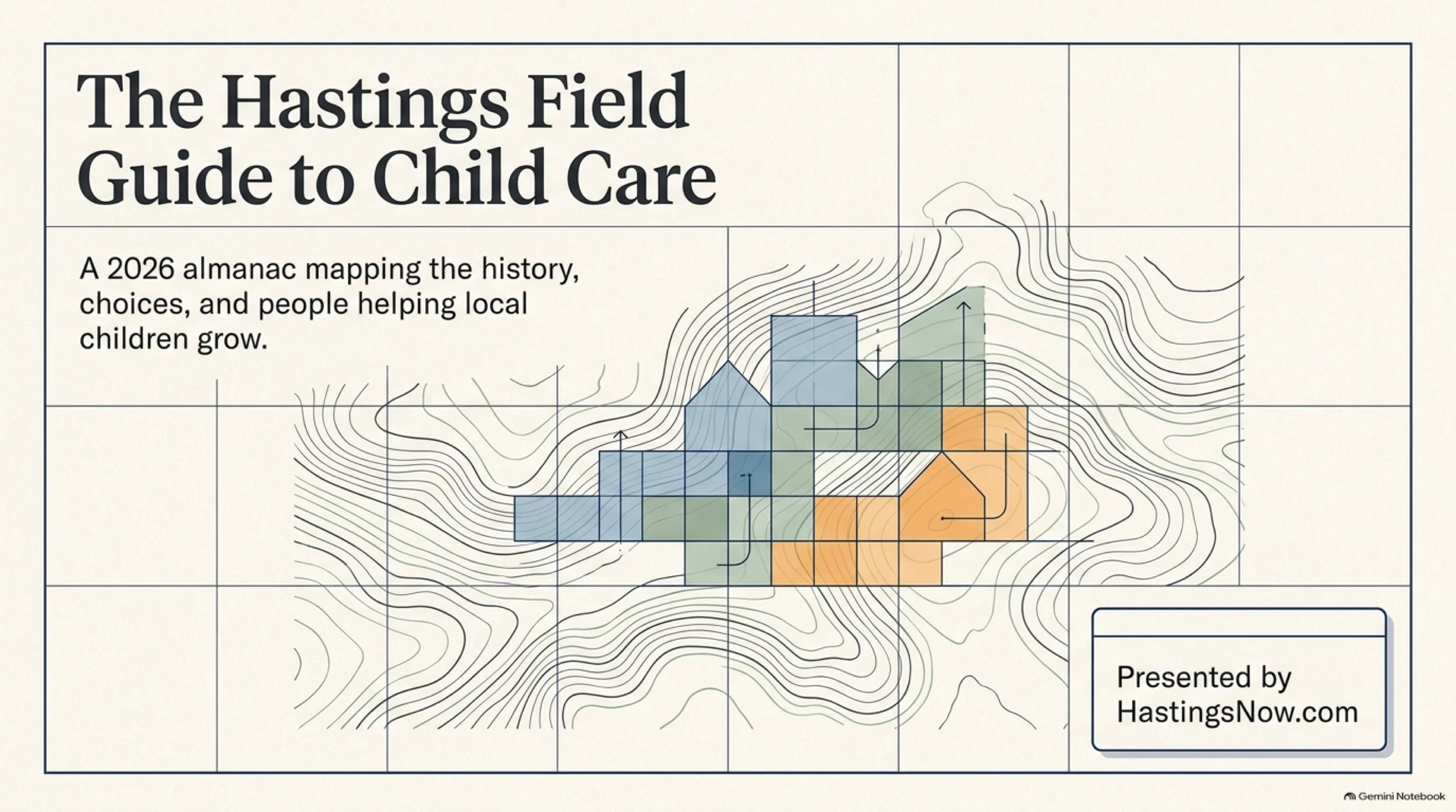
Helping Hastings families find care where children feel welcomed and known. AI-generated illustration; bridge backdrop inspired by an original HastingsNow.com photograph.
A 2026 guide to the history, the choices, and the people helping children grow
Information checked September 22, 2026. School-year offerings below refer to 2026–27 unless otherwise noted.
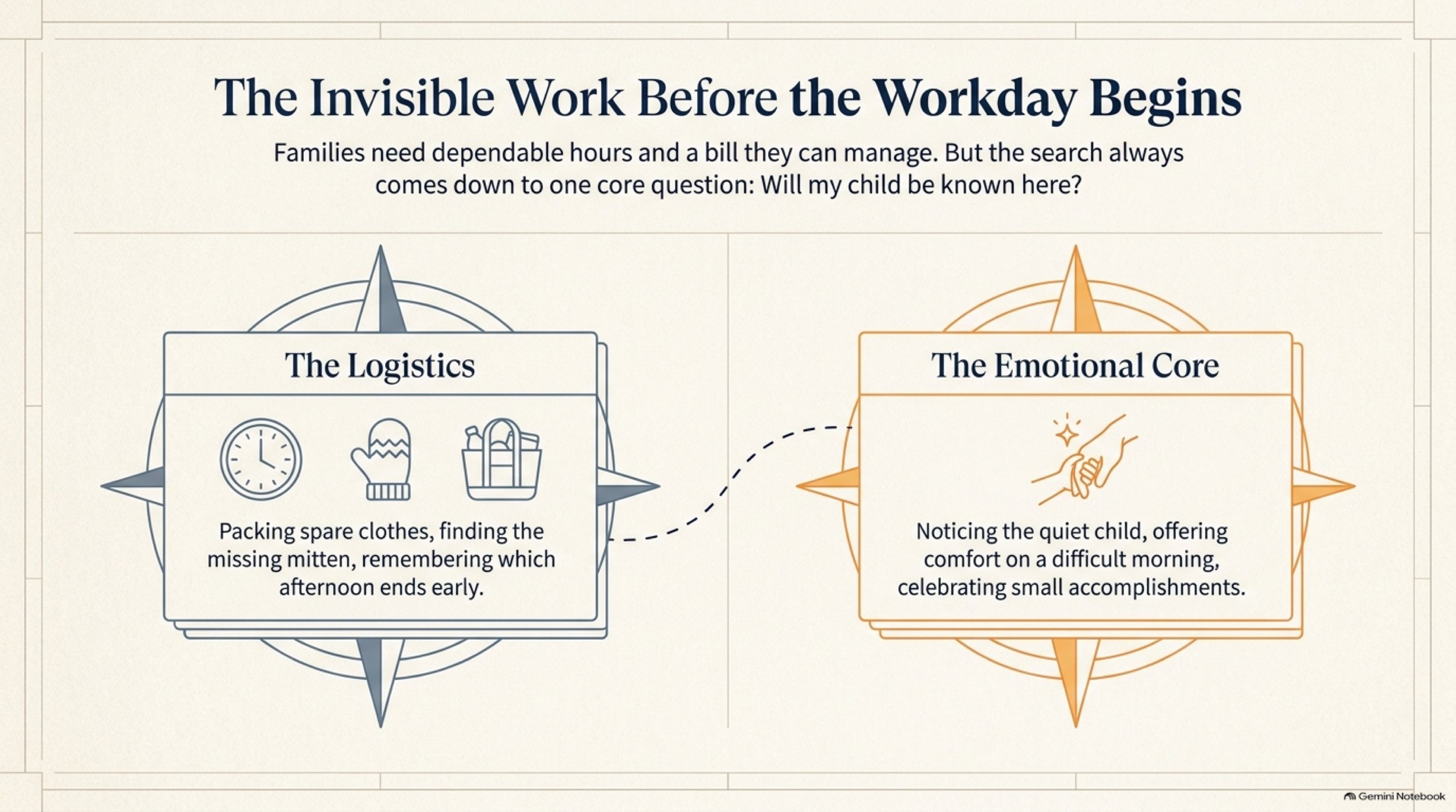
Before the workday begins, there is another kind of work: packing the spare clothes, finding the missing mitten, remembering which afternoon ends early. Then comes the handoff. A child reaches for another adult, and a parent or guardian leaves with a question that no enrollment form can quite answer: Will my child be known here?
That question sits at the heart of child care in Hastings, Minnesota. Families need dependable hours and a bill they can manage. They also want someone to notice the quiet child, celebrate the small accomplishment, and offer comfort on a difficult morning.
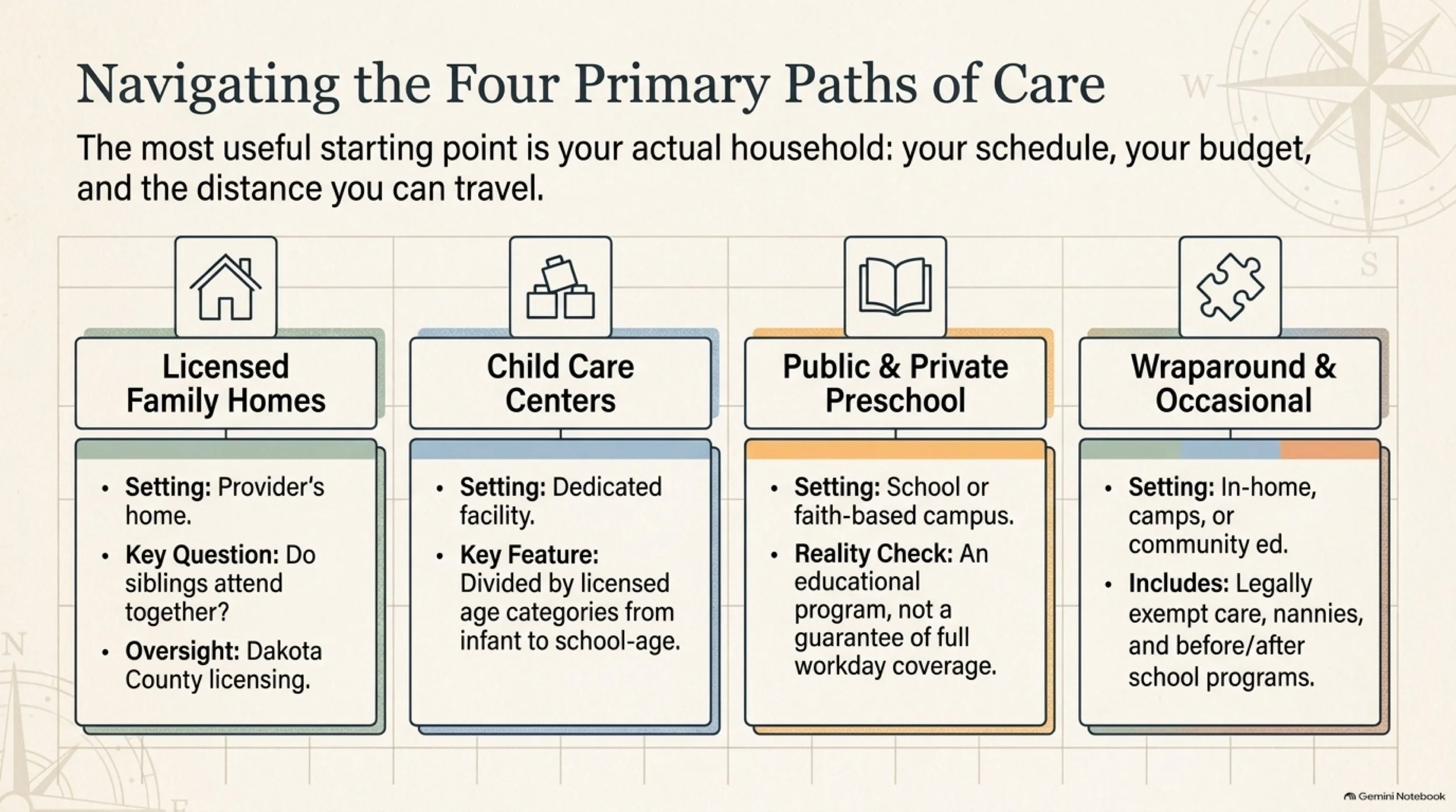
In 2026, Hastings families can explore licensed child care centers and family child care homes, public and private preschool, school-age programs, summer care, and care arranged with relatives, friends, or an in-home caregiver. Some families will use several of these over the course of a year. Minnesota also offers financial assistance and early learning support, although eligibility, funding, and available spaces differ by program. Parent Aware’s guide to care arrangements and Minnesota’s child care assistance overview explain the broad choices.
The most useful starting point is your actual household: your child’s age and needs, your work or school schedule, your budget, and the distance you can reasonably travel. A wise decision should fit the life you are living.
This guide covers the principal options and verified local starting points. It is not an exhaustive roster of individual caregivers, a ranking of providers, or a live vacancy list. For a current search, pair Minnesota’s Licensing Information Lookup with Parent Aware, which offers free help at 888-291-9811.
How child care in Hastings developed
The history of child care is harder to reconstruct than the history of a bridge or a public building. A licensing record can document a program. It cannot capture every relative who watched a child, every neighbor who covered a shift, or every household arrangement that helped a family get through the week.
For Hastings, the records reviewed for this guide establish several milestones in the modern system. They do not establish the city’s first child care provider or a complete history of care before licensing records available online.
A Minnesota commitment to supporting parents
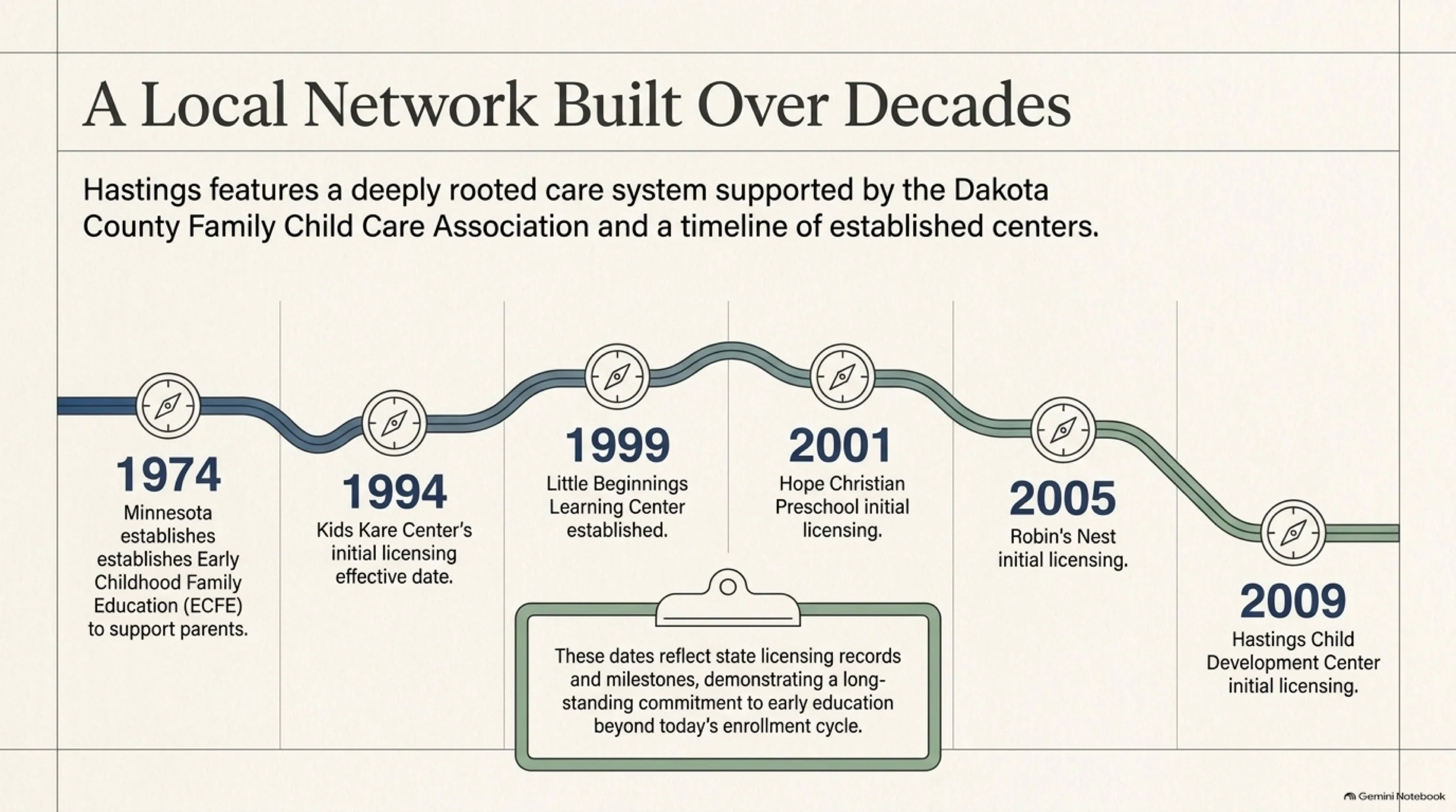
One important statewide milestone came in 1974, when Minnesota established Early Childhood Family Education, commonly called ECFE. Its premise was that supporting children also meant supporting the adults raising them. Today, ECFE serves families from birth to kindergarten entry through parent education and activities for children and caregivers. The state describes a sliding fee approach and says families cannot be excluded because they cannot pay. Minnesota Association for Family and Early Education; Minnesota Department of Children, Youth, and Families.
Hastings now offers ECFE through Community Education. It is a place to find guidance and connection, rather than a replacement for a full workday of child care. That distinction reflects an enduring need: families benefit from both dependable care and support for the work of parenting. Hastings Community Education ECFE listings.
Local records show a system built over decades
State records document Hastings-area programs across the 1990s and 2000s. Kids Kare Center’s current license record has an initial effective date of April 4, 1994. Little Beginnings Learning Center’s record begins April 19, 1999; the provider also describes serving families since 1999. Both have Hastings mailing addresses in Washington County. Kids Kare license record; Little Beginnings license record; Little Beginnings.
Other current records list initial effective dates of October 1, 2001, for Hope Christian Preschool; August 29, 2005, for Robin’s Nest; and March 2, 2009, for Hastings Child Development Center. These are dates attached to particular licenses, not independently verified founding dates or proof of newly added spaces. Together, they document a local network with roots extending well beyond today’s enrollment cycle. Hope license record; Robin’s Nest license record; Hastings Child Development Center license record.
Family child care belongs in that history, too. Dakota County continues to oversee licensing work for home-based providers, and the Dakota County Family Child Care Association supports providers through resources and professional development. A history built only around center names would leave out this part of the care available to families. Dakota County child care information; Dakota County Family Child Care Association.
The result in 2026 is a mix of settings, schedules, and educational approaches. Understanding those differences is more useful than searching for one program that can do everything.
The child care options Hastings families can explore in 2026
Licensed family child care homes
A licensed family child care program operates in a home. For parents considering this option, useful questions include whether siblings can attend together, which ages are currently enrolled, who provides care during an absence, and how the daily routine accommodates different developmental stages.
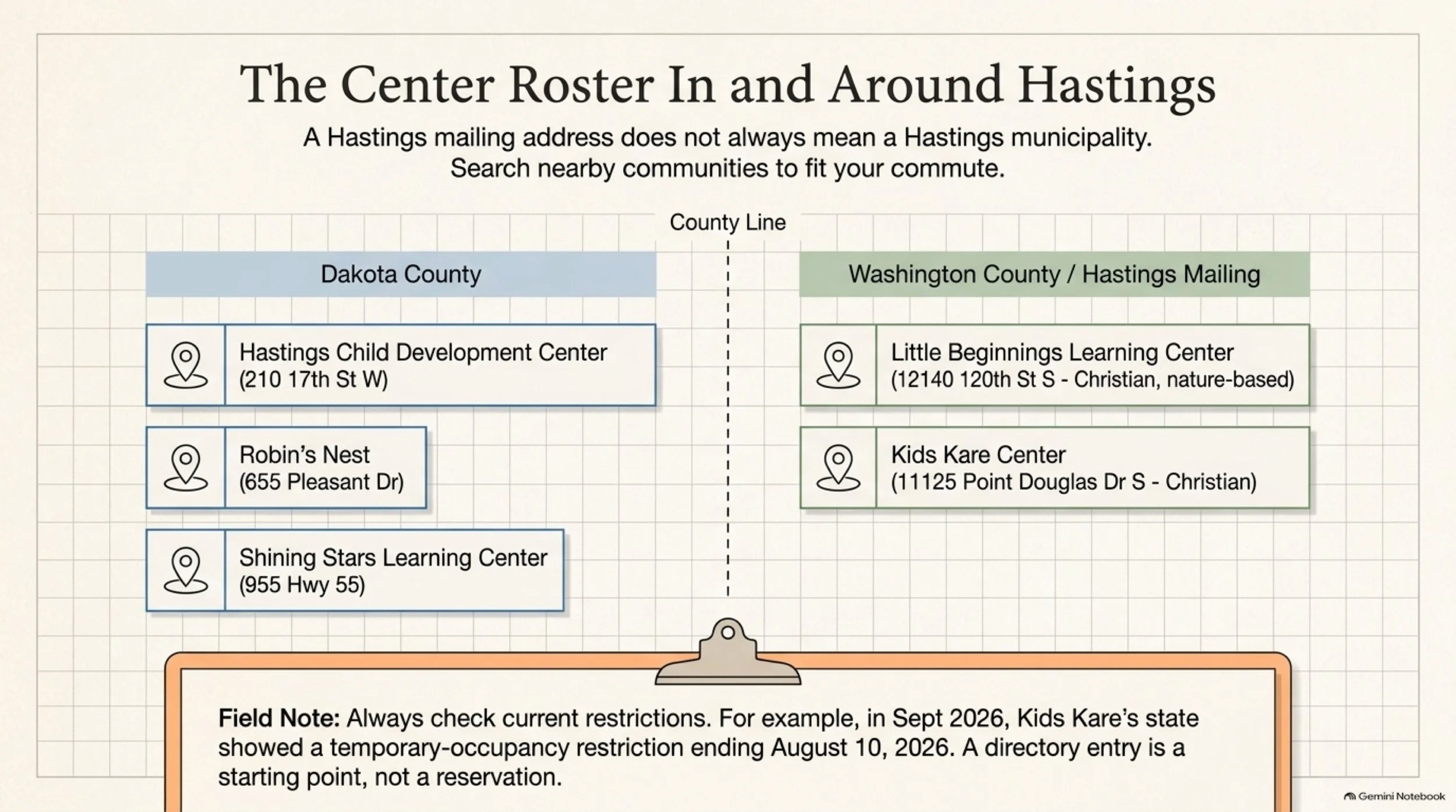
Start with Dakota County’s provider search guidance and the Dakota County Family Child Care Association. Use the state lookup to check the individual provider’s current license and restrictions. Search nearby communities as well if your commute makes that practical; a Hastings mailing address does not by itself settle the municipality or county in which a program operates.
Ask specifically about an opening for your child’s age and intended start date. A provider may have room for an older child without having room for an infant. A directory entry is a starting point for a conversation, not a reservation.
Child care centers in and around Hastings
The following programs have state records listing infant, toddler, preschool, and school-age care. Those licensed age categories do not establish that every classroom is operating or accepting children today. Each linked record should be reviewed alongside a direct conversation with the provider.
Program
Address in the state record
Geographic detail
Hastings Child Development Center
210 17th Street West
Dakota County
655 Pleasant Drive
Dakota County
955 Highway 55
Dakota County
Little Beginnings Learning Center
12140 120th Street South
Washington County with a Hastings mailing address
11125 Point Douglas Drive South
Washington County with a Hastings mailing address
Little Beginnings describes a Christian, nature-based approach. Kids Kare describes Christian early education and school-age care. Families considering either should ask how those approaches appear in everyday activities and whether they match the family’s preferences. Little Beginnings; Kids Kare.
A record requiring clarification: On September 22, 2026, Kids Kare’s state record displayed an active license and a temporary-occupancy restriction ending August 10, 2026. The online record does not resolve that discrepancy. Confirm current occupancy authorization with the program and the state licensing agency before enrolling. This observation does not establish that the program is closed. Kids Kare’s state record.
For every program, read the full current licensing record, including restrictions and available review or investigation documents. The state lookup also displayed a notice that a systems issue was delaying some document postings when this guide was researched. An active license or a short online document list should not be treated as a complete account of a program’s history. Minnesota Licensing Information Lookup.
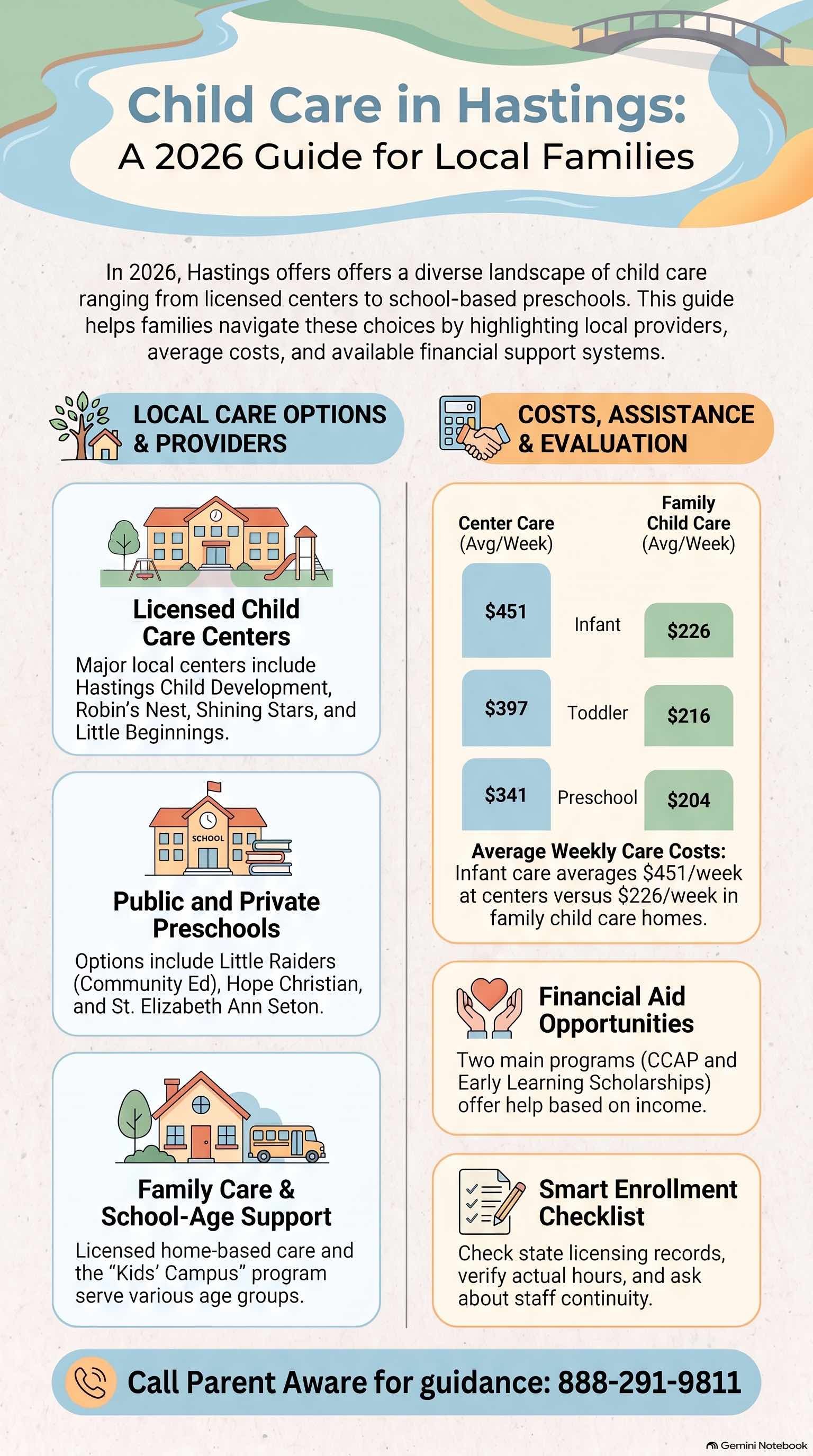
Child care infographic by HastingsNow.com
Public preschool through Hastings Community Education
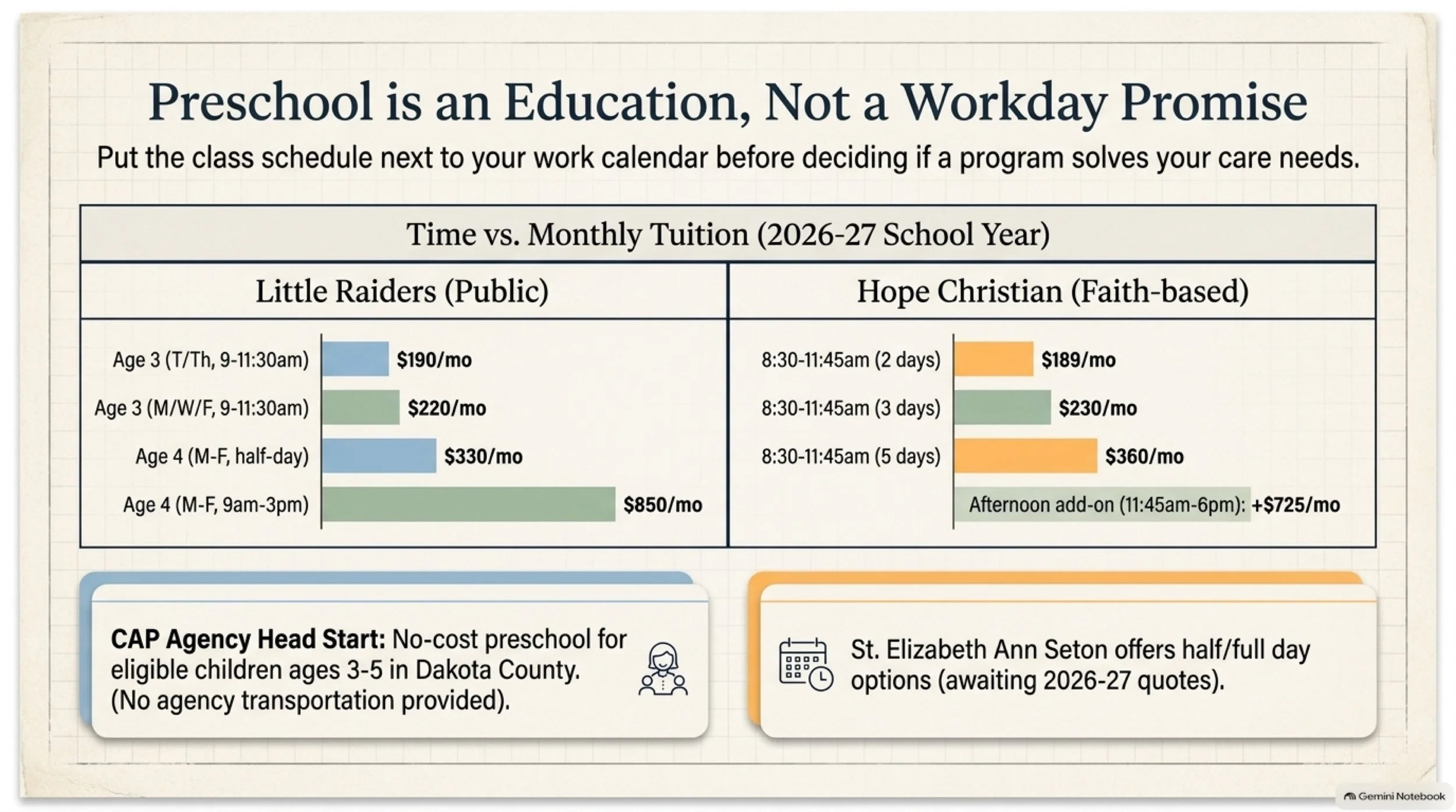
Hastings’ Little Raiders preschool offers several schedules for children who meet the listed September 1 age cutoffs. The district’s 2026–27 registration pages provide unusually useful information for comparison: actual session times and monthly tuition.
Selected Little Raiders offering
Published schedule
Monthly tuition
Age 3 by September 1
Tuesday and Thursday, 9–11:30 a.m.
$190
Age 3 by September 1
Monday, Wednesday, and Friday, 9–11:30 a.m.
$220
Age 4 by September 1
Monday–Friday, morning or afternoon half-day
$330
Age 4 by September 1
Monday–Friday, 9 a.m.–3 p.m.
$850
These are selected offerings. The page lists a $50 nonrefundable registration and materials fee, plus a 3.69 percent electronic-payment fee beginning July 1, 2026; cash or check avoids that processing charge. Confirm the calendar and availability. Little Raiders 2026–27 registration.
A six-hour preschool day can be an excellent fit for some households. A parent working an eight-hour shift plus a commute may still need care at both ends of it. Ask about those handoffs explicitly, including transportation and who is responsible for the child between programs.
Faith-based and private preschool
Hope Christian Preschool publishes 2026–27 morning classes from 8:30 to 11:45 a.m., with monthly tuition of $189 for two days, $230 for three days, or $360 for five days. Its afternoon preschool option, 11:45 a.m.–6 p.m. five days a week, is listed at an additional $725 per month. Hope also advertises new before- and after-school care for 2026–27. Confirm age and toileting requirements, calendar, transportation, and the exact combination of services in your contract. Hope classes and registration; Hope preschool overview.
St. Elizabeth Ann Seton Catholic School describes half-day and full-day preschool options for three- and four-year-olds. Its early childhood campus is at 2035 15th Street West. The preschool page reviewed for this article still labeled its tuition figures 2025–26, so families should request a current 2026–27 quote and verify any extended-day arrangements. St. Elizabeth Ann Seton preschool.
Preschool describes an educational program, not a promise about hours. For every option, put the class schedule next to your work calendar before deciding whether it solves your care needs.
Head Start and Early Head Start
The CAP Agency serves Scott, Carver, and Dakota counties and is accepting applications for the 2026–27 program year. Its Head Start program offers no-cost preschool for eligible children ages three to five. Ask which current classroom serves your address, its exact hours, and how you would get there: the agency says it does not provide transportation.
CAP’s Early Head Start serves pregnant participants and children from birth to age three through home visits and socialization opportunities. That can be valuable support, but it is not a daily infant child care placement. Eligibility and openings must be confirmed through the agency; families can call 651-322-3500, option 2. CAP Agency Head Start and Early Head Start.
Care before school and after the final bell
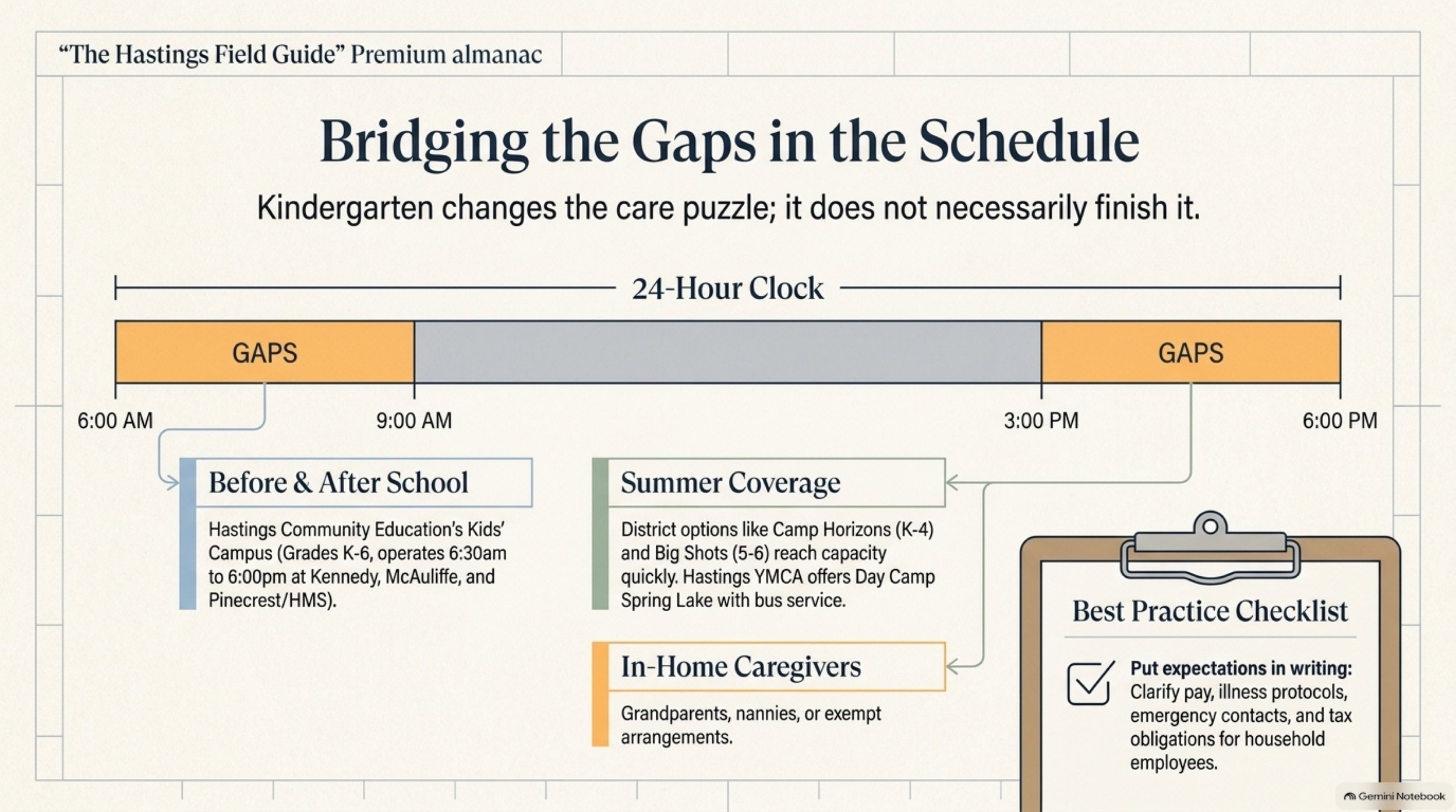
Kindergarten changes the care puzzle; it does not necessarily finish it.
Hastings Community Education’s Kids’ Campus serves children in kindergarten through sixth grade. The district describes before- and after-school care within a 6:30 a.m.–6 p.m. operating window and care on many nonschool days. Its 2026–27 registration lists Kennedy, McAuliffe, and Pinecrest/HMS arrangements. Confirm the site serving your school, transportation, daily charges, registration fees, and which closed-school days require separate enrollment. Kids’ Campus registration; Hastings Community Education.
Some centers and faith-based programs also offer school-age care. School transportation is a separate question from whether a program accepts elementary-age children. Ask about your child’s specific school and route, including early-release days.
Summer care and occasional care
The district’s Camp Horizons serves grades K–4, while Big Shots serves grades 5–6. The 2026 summer registration page reported that both had reached capacity. With that summer now past, families planning for 2027 should ask when registration will open and which grade definition the next program will use. A full summer program is a reason to plan early, not a measure of the entire city’s child care supply. Camp Horizons and Big Shots.
The Hastings YMCA lists youth activities and Day Camp Spring Lake, held at Spring Lake Park Reserve in Rosemount, with bus service including Hastings. Confirm next-season dates, age eligibility, transportation, and the hours between drop-off and pickup. The YMCA’s Kids Stuff service, described for children ages six weeks through ten years while members work out, should not be confused with full-day care while a parent is at work. Hastings YMCA children’s activities.
For occasional or backup care, ask programs directly whether they accept drop-in enrollment, what paperwork is required, and whether space must be reserved. A camp, class, or recreation membership can enrich a week without necessarily covering a workweek.
Relatives and caregivers in your home
Grandparents, other relatives, friends, and neighbors may be part of a family’s regular or backup plan. Minnesota recognizes legally exempt care arrangements, but an informal arrangement is not automatically exempt simply because the caregiver is someone you know. Check the arrangement against current state guidance. Parent Aware’s explanation of care types.
A nanny or nanny share may also be worth exploring. Compare total compensation, paid time off, backup coverage, references, and responsibilities. A nanny working under a household’s direction may be a household employee, with tax obligations for the employer; calling someone an independent contractor does not settle that question. For a shared arrangement, also check whether the location and number of families served affect licensing requirements. IRS household employee guidance.
Whatever the relationship, put expectations in writing. Clarify schedules, pay, transportation, meals, illness, emergency contacts, and how either party can end the arrangement. Clarity can protect a valued relationship as well as a child’s routine.
What child care costs and where help may be available
A family deserves useful numbers without being misled by them.
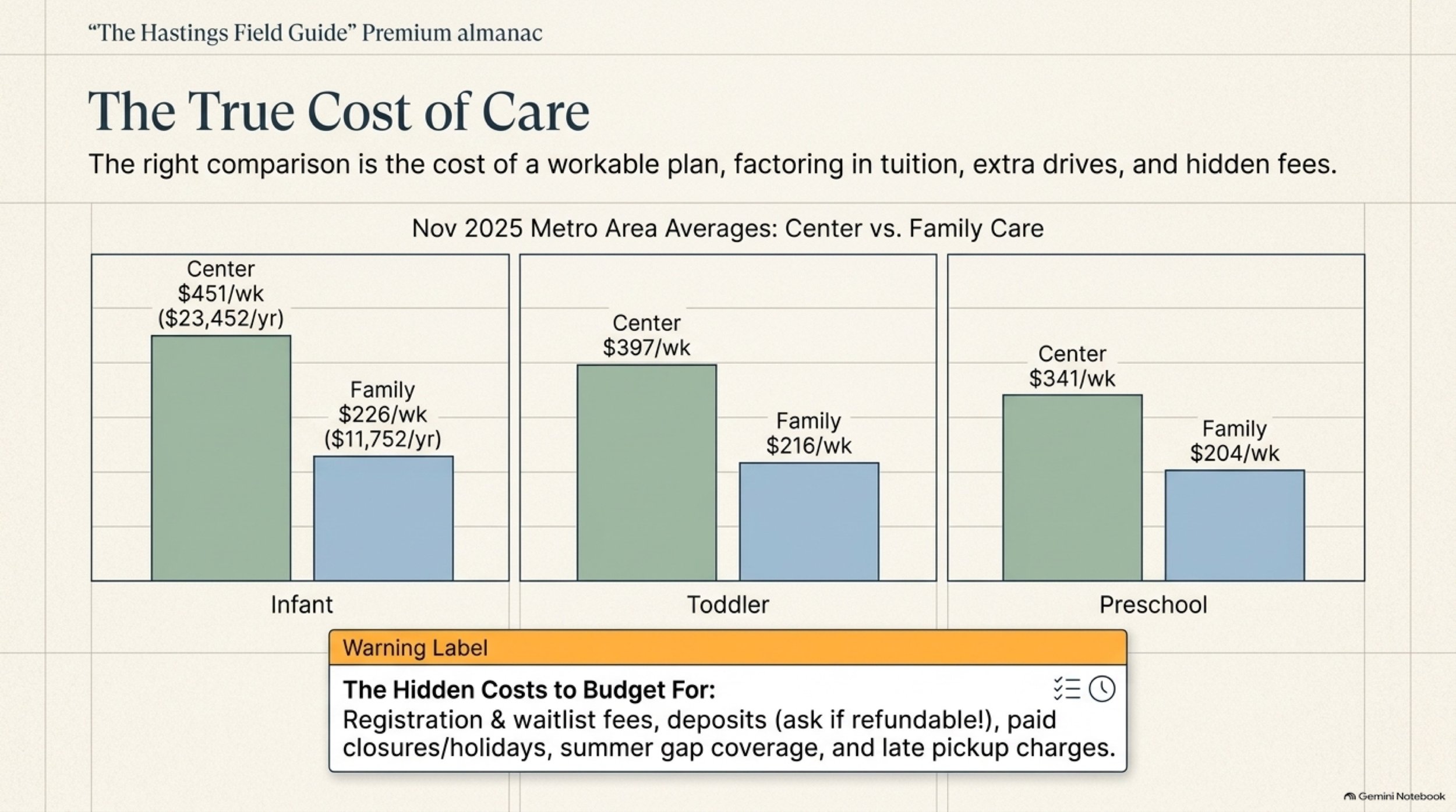
Child Care Aware of Minnesota’s November 2025 metro-area averages provide a benchmark for planning. They are not Hastings-specific rates or quotes for an individual program in 2026.
Child age
Center care average per week
Family child care average per week
Infant
$451
$226
Toddler
$397
$216
Preschool
$341
$204
Source: Child Care Aware of Minnesota cost of care.
For perspective, paying the infant-care averages for 52 weeks would total $23,452 at a center or $11,752 in family child care. Those are arithmetic illustrations, not local tuition estimates. Actual contracts differ in paid weeks, hours, holidays, and fees.
When comparing offers, ask for the total cost of your expected year. Include registration, deposits, meals, supplies, late pickup, paid closures, summer coverage, and any second arrangement needed to bridge a short day. Ask whether a deposit is refundable and whether a waitlist fee guarantees anything beyond a place on the list.
A lower tuition figure can be meaningful. So can avoiding an extra daily drive or a second pickup. The right comparison is the cost of a workable plan.
Check assistance before assuming you will not qualify
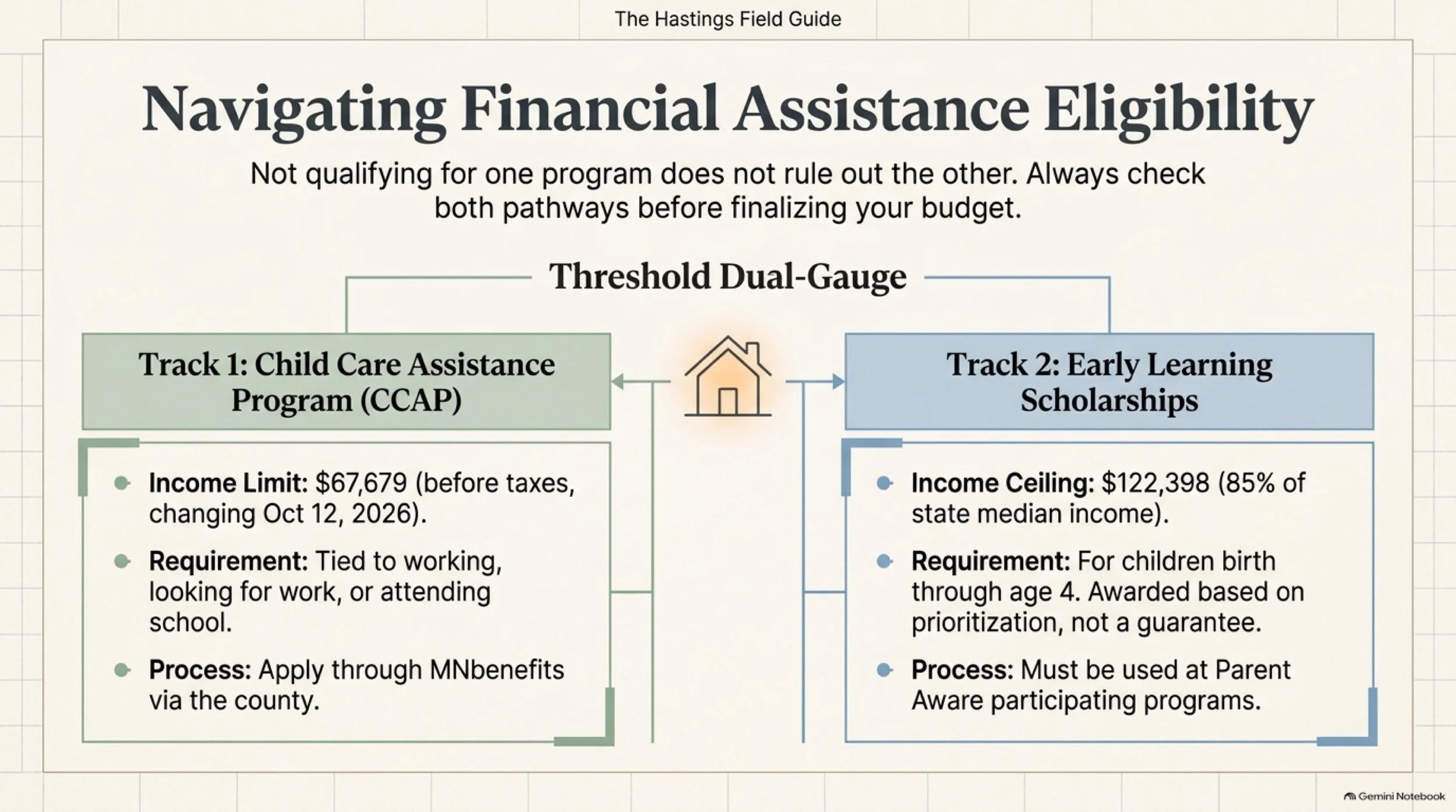
Minnesota’s Child Care Assistance Program, or CCAP, can help eligible families pay for care while working, looking for work, attending school, or participating in an employment plan. On the date this guide was checked, the state listed an annual income limit of $67,679 before taxes for a household of four. Other eligibility requirements apply, most families have a copayment, and the state says these income guidelines change on October 12, 2026. Check the updated table before applying. Applications begin through MNbenefits, with questions directed to the relevant county or Tribal agency. Minnesota CCAP information.
Early Learning Scholarships are a separate program. Current guidance covers eligible children from birth through age four as of September 1 who are not yet in kindergarten. For a household of four, the posted income ceiling is $122,398, or 85 percent of state median income. Awards prioritize lower-income households and specified circumstances; meeting the income limit does not guarantee funding. Scholarships can be used at eligible Minnesota programs participating in Parent Aware. Review the current rules and apply through the state’s linked scholarship hub. Minnesota Early Learning Scholarships.
These different limits matter. A family that does not qualify for one form of help should still check the others. Ask an assistance specialist to explain how funding would apply to the specific program you are considering before counting an award in your budget.
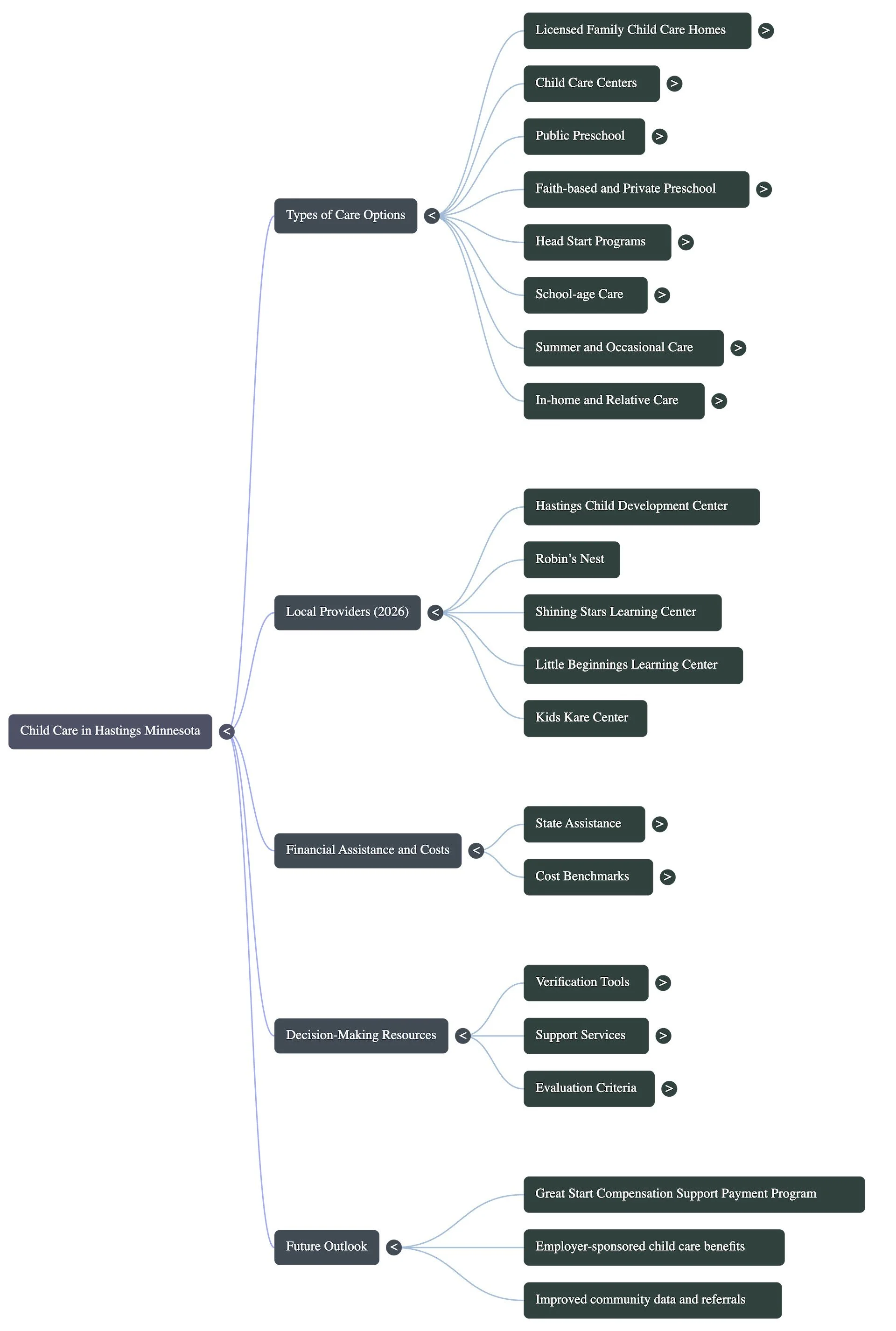
Child care mind map by HastingsNow.com
How to make a decision you can feel good about
Start with the requirements that make care possible: the child’s age, hours needed, transportation, budget, and any developmental, medical, language, or cultural needs. Then choose a manageable shortlist. You do not have to tour every program in the area to make a thoughtful decision.
Read the record and visit the room
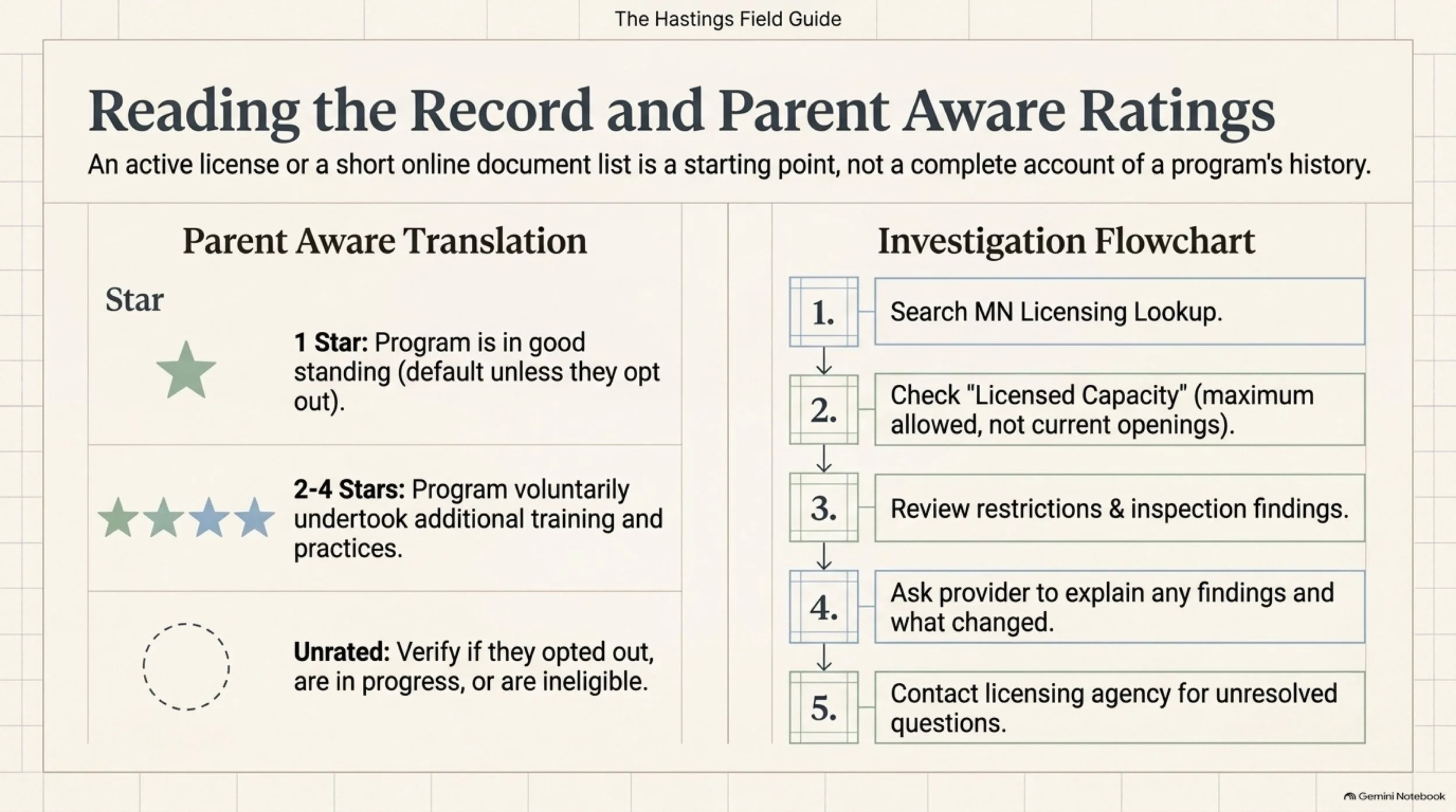
For licensed programs, review the current status, restrictions, inspection findings, and any available corrective or appeal documents. Licensed capacity is the maximum number of children permitted at one time, not the number of open places. Ask the provider to explain relevant findings and what changed afterward; contact the licensing agency when an answer remains unclear. Parent Aware’s guide to licensing records.
Parent Aware ratings provide another piece of information. Under the system described on its current site, licensed programs in good standing receive one star unless they opt out. Programs voluntarily undertake additional training and practices for two-, three-, or four-star ratings. If a listing has no rating, read its specific status: opting out, being in progress, being ineligible, and being barred from participation are different situations. Parent Aware star ratings.
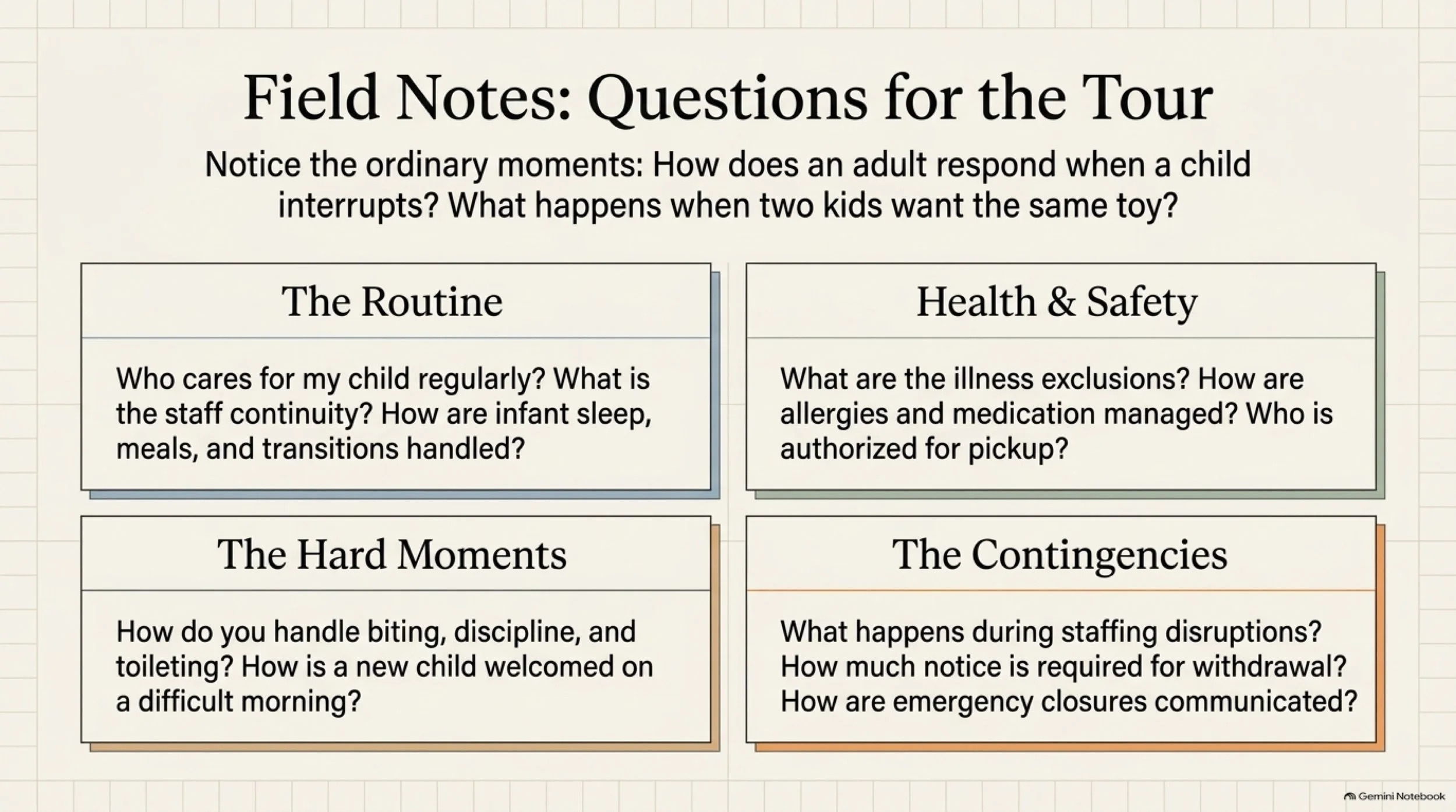
On a visit, give yourself time to notice ordinary moments. How does an adult respond when a child interrupts? What happens when two children want the same toy? Can someone tell you how a new child is welcomed into the day?
Ask questions that produce examples rather than a sales pitch:
Who will care for my child regularly? Ask about staff continuity, substitutes, and group sizes at opening, closing, and during breaks.
How do you handle a hard moment? Discuss comfort, discipline, biting, toileting, and how concerns are communicated to families.
How do daily health and safety routines work? Ask about infant sleep, medication, allergies, illness exclusions, emergencies, and authorized pickup.
What will my child’s day feel like? Discuss play, outdoor time, rest, meals, screens, and transitions.
How will we stay in touch? Ask about updates, privacy and photo permissions, and how parents can raise a concern.
What happens when the plan changes? Review closures, staffing disruptions, withdrawal notice, and backup arrangements.
Take brief notes immediately afterward. Warm impressions matter, but written answers are easier to compare after several visits.
Make room for the child you have
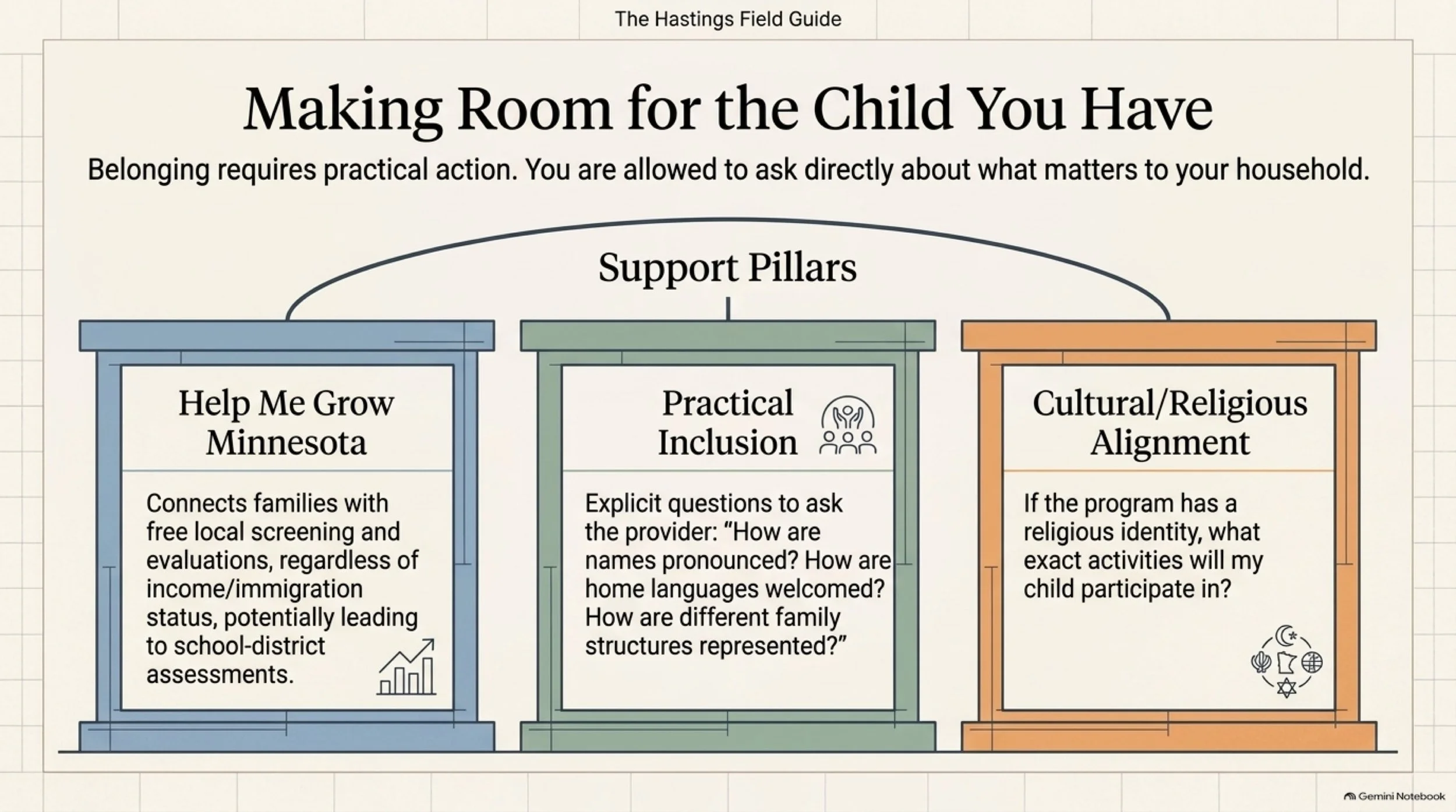
A child who needs a quieter transition, communication support, or additional help joining activities deserves a specific conversation. Ask what the program can provide, what training staff have, and how they would work with your family and any specialists already involved.
If you have questions about development, Help Me Grow Minnesota connects families with local screening and evaluation pathways. Its referral process can lead to school-district assessment for early intervention or preschool special education. These services do not automatically supply a full day of child care, but they can be part of a coordinated plan. Help Me Grow describes evaluation and eligible services as free, regardless of income or immigration status. Help Me Grow Minnesota.
Belonging also deserves practical questions. How are names pronounced? How are home languages welcomed? How are different family structures represented? If the program has a religious identity, what will your child participate in? You are allowed to ask directly about what matters to your household.
Give yourself permission to choose and reassess
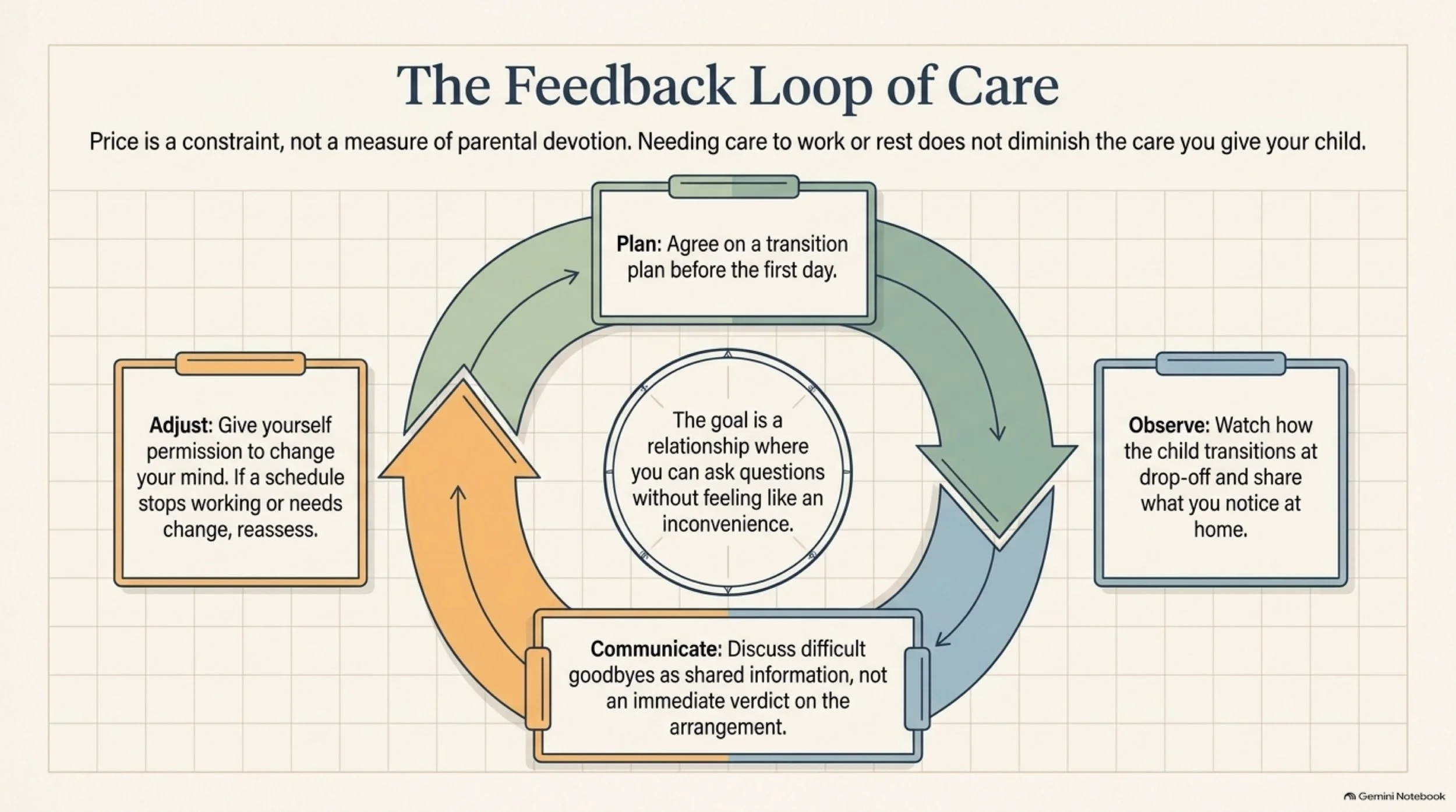
Price is a constraint, not a measure of parental devotion. Needing care so you can work, study, rest, or meet other family responsibilities does not diminish the care you give your child.
Before the first day, agree on a transition plan and a time to check in. Ask what the caregiver is observing after you leave, and share what you notice at home. A difficult goodbye is information to discuss; it need not become a verdict on the whole arrangement.
You can also change your mind. A schedule can stop working. A child’s needs can change. Questions that seemed minor can become significant. Choosing thoughtfully includes paying attention after enrollment and acting when the evidence calls for it.
The goal is a relationship in which your child is cared for and you can ask questions without feeling like an inconvenience.
What the future of child care in Hastings could hold
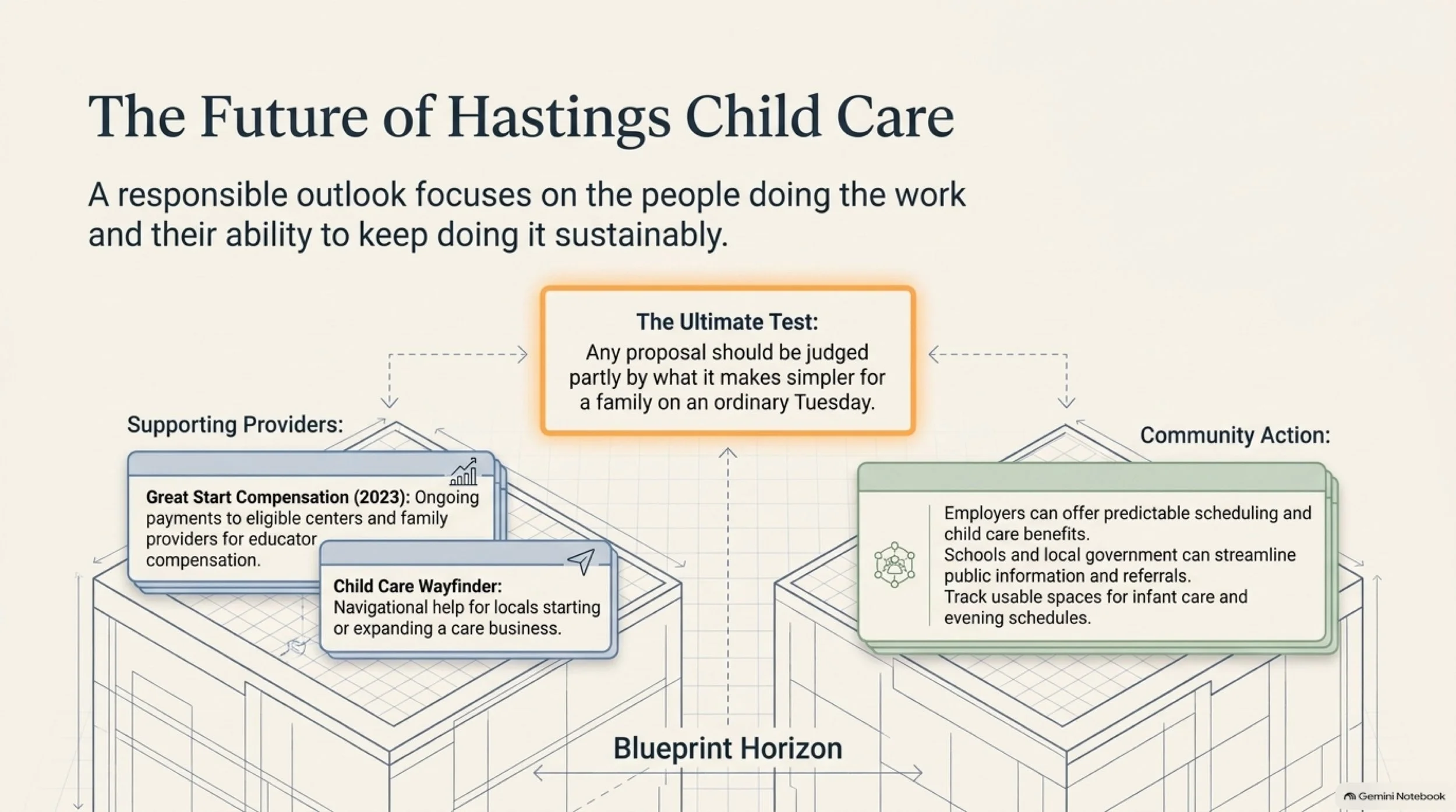
There is no verified local forecast in the sources reviewed that can tell a parent exactly how many infant openings Hastings will have next year. A responsible outlook should separate developments already documented from changes the community might choose to pursue.
Supporting the people who provide care
Minnesota’s Great Start Compensation Support Payment Program, signed into law in 2023, provides ongoing payments to eligible child care programs for educator compensation and benefits. The state includes eligible family child care providers as well as centers and other qualifying programs. This gives the future discussion a concrete focus: the people doing the work and their ability to keep doing it. Minnesota Great Start program.
For someone considering opening or expanding a program, Child Care Wayfinder offers help navigating startup, licensing, and business sustainability. Supporting an existing family provider or helping a new one get established is one practical avenue for local action, alongside discussion of larger facilities. Child Care Wayfinder.
Neither initiative guarantees a Hastings opening. Both are concrete resources that providers and community partners can investigate now.
Making the available hours fit family life
Hope’s advertised addition of before- and after-school care for 2026–27 is one documented local change. The district’s range of preschool schedules illustrates another important planning question: how can educational offerings and the rest of the care day fit together? Hope preschool; Hastings preschool registration.
For future planning, Hastings would benefit from asking families about the spaces they can actually use: infant care, evening or variable schedules, reliable transportation, summer coverage, and care equipped to include children with additional needs. Those are priorities to investigate, not quantified findings of a local survey.
Employers could contribute through predictable scheduling, child care benefits, and partnerships with providers. Schools, local government, and community organizations could help by keeping public information current and making referrals easier. Any proposal should be judged partly by what it makes simpler for a family on an ordinary Tuesday.
Making the search less lonely
A useful community directory would show when each listing was last confirmed, which ages a program serves, how to ask about openings, and where to find its licensing record. It would distinguish a morning preschool from a full workday of care and a summer camp from year-round enrollment.
That is also an opportunity for HastingsNow: keep this guide current, invite documented updates from providers, and listen to families whose schedules or circumstances are easy to overlook. A more accurate map of the choices would be a service in itself.
Quick answers for Hastings parents and guardians
Where should I start looking for child care in Hastings
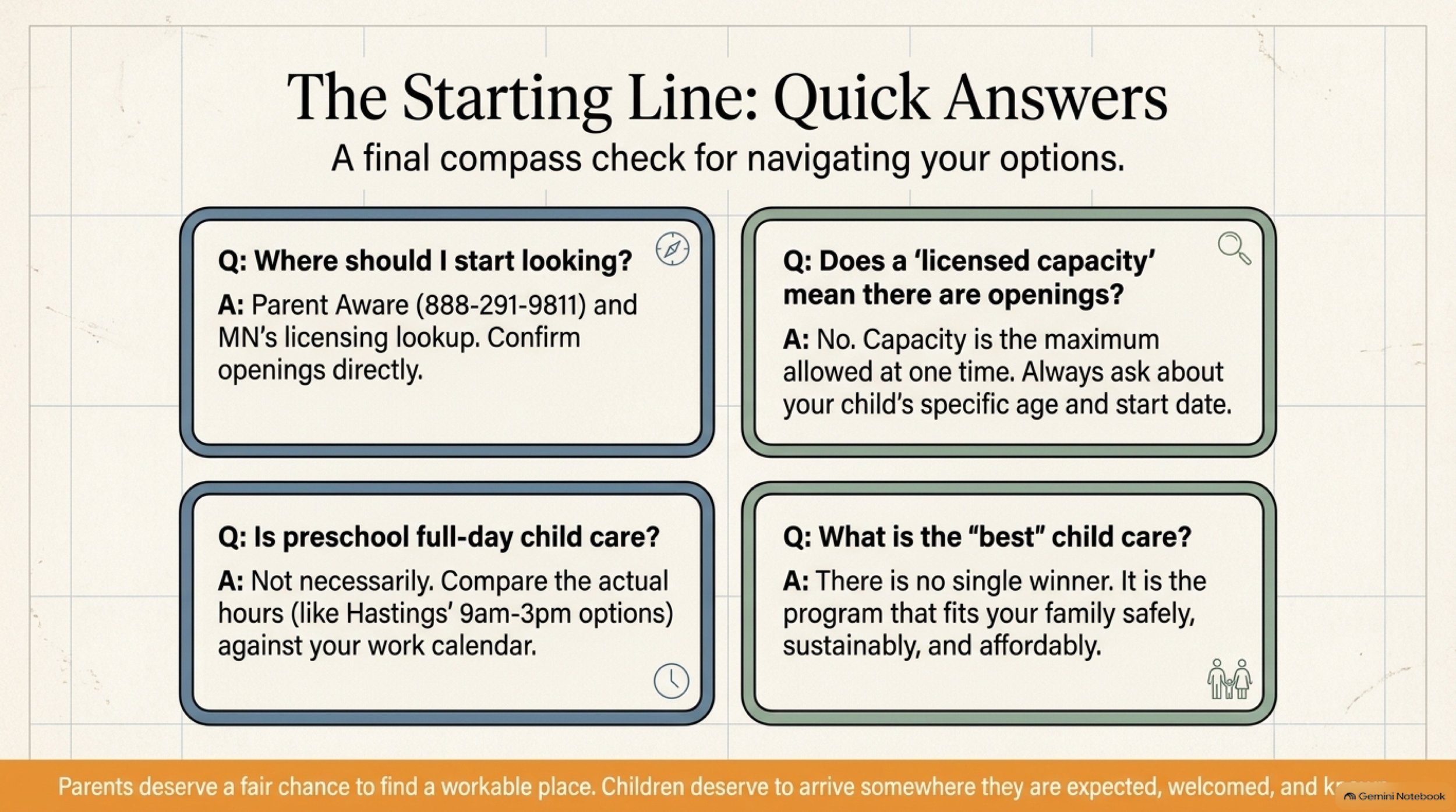
Start with Parent Aware at 888-291-9811 and Minnesota’s licensing lookup. Search by your child’s age, location, and schedule, then confirm openings directly. Dakota County also provides local search guidance.
Is preschool the same as full day child care
Not necessarily. Compare the actual hours, school-year calendar, and care available before and after class. Hastings’ published preschool offerings include both short sessions and a 9 a.m.–3 p.m. option. Little Raiders registration.
Can I get help paying even if I do not qualify for CCAP
Possibly. Early Learning Scholarships have their own eligibility and award rules. Check them separately rather than assuming a CCAP decision answers both questions. Minnesota scholarship information.
Does a licensed capacity mean there are openings
No. Capacity is the number allowed at one time. Ask about an available place for your child’s age, start date, and schedule. Understanding licensing records.
What is the best child care in Hastings
There is no evidence-based single winner in this guide. Begin with safety and current records, then assess the caregiver relationship, your child’s needs, dependable coverage, and the full cost. A program that fits another family beautifully may not fit yours.
A community seen through its care for children
Child care is experienced in small, repeated moments: a familiar greeting, a remembered preference, a caregiver who has something specific to tell you at pickup. For the adults arranging it, dependable care can make room for a workday, an education, or a little breathing space.
Hastings has several paths for families to explore. Making those paths easier to understand, afford, and sustain is work worth sharing among caregivers, employers, schools, neighbors, and public institutions.
Parents and guardians deserve clear information and a fair chance to find a workable place. Children deserve to arrive somewhere they are expected, welcomed, and known.
Research note: This article draws on public agency, school district, provider, and nonprofit sources linked throughout. It includes no original interviews or independently confirmed vacancies. Program details, fees, eligibility, and licensing records can change; confirm the information relevant to your enrollment before committing.