
People Are Saying: How Whisper Campaigns and Reputation Really Work

AI-generated image by HastingsNow.com
One account can travel through several social circles and return sounding like a consensus. Other times, several people really do know something firsthand. Understanding the difference can help a community listen, question and respond fairly.
People are saying…
Which people?
Before answering, consider a hypothetical. This is an invented example to explain a communication pattern, not a description of a Hastings business or incident.
A resident has a frustrating experience with a service provider and tells three people. One mentions it during a business conversation. Another brings it up among parents at a youth-sports practice. The third passes it along in a neighborhood text thread.
Later, someone hears a version from a business acquaintance and another from a neighbor. The messengers are different. The settings are different. The listener reasonably wonders whether a pattern is emerging.
Yet both accounts may lead back to the same experience.
As this imaginary story travels, its wording could change. “Someone told me they had a problem” becomes “I've heard there have been problems.” Eventually, a speaker says, “Everybody knows they're unreliable.”
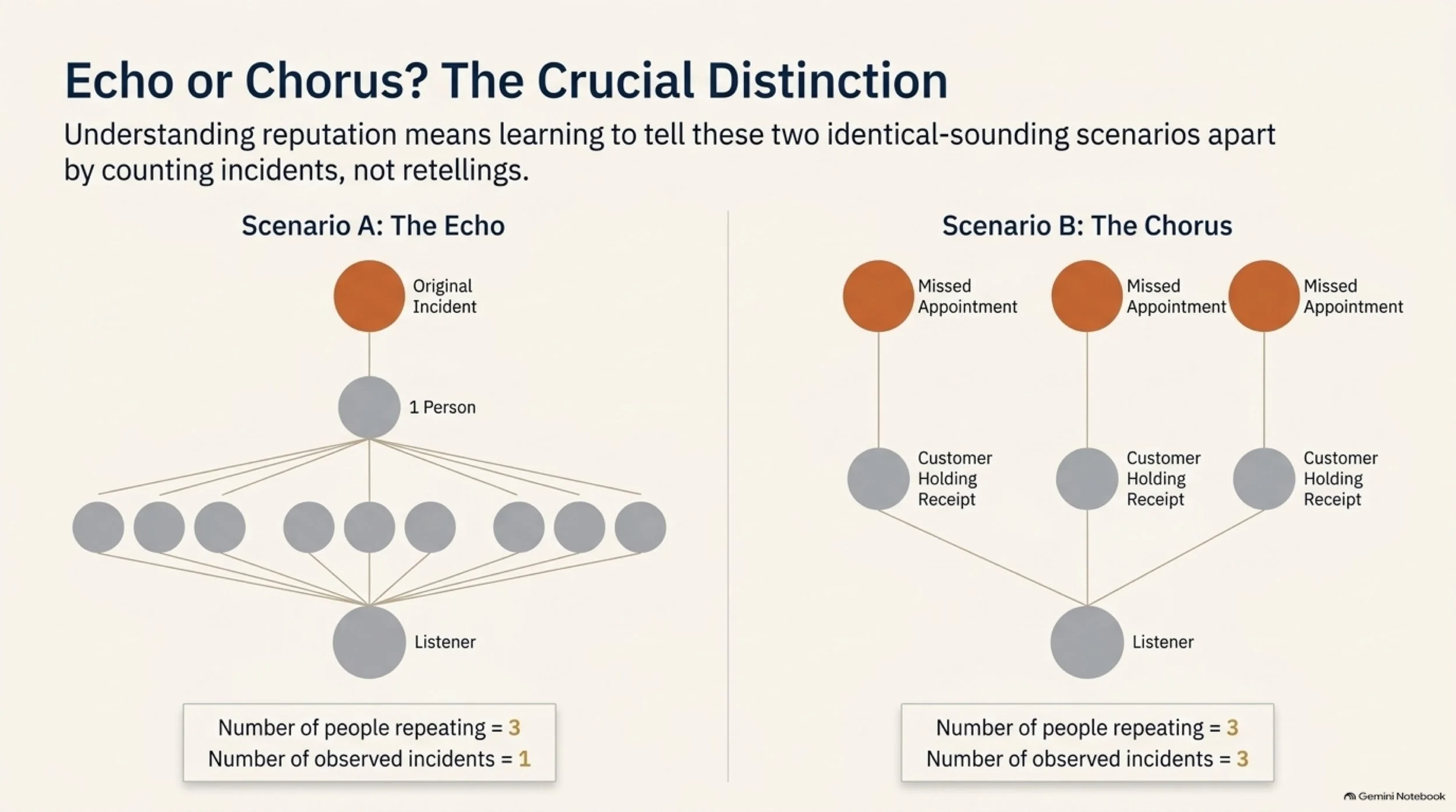
The number of people repeating the account has grown. The number of observed incidents has not.
Now reverse the example. Three customers separately experience three missed appointments. Each has the original booking confirmation and messages documenting what happened. They later compare notes.
Their agreement could reveal a real problem. Knowing one another would not erase their separate experiences.
These two situations can sound remarkably similar from a distance. Understanding reputation means learning to tell them apart.
What is a whisper campaign?
A deliberate whisper campaign is a purposeful effort to shape someone's reputation through indirect or informal negative messaging, often while obscuring responsibility. It can target a person, business, organization, institution or idea.
Repeated criticism alone does not establish that such a campaign exists. “Whisper campaign” describes conduct; it is not a standalone legal category or a diagnosis that follows from hearing an unwelcome story several times.
A deliberate effort might have one organizer or several loosely coordinated participants. People farther along the chain may repeat the message sincerely, without knowing how it began. Conversely, a story can spread widely without anyone organizing its spread.
That leaves two questions to investigate separately: What supports the claim? And what supports the conclusion that someone deliberately promoted it?
An accurate account can be strategically amplified. An inaccurate account can circulate through ordinary conversation. Evidence about one question does not automatically answer the other.
About this story: This feature draws on peer-reviewed studies, historical scholarship, government records, court opinions and journalism ethics guidance. Its community examples are explicitly hypothetical. It does not allege that Hastings, Minnesota, is experiencing a coordinated whisper campaign or accuse any local person or organization of participating in one. Read HastingsNow's editorial standards and corrections policy and explanation of how its stories are made.
Is a whisper campaign the same as gossip?
No. Gossip is a much broader part of social life, and the distinctions matter. Researchers do not use every term identically, but scholarship on gossip and rumor provides a useful starting point.
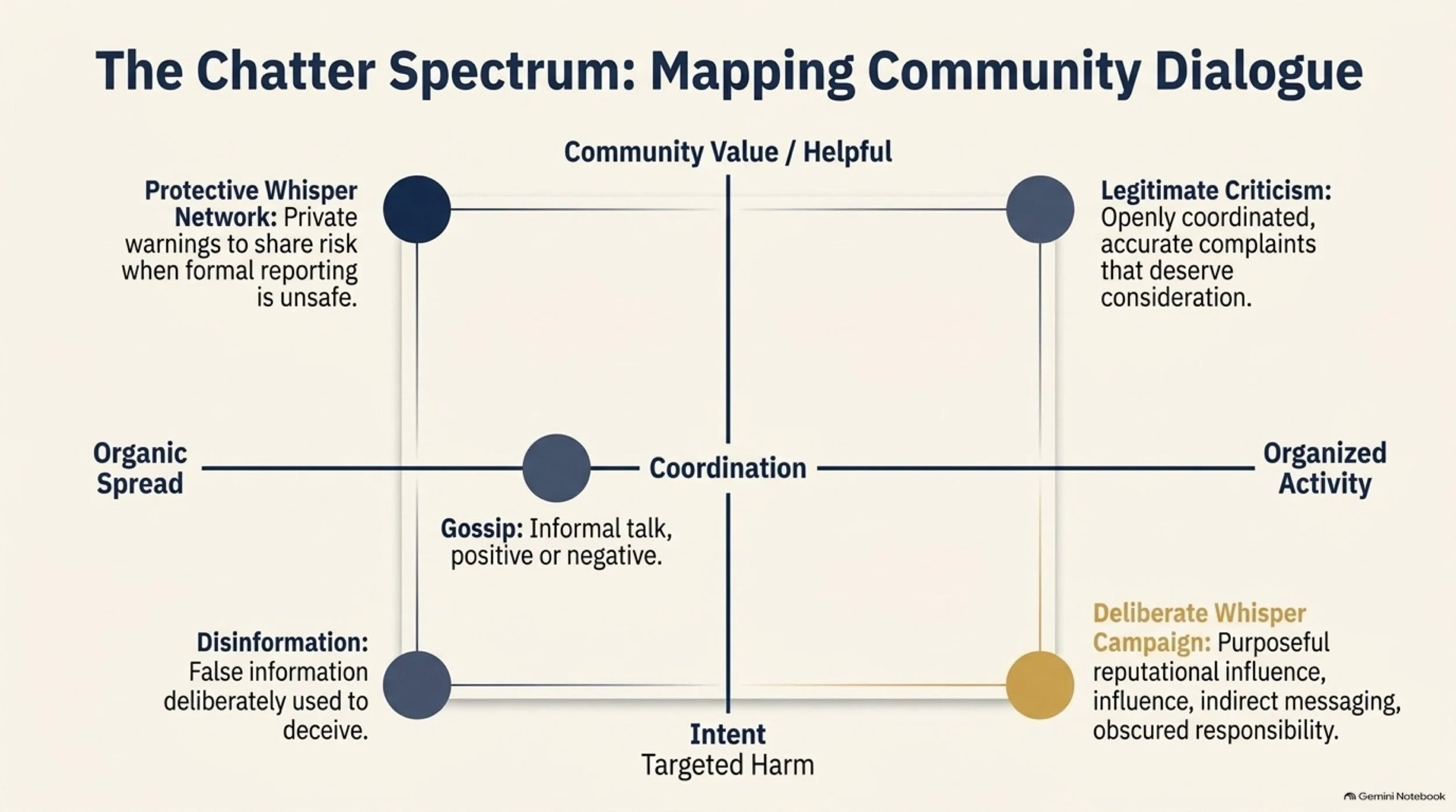
TermWhat it means hereGossipInformal talk about someone who is absent. It can be positive, neutral, negative, useful or harmful.RumorInformation circulating while its evidentiary status remains unsettled. Unverified does not mean disproven.MisunderstandingAn incorrect interpretation, memory or inference, which may be entirely sincere.Legitimate criticismComplaints, disagreement or accounts of experience that deserve consideration on their merits. A negative effect on reputation does not itself make criticism improper.Reputation formationThe expectations people develop from observations and reports about others.Protective whisper networkPrivate communication used to share warnings or make sense of possible misconduct, sometimes because formal reporting feels unsafe or ineffective.Coordinated negative messagingPeople intentionally aligning critical communications. Coordination can be open and the criticism can be accurate.AstroturfingOrganized activity deliberately made to look like independent grassroots participation.Covert influenceInfluence whose sponsor or method is deliberately concealed.DisinformationFalse or misleading information deliberately used to deceive. An honest error does not establish that intent.DefamationA legal claim involving specific requirements and defenses, rather than a general label for insults or hurt feelings.Deliberate whisper campaignPurposeful reputational influence through indirect negative messaging, often with obscured responsibility.
These categories can overlap. A truthful warning might also be gossip. A rumor could later be confirmed. A coordinated campaign might use accurate facts selectively. Calling everything a whisper campaign loses the distinctions needed to understand what happened.
Why can one voice sound like many?
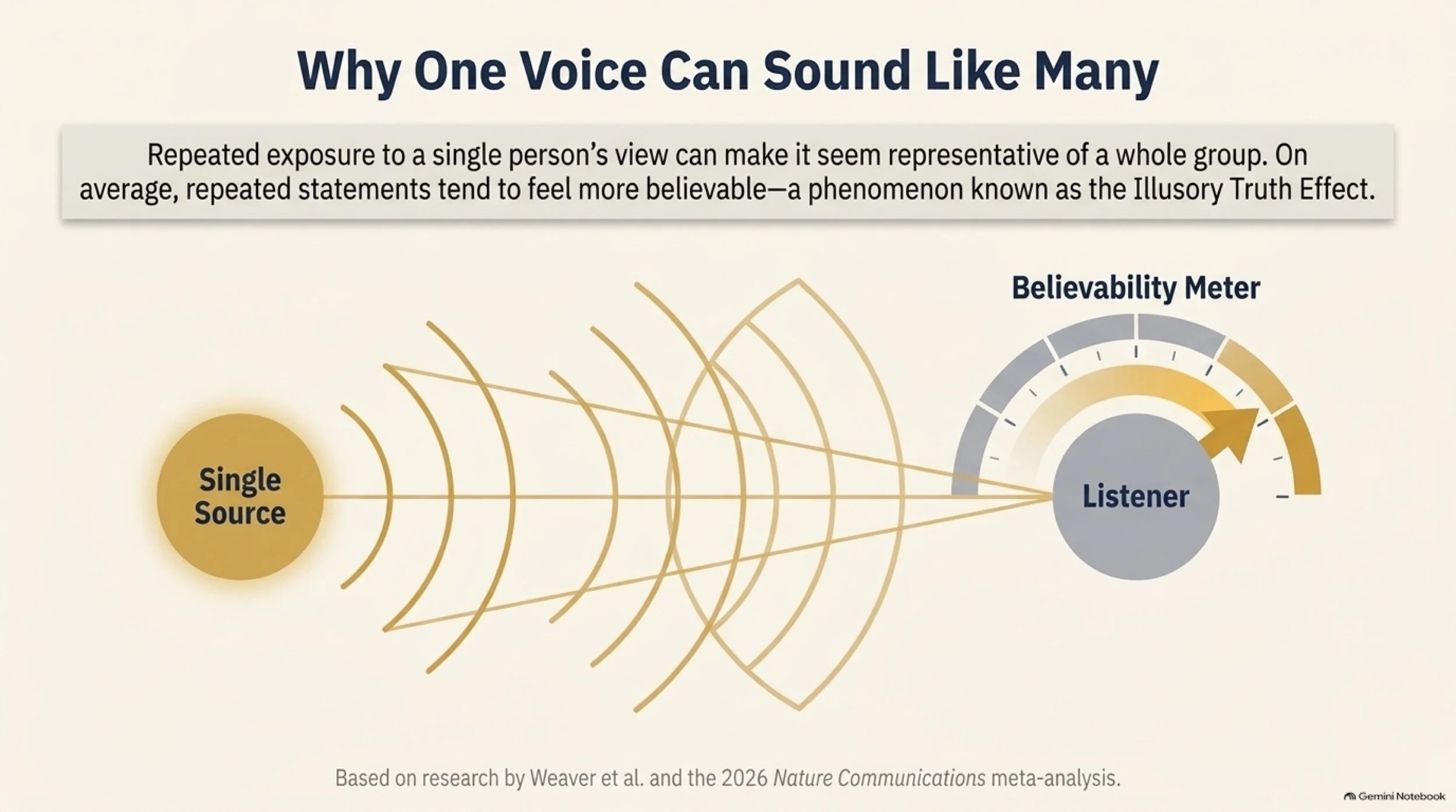
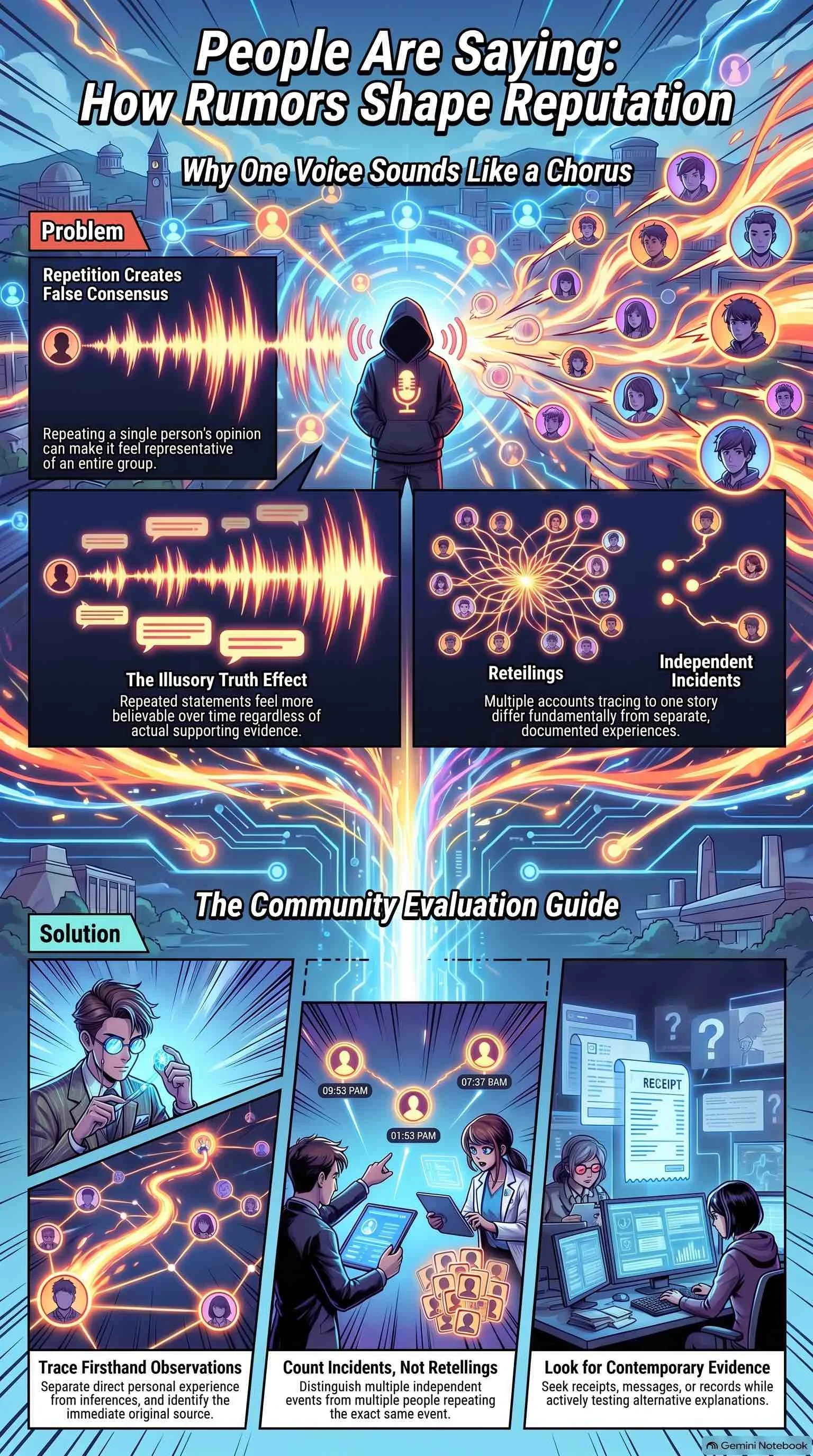
Repetition can affect how widespread an opinion seems, even when the repetition comes from one person.
In six experiments published in 2007, Kimberlee Weaver, Stephen Garcia, Norbert Schwarz and Dale Miller examined how familiarity affected judgments about an opinion's popularity. Repeated exposure to a single person's view could make it seem more representative of a group.
The finding gives the opening hypothetical a psychological foothold: a repeated voice can begin to sound like a chorus. The experiments did not track a Minnesota town or measure the loss of customers from a particular rumor. They tested a mechanism that could contribute to such situations.
There is a related, extensively studied effect on perceived truth. A 2026 meta-analysis in Nature Communications synthesized 182 studies, comprising 366 effects and 31,184 participants. Repetition retained a positive effect on truth judgments after adjustment for small-study effects, with substantial variation across conditions.
In ordinary language, repeated statements tend, on average, to feel more believable. This is known as the illusory truth effect. It does not mean repetition makes everyone believe everything. The study's adjusted effect size, 0.37, is a standardized statistical measure—not a finding that 37 percent of people believe a rumor.
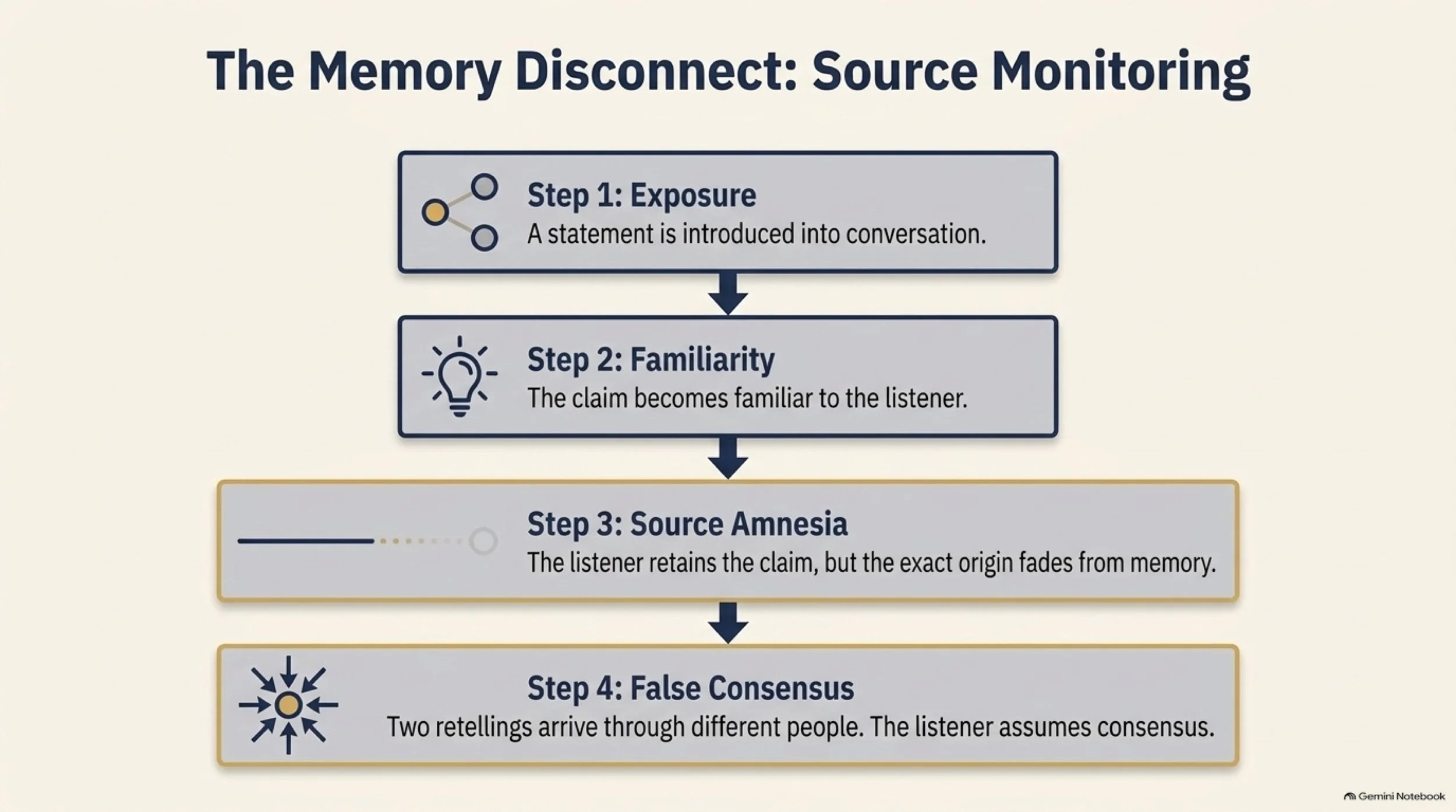
Remembering the message is another matter from remembering its origin. Psychologists call the process of identifying where a memory came from source monitoring. People can retain a claim while becoming less certain whether they read it, heard it directly or heard someone repeat it.
Put those possibilities together carefully. A statement becomes familiar. Familiarity affects a judgment. Its origin becomes harder to recall. Two retellings arrive through different people. The listener gets the impression that a lot of people know.
Every step is possible. None is inevitable, and no single experiment proves that whole sequence occurred in a real dispute. Reconstructing the communication would require evidence of its own.
Why does this matter in a connected community?
The useful question for Hastings readers is how relationships overlap, rather than whether small towns are unusually gullible. The research does not establish that Hastings is especially susceptible to whisper campaigns.
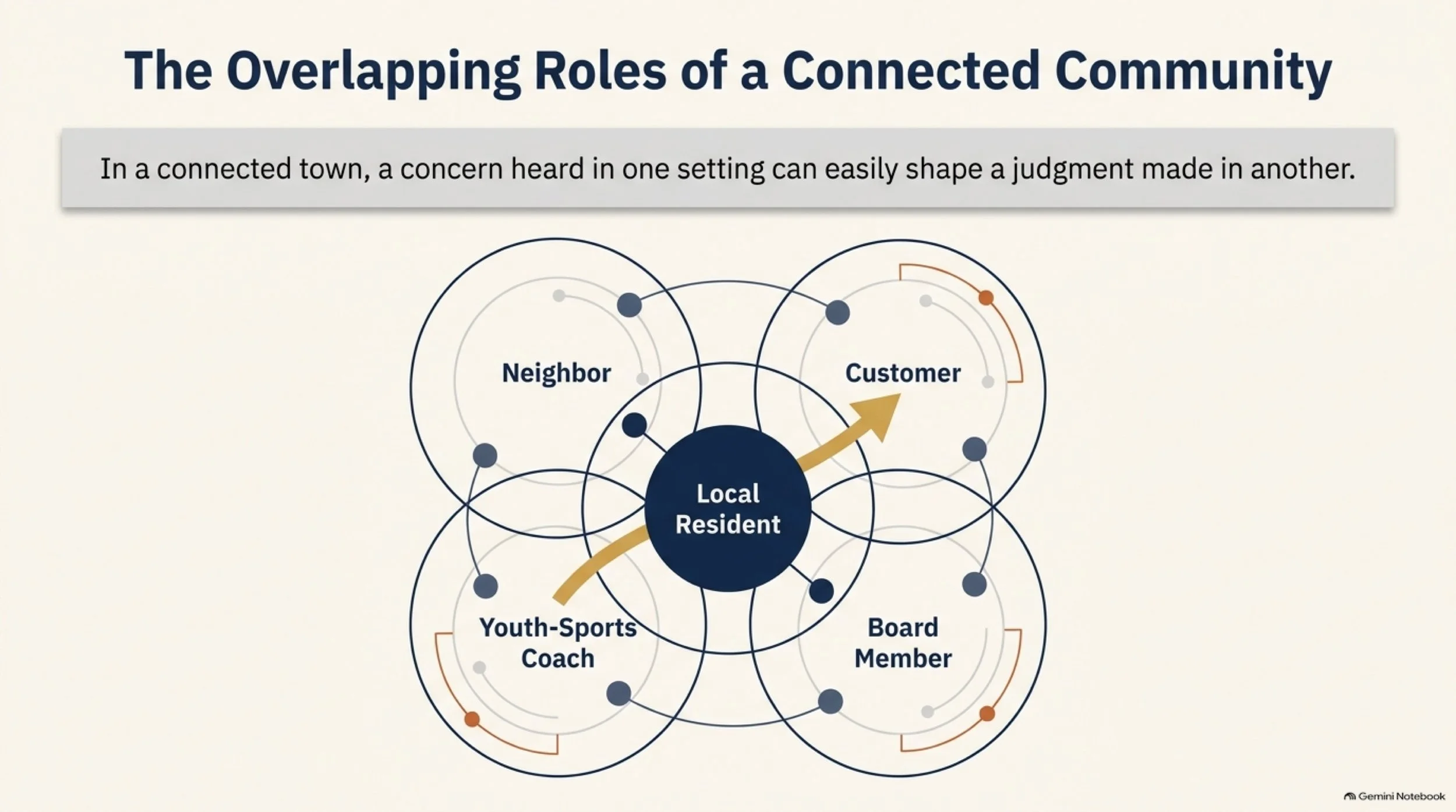
Think about the roles one person might hold: customer, neighbor, coach, employee, volunteer, parent, board member and friend. A concern heard in one setting can enter a judgment made in another. Someone choosing a contractor may remember a conversation at a school event. A private business impression may surface while discussing a civic appointment.
These are possible pathways, not findings about local conduct. They matter because a message's social route can look like evidence of its reach.
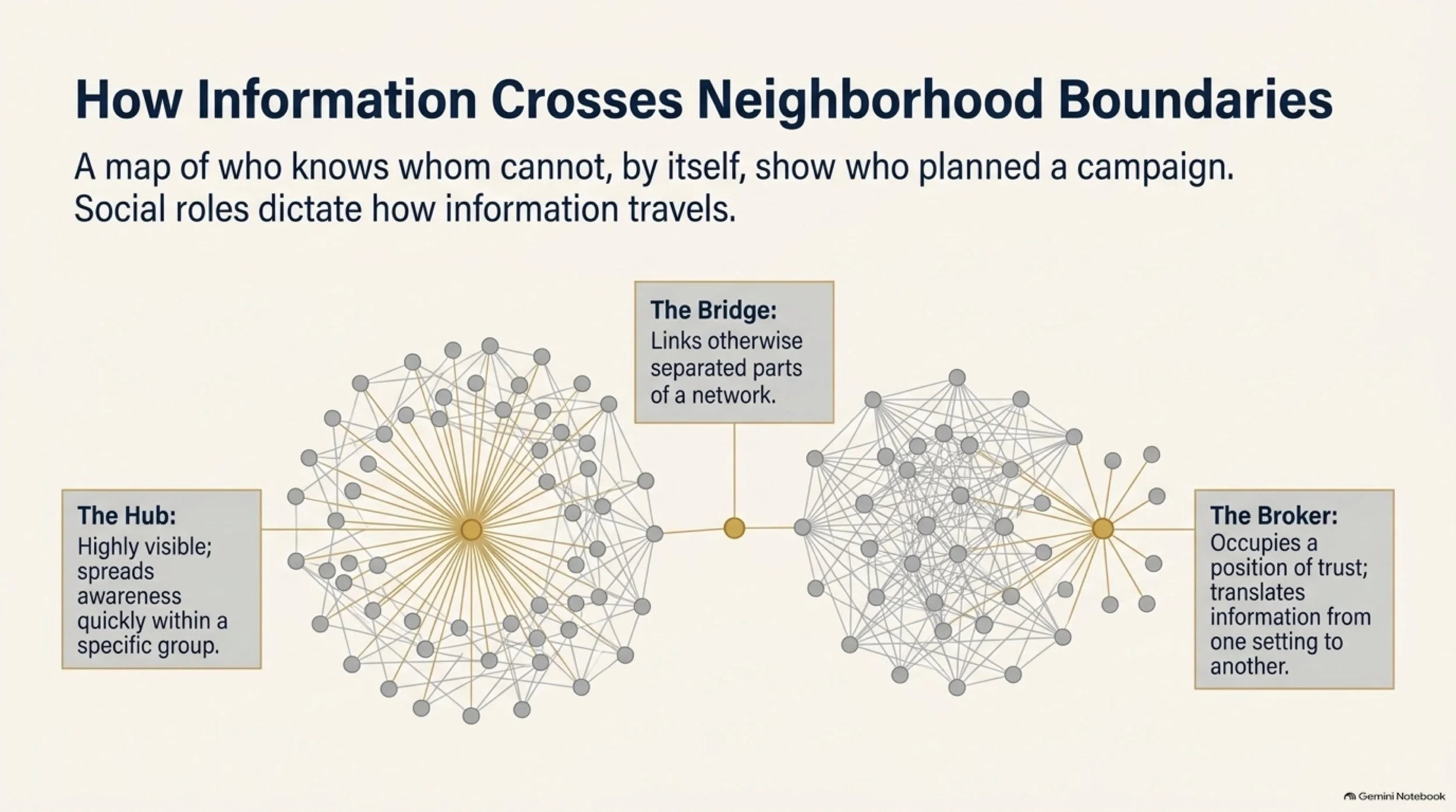
Sociologist Mark Granovetter's influential “The Strength of Weak Ties” helps explain how information crosses between circles. An acquaintance may connect people whose close friends mostly know one another. A message that stays within one tightly connected group can gain a new audience through that connection.
Different network roles should not be confused. A hub has many connections. A bridge links otherwise separated parts of a network. A broker occupies a position between circles and can mediate exchanges. A trusted messenger carries credibility for particular listeners. These roles may overlap, but neither a prominent title nor a large contact list proves someone is influential in all these ways.
Introducing information is also different from persuading people to accept it. Models developed by Damon Centola and Michael Macy distinguish simple transmission from adoption that requires reinforcement by several contacts. A structure that spreads awareness well may not produce the same pattern of belief or action. These are models, not a formula for predicting which neighbor will believe which claim.
Overlapping relationships can supply additional checks, too. Someone may know the subject well enough to challenge an implausible account or ask for particulars. Close connections can carry both a rumor and its correction.
If reputational information affects who receives trust, invitations or business, it can function as informal social control. That can discourage harmful conduct. It can also make an unsupported judgment consequential before anyone has examined it. Identifying a possible mechanism still leaves the practical questions: What changed, whose decision changed, and what evidence connects that decision to the communication?
Is gossip always harmful?
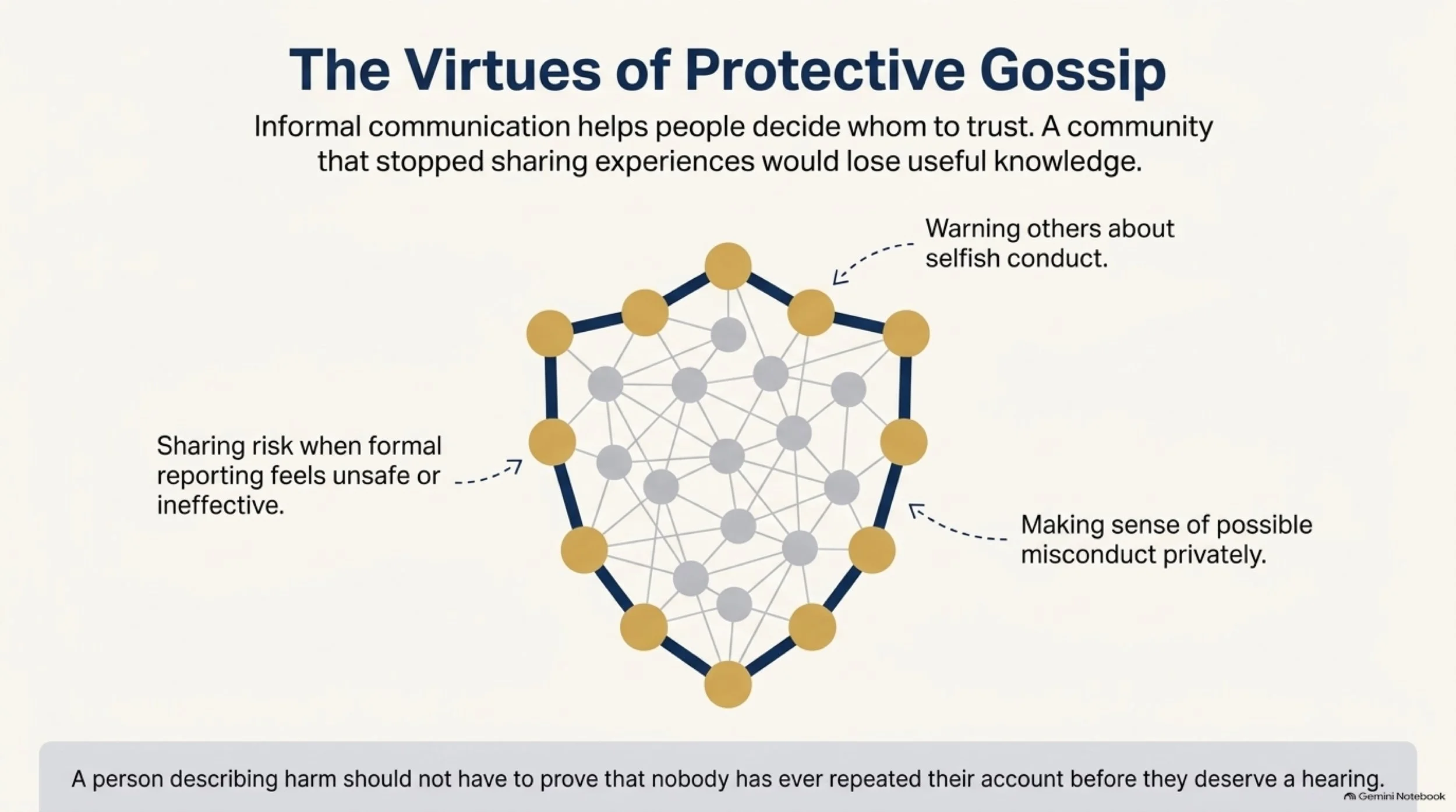
No. Informal communication helps people decide whom to trust and when to be cautious. A community that stopped sharing experiences would lose useful knowledge along with harmful rumor.
In experiments reported in “The Virtues of Gossip”, Matthew Feinberg and colleagues examined reputational information sharing as prosocial behavior. Participants could use gossip to warn others about selfish conduct. The work supports a protective function for some negative information, rather than the assumption that all negative talk is motivated by pleasure in another person's misfortune.
Experimental cooperation games are simplified environments. They do not tell us that every private warning is accurate or every person passing one along is altruistic. They do establish that warning others and protecting cooperation are serious functions to consider.
Another experiment offers an especially useful counterweight to the fear of repetition. Ralf Sommerfeld and colleagues studied multiple gossip statements in a cooperation game and found that aggregation could make reputation informative about behavior. More information can improve judgment when the underlying reports supply useful evidence. The study does not make three copies of one allegation equivalent to three separate experiences.
Protective whisper networks deserve particular care. In a 2023 qualitative study, Carrie Ann Johnson interviewed 20 participants about networks through which people discussed sexual harassment and misconduct. Participants described warning, support and efforts to make sense of experiences when formal channels were considered inadequate or risky.
That small, nonrepresentative interview sample cannot establish how common such networks are or adjudicate the underlying allegations. It does illuminate why someone might share a concern privately for reasons other than a desire to smear another person.
A person describing harm should not have to prove that nobody has ever repeated their account before they deserve a hearing. Nor does protecting someone from retaliation require treating every detail as already established. A listener can take an account seriously, preserve the speaker's privacy and still distinguish firsthand knowledge from uncertainty.
For journalists, that means explaining what anonymity protects, verifying independently where possible and giving the person accused a meaningful opportunity to respond. The Society of Professional Journalists' ethics code joins verification with minimizing harm and accountability. Those obligations belong together.
The practical goal is to improve the quality of conversation while preserving people's ability to warn one another.
Can it happen without a mastermind?
The appearance of a campaign can emerge without deliberate coordination. People may independently pass along information they believe, draw inferences from others' reactions or arrive at similar conclusions for good reasons.
Economists studying information cascades modeled situations in which people follow earlier choices even when their own private information points elsewhere. Convergence can develop without central direction. The model concerns a particular process of inference from others' actions; it is not a scientific label for every widely repeated sentence.
A deliberate campaign likewise need not have one mastermind. Several people could agree to circulate a message, while later repeaters know nothing about that agreement. But shared interests or similar opinions do not, by themselves, demonstrate such an agreement.
The opening hypothetical needs no plot. One person tells three acquaintances, who tell others. Their social circles overlap. The account returns through several routes. Everyone may be acting sincerely, even as the apparent number of sources grows beyond the number of original observations.
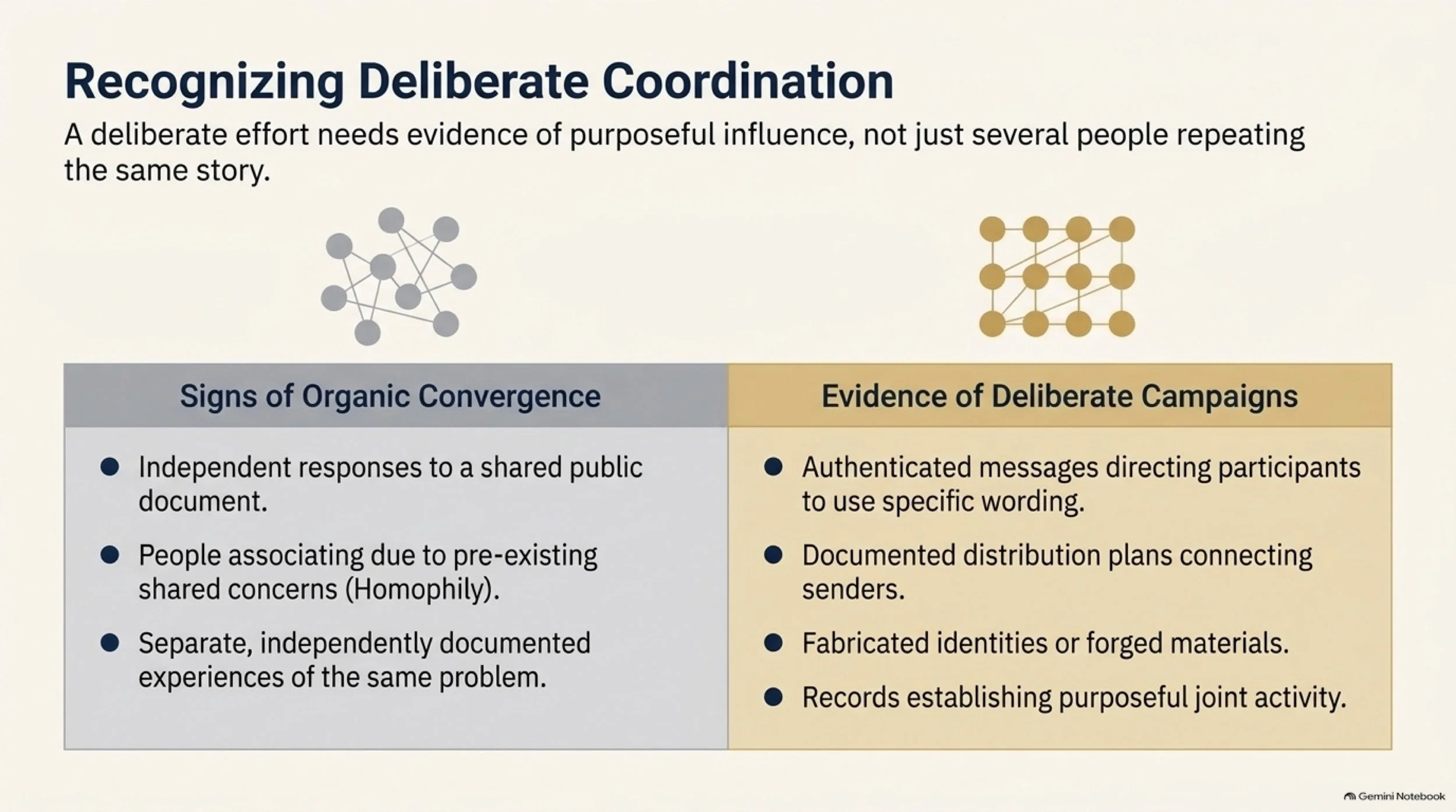
There are other explanations to test before calling that pattern manipulation. People may be responding to the same public document. They may already share concerns and therefore associate with one another. Or several may have experienced the same problem separately.
Research on networks warns that similarity between connected people can be difficult to separate from influence. A map showing who knows whom cannot, by itself, show who persuaded whom, much less who planned a campaign.
Confirmation bias can affect an investigation on both sides. Raymond Nickerson's review describes how people favor evidence that fits an existing belief. Someone convinced a business is unreliable may give special weight to every complaint. Someone convinced critics are coordinating may treat every shared phrase as another clue.
The discipline is the same in either direction: actively look for information that would make the initial explanation less convincing.
When does gossip become a campaign?
Purpose and conduct matter more than the number of speakers. The research reviewed for this story supplies no validated threshold at which three, five or ten people saying something turns a rumor into a campaign.
Some patterns justify questions. Stronger evidence can answer them.
A reason to investigate furtherEvidence with more direct bearing on deliberate activitySimilar wording or unusual phrasesAuthenticated messages directing participants to use that wording, or records of shared draftingSeveral messages appearing togetherDated instructions or a documented distribution plan connecting the sendersAn apparent beneficiaryCommunications, payments or contracts connecting that beneficiary to the effortAnonymous or misleading attributionEvidence identifying who created fabricated identities or forged materials and whyShared memberships or acquaintancesRecords or admissions establishing purposeful participation in the specific activity
Even the stronger items need interpretation. A contract may document ordinary public relations. Shared drafting may belong to openly organized advocacy. Fabrication may establish deception by one person without establishing a wider conspiracy. The evidence should support the narrow claim being made about it.
A beneficiary is not necessarily an organizer. Someone gaining customers after a competitor's difficulties does not prove they caused the difficulties. A politician benefiting from a damaging story does not prove their campaign planted it.
Two more distinctions deserve equal weight: a critic's sincerity does not establish truth, and a target's distress does not establish falsity. Both people can deserve a fair hearing while the facts remain unresolved.
Where did the term come from?
The expression is roughly a century old; the behavior is much older.
Merriam-Webster lists 1920 as the first known use of “whispering campaign.” Dictionary.com gives an origin range of 1915–1920. These are dictionary datings, not proof of the first time anyone uttered the phrase. The research does not establish a definitive earliest newspaper use.
Walter Lippmann discussed whispering campaigns in Public Opinion in 1922. The modern vocabulary was already part of thinking about public persuasion.
Historian Robert Darnton's work on eighteenth-century Paris reaches much farther back. Spoken news, songs, handwritten material and print interacted in a system through which information traveled and changed form. The network linking conversation with other media existed long before a neighborhood group chat.
That history does not make every old rumor a coordinated campaign. It reminds us to separate the age of the words from the age of the conduct—and to look for evidence of intention in particular cases.
What does a documented influence effort look like?
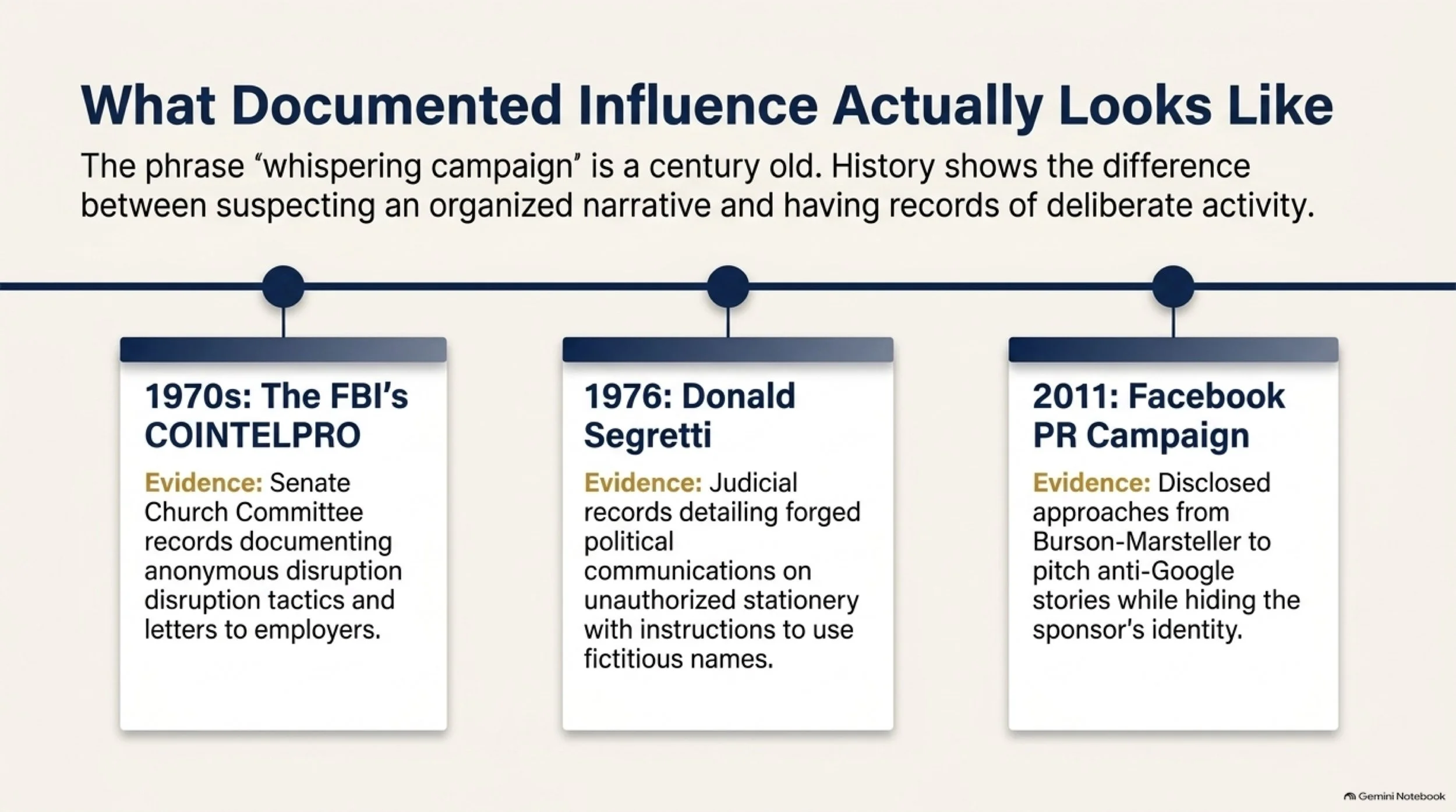
Three historical cases show the difference between suspecting that a narrative was organized and having records that establish deliberate activity.
The FBI's anonymous disruption tactics. The Senate's Church Committee documented covert efforts to damage relationships and reputations, including anonymous communications to employers and spouses and attempts to make people distrust one another. Its 1976 report drew on an investigation of government intelligence activities. These were documented methods of covert disruption. The FBI's counterintelligence program, known as COINTELPRO, encompassed other activities as well; labeling the entire program a whisper campaign would obscure those differences.
Donald Segretti's forged political communications. A 1976 California Supreme Court disciplinary opinion describes knowingly false materials attributed to rival political campaigns, including letters on unauthorized campaign stationery. The record also describes instructions to use a fictitious name to conceal association with President Richard Nixon's office. The court ordered two years of actual suspension from legal practice within a longer probationary disposition. Here, concealment and political disruption are documented in a judicial record, rather than inferred from who might have benefited.
Facebook's undisclosed public-relations campaign against Google. In 2011, Facebook acknowledged hiring Burson-Marsteller to raise criticism of Google's privacy practices without initially identifying Facebook as the client. Chris Soghoian disclosed an approach from the firm; reporting exposed the sponsorship. Contemporary Forbes reporting described the acknowledgment, and Wired called the effort a whisper campaign. Concealed sponsorship and the merits of the privacy criticism remain separate questions.
Such arrangements can offer plausible deniability: a beneficiary is separated from public responsibility for a message. Segretti's instructions provide direct evidence of an effort to create that separation. In an ordinary local dispute, it would need to be demonstrated rather than assumed.
These cases establish that deliberate, concealed influence occurs. They do not establish that every effort worked, or supply a shortcut for diagnosing a contemporary community disagreement.
What changes when a rumor moves online?
Digital communication can leave a better record of a claim while making its original context harder to recover.
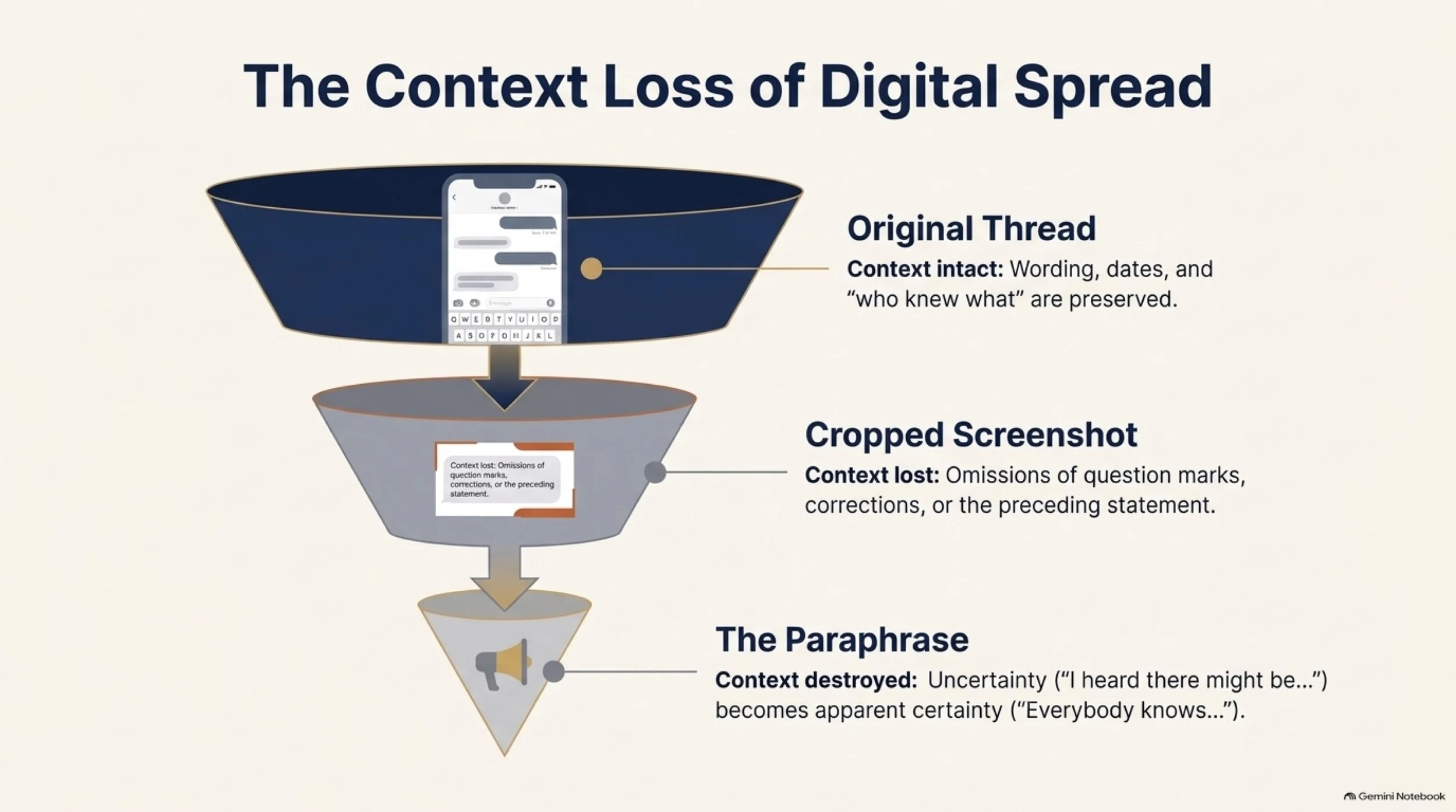
Imagine another possible route: a private conversation becomes a text; the text becomes a screenshot; the screenshot prompts a Facebook comment; that comment comes up in person; someone summarizes the conversation in a private group. At each transfer, a careful investigator would ask what survived and what was omitted.
Facebook, Instagram, Reddit, Nextdoor and group messaging provide different communication environments. Naming them does not mean their audiences, algorithms or privacy arrangements behave identically. Nor does the movement of a claim between them establish a coordinated plan.
An original thread may preserve wording, dates and replies that clarify who knew what. A cropped screenshot may omit a question mark, a correction or the statement being answered. A paraphrase may turn uncertainty into apparent certainty. Private groups and unavailable messages can leave gaps that a journalist cannot responsibly fill with inference.
A screenshot is a piece of evidence to authenticate. On its own, it does not establish who created the underlying communication, whether it is complete or whether its allegation is true. A deleted post does not automatically establish guilt. An anonymous account does not automatically establish wrongdoing.
Those distinctions apply offline, too. “I won't name names, but…” could reflect source protection, fear of retaliation, uncertain memory or deliberate ambiguity. “I've heard from several people” may be entirely accurate about the number of conversations and still leave the independence of their information unresolved.
A useful response begins with curiosity: What exactly is being claimed? What did you personally observe? If someone told you, who was your immediate source?
The purpose is to understand the information, not to demand that a vulnerable person identify themselves publicly before anyone listens.
AI infographic by HastingsNow.com
How can you tell whether reports are independent?
Follow the accounts backward, with permission and care, until you can distinguish original observation from retelling. Count people, source accounts, observations and incidents separately.
Three people who watched one meeting may provide three independently remembered observations of one event. Three people who all heard about the meeting from a fourth person supply three retellings. Three customers with separately documented transactions may provide evidence of three incidents.
Those distinctions say nothing, by themselves, about whether an allegation is true. One well-supported firsthand account may be highly significant. Ten repetitions may add little. Independence is one dimension of evidence, alongside accuracy, detail, relevance and opportunities for verification.
The following questions adapt that approach for everyday use.
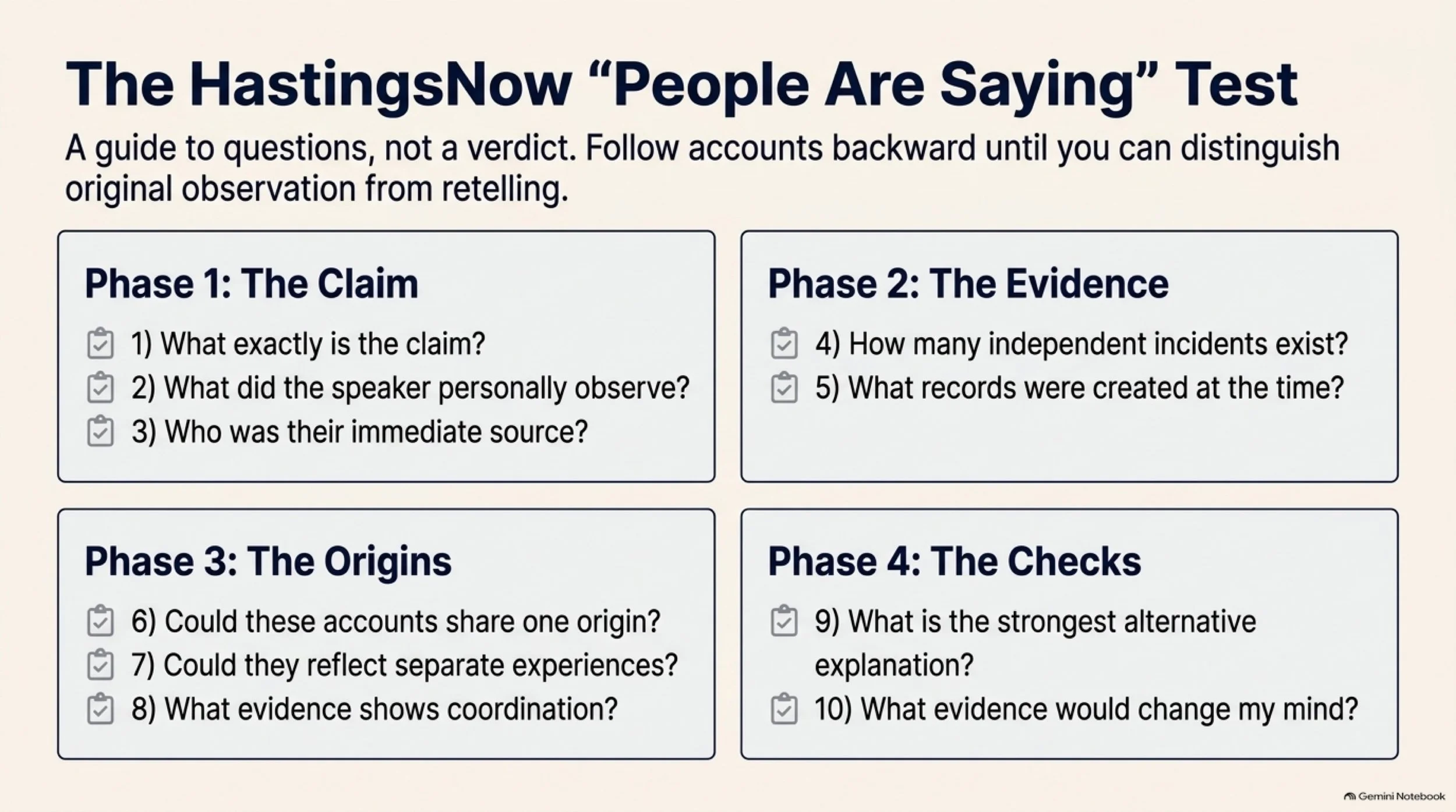
The HastingsNow “People Are Saying” test
What exactly is the claim? Separate a checkable statement, such as an invoice remaining unpaid on a particular date, from a broad judgment about someone's character.
What did this person personally observe? Distinguish what they saw, heard or experienced from what they inferred.
Who was the immediate source? If the speaker heard it from someone else, trace that step without assuming the chain is complete.
How many independent incidents exist? Count people, accounts, observations and events separately.
What evidence was created at the time? Look for original messages, receipts, minutes, photographs, transaction records or other relevant documents.
Could these accounts share an origin? Two social routes can carry the same original story.
Could these be separate experiences? Actively test the possibility that similar reports reflect a real pattern.
What demonstrates coordination? Distinguish similarity from records of purposeful joint activity.
What is the strongest alternative explanation? Consider misunderstanding, public information, ordinary transmission and independent observation.
What evidence would change my mind? Apply the same standard to explanations you welcome and explanations you dislike.
This is a questioning tool, not a scoring system. Ten checked boxes cannot adjudicate a dispute. A conversation may leave important gaps, and “we do not yet know” is a responsible conclusion when the evidence stops there.
How should you respond to a damaging rumor?
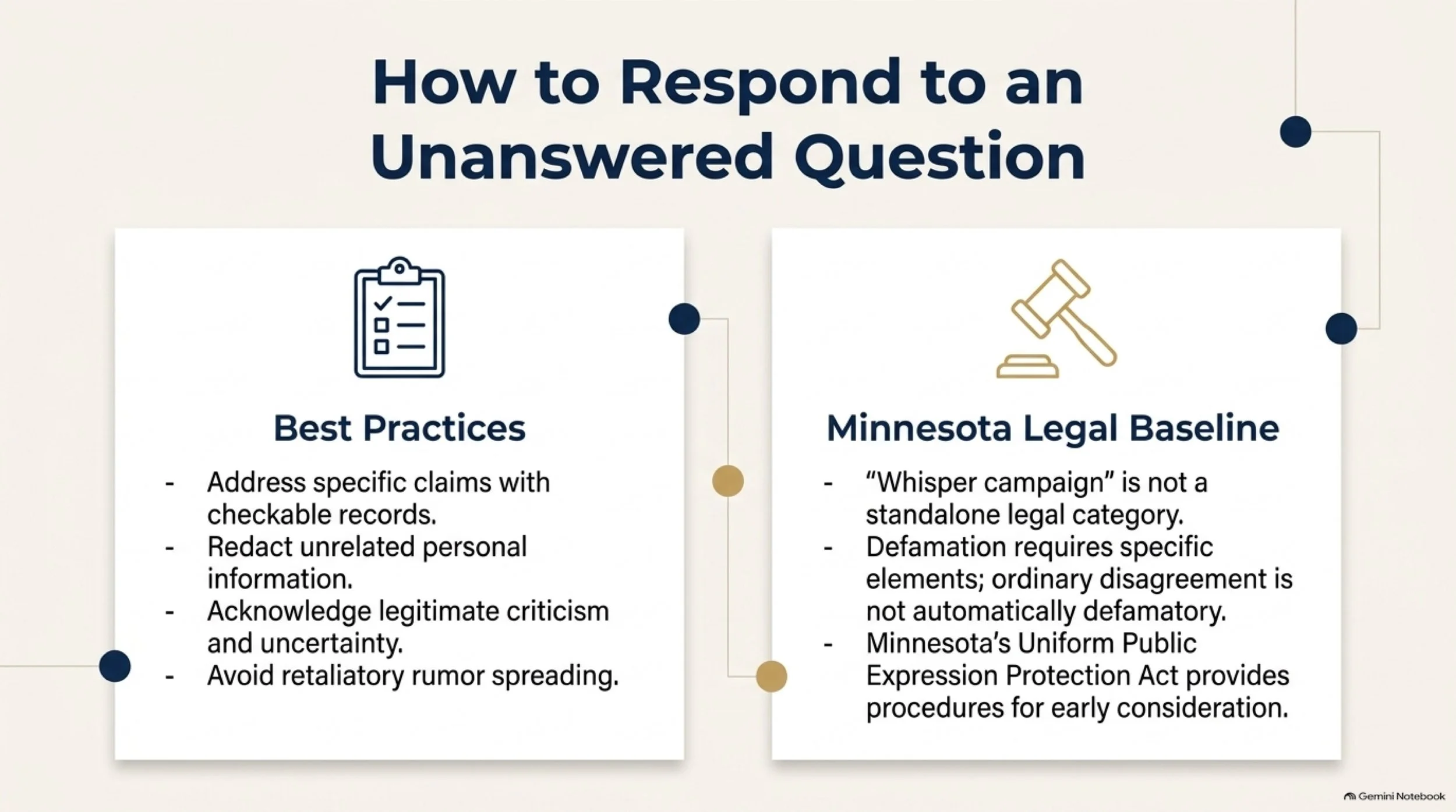
Begin with the specific claim and the available record. That gives you something useful to correct, investigate or acknowledge.
Save the original communication where you can, along with its date, surrounding context and the distinction between what you personally received and what someone reported to you. Keep lawful records of concrete consequences, such as a cancellation that explicitly references the claim. A general decline in business, standing alone, would not show what caused it.
If a statement is inaccurate, make the correction checkable. In a hypothetical billing dispute, “The attached receipt records payment on this date” gives readers more to evaluate than an accusation that unnamed enemies are lying. Redact unrelated personal information before sharing documents.
Match the response to the audience. A private misunderstanding may be resolved privately. A public claim with substantial reach may justify a public explanation. The question is who needs accurate information and how to reach them, rather than how to repeat the allegation to the largest possible audience.
State what the record establishes, acknowledge uncertainty and leave room for legitimate criticism. A document might correct the date of an incident without answering a complaint about how someone was treated. Fixing one factual error does not necessarily resolve the whole dispute.
Research does not support the blanket claim that corrections inevitably backfire. Thomas Wood and Ethan Porter tested corrections across five experiments, involving more than 10,100 participants and 52 issues, without finding the feared factual backfire in those tests. A broader review by Ullrich Ecker and colleagues explains both the usefulness of correction and the ways misinformation can retain influence.
Improving factual beliefs is not the same outcome as restoring a friendship, revenue or trust. Still, a verifiable correction gives people a basis for updating what they believe.
Avoid retaliatory rumor spreading and unsupported public accusations about who organized the problem. If the record reveals a real failure, address that failure. If the record remains incomplete, describe the limits precisely.
Journalists have additional responsibilities: seek original evidence, give affected parties a meaningful chance to respond, distinguish allegation from finding and correct errors prominently. A response is part of the record, not automatic proof for either side. New information may require changing the story, including its headline.
What about Minnesota law?
This is general information, not legal advice. Legal questions depend on the exact statement, its context, the people involved and the evidence.
False factual statements communicated to others and harming reputation can raise defamation issues. Substantial truth matters. In McKee v. Laurion, the Minnesota Supreme Court rejected the claims over the particular online-review statements before it. The decision does not mean every review is immune from suit.
Ordinary disagreement and rhetorical opinion are not automatically defamatory. But adding “in my opinion” does not necessarily protect an assertion that implies provably false facts, as the U.S. Supreme Court explained in Milkovich v. Lorain Journal.
Public officials and public figures can face different requirements from private individuals. The legal term “actual malice” concerns knowledge of falsity or reckless disregard for truth, not simply hostility. Public concern can also affect the analysis; these labels require care.
Anonymous political speech can receive constitutional protection. Anonymity is not blanket permission to defame. And damage to a business does not, by itself, establish unlawful interference: Minnesota's Gieseke decision explains specific requirements for interference with prospective economic advantage.
Minnesota's Uniform Public Expression Protection Act provides procedures for early consideration of qualifying speech-related claims, including scope rules, exceptions and fee provisions. It does not automatically protect every critical post.
An attorney can evaluate specific false allegations, business interference, threats, harassment or litigation deadlines. Any future article about an identifiable contemporary Hastings dispute would need its own evidence and individualized Minnesota legal review.
What a community can do with an unanswered question
Return to the imaginary service provider. Perhaps the original resident's experience was accurately described. Perhaps a misunderstanding changed the account. Perhaps separate records reveal a pattern the wider community should know about.
Asking where the story came from leaves all those possibilities open long enough to examine them.
A healthy community needs people willing to describe what happened to them. It needs warnings, disagreement and criticism that reaches people with the power to respond. It also needs a way to correct the record without requiring everyone to defend their first impression forever.
That work happens in ordinary exchanges. Someone distinguishes what they know from what they heard. Someone passes along a correction as readily as the original account. Someone takes a complaint seriously enough to ask for the details. Someone changes their mind.
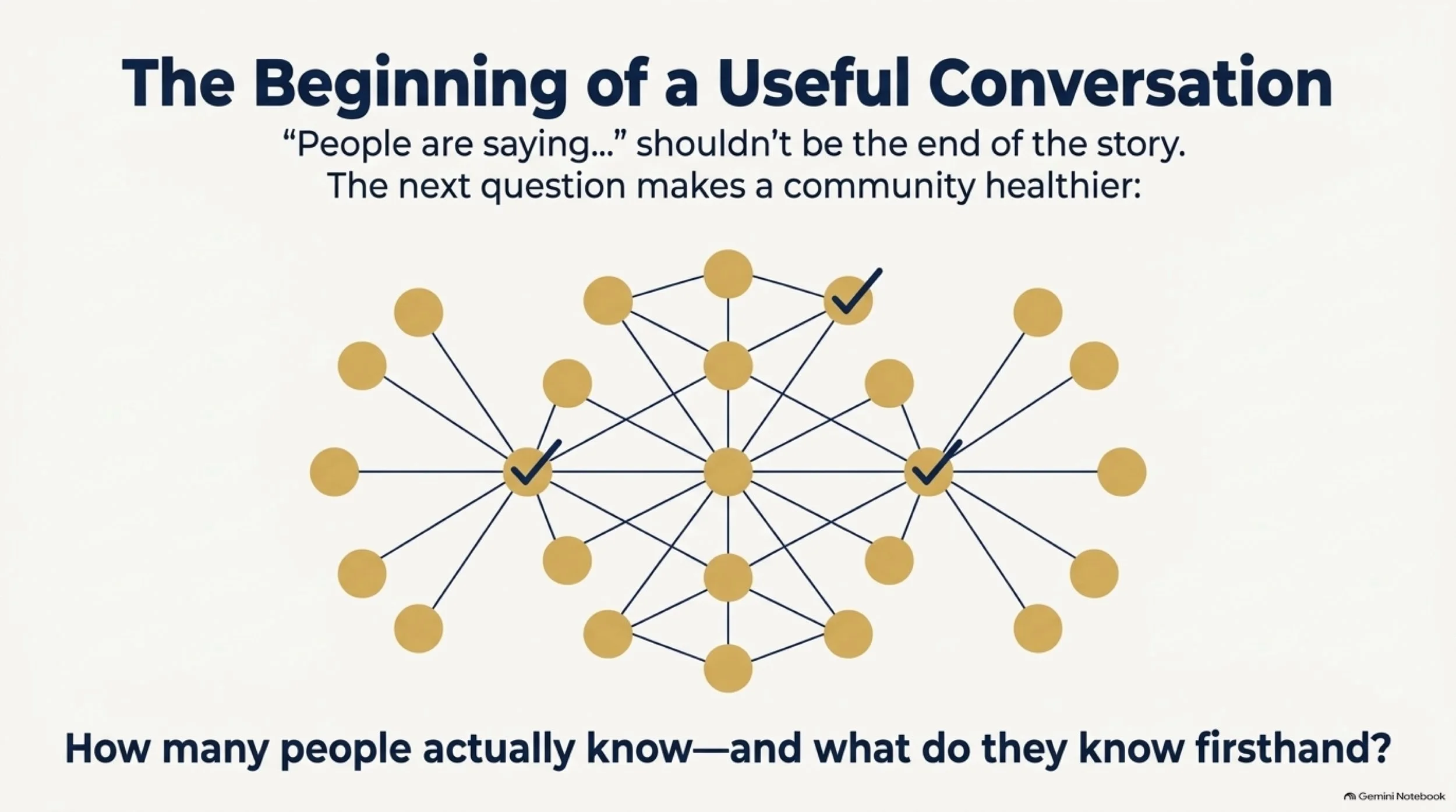
“People are saying…” can be the beginning of a useful conversation. The next question can make it better:
How many people actually know—and what do they know firsthand?
Key takeaway box
Before a story becomes a reputation
Several retellings can trace back to one original account.
Similar reports can also reflect separate, genuine experiences.
Repetition can affect perceived truth and popularity; it does not prove coordination.
Private warnings and gossip can protect people and encourage cooperation.
Check the exact claim, its evidence and its origins before drawing conclusions about intent.
Suggested placement: after the early definition or beside the article's evidence checklist.
Shareable checklist
The HastingsNow “People Are Saying” test
What exactly is the claim?
What did the speaker personally observe?
Who was their immediate source?
How many independent incidents exist?
What records were created at the time?
Could these accounts share one origin?
Could they reflect separate experiences?
What evidence shows coordination?
What is the strongest alternative explanation?
What evidence would change my mind?
Count people, accounts, observations and events separately. This is a guide to questions, not a verdict.
Frequently asked questions
What is a whisper campaign?
A deliberate whisper campaign is a purposeful attempt to shape reputation through indirect or informal negative messaging, often with responsibility obscured. Repetition alone does not establish that one exists.
Is gossip the same as a rumor?
No. Gossip generally concerns someone who is absent and may be accurate, neutral or positive. A rumor is circulating information whose evidentiary status remains unsettled. Unverified does not automatically mean false.
Can a whisper campaign happen without one organizer?
A deliberate effort can involve several loosely coordinated participants. But a campaign-like pattern can also emerge through sincere, uncoordinated repetition. Evidence of purpose or coordination is needed to distinguish those situations.
Does hearing a claim from several people confirm it?
No. Their accounts may share an origin. Ask what each person observed and whether they describe separate events. Several independent witnesses to one event can corroborate that event without establishing several incidents.
Does repetition make a claim more believable?
On average, repetition can increase perceived truth. Research also finds that a repeated opinion can seem more widely shared. These are tendencies under studied conditions, not guarantees about what any particular listener will believe.
Is a private warning network necessarily malicious?
No. People may privately share warnings for protection, support or help interpreting events, particularly when formal reporting feels unsafe. Those purposes deserve consideration while the underlying claims are assessed fairly.
How should I respond to something false about me or my business?
Preserve exact statements and context, identify the factual error and provide a checkable correction to the relevant audience. Acknowledge legitimate criticism and uncertainty. Avoid retaliatory allegations. Seek legal advice when the circumstances warrant it.
Is a whisper campaign illegal in Minnesota?
The phrase is not a standalone legal category. Particular conduct could raise defamation, interference or other legal questions, while criticism and other protected speech have legal safeguards. An attorney must evaluate the specific facts.
Does this article document a whisper campaign in Hastings?
No. It explains research and documented historical cases. Its local-style examples are hypothetical and make no accusation against a Hastings person, business or organization.
Sources and further reading
The following 25 selections are starting points for verification and further reading. Additional legal authorities and supporting studies are linked at the relevant passages above. Experimental findings describe studied conditions; theories describe mechanisms; historical records establish particular activities.
Eric K. Foster (2004), “Research on Gossip: Taxonomy, Methods, and Future Directions,” Review of General Psychology. Original study. A scholarly review of gossip's definitions, methods and functions; not an estimate of how much gossip is harmful.
Nicholas DiFonzo and Prashant Bordia (2007), “Rumor, Gossip and Urban Legends,” Diogenes. Original article. Explains conceptual differences, including rumor's unsettled evidentiary status.
Kimberlee Weaver, Stephen M. Garcia, Norbert Schwarz and Dale T. Miller (2007), “Inferring the Popularity of an Opinion From Its Familiarity,” Journal of Personality and Social Psychology. Original study. Six experiments concerning repetition and perceived group support.
Steeven Ye and colleagues (2026), “Systematic Review and Meta-analysis of the Evidence for an Illusory Truth Effect and Its Determinants,” Nature Communications. Original review. A synthesis of 182 studies; variation and small-study effects limit a single universal estimate.
Marcia K. Johnson, Shahin Hashtroudi and D. Stephen Lindsay (1993), “Source Monitoring,” Psychological Bulletin. Original review. Explains how people attribute memories to sources and how those judgments can fail.
Mark S. Granovetter (1973), “The Strength of Weak Ties,” American Journal of Sociology. Original article. Foundational network scholarship; not a universal rule for rumor speed.
Damon Centola and Michael Macy (2007), “Complex Contagions and the Weakness of Long Ties,” American Journal of Sociology. Original study. Models distinguish transmission from adoption requiring social reinforcement.
Sushil Bikhchandani, David Hirshleifer and Ivo Welch (1992), “A Theory of Fads, Fashion, Custom, and Cultural Change as Informational Cascades,” Journal of Political Economy. Original theory. Demonstrates how sequential decisions can converge without central direction under specified assumptions.
Matthew Feinberg, Robb Willer, Jennifer Stellar and Dacher Keltner (2012), “The Virtues of Gossip,” Journal of Personality and Social Psychology. Original study. Experimental evidence concerning prosocial reputational information sharing.
Ralf D. Sommerfeld, Hans-Jürgen Krambeck and Manfred Milinski (2008), “Multiple Gossip Statements and Their Effect on Reputation and Trustworthiness,” Proceedings of the Royal Society B. Full text. A cooperation-game experiment showing informative aggregation; it does not equate repeated copies with separate observations.
Carrie Ann Johnson (2023), “The Purpose of Whisper Networks: A New Lens for Studying Informal Communication Channels in Organizations,” Frontiers in Communication. Original article. Twenty qualitative interviews on protective networks; a small, nonrepresentative sample, not an adjudication of allegations.
Cosma Rohilla Shalizi and Andrew C. Thomas (2011), “Homophily and Contagion Are Generically Confounded in Observational Social Network Studies,” Sociological Methods & Research. Original article. Explains why network similarity alone cannot identify social influence.
Raymond S. Nickerson (1998), “Confirmation Bias: A Ubiquitous Phenomenon in Many Guises,” Review of General Psychology. Original review. A broad review applicable to both acceptance of allegations and suspicion of coordination.
Merriam-Webster, “Whispering campaign.” Dictionary entry. Lists first known use as 1920; that is not a definitive earliest newspaper occurrence.
Walter Lippmann (1922), Public Opinion. Primary text. Chapter IX includes discussion of whispering campaigns.
Robert Darnton (2000), “An Early Information Society: News and the Media in Eighteenth-Century Paris,” American Historical Review. Original article. Historical scholarship on interaction among oral, manuscript and printed communication.
U.S. Senate Select Committee to Study Governmental Operations with Respect to Intelligence Activities (1976), Final Report, Book II, Senate Report 94-755. Primary government report. Documents covert disruption and anonymous attacks, including the overview at printed pages 10–11.
California Supreme Court (1976), Segretti v. State Bar, 15 Cal. 3d 878. Primary opinion. Judicial findings concerning false political communications, concealed association and professional discipline.
Kashmir Hill (May 12, 2011), “Facebook Admits To Being Behind Smear Campaign Against Google,” Forbes. Contemporary reporting. Reports acknowledged sponsorship and undisclosed approaches; does not settle every underlying privacy claim.
Sam Gustin (May 12, 2011), “BOOM! Goes the Dynamite Under Facebook's Google Smear Campaign,” Wired. Contemporary reporting. Additional reporting on the episode, explicitly using “whisper campaign.”
Thomas Wood and Ethan Porter (2019; first published online 2018), “The Elusive Backfire Effect: Mass Attitudes' Steadfast Factual Adherence,” Political Behavior. Original study. Five experiments finding no factual backfire in the tested conditions; not proof about every correction or relationship outcome.
Ullrich K. H. Ecker and colleagues (2022), “The Psychological Drivers of Misinformation Belief and Its Resistance to Correction,” Nature Reviews Psychology. Original review. Research on misinformation, correction and continued influence.
Minnesota Supreme Court (2013), McKee v. Laurion, 825 N.W.2d 725. Primary opinion. Substantial truth and nonactionable statements in a particular online-review dispute.
Minnesota Legislature, Uniform Public Expression Protection Act, Minn. Stat. §§ 554.07–554.20. Official statutory text. Procedures and qualifications for certain speech-related claims; consulted September 25, 2026.
Society of Professional Journalists (2014), Code of Ethics. Professional guidance. Verification, fair response, harm minimization, transparency and correction; ethical guidance rather than law.