

The real cost of buying, staying, and downsizing in 2026.
Advertisement. This feature was commissioned by Shannon Zywiec of Edina Realty.
By the HastingsNow team · Research checked November 9, 2026
The next chapter starts with a question
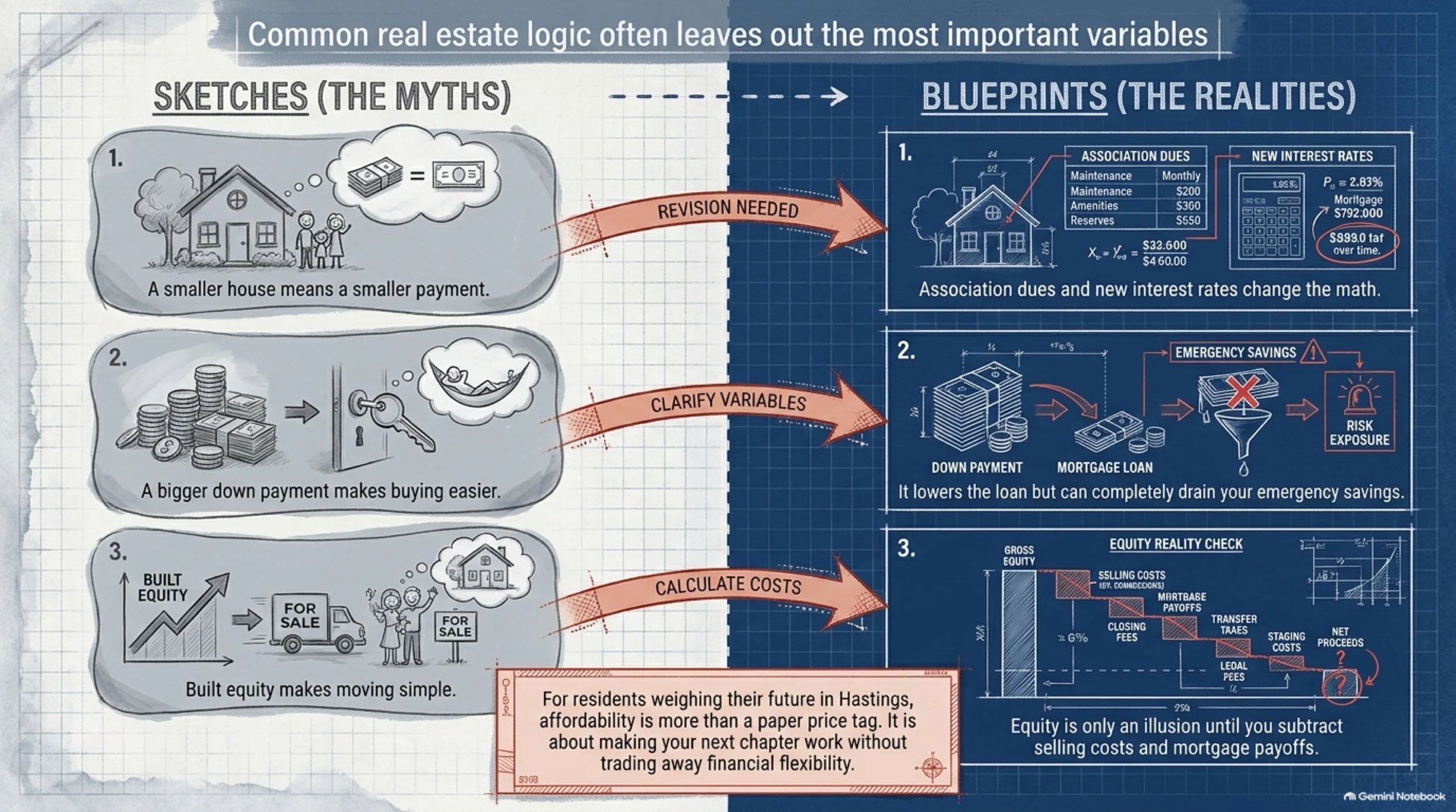
A smaller house should mean a smaller payment. A bigger down payment should make buying easier. And once you have built equity, moving should get simpler.
Each idea contains some truth. Each can also leave something important out.
The smaller home may come with association dues. The bigger down payment may empty the savings account. The equity may look substantial until you subtract what it takes to sell, settle the mortgage, and buy again.
For people weighing their future in Hastings, Minnesota, the question is larger than whether a house is affordable on paper: What would it take to make our next chapter work here?
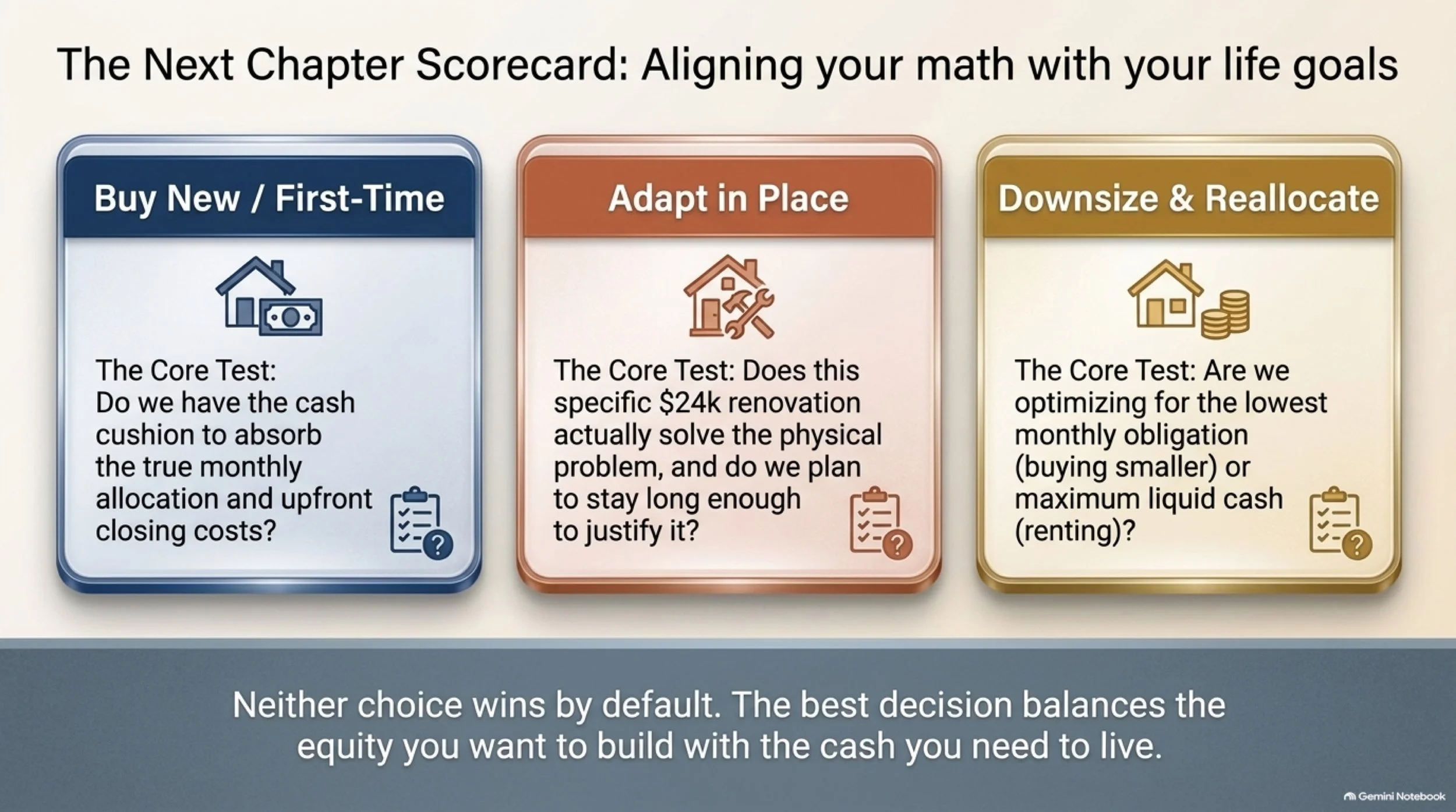
For a first-time buyer, that might mean getting the keys while keeping enough money for ordinary life. For a longtime homeowner, it might mean making a familiar home easier to use. For someone downsizing, it might mean trading yardwork for convenience without trading away financial flexibility.
In her written interview with HastingsNow, real estate agent Shannon Zywiec offers a useful starting point: “Does it make sense financially to move?”
Answering that requires more than a market headline. The Minneapolis Area REALTORS® report labeled Hastings records 26 closed sales and a $344,000 median sale price for September 2026, with data current as of October 7. That was the latest completed-month public report we could verify for this story. A median is the midpoint of recorded prices, not a price tag for every home. The report does not spell out all property-type filters; its Hastings series should not be treated as a ZIP-code-wide estimate or a valuation of a particular property. marketstatsreports.showingtime.com
That snapshot helps orient a search. Your own numbers determine what happens next.


Getting the keys—and keeping some breathing room
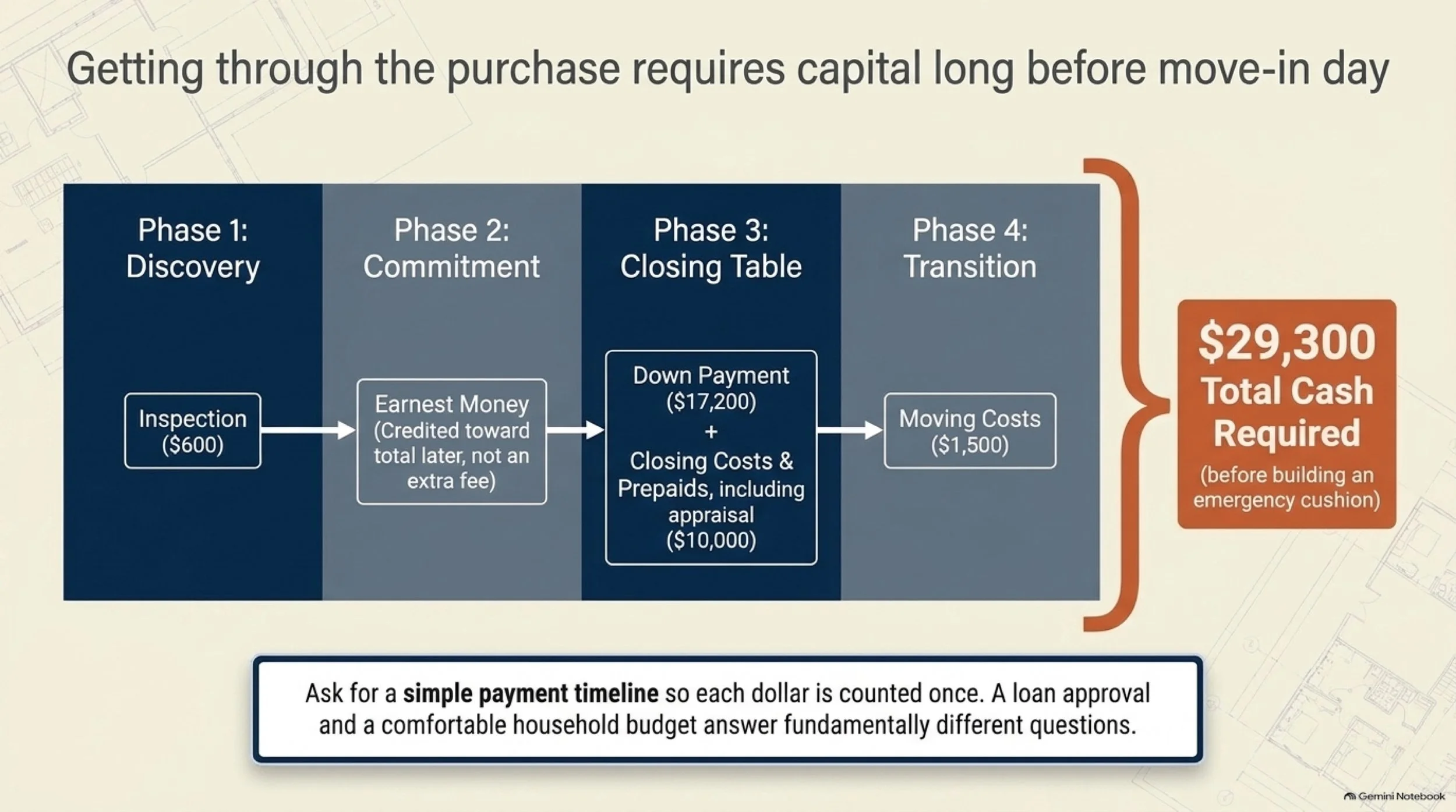
Shannon says buyers are often surprised by expenses that arrive before the first mortgage payment: earnest money, inspections, and sometimes an appraisal paid before closing.
The timing matters as much as the total. Earnest money is an early deposit, not automatically an extra cost on top of the purchase budget. When credited at closing, it reduces what remains due. The Consumer Financial Protection Bureau’s Loan Estimate explainer shows how deposits and other adjustments affect cash needed at closing. Ask for a simple payment timeline so each dollar is counted once. Consumer Financial Protection Bureau
Nor is 20 percent down a universal admission ticket. The CFPB’s down-payment guidance describes lower-down-payment options, with requirements and costs that vary. A smaller down payment may preserve savings while increasing borrowing costs. A larger one may reduce the loan while leaving less money accessible afterward. Consumer Financial Protection Bureau
The mortgage payment itself is only one line in the household budget.
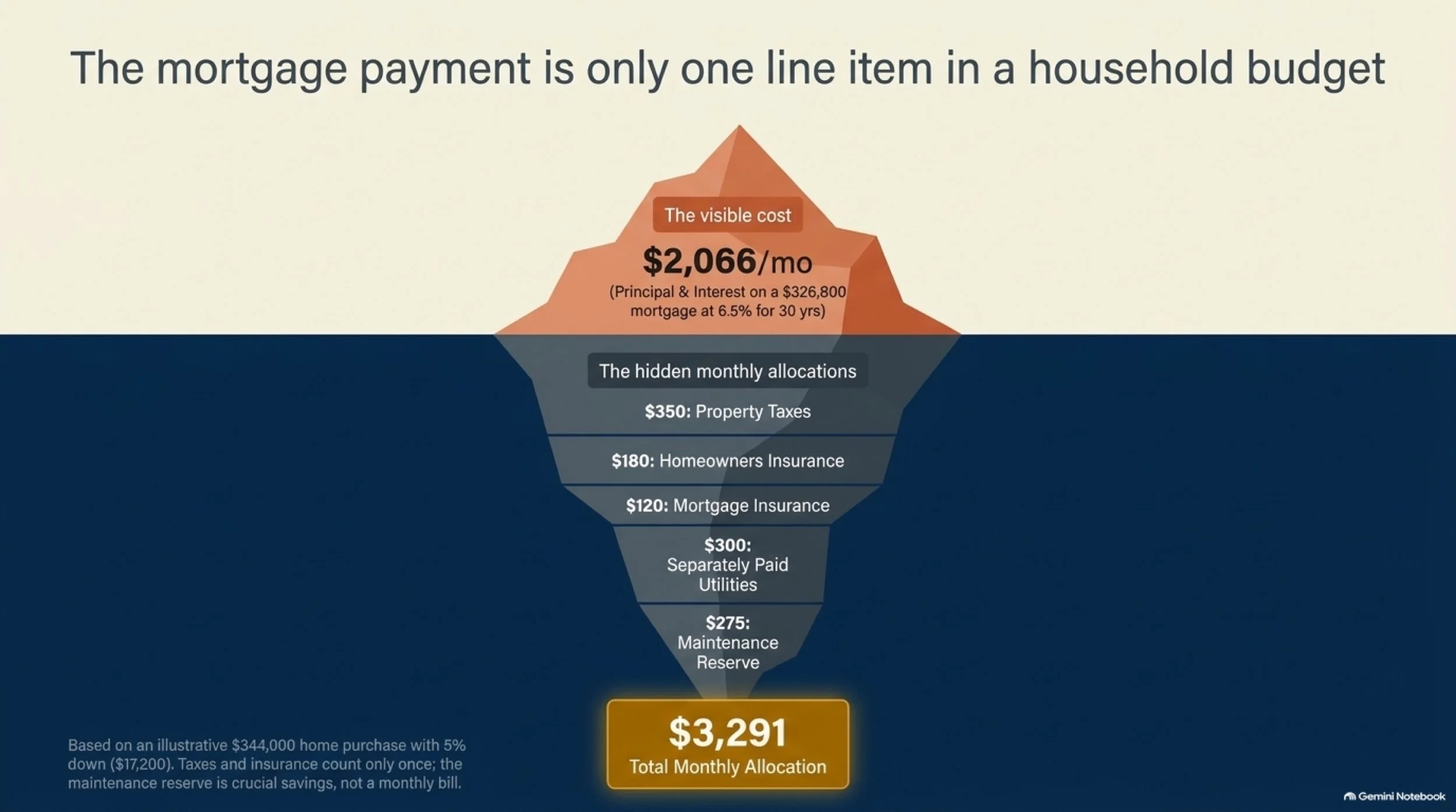
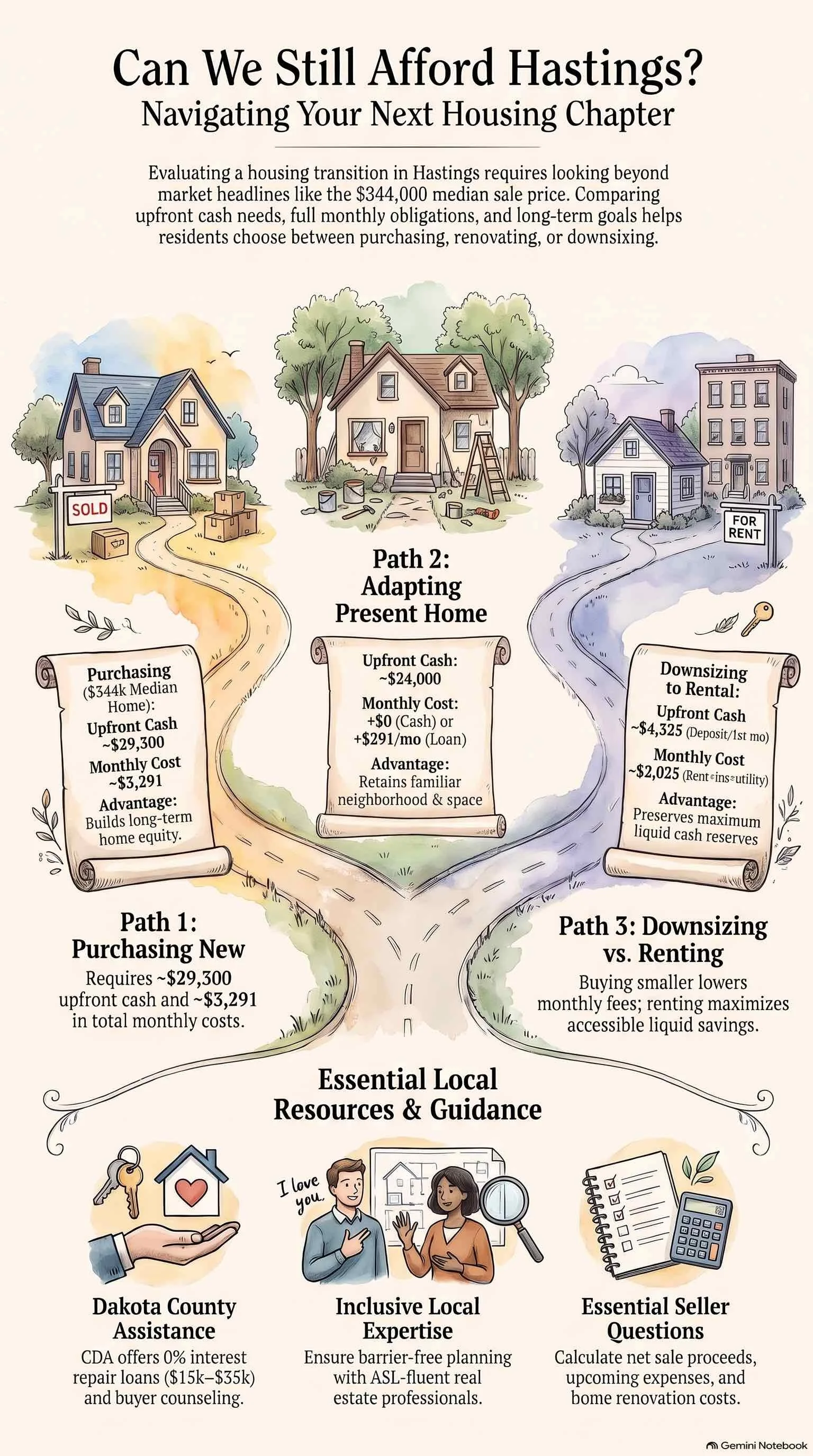
Consider an illustrative purchase, not a listing or loan offer: a $344,000 home, with 5 percent down—$17,200—and a $326,800 mortgage. At an assumed fixed rate of 6.5 percent over 30 years, principal and interest would be about $2,066 a month.
Now add assumed monthly amounts of $350 for property taxes, $180 for homeowners insurance, $120 for mortgage insurance, $300 for separately paid utilities, and $275 set aside for maintenance. The monthly allocation becomes about $3,291. This example has no association dues. All costs and the interest rate are illustrative; only the purchase-price anchor comes from the cited market report.
The maintenance reserve is savings for future work, not necessarily a bill spent that month. Taxes and insurance count only once, whether paid through the lender or separately. The point is to see the whole obligation before deciding whether it fits.
There is a second calculation: getting through the purchase. With the $17,200 down payment, an assumed $10,000 for closing costs and prepaids, a $600 inspection, and $1,500 to move, this example requires $29,300 before an emergency cushion. The $10,000 already includes an assumed appraisal charge; it is not added twice. Any credited earnest money is part of this total, not another amount on top.
A loan approval and a comfortable household budget answer different questions. What happens when work slows down, childcare costs change, or the car needs repairs? Before committing, compare the proposed full housing allocation with your actual spending. If practical, rehearse the increase by setting that amount aside while you are still in your current home.
The goal is to afford life after closing, too.
Infographic by HastingsNow.com
What if the house can change before the address does?
A home can remain deeply familiar while becoming harder to live in. The stairs are tiring. The bathroom layout no longer works. Maintenance keeps claiming weekends and savings.
Before translating those problems into “we need to move,” name what needs to change. A usable entrance and bathroom are a different assignment from a complete renovation. Getting specific makes it possible to compare real options.
Shannon suggests considering modifications when a home still meets most of its owner’s needs and the work could cost less than moving. That calls for estimates, not assumptions about what a renovation ought to cost.
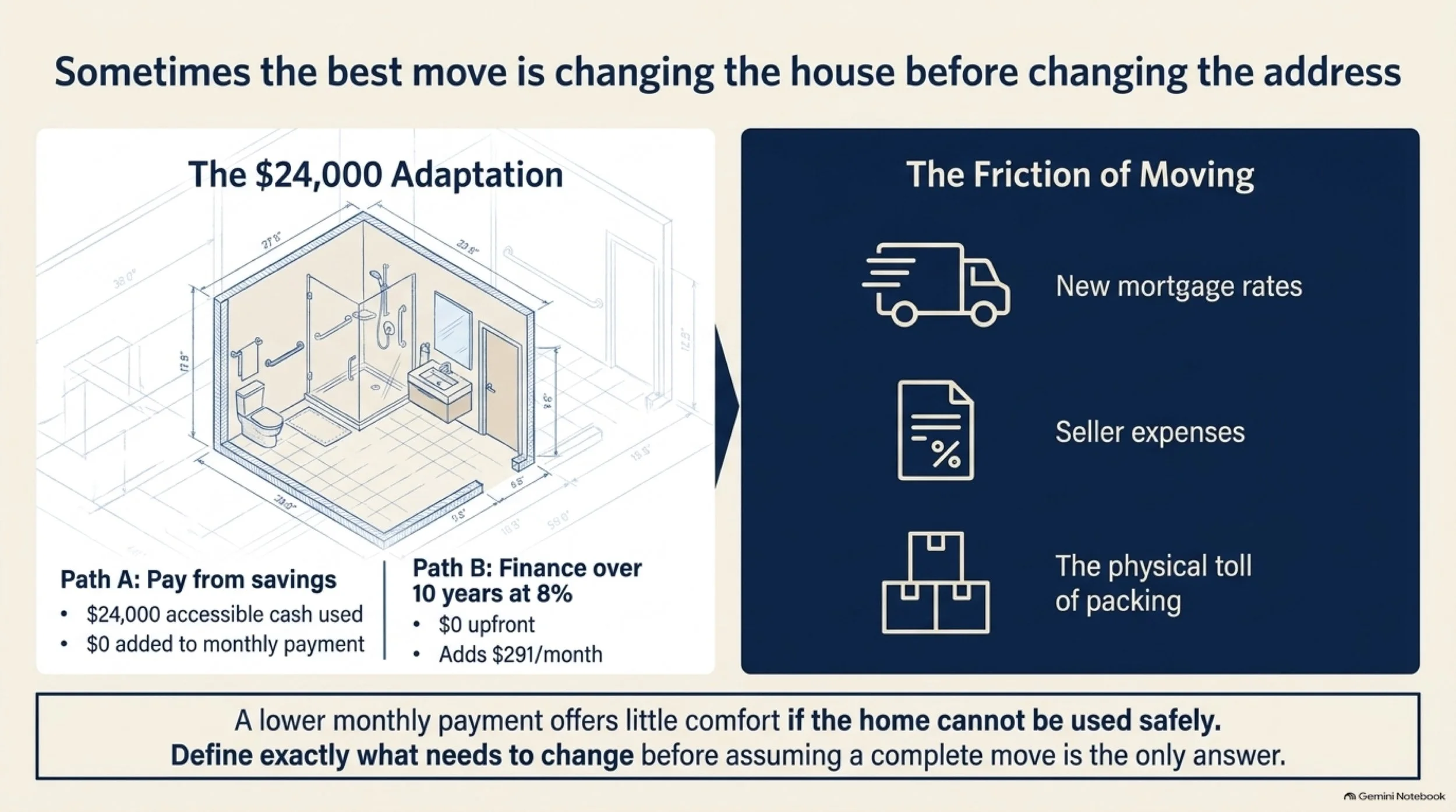
A second illustration: suppose suitable adaptations would cost $24,000. Paying from savings would use $24,000 of accessible cash without adding a loan payment. Financing the same amount over ten years at an illustrative fixed 8 percent rate would add about $291 a month, assuming no financing fees. Neither route makes the project free; each affects a different part of the household’s finances.
The comparison should include whether the proposed work actually solves the problem, any further repairs, and how long the owner expects to remain. A lower monthly payment offers little comfort if the home still cannot be used safely or comfortably.
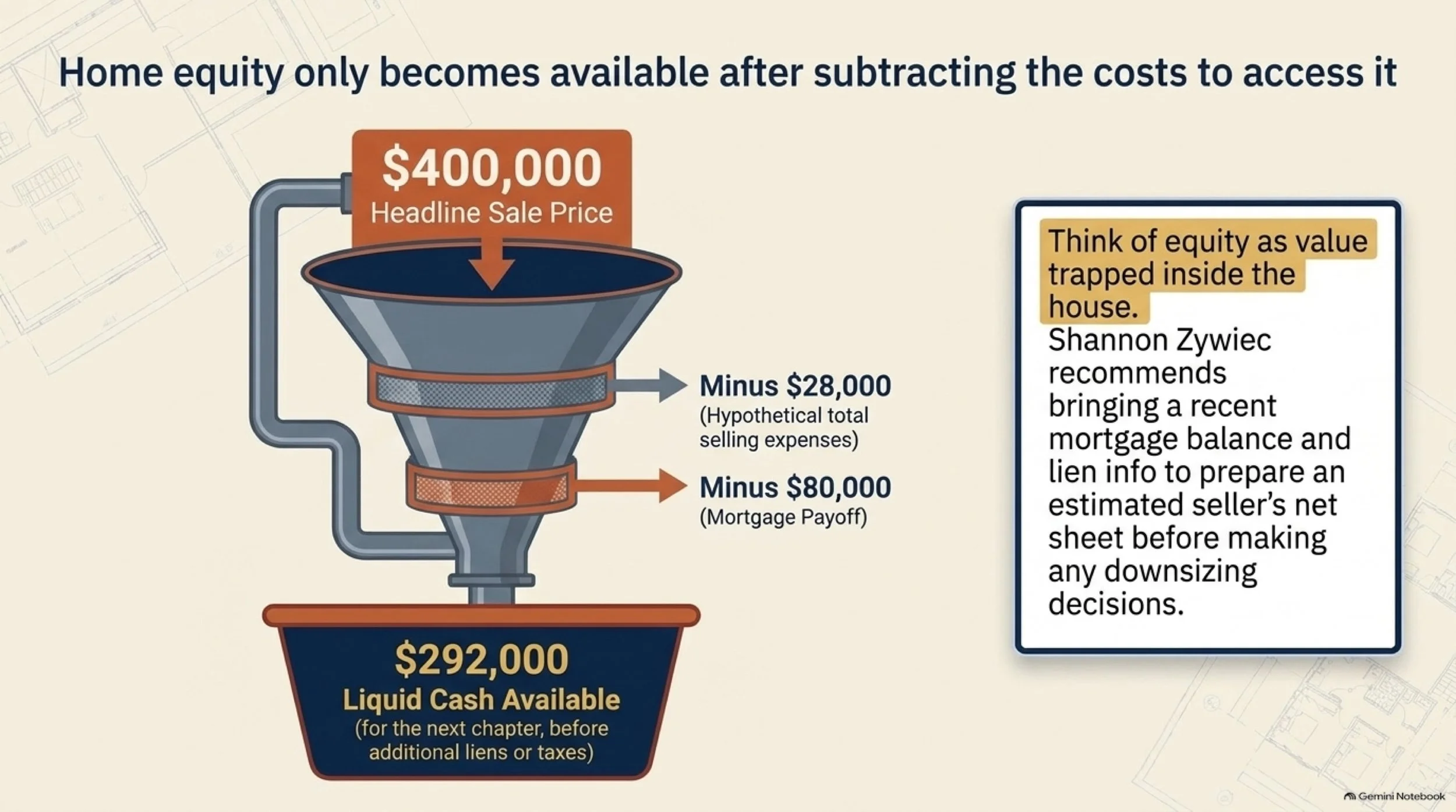
Moving has its own arithmetic. Shannon recommends bringing a recent mortgage balance and information about other liens so an agent can prepare an estimated seller’s net sheet: a calculation of what may remain after the sale expenses and debts are paid.
Think of equity as value stored in the house. It becomes available for the next decision only after accounting for the borrowing against it and the costs of accessing it. A headline sale price is not the amount deposited in your account.
For the home you might buy, check the property’s actual obligations. Hastings provides information on property taxes and special assessments, including how to request pending assessment amounts. Check whether an assessment is already included in the tax figure you are using. City of Hastings
Routine bills deserve the same attention. The city’s utility billing information explains that accounts are billed quarterly. Totaling a year of bills and dividing by 12 can make them easier to compare with monthly expenses. Allow separately for electricity, heating, and other services, while checking what rent or association dues already cover. City of Hastings
Staying can be a deliberate investment in a workable home. Moving can be the better answer when the needed changes are impractical. Neither choice needs to win by default.

Fewer rooms, but which bills get smaller?
Downsizing sounds like subtraction: fewer rooms, less cleaning, less yardwork. Financially, it is also a rearrangement.
“If the interest rate on the existing mortgage is significantly different than the current interest rate, the new mortgage payment may not be as low as someone would hope,” Shannon writes.
The new rate is one variable. The amount borrowed, taxes, insurance, association charges, and maintenance responsibilities matter alongside it. So does the money left available afterward.
A third illustration: assume a home sells for $400,000. Subtract $28,000 in hypothetical total selling expenses and an $80,000 mortgage payoff. That leaves $292,000 before any additional liens or taxes. The selling allowance is an assumption, not a standard commission.
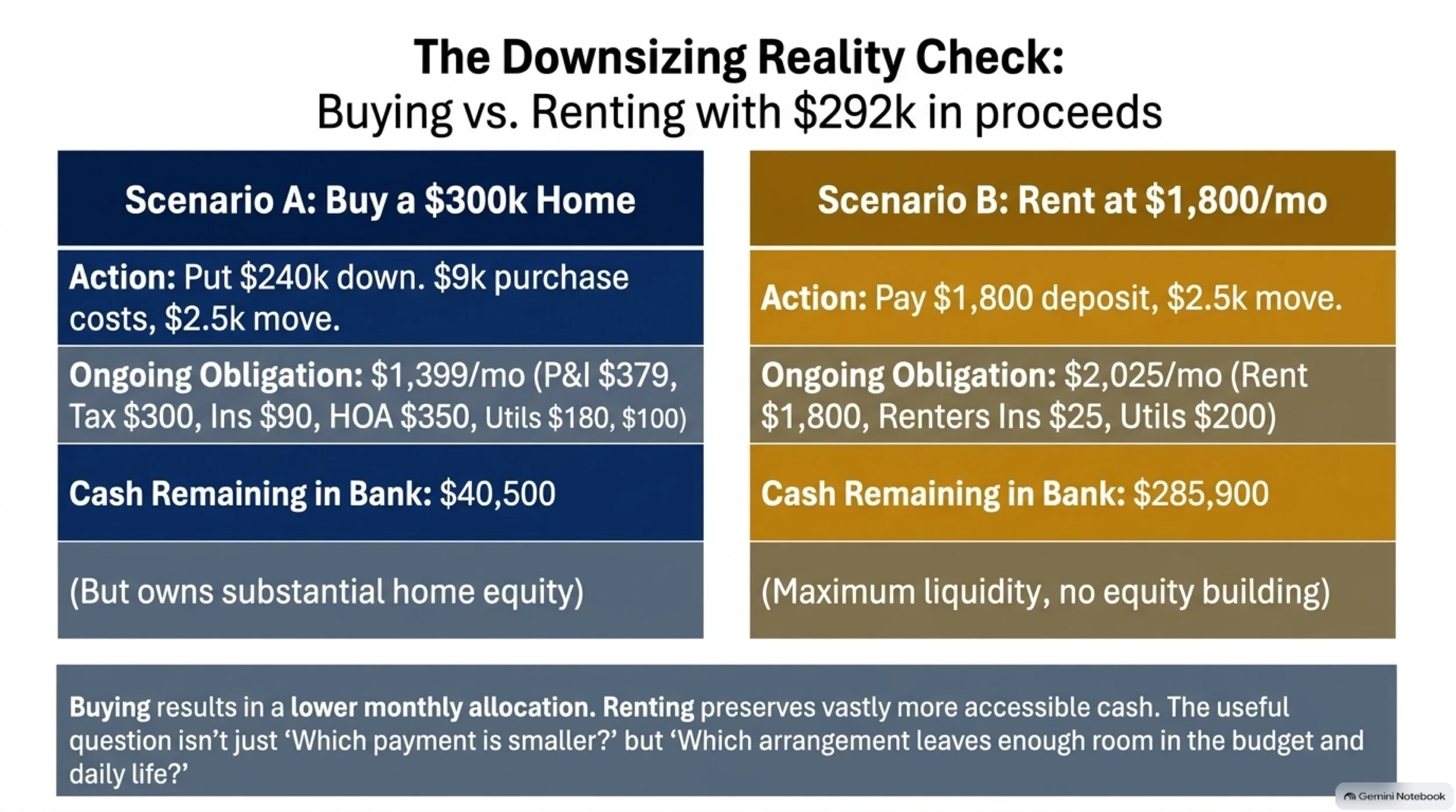
Suppose the next home costs $300,000. Putting $240,000 down leaves a $60,000 mortgage. After an assumed $9,000 in purchase costs and $2,500 to move, $40,500 of the sale proceeds remains in cash. The down payment becomes equity in the new home; it has not simply disappeared as an expense.
At an illustrative fixed 6.5 percent rate over 30 years, that mortgage costs about $379 monthly in principal and interest. Add assumed monthly property taxes of $300, insurance of $90, association dues of $350, separately paid utilities of $180, and a $100 interior-maintenance reserve. The total is about $1,399 a month. This assumes association coverage of exterior maintenance, which would need confirmation in the actual documents.
Alternatively, assume renting costs $1,800, plus $25 for renters insurance and $200 for utilities: $2,025 monthly. After a $1,800 refundable deposit, the first month’s rent, and $2,500 moving costs, $285,900 remains in cash from the same sale. The first month’s rent is already paid in that starting calculation. This is an assumed rent, not a verified Hastings rental offer.
Buying has the lower monthly allocation here. Renting preserves more accessible cash. That cash difference is not a profit comparison: the buyer owns substantial equity, and future repairs, rent changes, investment returns, home values, and resale costs could alter the outcome.
Association obligations can also change the picture. Ask what dues cover, how future repairs are funded, and whether additional assessments are expected. A low mortgage payment cannot answer those questions.
The useful question is not simply “Which payment is smaller?” It is “Which arrangement leaves enough room—in the budget, in savings, and in daily life—for what comes next?”
A workable home includes access to information
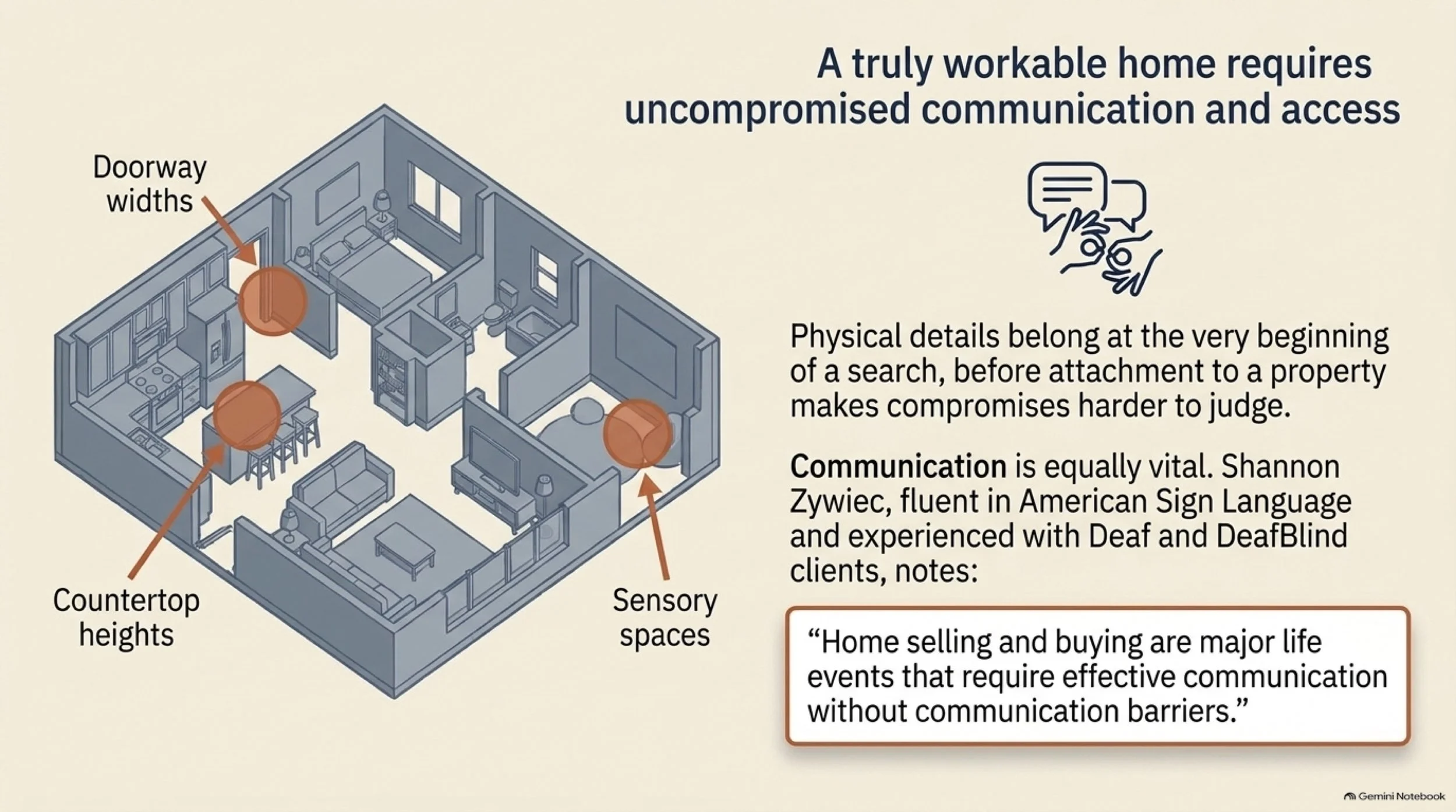
The right home must work for the person living there. Shannon’s interview describes physical considerations such as single-level living, doorway widths, countertop heights, and space for sensory needs. These details belong near the beginning of a search, before attachment to a property makes compromises harder to judge.
Communication deserves the same attention. Shannon describes herself as fluent in American Sign Language and discusses serving Deaf and DeafBlind clients.
“Home selling and buying are major life events that require effective communication without communication barriers,” she writes.
Ask what communication methods and support each person needs throughout the transaction. ASL fluency is a relevant skill, but no single approach meets every person’s needs. Understanding the choices is part of being able to make them.
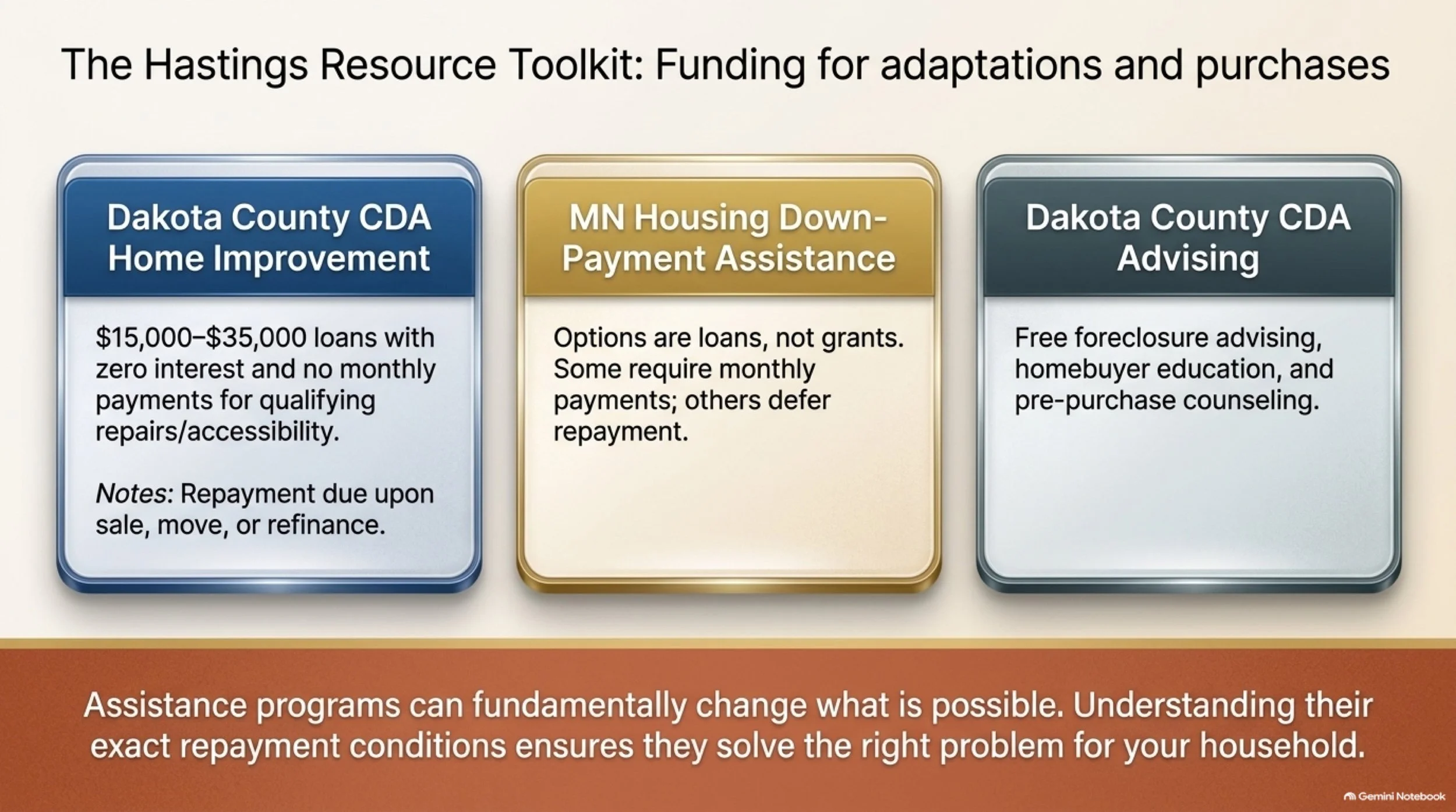
There are also resources worth exploring before assuming a purchase or repair is out of reach. For eligible Dakota County residents, the Dakota County CDA’s homeownership resources include homebuyer education, pre-purchase counseling, and free foreclosure advising. Confirm address eligibility and program details directly. Dakota County Community Development Agency
The CDA’s Home Improvement Loan Program lists loans of $15,000–$35,000 with zero interest and no monthly payments for qualifying repairs, including some accessibility improvements. Eligibility includes income, assets, credit, and equity requirements. Repayment is due when ownership changes or the borrower moves; refinancing or a home-equity loan may also trigger repayment. Already completed work is not reimbursed. Check eligibility and approval before committing to work. Dakota County Community Development Agency
Minnesota Housing’s homebuyer programs offer another starting point through participating lenders. Its down-payment and closing-cost assistance options are loans, not grants. Some require monthly payments; others defer repayment until specified events. Ask what is owed now, what becomes due later, and how that changes the complete budget. Minnesota Housing
Assistance may change what is possible. Understanding its conditions helps ensure it solves the right problem.
Bring your questions before you bring your boxes

You do not need a moving date to start getting useful answers.
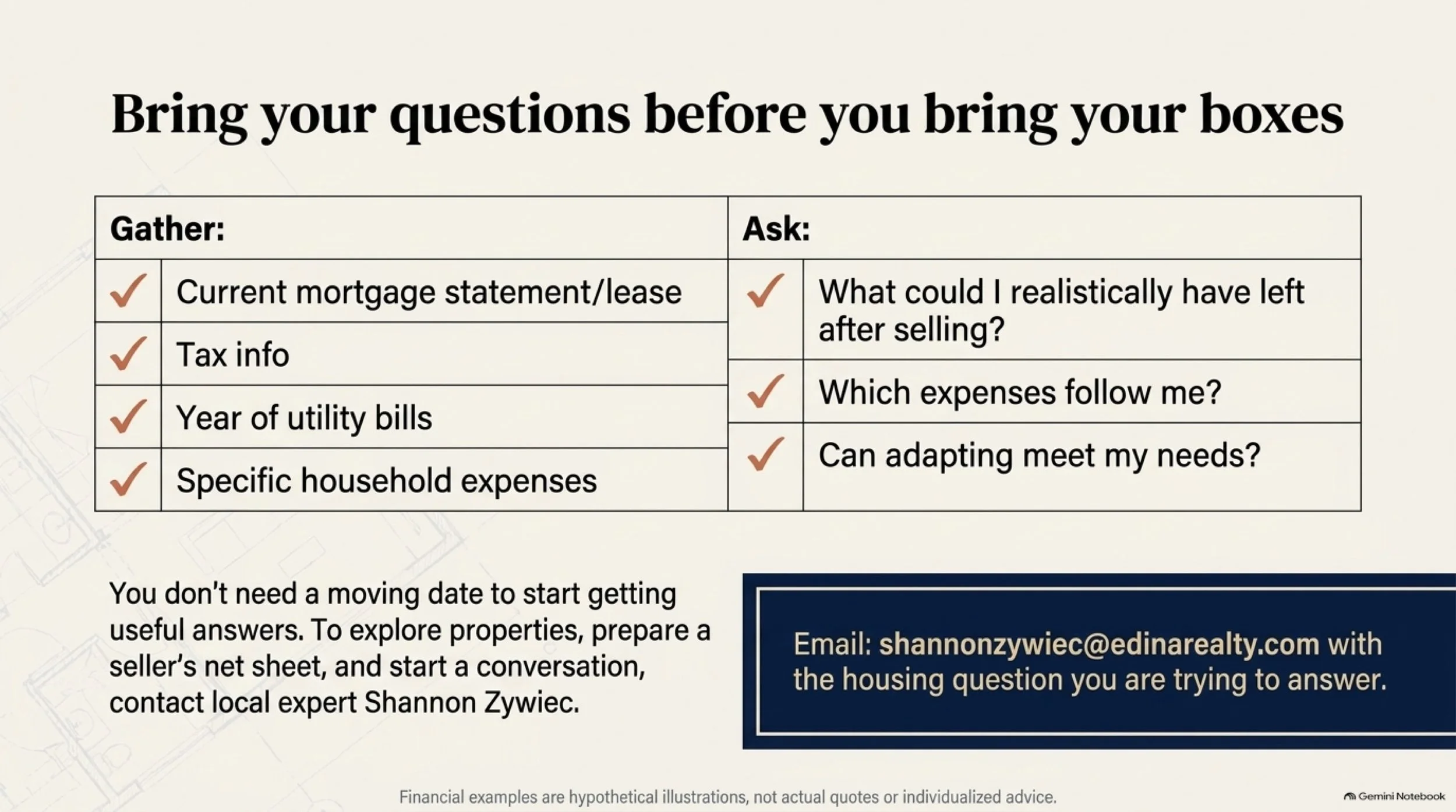
Gather your current mortgage statement or lease, tax and insurance information, a year of utility bills, and estimates for work the home needs. Add your other household expenses and the savings you want to keep available. Then describe what you need the next arrangement to do better.
Bring Shannon three questions:
What could I realistically have left after selling and paying every obligation?
Which expenses would follow me—and which new ones would arrive?
Could adapting my current home meet my needs, and what would we need to know to compare that fairly with moving?
Shannon can help explore properties and prepare an estimated sale net sheet. A lender can evaluate financing; an insurer can quote coverage; an assessor can explain valuation; and qualified contractors can estimate work. Tax professionals and housing counselors can help with questions within their respective roles.
To start a conversation, email Shannon Zywiec at shannonzywiec@edinarealty.com with the housing question you are trying to answer. Detailed financial documents can follow through an appropriate secure process.
The next chapter might begin with new keys. It might begin with a renovation estimate, a savings plan, or the decision to stay. What matters is making the choice with a clearer view of what it will ask of you—and what it will make possible.
The financial examples are hypothetical, not actual households, property quotes, or individualized financial advice. Figures are rounded; original sources are linked near the claims they support.