
Quitting Alcohol as a Working Parent in Minnesota

An original HastingsNow.com photo of the Hastings Bridge anchors this AI-assisted illustration of a single parent with kids. The local scenes are artistic interpretations.
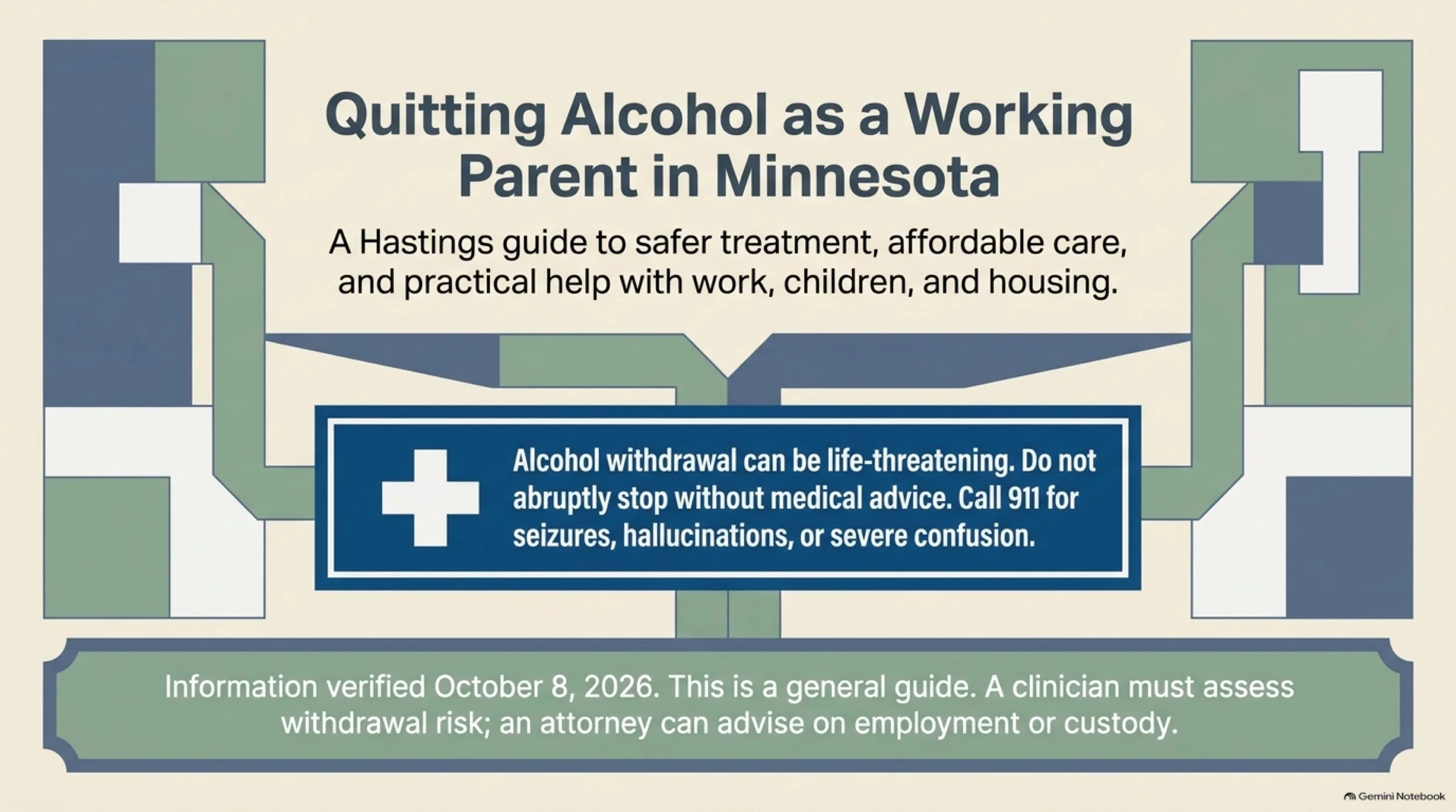
A Hastings guide to safer treatment, affordable care, and practical help with work, children, and housing
Information checked October 8, 2026. This guide provides general health and legal information. A clinician must assess withdrawal risk and treatment needs; an attorney can advise on an individual employment, custody, or housing matter.
If you need help now: Alcohol withdrawal can be life-threatening. If you drink heavily or regularly, or have had withdrawal before, get medical advice before abruptly stopping or sharply reducing alcohol. If you already have shaking, sweating, nausea, or a racing heart after cutting back, seek prompt medical assessment. Call 911 for seizures, hallucinations, severe confusion, or other severe symptoms. Do not drive yourself while impaired or seriously ill. MedlinePlus explains alcohol withdrawal and emergency symptoms.
The decision at the kitchen table
At 9:17 p.m., the kitchen finally gets quiet.
One child needs a signature on a school form. Another has announced that tomorrow requires a clean team shirt. The youngest has rejected bedtime on procedural grounds.
The parent at the table has a job in the morning, rent due soon, and a phone open to a treatment website.
There is a photograph of a peaceful room. There is language about a fresh start. What the parent wants to know is much more specific:
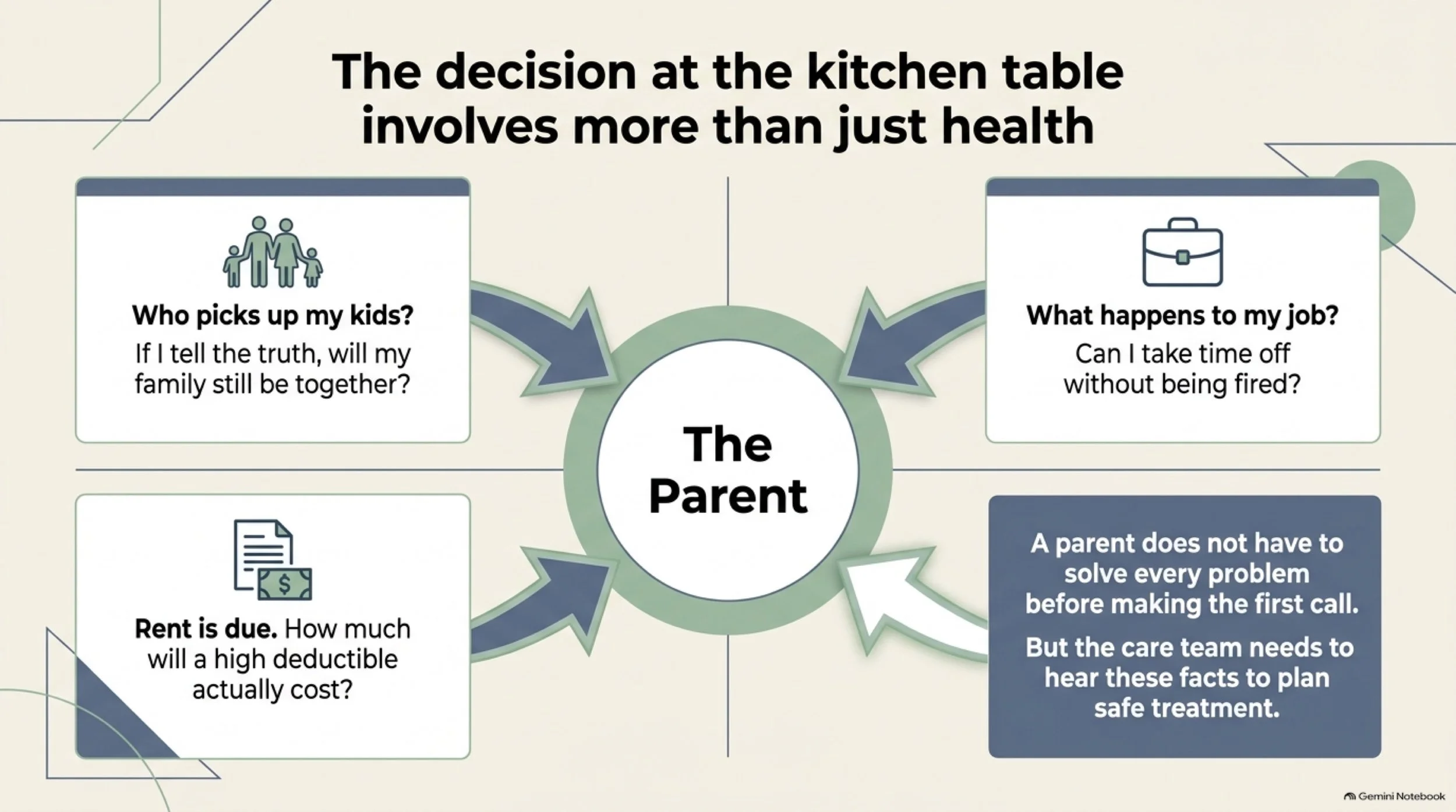
Who picks up my kids? What happens to my paycheck? How much will this actually cost? If I tell someone the truth, will my family still be together?
This is an imagined scene, not an interview or the story of an identifiable Hastings resident. The parent we will call Sam is fictional. The practical questions deserve real answers.
For a single, employed parent raising several children, the desire to quit alcohol can arrive long before the logistics appear possible. A high insurance deductible makes the gap feel even wider.
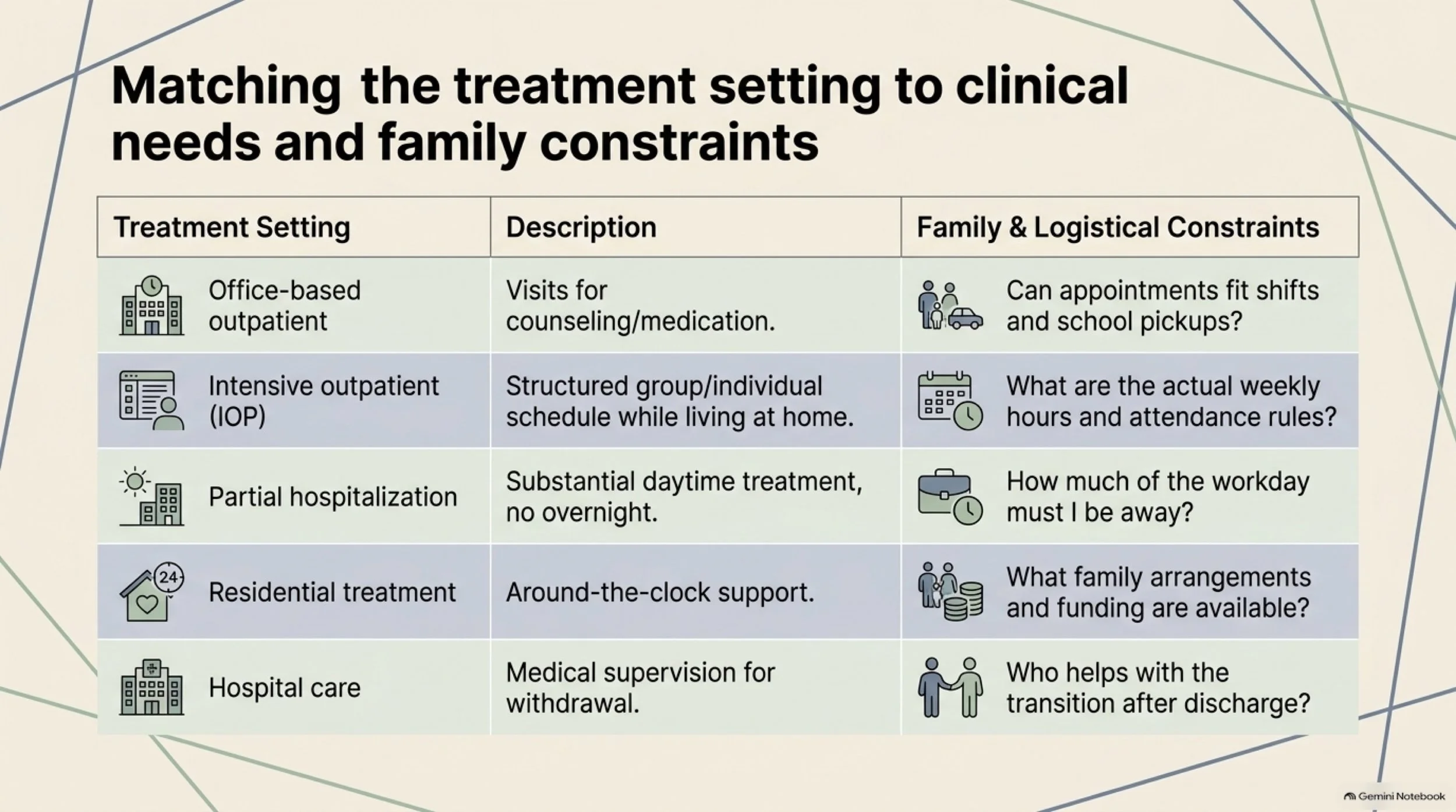
The best starting strategy is to obtain a medical safety assessment, match treatment to clinical needs, and arrange support for the household alongside care. Depending on the assessment, treatment may include office visits, medication, counseling, an intensive outpatient program, or a period of inpatient or residential care. Staying home is possible for some people; others need more supervision to be safe. NIAAA explains how treatment settings differ.
A parent does not have to solve every problem before making the first call. But the person answering that call needs to hear about the children, the work schedule, and the money.
Those are treatment-planning facts.
Start by separating withdrawal care from ongoing recovery
Two different questions often get compressed into the word “rehab.”
The first is: What medical care will help me safely stop drinking?
The second is: What ongoing treatment and support will help me stay well?
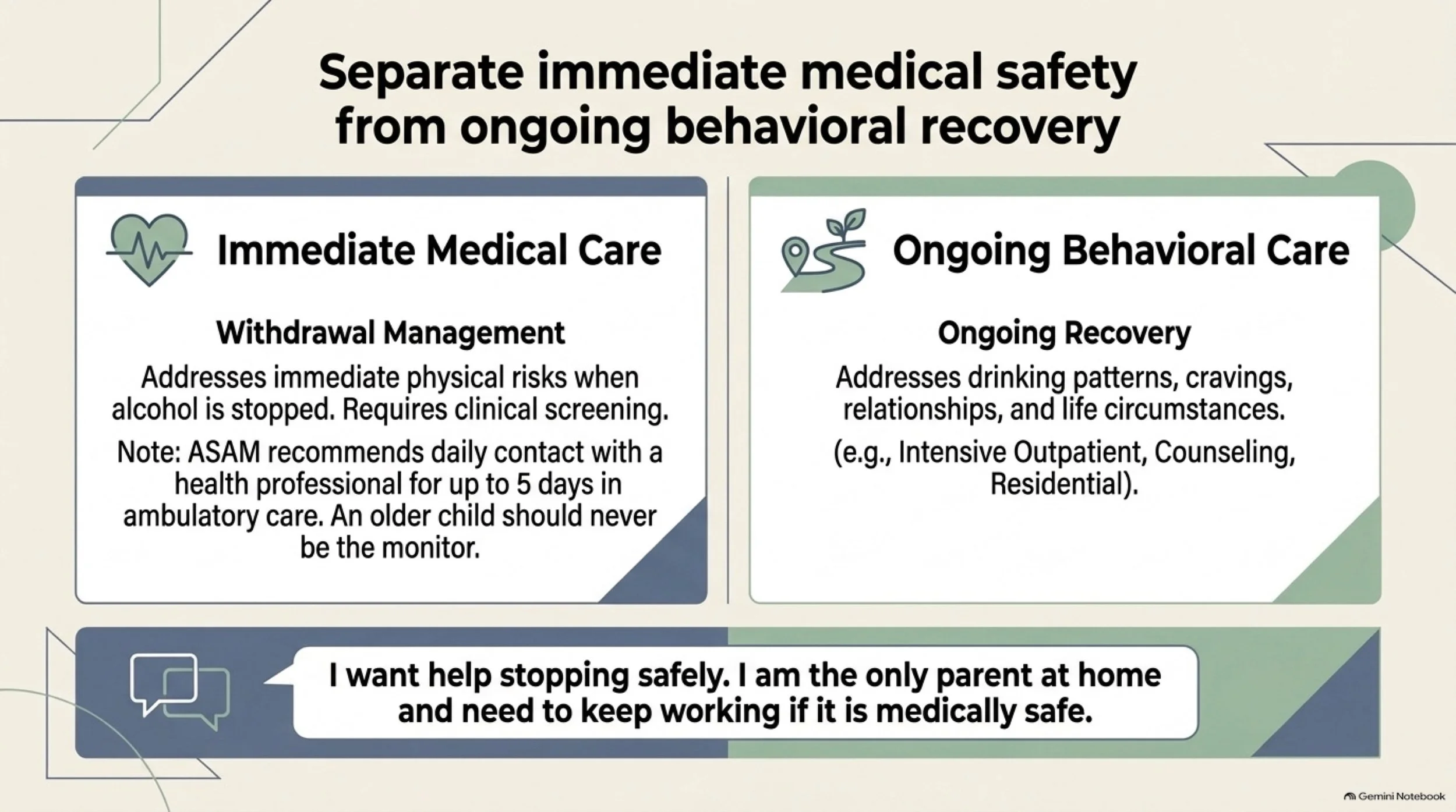
Withdrawal management addresses the immediate physical risks when alcohol is reduced or stopped. Ongoing treatment addresses drinking patterns, cravings, health conditions, relationships, and the circumstances that make alcohol difficult to leave behind. NIAAA explains why detoxification alone is insufficient; ASAM likewise recommends connecting withdrawal care with ongoing treatment.[1]
A clinician may recommend hospital care for withdrawal, followed by outpatient treatment. Another person may qualify for supervised outpatient withdrawal care and continued outpatient recovery. Residential treatment can serve needs beyond withdrawal. These are different services with different admission criteria and costs.
For Sam, that distinction opens a better conversation than “Can I afford a month away?”
A useful opening is:
I want help stopping alcohol safely. I am the only parent available at home, I have several children, and I need to keep working if it is medically safe. My deductible is difficult to afford. Can someone assess my withdrawal risk and help me understand the safest treatment options and financial assistance?
Give the clinician an honest account of how much and how often you drink, when you last drank, previous withdrawal or seizures, other substances and medications, and relevant medical conditions. Explain if pregnancy is possible. Explain whether another responsible adult can help at home.
Outpatient withdrawal care requires clinical screening and monitoring. ASAM recommends daily contact with a qualified health professional for up to five days after stopping or reducing alcohol in ambulatory withdrawal care; some contacts may be remote when appropriate. The living environment and available support help determine whether that setting is safe.[1]
An older child should not become the person responsible for monitoring a parent's withdrawal. If there is no adult backup, say so. Do not attempt to substitute an internet taper schedule, borrowed sedatives, or a support-group meeting for a medical assessment.
If a clinician recommends a more supervised setting, ask immediately for help arranging child care, funding, and leave. Financial and family barriers deserve active problem-solving; they do not make medically unsafe care safe.
Treatment can have more than one shape
The National Institute on Alcohol Abuse and Alcoholism describes a range of treatment settings. A comprehensive assessment helps determine the appropriate level.[2]
Treatment option
What it generally involves
A working parent should ask
Office-based outpatient care
Visits for counseling, medication, or both
Can appointments fit my shifts and school pickups?
Intensive outpatient care
A structured schedule of group and individual treatment while living at home
What are the actual weekly hours and attendance rules?
Partial hospitalization or day treatment
More substantial daytime treatment without an overnight stay
How much of the workday must I be away?
Residential treatment
Living at a treatment program with around-the-clock support
What family arrangements and funding are available?
Hospital or medically intensive care
Medical supervision for withdrawal or other acute needs
Who can help with the children and the transition after discharge?
A 2014 evidence review by McCarty and colleagues found that intensive outpatient programs and inpatient or residential programs often produced comparable outcomes among the populations studied. These findings support outpatient care as a substantive treatment option for appropriate patients. They do not establish that outpatient care is safe for everyone: the review concerned people who did not require medical detoxification or 24-hour supervision, and programs and outcome measures varied.[3]
For an employed parent, the best-fitting program is one that meets clinical needs and can actually be attended.
“Evening treatment” may still conflict with bedtime. “Virtual” may still require uninterrupted participation. A phone and headphones can reduce travel; they cannot supervise a toddler.
Ask for a sample weekly schedule before enrolling. Ask what happens if a child becomes ill. Ask whether child care exists on site, whether referrals are available, and whether any assistance covers the hours you need. Do not assume that a family-oriented program supplies babysitting.
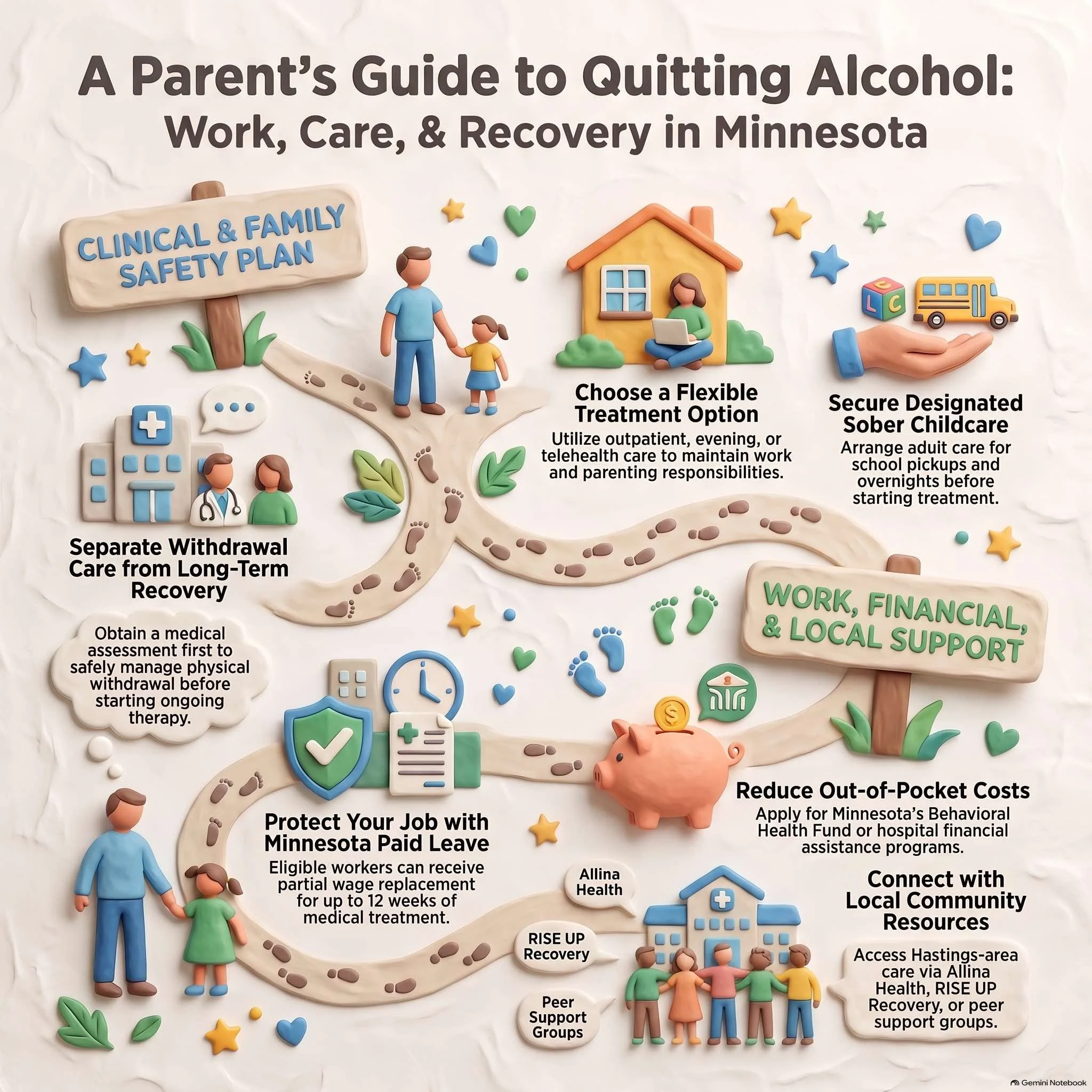
Infographic by HastingsNow.com
Ask about medication
A useful question at the first medical visit is:
Would medication for alcohol use disorder be appropriate for me?
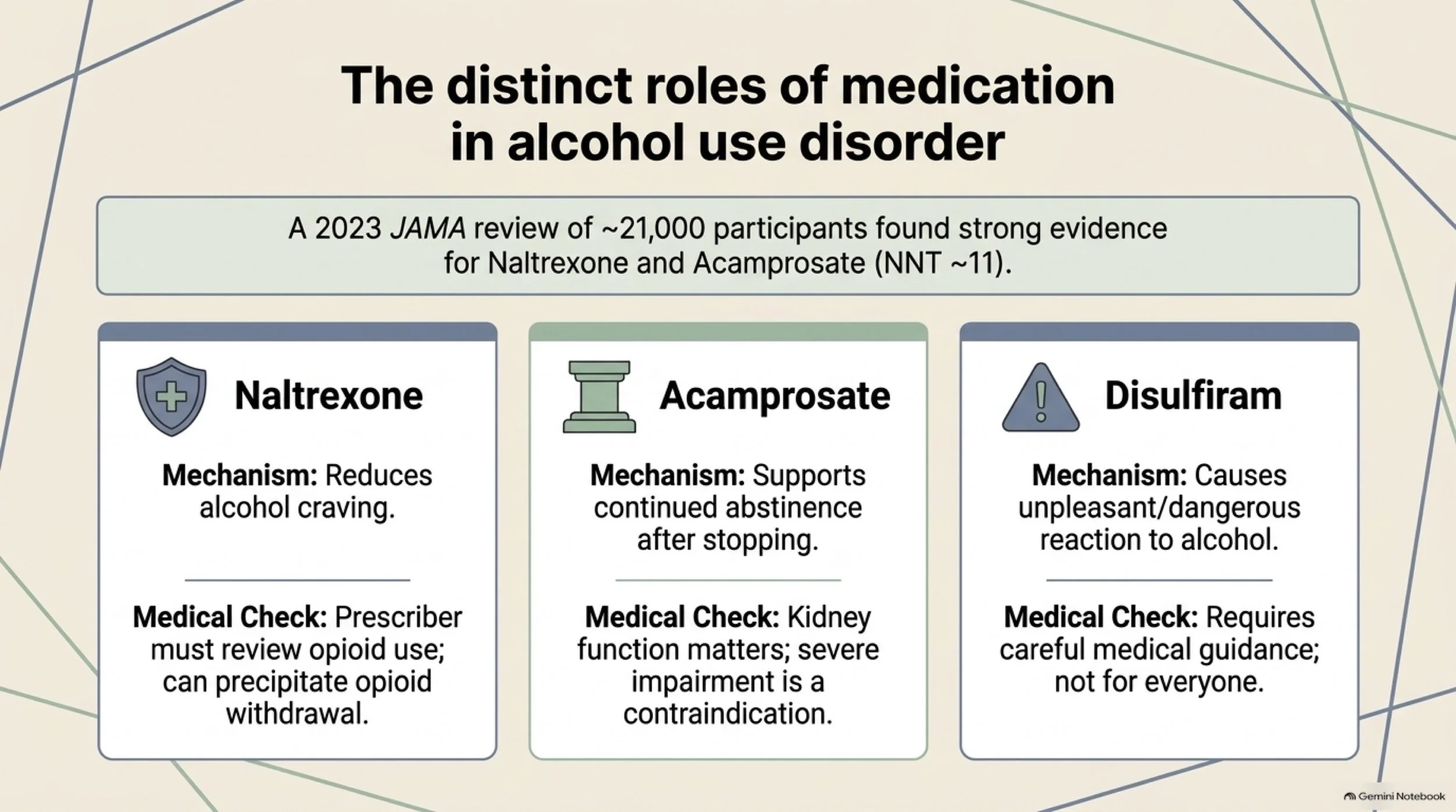
In a 2023 systematic review and meta-analysis of 118 trials involving 20,976 participants, McPheeters and colleagues found the strongest evidence among the medications reviewed for oral naltrexone and acamprosate. Most studies also included counseling or another supportive intervention.[4]
For oral naltrexone, the pooled estimate suggested that treating approximately 11 people would prevent one additional return to heavy drinking compared with placebo during the study follow-up periods. For acamprosate, approximately 11 people would need treatment to prevent one additional return to any drinking. These are different outcomes, averaged across studies; they are not an individual's chance of success.[4]
The three FDA-approved medications for alcohol use disorder have different roles:
Naltrexone can reduce alcohol craving. A prescriber must review opioid use, including some pain medicines, and medical history. It can precipitate opioid withdrawal in someone using opioids and does not treat alcohol withdrawal. Medication information.
Acamprosate helps support continued abstinence after stopping alcohol. Kidney function matters, and severe kidney impairment is a contraindication. Medication information and prescribing information.
Disulfiram causes an unpleasant and potentially dangerous reaction when alcohol is consumed. It requires careful medical guidance and is not suitable for everyone. NIAAA treatment guide.
Ask about generic options, insurance coverage, pharmacy prices, side effects, and follow-up costs. A clinician should review liver and kidney health, other medicines, pregnancy or breastfeeding, and mental health needs as appropriate.
The purpose is to leave with an informed treatment discussion, not a shopping list of medicines to try independently.
A high deductible deserves a second conversation
Sam's insurance card is real. So is the number on the deductible.
That does not establish what every possible treatment option will cost. An office visit, a prescription, an intensive outpatient program, and a hospital admission may have different benefits and billing arrangements.
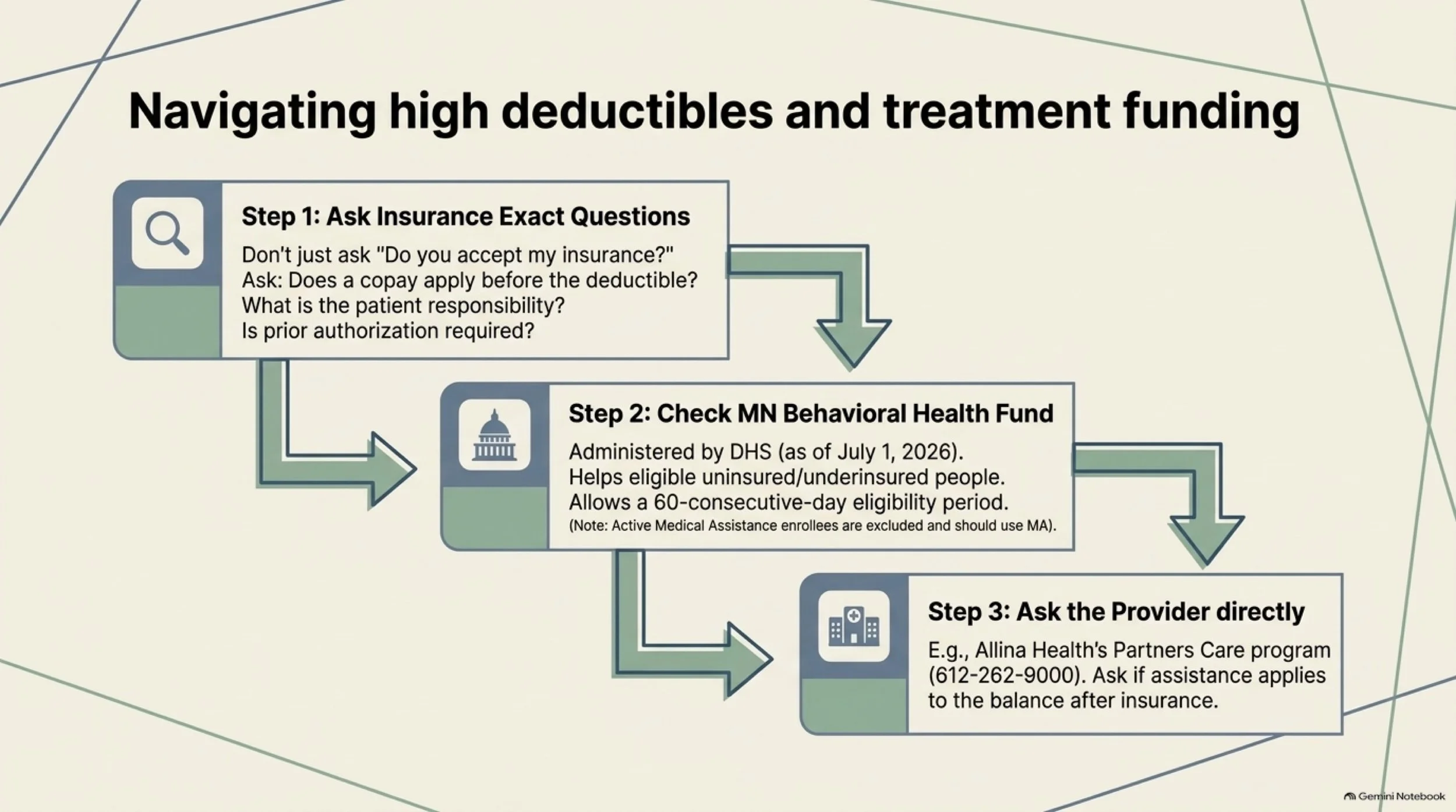
Ask the insurer and provider to clarify:
Is this specific provider and service in network?
What must I pay for the assessment, visits, laboratory work, prescriptions, and program sessions?
Does a copay apply before the deductible, or will I owe the negotiated cost?
Is prior authorization required, and who obtains it?
What financial assistance can I apply for before starting?
Can I receive the estimate and coverage explanation in writing?
Keep the representative's name, date, and reference number. “We accept your insurance” does not answer how much you will owe.
Check Minnesota treatment funding under the current rules
Minnesota's Behavioral Health Fund may help eligible people who have no insurance or insurance that does not pay the full cost of substance use disorder treatment. Administration moved to the Minnesota Department of Human Services on July 1, 2026. Counties, Tribal Nations, and providers can still help people apply.[6,7]
Eligibility depends on income, household size, applicant category, and other rules. DHS lists active Medical Assistance enrollment as an exclusion from this particular fund; people with MA should use their MA coverage and ask for care-navigation help. A high deductible alone does not establish eligibility.[7]
DHS describes a 60-consecutive-day eligibility period to seek covered treatment from a participating Minnesota Health Care Programs provider. Ask how those dates apply to your assessment, admission, and continuing coverage.[6]
Start with the current DHS funding information and application instructions. Ask for a formal screening even if an older webpage or conversation left you uncertain.
Ask the provider about financial assistance
Allina Health lists its Partners Care financial-assistance program and payment-plan options. Call 612-262-9000 or 800-859-5077 and ask whether your household and the particular treatment service qualify. Specifically ask whether assistance can apply to your patient responsibility after insurance. Allina financial assistance.
Ask a benefits navigator whether Medical Assistance, MinnesotaCare, or another coverage option fits your current situation. Eligibility is individual; employment and an existing insurance card do not answer every question.
If care is denied, request the reason in writing and ask about the appeal process. Mental health parity rules generally restrict more burdensome treatment of mental health and substance use benefits compared with medical benefits; they do not erase an ordinary deductible. Minnesota Commerce provides parity and appeal information. The appropriate regulator depends on the type of plan.
Protecting a job starts with the right leave questions
A parent should not have to guess whether asking for treatment will cost a paycheck. The available protections, however, depend on the worker, employer, treatment, and required paperwork.
Minnesota Paid Leave
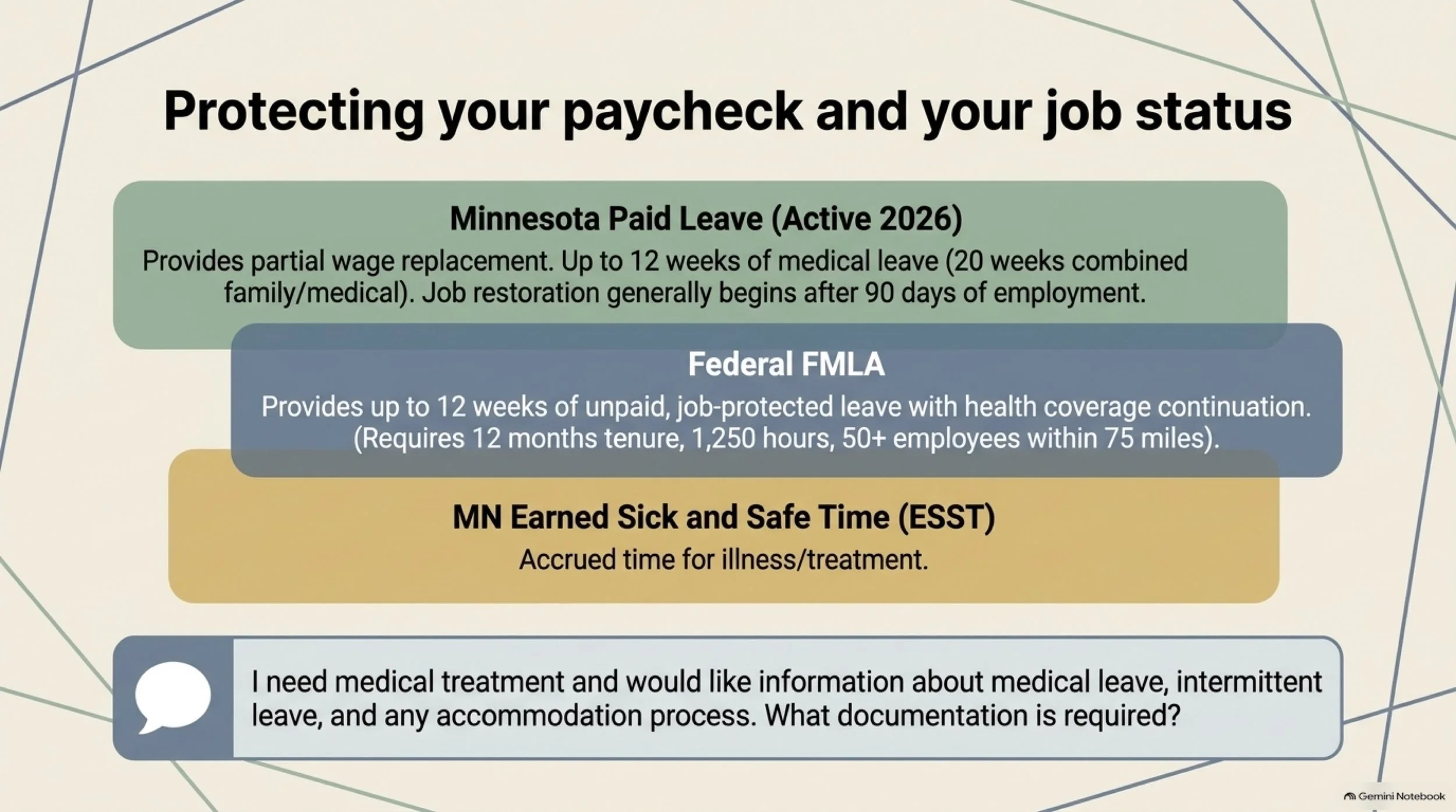
Minnesota Paid Leave is available in 2026 and can provide eligible workers with partial wage replacement for qualifying medical leave. The program allows up to 12 weeks of medical leave; people qualifying for both medical and family leave have a combined annual limit of 20 weeks. Job-restoration protections generally begin after 90 days with the employer.[8]
Substance use disorder can qualify as a serious health condition when the legal and medical-certification requirements are met. Intermittent leave may be available for qualifying care. Ask the program and your clinician how the rules apply to your treatment schedule.[9]
Benefit eligibility and job protection are separate questions. Self-employed people and independent contractors are not automatically covered; optional enrollment has advance requirements. Do not assume that enrolling after a crisis begins creates immediate coverage.[8]
Visit Minnesota Paid Leave or call 651-556-7777 for program guidance. Ask about your eligibility, certification, notice requirements, benefit estimate, and expected payment timing before building the household budget around a payment.
Federal FMLA
The federal Family and Medical Leave Act can provide eligible employees up to 12 weeks of unpaid, job-protected leave, with continuation of group health coverage. Common eligibility requirements include at least 12 months with the employer, at least 1,250 hours worked in the prior 12 months, and a worksite with at least 50 employees within 75 miles.[10]
Qualifying substance use treatment may be covered. An absence caused by drinking itself is not the same as protected leave for treatment. Medically necessary intermittent leave may be possible. FMLA does not automatically shield an employee from an employer's otherwise lawful, consistently applied substance-use policy.[11]
Sick time and disability accommodations
Minnesota earned sick and safe time can be used for an employee's mental or physical illness, treatment, and preventive care. Eligibility and the available balance matter. Check your pay statement and ask about using accrued time for assessment and appointments. Minnesota ESST guidance.
Alcohol use disorder may also qualify for disability-related workplace accommodations, depending on the circumstances. EEOC guidance describes potential accommodations such as treatment leave or a modified schedule. Employers may still enforce applicable performance, conduct, and safety standards. EEOC guidance.
A useful first message to HR or the leave administrator is:
I need medical treatment and would like information about medical leave, intermittent leave, and any accommodation process. Please tell me what documentation is required, who receives it, and how my health coverage and pay would be affected.
This starts the process; additional information or certification may be necessary. Ask whether an employee assistance program is available and what it reports to the employer before discussing sensitive details.
Where multiple leave programs apply, ask how they run together. Do not add their maximum weeks as if each automatically extends the others. If there is a threatened termination, a safety-sensitive job, or an existing disciplinary agreement, seek individualized legal or union advice promptly.
The question about the children deserves an honest answer
For some parents, the most difficult sentence is: I am afraid that if I ask for help, someone will take my children.
No responsible article can promise a custody outcome. Nor should fear be answered with a vague instruction to “just be honest” and no explanation of the rules.
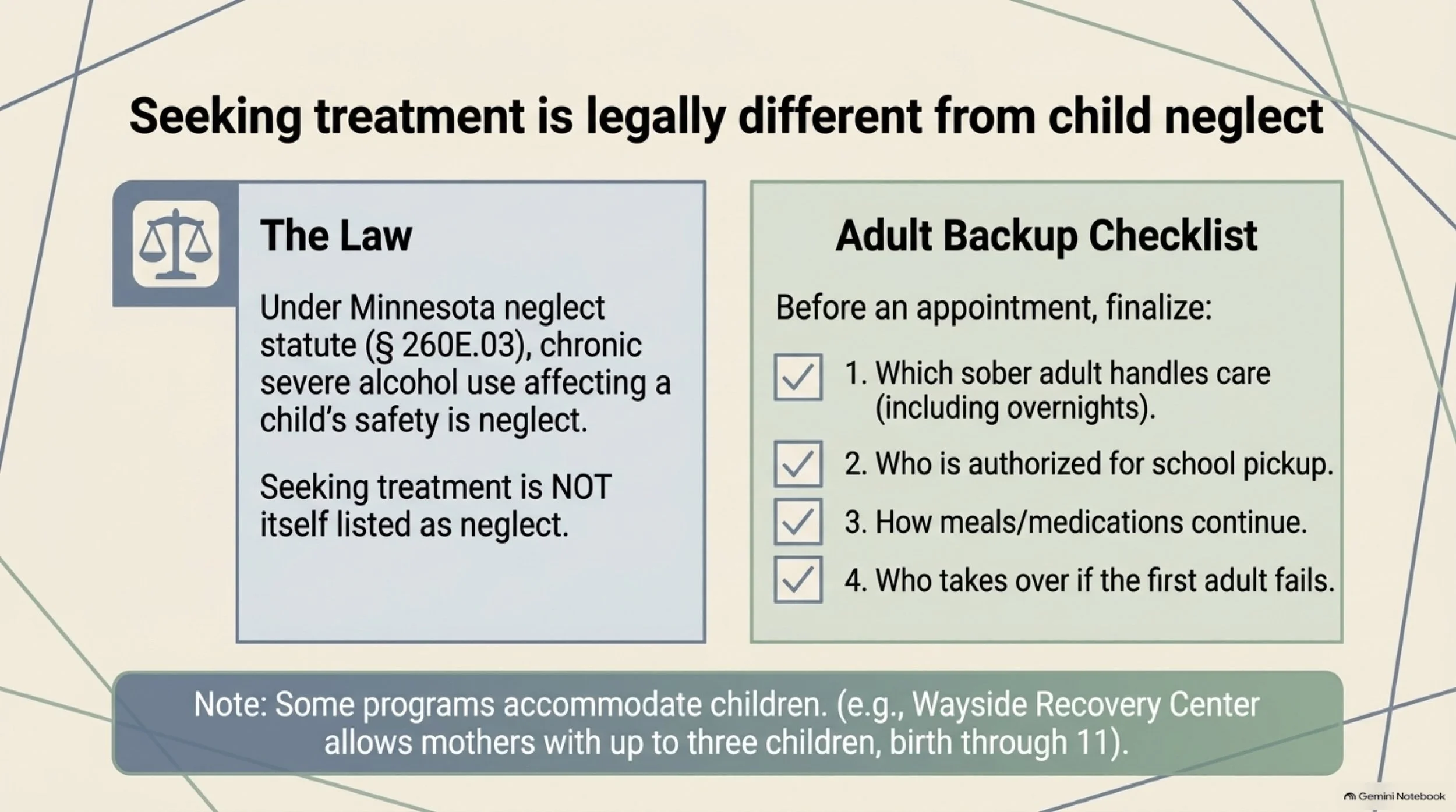
Minnesota's neglect statute addresses conditions such as inadequate supervision and chronic, severe alcohol use that adversely affects a child's basic needs and safety. Seeking treatment is not itself one of the acts listed in that definition. Health and social-service professionals are generally required to report when they know or have reason to believe maltreatment has occurred, subject to the law's terms.[12,13]
The practical goal is to get care while making the children's safety concrete.
Before a planned appointment or treatment start, work out:
Which responsible, sober adult will handle care, including overnight care if necessary.
Who is authorized to collect each child from school or child care.
How meals, medications, transportation, and school attendance will continue.
Who can take over if the first adult is unavailable.
What you will do if symptoms worsen or the treatment setting changes.
Do not make the oldest child responsible for keeping the parent medically safe or carrying the secret alone. If you cannot arrange safe supervision, tell the care team immediately. If a child is in immediate danger, call 911.
For a younger child, an age-appropriate explanation might be:
I am getting help with a health problem. Adults are helping make a plan so you are taken care of. You did not cause this, and it is not your job to fix it.
Only promise arrangements that are actually in place. Older children may need their own counseling or support and room to talk about what they have experienced.
If there is an existing custody order, a contested parenting situation, or child-protection involvement, consult an attorney before changing arrangements or signing documents you do not understand. Continue to address urgent medical and child-safety needs.
Legal Assistance of Dakota County provides family-law services for eligible low-income residents and referrals: 952-431-3200. The county also lists family-law consultation clinics.
When a parent needs residential care
Some programs can accommodate children. Wayside Recovery Center's Family Treatment Center serves women who are pregnant or mothers with young children and describes space for a mother with up to three children, ages birth through 11. Its services also include an evening telehealth outpatient option for women.[14]
Call 651-242-5540 to ask about clinical fit, eligibility, funding, openings, and family arrangements. A program description is not a guarantee of admission or that every child can stay. Parents outside that program's eligibility—including fathers or parents with older children—can ask an assessor to search for other arrangements.
The need for a more intensive setting should start a family-support conversation as early as possible.
Understand what confidentiality does and does not mean
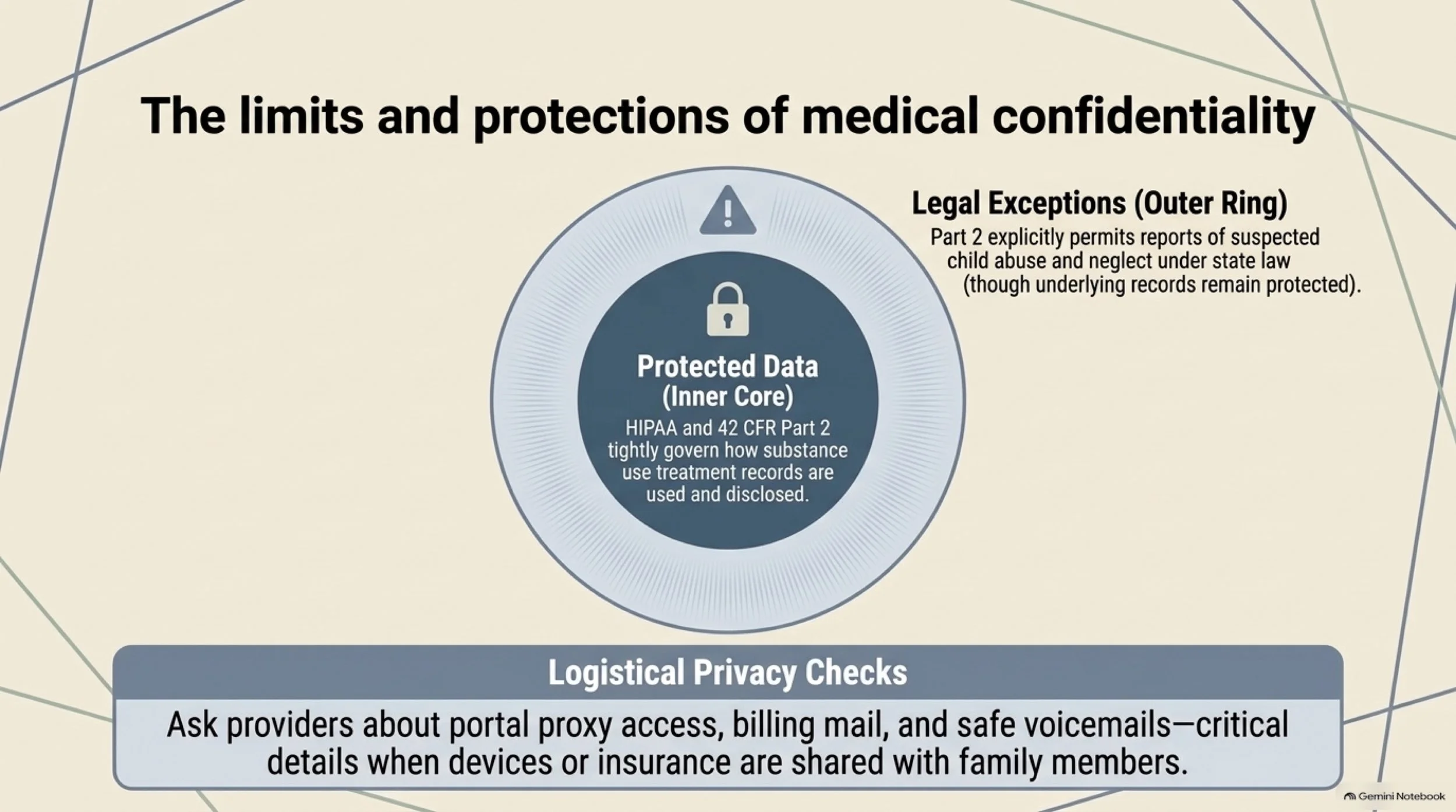
Federal protections cover many substance use treatment records. HIPAA and, for covered substance use programs, 42 CFR Part 2 govern how records may be used and disclosed. Part 2 does not automatically apply to every conversation or every health professional.[15]
Confidentiality has limits. Part 2 permits reports of suspected child abuse and neglect under state law, although the underlying treatment records retain protections. Other disclosures may be permitted under applicable rules, consent, or legal processes.[16]
Before enrolling, ask the provider:
Who can see my records? Does Part 2 apply here? What does this consent authorize? What information may go to my insurer, employer, or another agency? What circumstances require a safety report?
Ask about portal proxy access, billing mail, voicemail, and safe ways to contact you. These practical details matter when devices, insurance, or an address are shared.
If records are requested in a custody or employment dispute, seek legal advice. A privacy notice is useful; it cannot promise secrecy in every circumstance.
Keeping the lights on belongs in the recovery plan
Sam still needs groceries. The landlord still expects rent. A treatment plan that never asks about these facts is missing information.
Make a short list of the bills that must be paid during the first month: housing, utilities, food, transportation, child care, insurance premiums, and treatment costs. Add any likely reduction in wages. Ask for navigation help before a manageable shortfall becomes an emergency.
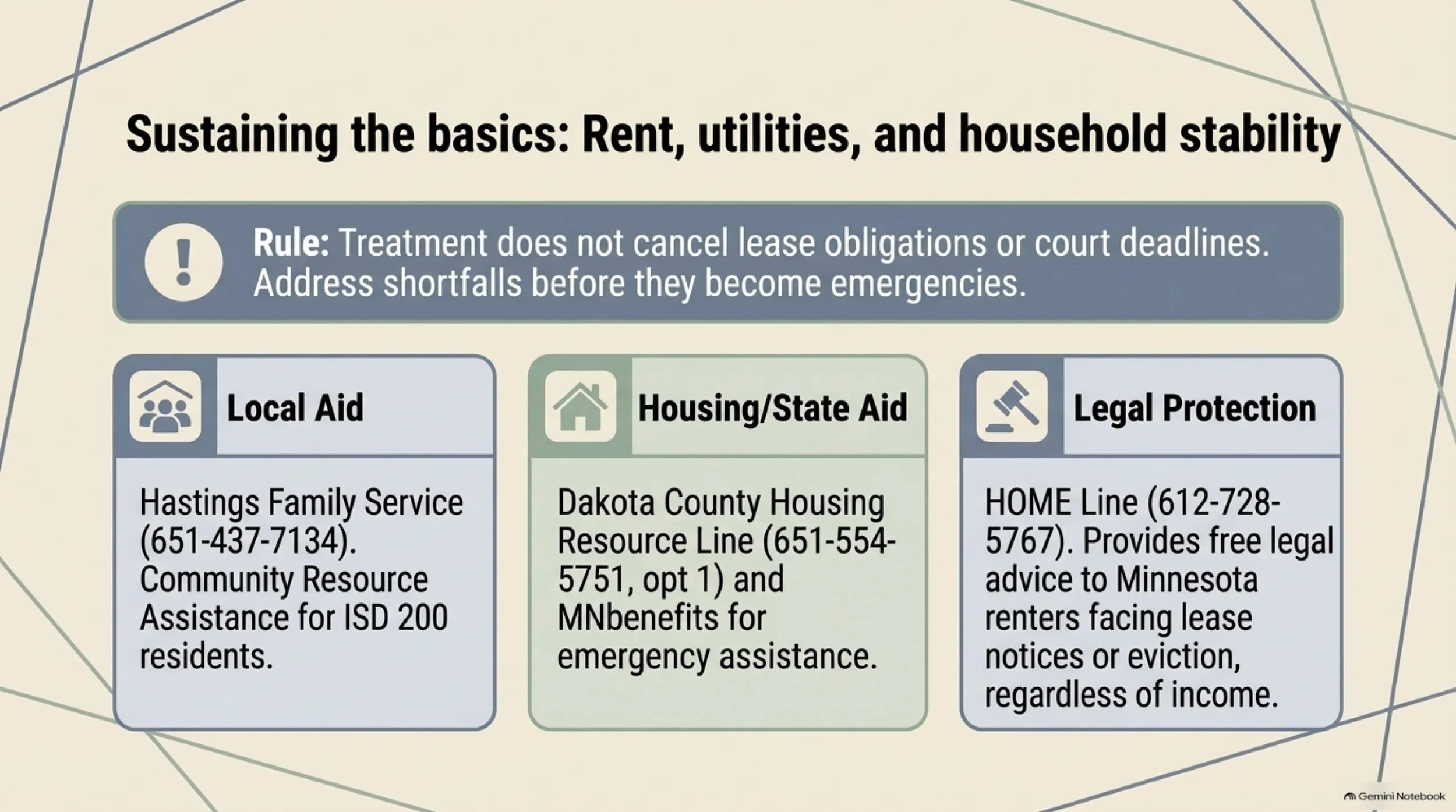
Hastings Family Service offers Community Resource Assistance for residents of Independent School District 200 experiencing a short-term crisis. Its published rent-assistance pathway begins with Dakota County Emergency Assistance through MNbenefits, then the CAP Agency if county assistance is denied, and then HFS if those resources cannot help. Documentation and eligibility requirements apply.[17]
Call 651-437-7134 to discuss the situation and current process. HFS can also help people explore other basic-needs resources. Funding is limited by program rules and availability.
The Dakota County Housing Resource Line, 651-554-5751, option 1, helps people understand available housing resources. If a lease notice or eviction issue arises, HOME Line, 612-728-5767, provides free legal advice to Minnesota renters regardless of income.[18,19]
Treatment does not cancel lease obligations or court deadlines. Bring notices to an adviser promptly and ask what action is required by which date.
Places to begin in Hastings and Minnesota
These are starting points, not a ranking or a guarantee of openings, coverage, or suitability. Confirm details directly.
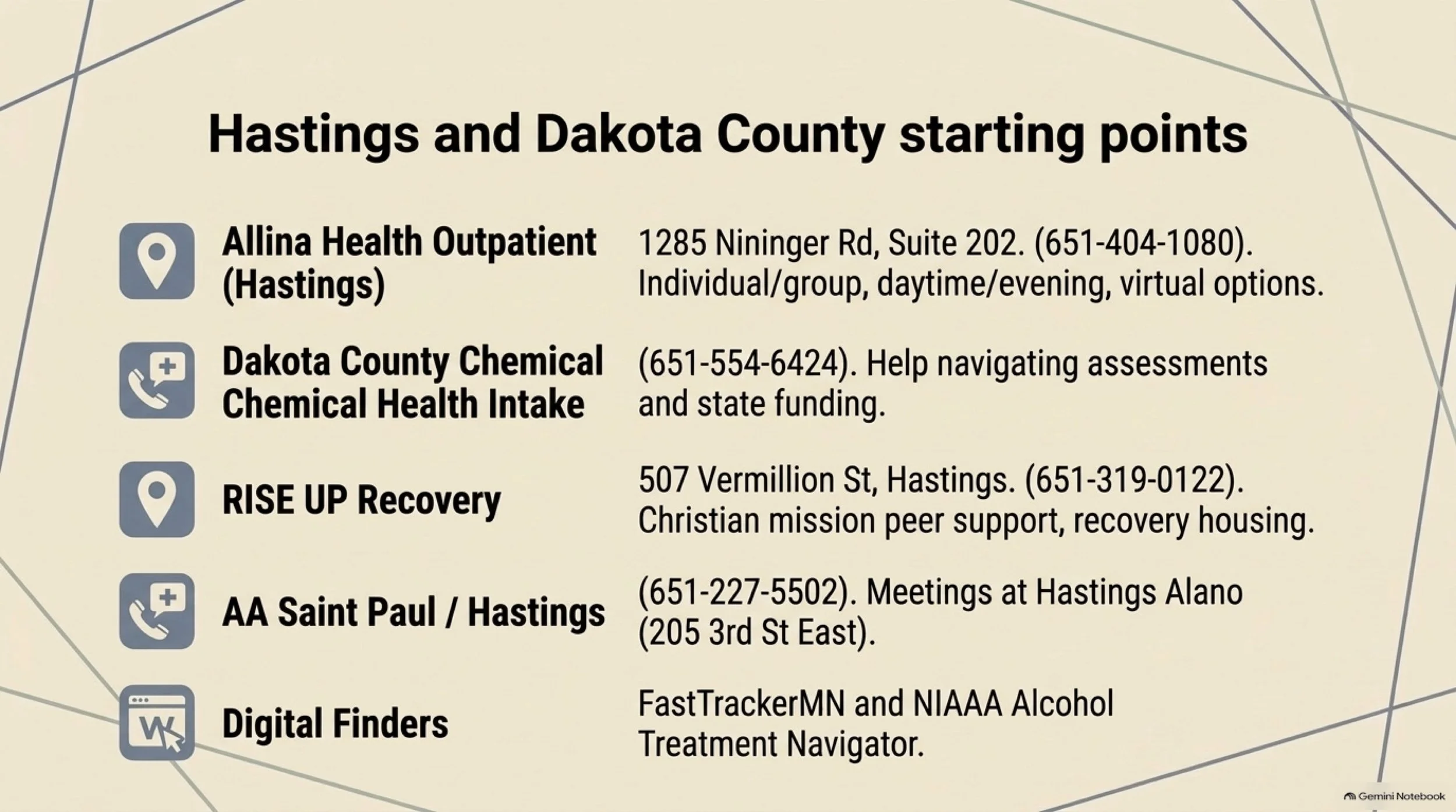
Allina Health Outpatient Addiction Services at United Hospital Hastings Regina Campus
1285 Nininger Road, Suite 202, Hastings • 651-404-1080
A local option for assessment and outpatient addiction treatment. Allina's program page describes individual and group counseling, with in-person and virtual options across its program; it lists daytime virtual sessions and daytime or evening in-person care. Ask which schedules are currently available through Hastings and whether medical withdrawal services would need to occur elsewhere. Program and location information.
Dakota County Chemical Health Intake
651-554-6424
Help navigating assessment and treatment. You can also approach a provider directly. Ask the county or provider to help clarify the current state funding application process. Dakota County substance use services.
RISE UP Recovery
507 Vermillion Street, Hastings • 651-319-0122
A local recovery community organization offering peer recovery services, support groups, and recovery housing. It has a Christian mission; ask about the approach of the particular service and whether it fits your preferences. Peer support can complement clinical treatment. Ask separately about fees, eligibility, housing availability, and whether any housing accepts children. RISE UP Recovery.
Alcoholics Anonymous and Saint Paul Intergroup
651-227-5502, answered 24 hours a day
AA has no membership dues or fees. The local directory includes meetings in Hastings, including at Hastings Alano, 205 Third Street East. Check the current listing for time, format, and whether a meeting is open to visitors or limited to people with a desire to stop drinking. Confirm child-care arrangements separately. AA assistance and Hastings meeting listings.
SMART Recovery
Free, facilitated peer meetings are available online and in person. This is another option when a person wants practical tools and a different meeting approach. Online participation may help with travel barriers, but children still need appropriate supervision. Find a SMART Recovery meeting.
FastTrackerMN and the NIAAA Alcohol Treatment Navigator
Use these to search beyond the first available program and learn what to ask. Search for mental health care as well as alcohol treatment when both are needed. FastTrackerMN • NIAAA Navigator.
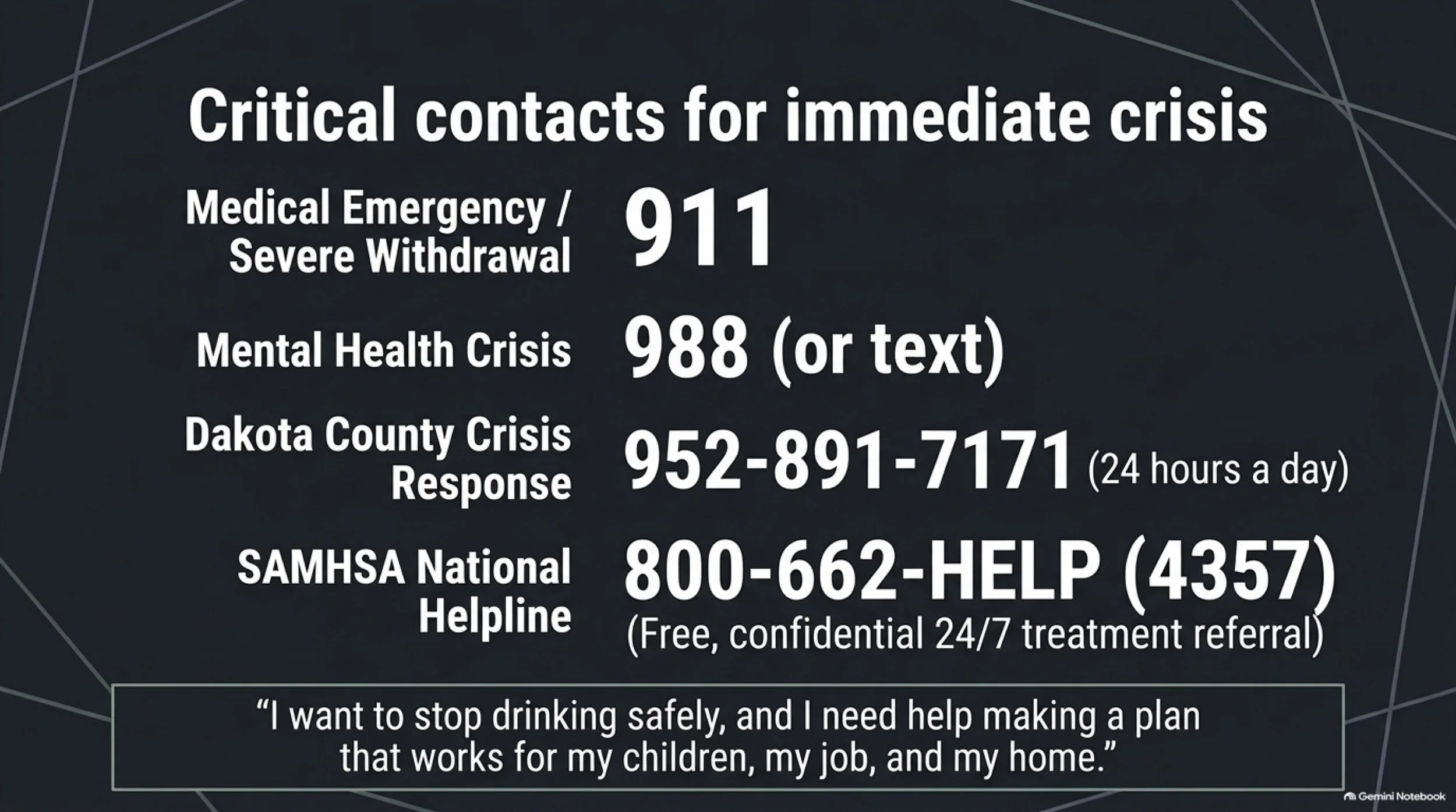
SAMHSA National Helpline
800-662-HELP (4357)
Free, confidential, around-the-clock treatment-referral information in English and Spanish. The referral service is free; referred treatment may have a cost. SAMHSA helpline.
For a mental health crisis
Call or text 988, or call Dakota County Crisis Response at 952-891-7171, available 24 hours a day. For a medical emergency, including severe withdrawal, call 911. Dakota County crisis resources.
Find support you can return to
A first meeting does not have to answer every question about recovery. It can answer a smaller one: Can I come back here and speak honestly?
AA deserves a fair description of its evidence. A 2020 Cochrane review by Kelly, Humphreys, and Ferri included 27 studies and 10,565 participants. It found high-certainty evidence that structured, professionally delivered Twelve-Step Facilitation approaches designed to increase AA participation improved continuous abstinence compared with some other established treatments.[5]
That finding does not mean every AA meeting is equally effective, every person will prefer AA, or that peer support can manage dangerous withdrawal. Evidence varied by outcome and study design. A person can explore AA, SMART Recovery, and other supportive communities while receiving medical care.
Try more than one meeting if needed. Ask about online access, accessibility, language, and groups where you feel comfortable. A poor fit with one group is information about that group.
Counseling can also help a person identify triggers, practice coping skills, and plan responses to stress. Depression, anxiety, trauma, and sleep problems may need attention alongside drinking.[20]
For Sam, “stress management” becomes useful only when it turns into something specific: a plan for the hour after work, an adult who can answer a call, and a realistic way to attend the next appointment.
Build a first week around actual responsibilities
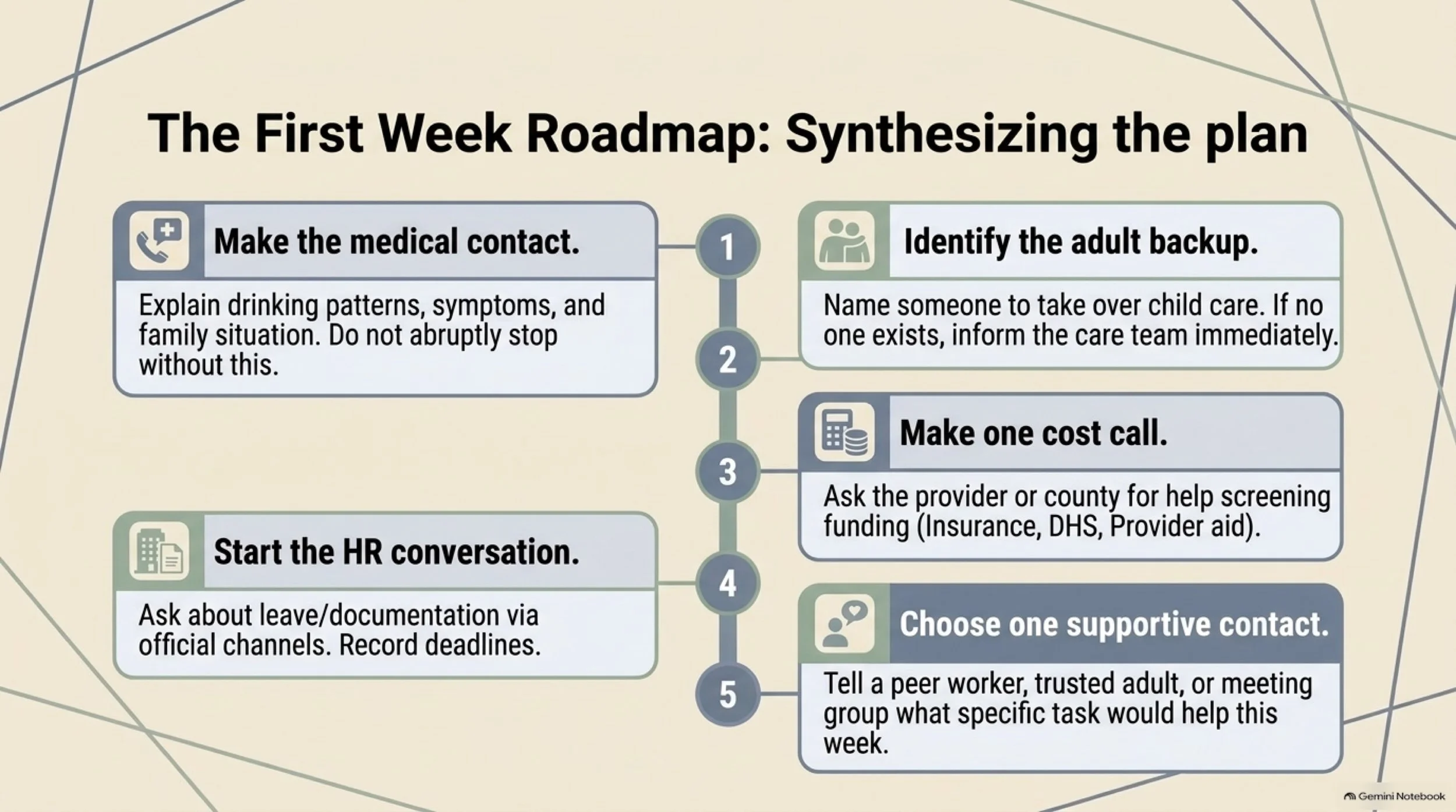
This is an organizing checklist, not a detox schedule. A clinician determines when and how alcohol can be stopped safely.
First, make the medical contact. Explain the drinking pattern, symptoms, medications, and family situation. Ask where to go today if symptoms are present and what care is appropriate.
Next, identify the adult backup. Name someone who can take over child care or transportation. If nobody is available, tell the care team. Do not quietly build a plan that depends on an unavailable relative.
Then, make one cost call. Ask the provider or county for help screening funding and obtaining an estimate. You do not have to become an insurance expert before accepting help.
Start the work conversation through the appropriate channel. Ask about leave and documentation. Record deadlines. Keep copies of submitted forms.
Put the next appointment on the calendar. Include transportation, coverage for the children, and any work notice required. A referral without a workable appointment is still unfinished business.
Choose one supportive contact. That might be a peer recovery worker, a trusted adult, or a meeting. Tell that person what would actually help this week.
For a household with three children, success in planning may look like confirming three pickup arrangements and one ride to a clinic. Those small decisions can make attendance possible.
Plan for the evening when everything goes sideways
The permission slip will eventually be signed. Another will take its place.
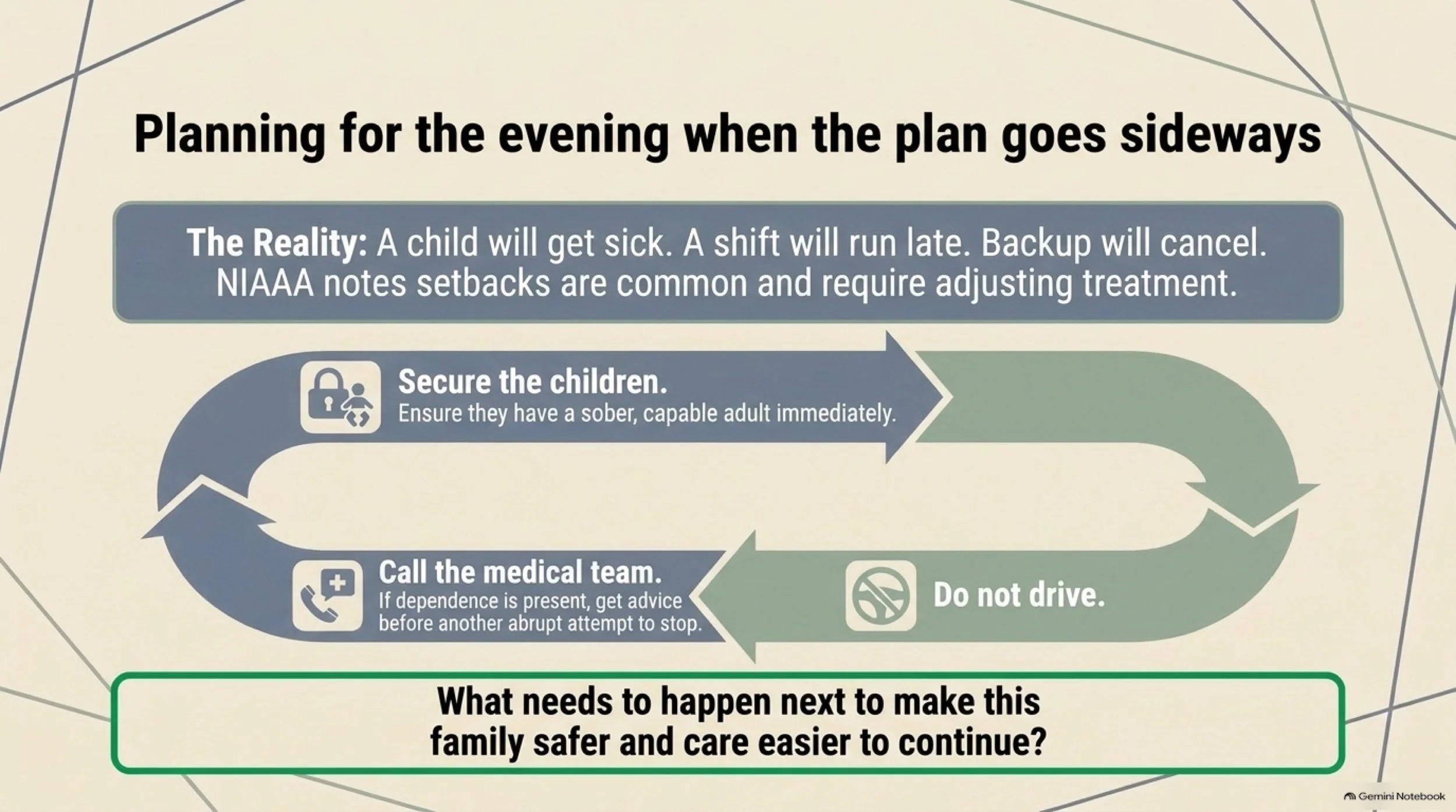
A child will get sick. A shift will run late. The person who offered to help may cancel.
Work with a counselor on responses to the situations that usually lead to drinking. Consider preparing a simple dinner, changing a routine associated with alcohol, choosing a supportive person to contact, or arranging an activity during a difficult hour. Use these as additions to professional care.
If drinking resumes, contact the treatment team promptly. NIAAA describes setbacks as common and advises reviewing and adjusting treatment when needed.[20] One episode does not erase prior effort, but it can create immediate medical, driving, or child-safety risks.
Make sure children have a sober, capable adult. Do not drive after drinking. If dependence or withdrawal risk is present, get medical advice before another abrupt attempt to stop. Ask the clinician whether the treatment intensity, medication, or support plan needs to change.
The useful question is: What needs to happen next to make this family safer and care easier to continue?
What Hastings can do with this information
A neighbor may never tell you they are getting help with alcohol. They may simply ask whether you can pick up a child on Tuesday.
You can say yes without requesting the full story.
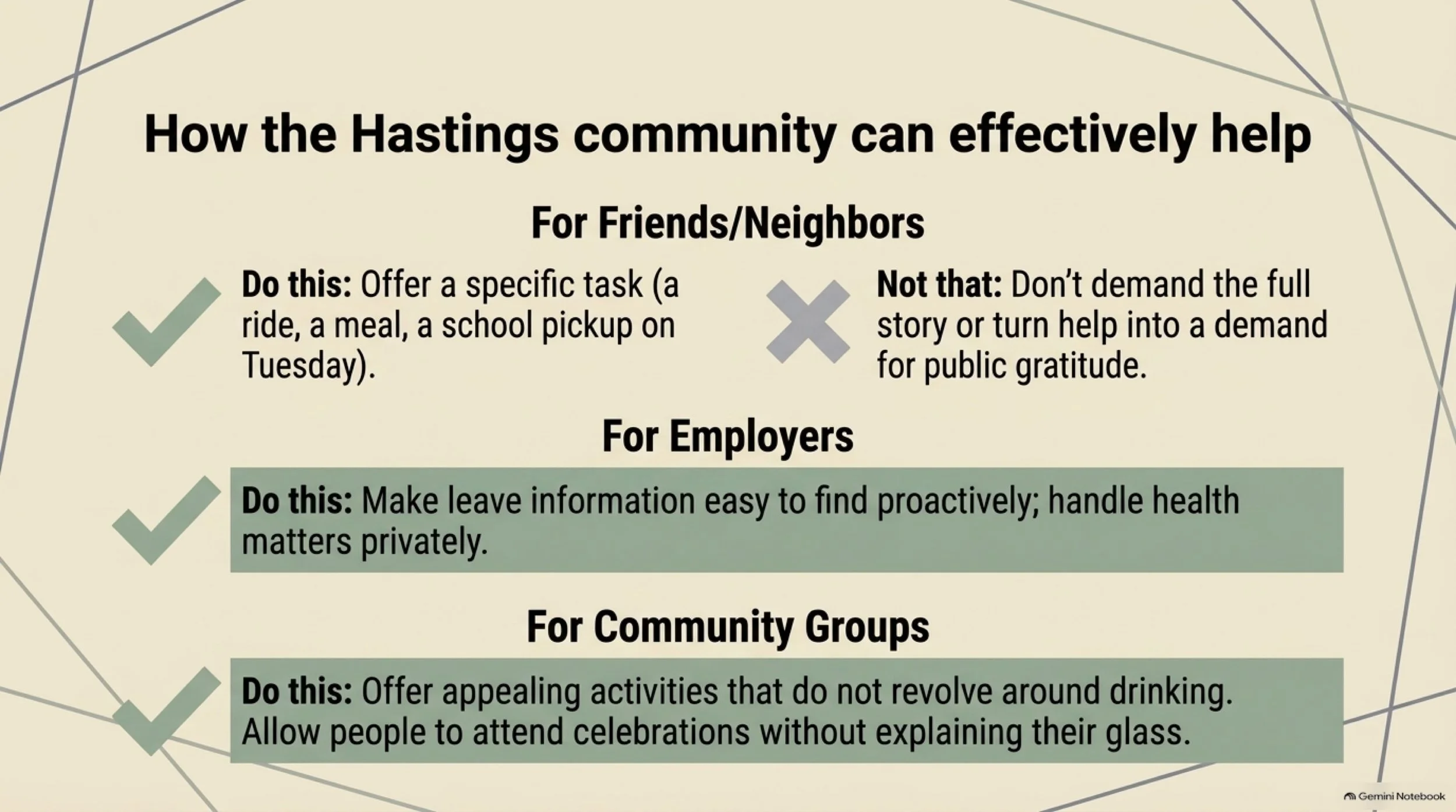
Friends and relatives can offer a specific task: a ride, a meal, a school pickup, or company while someone makes a difficult call. Ask what is wanted and respect the answer. Do not turn help into a demand for public gratitude.
Employers can make leave information easy to find and handle health matters through appropriate private channels. Community groups can offer appealing activities that do not revolve around drinking. People in recovery should be able to attend a dinner or celebration without having to explain what is in their glass.
A community publication can keep resource links current, describe treatment accurately, and avoid using an identifiable person's struggle as an inspirational device without informed consent.
For Hastings, an encouraging story can be quiet.
Imagine Sam at that same kitchen table, this time writing down an appointment and a name beside “school pickup.” Nothing about the rent has magically changed. The laundry remains ambitious. There is still a great deal to arrange.
But one part of the plan now exists outside Sam's head. Someone else knows what help is needed.
A person reading this tonight can begin with one sentence:
I want to stop drinking safely, and I need help making a plan that works for my children, my job, and my home.
Research references
The clinical references below include research reviews and a professional guideline. They support treatment principles; they do not establish that a specific local provider, schedule, or approach is appropriate for every parent.
American Society of Addiction Medicine. (2020). The ASAM Clinical Practice Guideline on Alcohol Withdrawal Management. See recommendations on level of care, ambulatory monitoring, and transition to ongoing treatment. Guideline and full text.
National Institute on Alcohol Abuse and Alcoholism. Alcohol Treatment Navigator: How to search and what to ask. Treatment settings and assessment. Read the guide.
McCarty, D., Braude, L., Lyman, D. R., Dougherty, R. H., Daniels, A. S., Ghose, S. S., & Delphin-Rittmon, M. E. (2014). Substance abuse intensive outpatient programs: Assessing the evidence. Psychiatric Services, 65(6), 718–726. https://doi.org/10.1176/appi.ps.201300249.
McPheeters, M., O'Connor, E. A., Riley, S., et al. (2023). Pharmacotherapy for alcohol use disorder: A systematic review and meta-analysis. JAMA, 330(17), 1653–1665. https://doi.org/10.1001/jama.2023.19761.
Kelly, J. F., Humphreys, K., & Ferri, M. (2020). Alcoholics Anonymous and other 12-step programs for alcohol use disorder. Cochrane Database of Systematic Reviews, 3, CD012880. https://doi.org/10.1002/14651858.CD012880.pub2.
Minnesota policy and service references
Minnesota Department of Human Services. Need help paying for substance use disorder treatment? Includes the July 2026 administrative change and eligibility period. DHS funding overview.
Minnesota Department of Human Services. Behavioral Health Fund Eligibility. Current household categories, income table, exclusions, and application links. Eligibility rules.
Office of the Minnesota Attorney General. Your Rights and Obligations under the Paid Leave Law in Minnesota. Paid Leave rights and obligations.
Minnesota Statutes, Chapter 268B, including the definition of serious health condition and leave provisions; University of Minnesota Office of Human Resources, Minnesota Paid Leave, for an explanation of intermittent scheduling and certification. Minnesota statute • Scheduling and certification explanation. Employer-specific procedures may differ.
U.S. Department of Labor. Family and Medical Leave. FMLA overview and eligibility.
U.S. Department of Labor. FMLA Advisor: Leave for Treatment of Substance Abuse and FMLA Frequently Asked Questions. Treatment-related leave • Intermittent leave and other questions.
Minnesota Statutes, § 260E.03, subdivision 15. Definition of neglect. Current statutory page.
Minnesota Statutes, § 260E.06. Maltreatment reporting. Current statutory page.
Wayside Recovery Center. Services. Family residential treatment and outpatient programming. Program descriptions.
U.S. Department of Health and Human Services. Understanding Confidentiality of Substance Use Disorder Patient Records or Part 2. Confidentiality overview.
Electronic Code of Federal Regulations. 42 CFR § 2.12, including the child-abuse reporting provision. Regulation.
Hastings Family Service. Community Resource Assistance. Eligibility and application sequence.
Dakota County. Get Help in a Crisis. Crisis Response and Housing Resource Line. County contacts.
HOME Line. Hotline Services. Tenant legal assistance.
National Institute on Alcohol Abuse and Alcoholism. Treatment for Alcohol Problems: Finding and Getting Help. Medications, behavioral treatment, co-occurring conditions, and setbacks. Treatment guide.
Additional provider, medication, benefit, and community-resource sources are linked beside the relevant information above. Services, openings, financial eligibility, and meeting schedules can change; contact the organization for an individual determination.